Siskiyou wild plants: horsetail, chokecherry and yarrow, and a detour into the Iliad

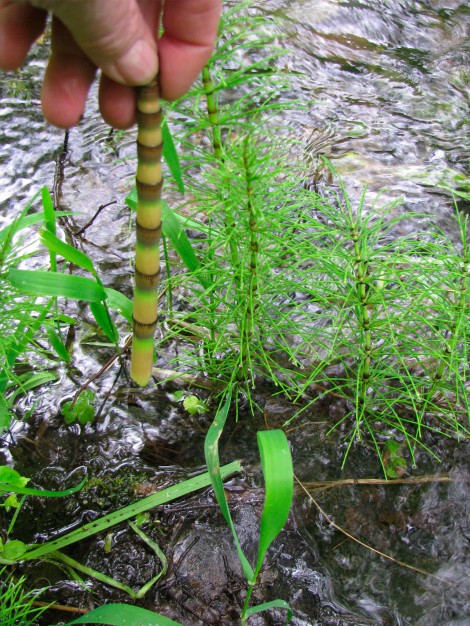
Today I’ll start with a genus of plants that is a bit different: it’s a “living fossil” from the Devonian (405 million to 345 million years ago, age of fishes and appearance of amphibians) when some specimens topped 90 feet (30 meters), it does not flower, and it’s found on every continent except Australia and Antarctica. And, people both cook it and use it to scour pots. This is the genus Equisetum, commonly called horsetail. It’s a lover of wet places and we found it at the edge of a creek.
Equisetum 2stages.jpg

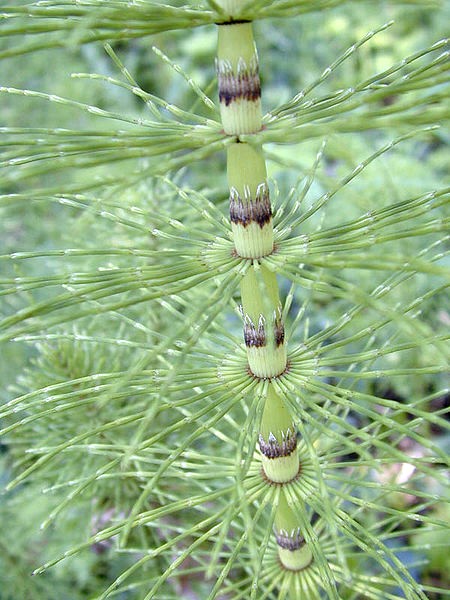
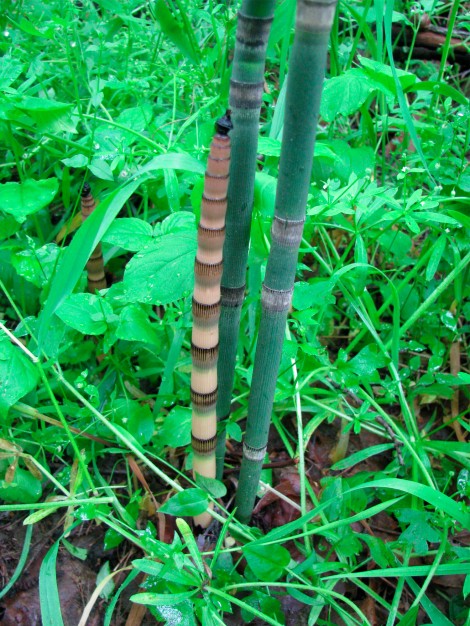
Above are both stages of growth side by side: the jointed stem somewhat like bamboo, which I plucked from a slope next to the creek, and a smaller stem that has already “leafed out” in radial whorls of needle-like leaves. This picture from Wikipedia shows the leaf whorls well.
EquisetumWhorls.jpg

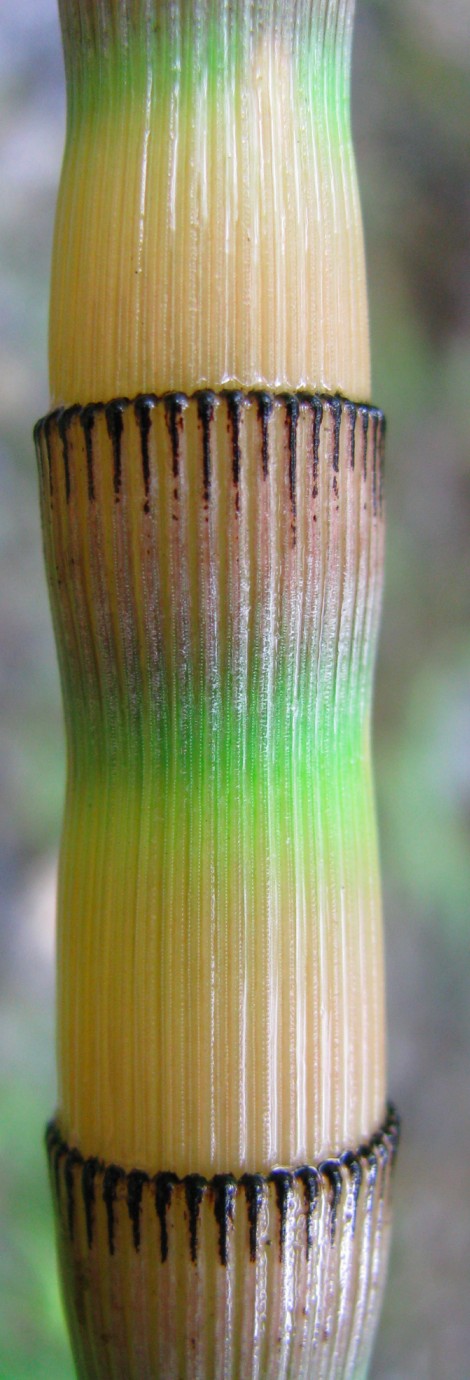
The unleafed stems were beautifully colored,
Equisetum StemCLOSE.jpg

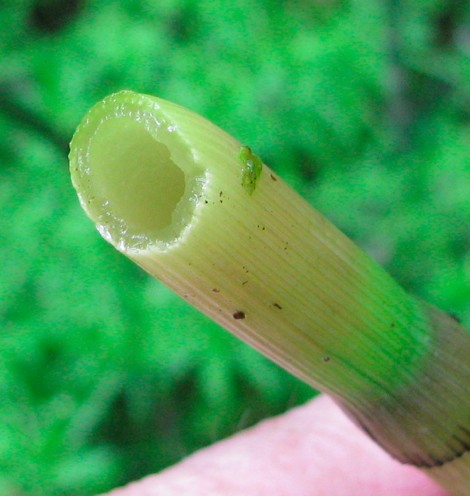
and hollow.

Equisetum Hollow.jpg

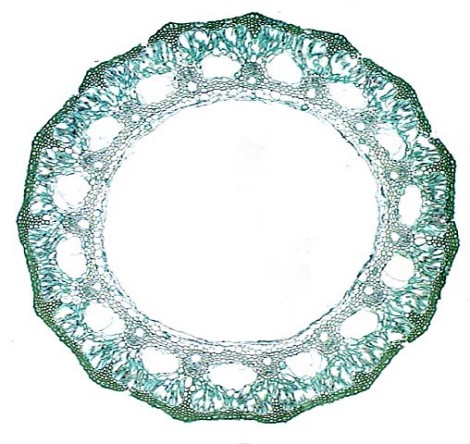
The stems are said to be “anatomically […] unique among plants”.
Equisetum stem cross-section.jpg

This beautiful microphotograph is of a stained cross-section of stem.

Equisetum species grow from underground rhizomes that are extremely persistent and invasive; think twice before deciding it is the perfect plant for that boggy spot in your yard, because it is likely to be there (and maybe other places too) forever. They’ve been used for all sorts of purposes through history. Many a camper and wildland dweller has scoured pots with the stems, which have a lot of silica in them, and they are “still boiled and then dried in Japan, to be used for the final polishing process on woodcraft to produce a smoother finish than any sandpaper.” The leaves are used as a dye for a soft green color. The young shoots are eaten but require special treatment because they contain the enzyme thiaminase[172], a substance that can rob the body of the vitamin B complex.
Equisetum strobilum forms.jpg

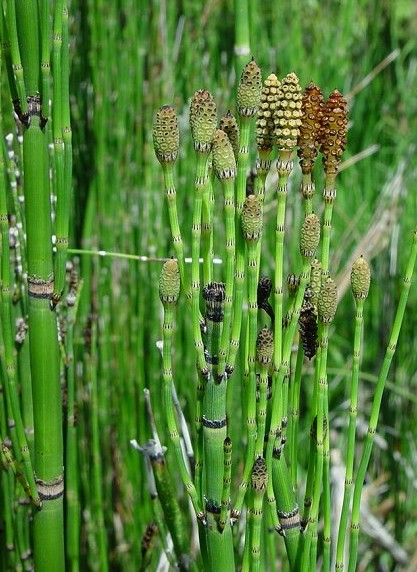
In addition to spreading locally via rhizomes, Equisetum produces spores on terminal cones, shown below.
EquisetumCones.jpg

Photo source.

There are several species found in Oregon, and I think the one we saw and photographed is Equisetum hyemale but I’m not sure. Equisetum, by the way, means “horse-bristle”, as in “scrub-brush”, and hyemale is from hiemis, “winter” (both terms from the Latin). Other common names include scouring rush, pipes (children play with them, as the hollow segments can be taken apart and put back together), and scrub grass.

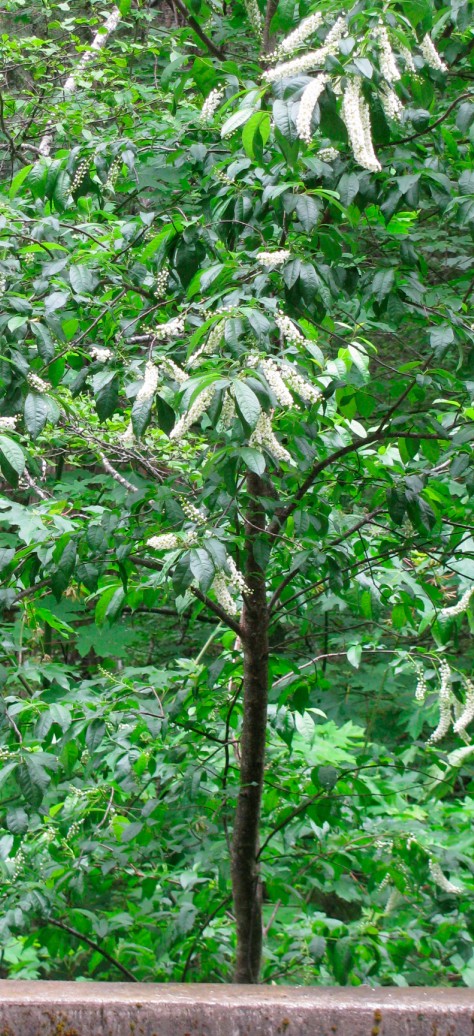
Downstream from the equisetum, back on the road, we saw next to the narrow concrete bridge a small tree growing in the water
Prunus virginianus tree.jpg

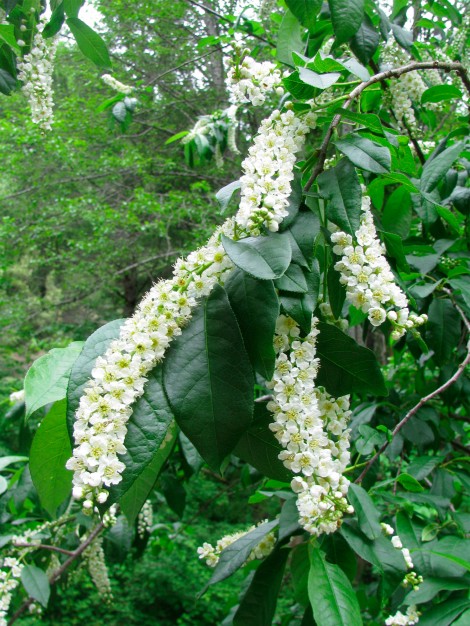
and laden with tresses of white blooms.
Prunus virginianus .jpg

This is choke cherry (Prunus virginiana), a species of “bird cherry”. Fruits are small and sour but very high in antioxidant pigment compounds, like anthocyanins. With a lot of added sugar, they are used to make wines, syrups, jellies, and jams.

Yarrow cultivars are familiar garden plants. Here is the ancestor of those, Achillea millefolium or common yarrow. It’s found throughout the Northern Hemisphere, even in the Himalayas.
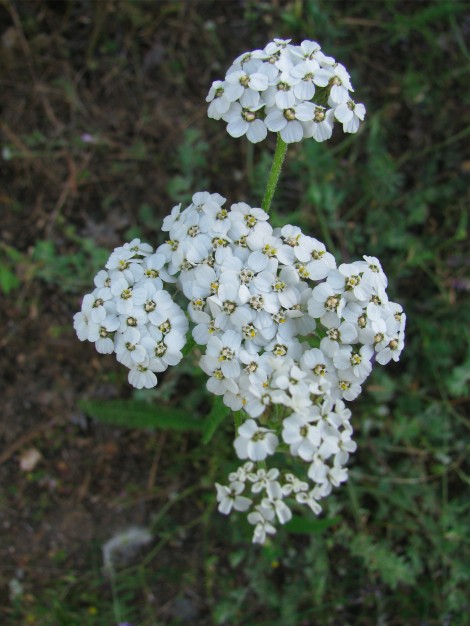
Achilleia millefolium flowers.jpg

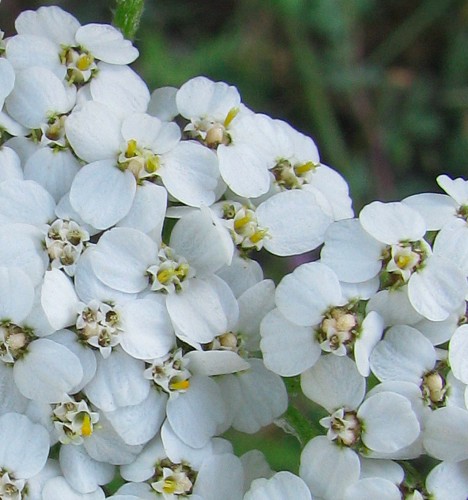
A closer view of the flowers.

Achillea millefolium flower detail.jpg

The leaves are distinctive, giving rise to the common name plumajillo, or “little feather” in Spanish-speaking New Mexico and southern Colorado, and to the millefolium (thousand-leaf) in its scientific name.

achillea millefolium leaf .jpg

It’s called Achillea after Achilles, Homer’s hero in the Iliad, who was well-trained in healing wounds as well as in causing them. Yarrow has been used for thousands of years to staunch the flow of blood and for other medical purposes, and among its common names are “herbal militaris” or soldier’s herb, nosebleed plant, and soldier’s woundwort. But there doesn’t seem to be any peer-reviewed research into compounds in the plant that may have medicinal properties. One site I visited, planetbotanic.ca, promoted it as an immune stimulant to ward off colds. But then the site’s “fact sheet” also tells us that “Yarrow’s scientific name hints of a legendary use. Achilles’ famous heel is said to have been healed when yarrow was applied to it.” Other than the words “Achilles” and “heel”, everything in this sentence is wrong: Achilles’s mother held her infant by the heel while dipping him in the River Styx to confer invincibility upon him. The water did not touch that part of his body, and eventually the warrior who had survived many wounds was killed by an arrow to the heel, from the bow of Paris.
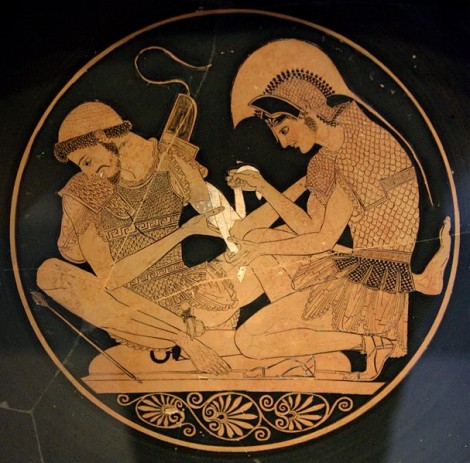
AchillesBinding Wound.jpg

Achilles bandaging the wounded Patroclus. From a Greek vase painting. Source.


Paris was not much of a fighter. He mostly stayed with the women and old men observing the ten years’ war from the heights of Troy’s great battlements, so it’s ironic that his blow (even if delivered from a distance) should kill the otherwise invincible champion of combat, Achilles.

Achilles in battle.jpg

Achilles in battle. Source.

Homer doesn’t include the death of Achilles in the Iliad; he ends with a final consequence of Achilles’s wounded pride, fit of rage and refusal to fight, when his friend Patroclus goes out wearing the great warrior’s armor to drive back the attacking Trojans. Patroclus and the Greeks carried the day, indeed seemed about to breach the walls of Troy, but the god Apollo intervened, striking Patroclus so as to daze him, sending his borrowed helmet spinning in the dust; one Trojan wounded him from behind and then Hector, Prince of Troy, delivered the fatal blow. When word of this reached Achilles he put aside his pride under force of a greater rage, and went after Hector like a lioness whose cub’s been killed.

All is not the clashing of bronze and shedding of blood in the Iliad. This is a famously tender moment, famously sad as well, one that is familiar to too many soldier parents.

Astyanax, Hector.jpg

“And tall Hector nodded, his helmet flashing:
… shining Hector reached down for his son—but the boy recoiled,
… screaming out at the sight of his own father,
terrified by the flashing bronze, the horsehair crest,
the great ridge of the helmet nodding, bristling terror—
so it struck his eyes. And his loving father laughed,
his mother laughed as well, and glorious Hector,
quickly lifting the helmet from his head,
set it down on the ground, fiery in the sunlight,
and raising his son he kissed him, tossed him in his arms…”

Iliad Bk. 6: 556-56, in the very readable translation by Robert Fagles. Source.


The Iliad ends with Hector’s father King Priam of Troy humbly seeking his son’s body for burial. In his boundless desire for vengeance upon his friend’s killer, Achilles has been dragging the body behind his chariot, around and around the city. Yet when the old man, escorted through the enemy lines by a disguised Mercury, kneels before Achilles, kisses his hands, and implores his son’s killer to think of his own faraway father and give up Hector’s body, Achilles weeps with Priam, and relents.

All that was about 1250 BC, yet reading the Iliad we find characters and feelings that match those we can see around us still. The immense destructive power of rage and wounded pride are as great now as then. And the history of the humble yarrow also connects us to people like Achilles and Hector; their eyes saw these flowers, crushed these leaves to keep with them against the likelihood of wound from sword or spear.
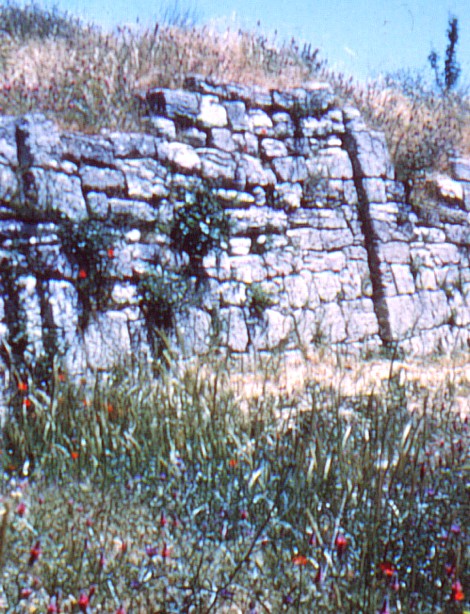
Walls of Troy.jpg

Troy, level VI, defensive walls, as excavated by Schliemann. This level is about a hundred years earlier than that believed to have been the city destroyed by war in the Iliad, about 1250 BC. Source.
Indian Paintbrush and Elegant Cat’s Ears

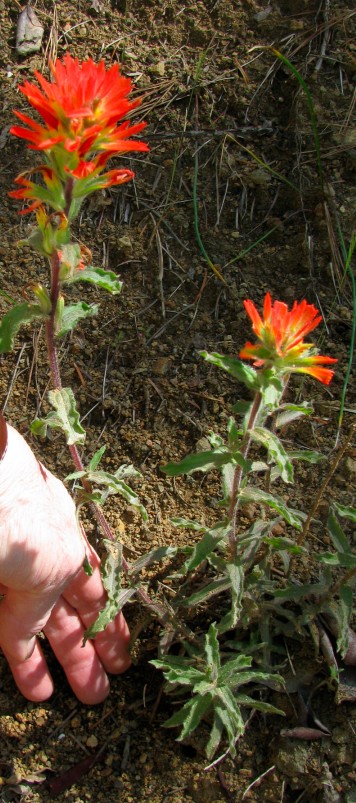
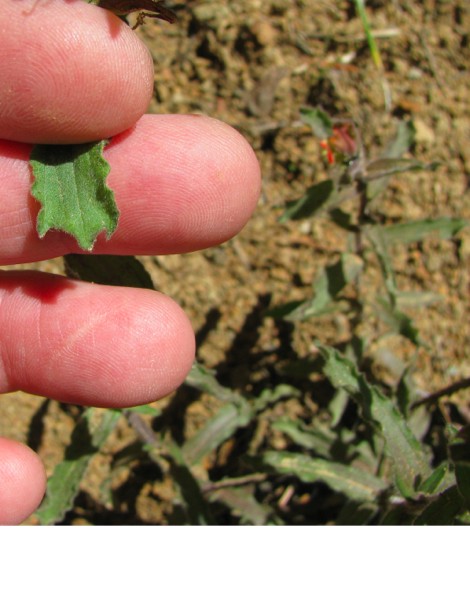
Today I revisited the Indian Paintbrush mentioned in my last post, to check it for diagnostic features of the species that it seemed most likely to be, Castilleja applegatei (Applegate’s Indian paintbrush, wavyleaf Indian paintbrush). Is this obsessive behavior? Maybe, but harmless. And I like it that trying to identify the plants we photograph makes me take a much closer look at them.

Castilleja with hand.jpg

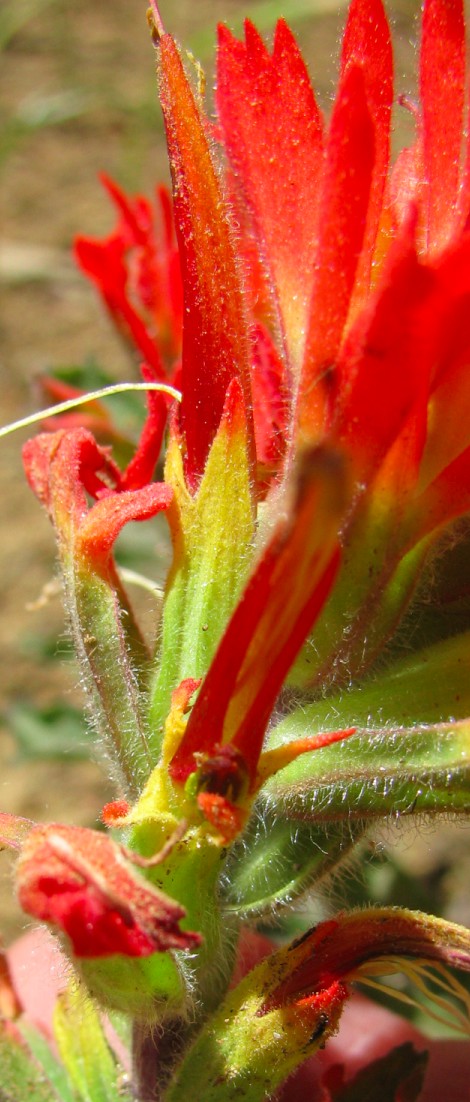
According to the Lady Bird Johnson Wildflower Center, there are 46 species of Castilleja known as “paintbrush” that are native to North America, and 17 are found in Oregon. The beauty above probably is wavyleaf Indian paintbrush, Castilleja applegatei; the wavy leaves are clearly visible in the photo, and it fits in other respects although different online sources vary on fine points. Is it the upper leaves that are often three-lobed, or the lower ones? Well, at first the narrow leaves of our plant seemed to have no lobes at all but when I uncurled the tip of an upper leaf, there were indeed three lobes.

Castilleja leaf.jpg

Lower leaves had no lobes.

The stickiness of flower and/or leaves that some describe was not evident today, but the flower is older and perhaps has dried out a bit. The flower and leaves are covered with tiny silvery hairs.

Castilleja hairs.jpg

Many Castilleja species are root-parasites, connecting to the roots of nearby grasses or forbs. They can live either independently or as parasites (a capability which makes them “hemi-parasites”) but naturally they grow faster and bigger when receiving some nutrients from a host plant. The individual in our pictures is small, perhaps because nothing much is growing near it to parasitize.

Castilleja wide view.jpg

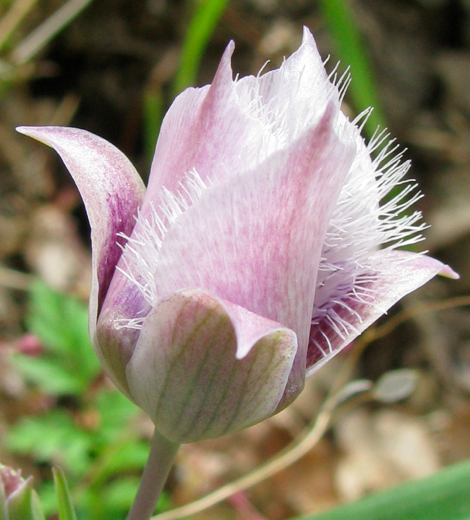
The small whitish flowers to the right are elegant cat’s ears, Calochortus elegans; we’ve seen more of this species this year than ever in the 14 years we’ve lived here.

Elegant Cat's Ear Bud.jpg

The Pacific Bulb Society’s site has 8 pages of photos and descriptions of Calochortus species; well worth browsing as this genus of lilies is notable for stunning flowers.

Elegant Cat's Ear from above.jpg

Siskiyou iris and Striped coralroot, a good wildflower walk!

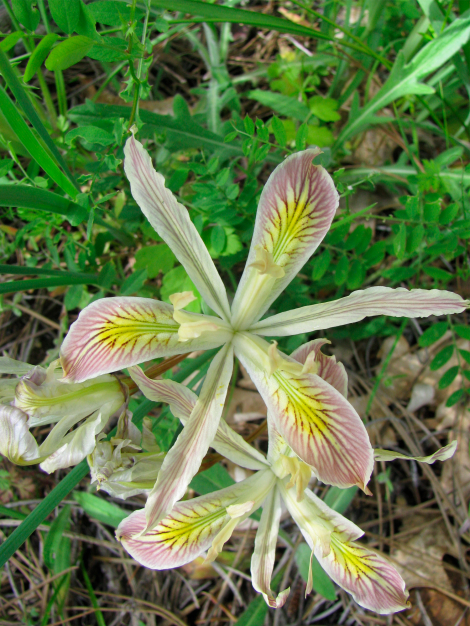
Change happens fast in the spring. We walked Saturday along a road we’d been on a week ago, and most of the flowers we saw had not been in bloom seven days earlier. The most abundant flowers were Siskiyou irisIris bracteata.

IrisSiskiyouCR.jpg

They vary in color from white to light yellow, and sometimes the reddish-brown veins are so numerous that they seem to tint the petals.

IrisSiskiyouBrownish2.jpg

Delphiniums were few and tattered, but some were much deeper in color than we’ve seen before. This is Menzies’ larkspur, Delphinium menziesii, we think.

DelphiniumDarkOld.jpg

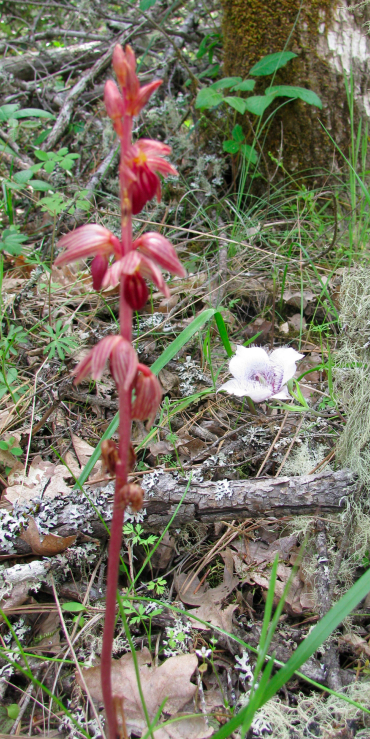
A rare sighting was of this Striped coralroot, Corallorrhiza/Corallorhiza striata, in the orchid family. We looked hard for others but saw only the one. It is a plant, but it is incapable of photosynthesis, and has no chlorophyll.

StripedCorealroot.jpg

When I was taking biology these sorts of plants were called saprophytes and it was believed that they got their grits by digesting organic material, as some fungi can do. This outdated theory is still found online. Now it is known (until further notice) that no plant can digest organic material through its roots (1), and the former saprophytes have been found to be parasitic either upon other plants, or upon fungi. Corallorrhiza striata dines upon nutrients produced by fungi, plugging into their mycelium, the underground structures of branching threadlike hyphae—the “body” of the fungus that produces the aboveground mushrooms we see.

(1) Wikipedia says “It is now known that no plant is physiologically capable of direct breakdown of organic matter”; I added “through its roots” above, because there are carnivorous plants that do digest insects they catch, either through secreting digestive enzymes or through some other means. How this fits in to current theory about plants digesting organic material, I don’t know.

StripedCorelrootCloseup.jpg

Plants like the coralroot are called myco-heterotrophs (2); the fungi they parasitize are the hosts. As far as we know, this is a parasitic relationship, with no benefits to the fungi. Many orchids are such parasites, others are only partially dependent on parasitism (producing the rest of their nutrients by photosynthesis), and some are “ordinary” photosynthesizing plants. Some myco-heterotrophs parasitize only specific fungi; for instance, Corallorhiza maculata sips only from Russula mushrooms, or I should say from their mycelium. Quite likely many species of myco-heterotroph have specialized in this way, we just don’t know the associations yet. For those interested in growing such orchids the parasitism presents a huge difficulty, since the ordinary requirements of a green plant—sun, water, nutrients in soil—will not sustain life in these non-photosynthesizing plants. Yet another reason, if more were needed, to avoid digging up or buying such plants (unless you are absolutely certain they were not taken from the wild).

(2) myco = fungus, heter = other, troph = nourishment

In the background of the coralroot (first photo) can be seen another flower that we saw dozens of today, with the engaging common name Elegant cat’s-ear (Calochortus elegans).

Elegant cat's ear1.jpg

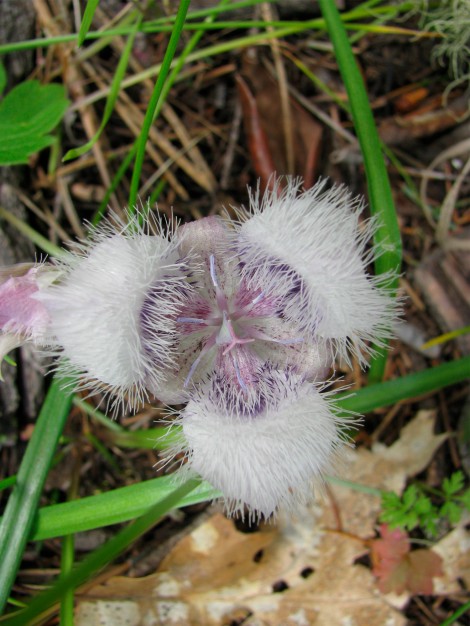
It repays closer examination.

Elegant cat's ear2.jpg

The pointed tips of the petals, or perhaps the fuzziness, give rise to the common name. This is the type species of the genus, discovered in 1806 by Meriweather Lewis on the Lewis and Clark expedition near what is today Kamiah, Idaho. Many are known by the common name of Mariposa lily; see one here.

The Calochortus genus contains a relatively large number of rare, localized, and endemic taxa, so don’t disturb any you find: they may be part of a very small population. One such is found only along the Umpqua River in SW Oregon. They seem to be more sensitive to soil type than to other aspects of habitat, with some preferring serpentine soils, which characteristically have high concentrations of toxic heavy metals. Although heavy metals like nickel, lead, and zinc are toxic to most plants, some can withstand them, perhaps taking them up to protect against pathogens and pests. Still, it’s an interesting puzzle why certain species would preferentially grow where toxic metals are found in abundance.

Elegant cat'sEar5.jpg

Look into the center of this unassuming little flower:

Elegant cat's ear3.jpg

How wonderful the digital camera is, enabling us to take home such magnified images of small beauties, so we can look our fill at them.

Bugloss fiddleneck, Amsinckia lycopsoides.jpg

Above is a more assertive plant: native to much of western North America from California to British Columbia, it has spread as far as New England, thriving in the disturbed soils of many habitats. It’s a roadside hitchhiker, an “invasive non-native” as far away as Australia, and toxic to livestock; for its sins it carries the dismal name of Bugloss fiddleneck, Amsinckia lycopsoides. (3)

(3) Bugloss, from Ancient Greek βούγλωσσον (bouglōssos, name of a plant: Anchusa italica), βούς (bous, “ox”) + γλωσσον (glosson, “tongue”)

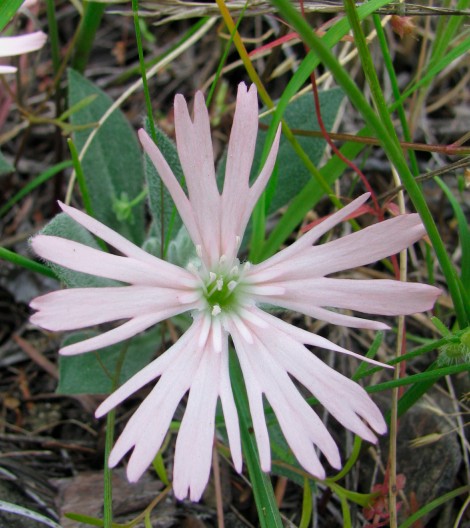
Hooker's Indian Pink, Saline hookeri MOREPINK.jpg

Hooker’s Indian Pink, Saline hookeri, varies from nearly white to dark pink; the California species, Indian pink (Silene californica) is much darker, nearly a chinese red.

Hooker's Indian Pink, Saline hookeri - 2.jpg

Look at the symmetry in those petals.

The Hooker after whom it is named is the immensely influential British botanist William Jackson Hooker (1785-1865), first director of the Royal Botanic Gardens at Kew. His son Joseph Dalton Hooker, who grew up attending his father’s lectures, also became a renowned botanist and was the second director of Kew. He classified the plants that Darwin collected on the Beagle, and the two scientists became close friends. Many New World plants are named after one or the other of the Hookers, though only the son visited our hemisphere.

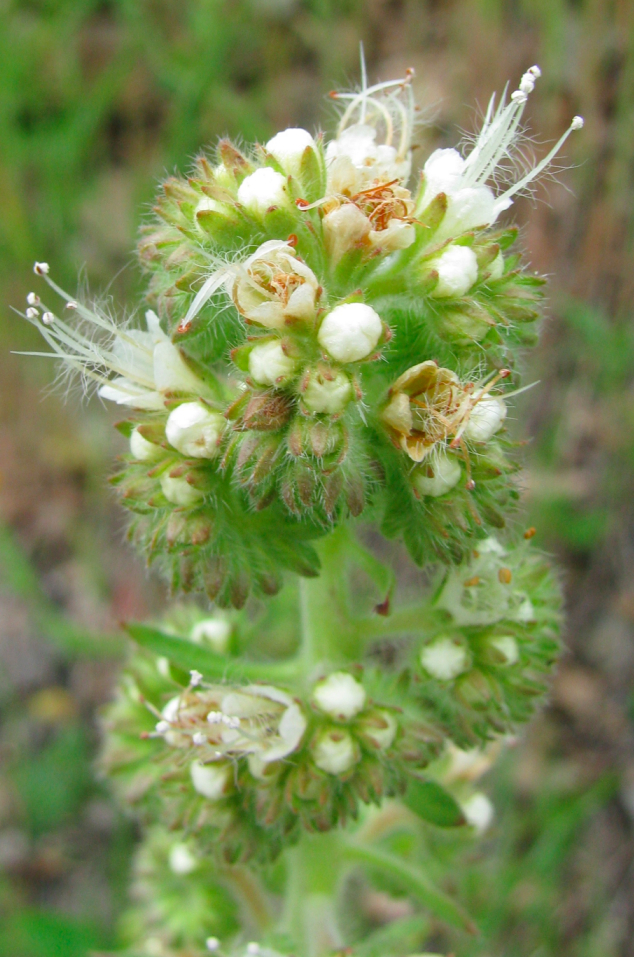
This post grows long, but we saw so many great flowers! Just one more: Phacelia heterophylla, or Variable-Leaf Scorpion-Weed, is as the botanists say an an erect, unbranched herb (herb, meaning neither a grass nor a woody plant).

Phacelia heterophylla .jpg

Naturally I was curious why the plant was called “scorpionweed”. Online explanations refer to “the way the stem curls like a scorpion’s tail”, as in the picture below of another species that’s found in Arizona.

PhaceliaBlue.jpg

photo from www.micktravels.com.

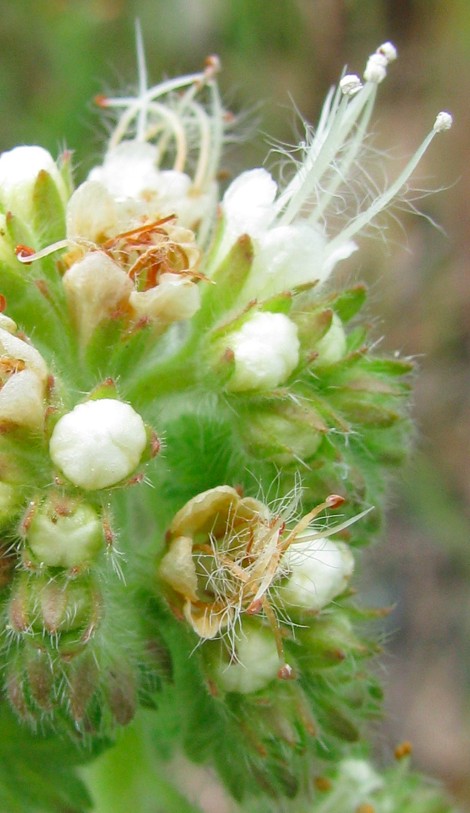
That species has blooms only along one side of the stem, while the one we saw has blooms surrounding the stem in a way that would make such a curling habit unlikely. Maybe the dramatic name has just spread to various members of the Phacelia genus whether it applies or not. Or, another possibility is that “scorpion” might refer to the ability of some members of the family to cause a skin rash, like poison oak or ivy, in some people. All those tiny hairs do look itchy!

PhaceliaCR.jpg

No unusual wildlife sightings on this walk, not like the day we saw four osprey (one was doing an odd behavior, I do have to write about that soon). One caterpillar, unidentified:

Caterpillar.jpg

and our hiking buddy Jack, here near a giant tree marked with what we hope is the sign for “Seed tree, do not cut”.

Jack&Tree.jpg

Spring in the Siskiyous: more great wildflowers

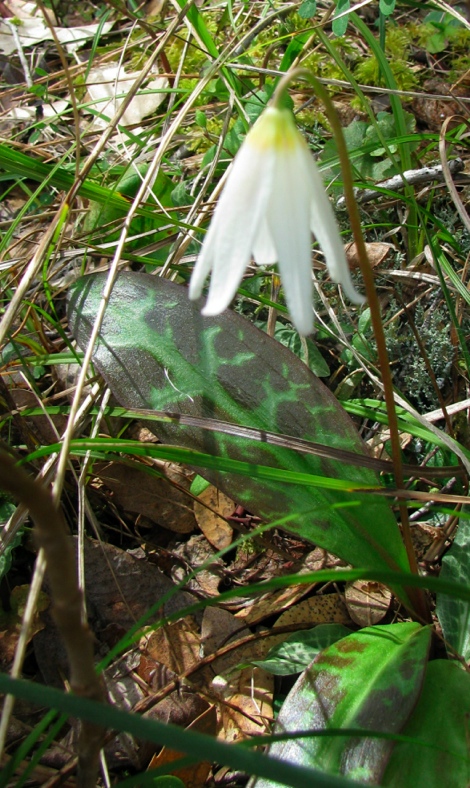
In a previous post I showed off one local member of the species Erythronium, E. hendersonii, with pinkish/purplish flowers. This morning up on the middle fork of the Applegate River we found something different, which is probably Erythronium citrinum S Watson, the pale fawn lily.

Another possibility is E. oregonum but Flora of North America says that species is found at altitudes of 0 – 500 m, with E. citrinum at 100 – 1300 m and we found these at 750 m or higher. In addition, the Pacific Bulb Society mentions unusually dark leaves being common on E. citrinum and we saw those. In the end, though, I’m no botanist and won’t wager anything on my identifications of Erythronium species, particularly given what Flora of North America says in the article on citrinum:

Plants lacking auricles on inner tepals are sometimes segregated as Erythronium howellii, Howell’s fawn-lily, but they do not appear to differ from typical E. citrinum in any other characters.
Erythronium citrinum intergrades with E. californicum and E. hendersonii, occasional populations or individuals displaying intermediate or recombined characteristics. [and no, “tepals” is not a typo but a botanical term for one variety of what the rest of us lump together as “petals”]

Anyway, here’s what we saw, beautiful by any name.

EOregonum2.jpg

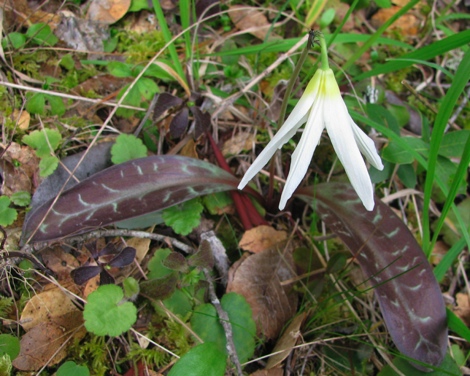
The plants are a bit larger and more robust than the pink-flowered E. hendersonii, and the petals are white touched with yellow at the base.

E. oregonum1.jpg

The mottling of the leaves is more pronounced than the leaves of E. hendersonii, and a few plants had nearly chocolate-colored leaves.

EOregonum3.jpg

Here’s one more close-up; perhaps someone can make an ID from it.

E. citrinum closeup.jpg

Another species with a white flower touched with yellow is Erythronium montanum, the avalanche lily, but its leaves are plain green, not spotted. The photo below is from Wikipedia. There’s a fantastic close-up of its flowers at the Botany Flower of the Day site.

EOregonum,montanum.jpg

Rattlesnake plantain, Goodyera oblongifolia, also has distinctively marked leaves, which grow in rosettes flat to the ground. It’s at the left in the picture below, with a damaged erythronium leaf on the right.

EOregonum& Rattlesnake plantain1.jpg

The common name “plantain” simply refers to the broad leaves; actually Goodyera oblongifolia is a member of the orchid family, with a spire of small white flowers. I can’t remember ever seeing it in bloom.

Yesterday, in a moist environment above the Applegate River, we found this beauty:

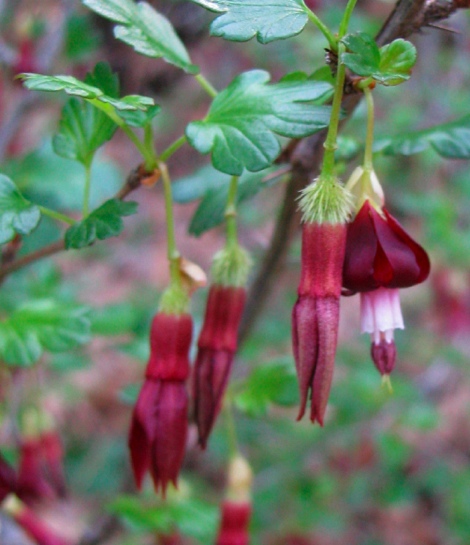
ECitrinumRibes.jpg

It’s a member of Ribes, the gooseberry or currant family, probably Ribes roezlii, the shiny-leaved gooseberry. Mostly evergreen, with thorns. Wild gooseberries/currants are edible, according to what I read, though some including R. roezlii have berries that are prickly or hairy (photos).

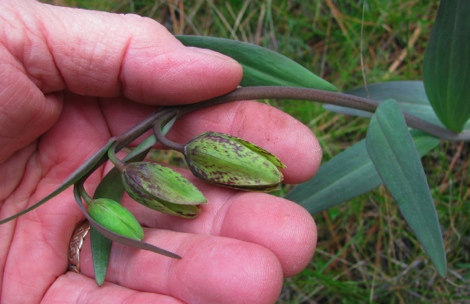
In this wetter area, there were also several of the chocolate lily, Fritillaria affinis, mentioned in a previous post in connexion with the scarlet fritillary seen on an earlier walk.

ECitrinumFritillary1.jpg

The flowers weren’t open quite yet but are still striking.

ECitrinumFritillary2.jpg

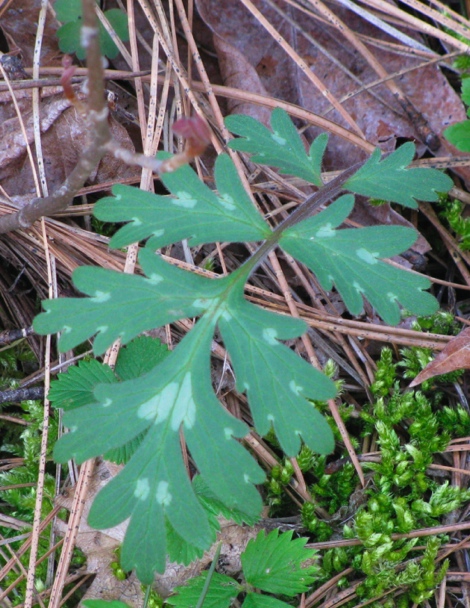
Here’s a plant with a handsome and unusual leaf, as yet unidentified.

ECitrinumMysterleaf.jpg

Finally, here’s a sweet little wildflower, Viola nuttallii (Nuttall’s violet, Yellow prairie violet). We saw it yesterday in that moister environment overlooking the river.

ECirtrinumViolet.jpg

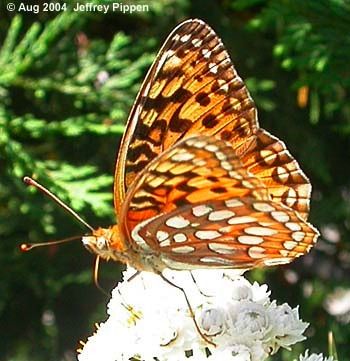
It’s a food plant for the larva of the Coronis Fritillary butterfly, Speyeria coronis, seen below.

ECitrinumButterfly.jpg

(Photo by Jeffrey Pippen)

We’ve marked down a couple of spots to revisit in a few days, to find out what sort of flowers will appear from some unknown plants. Most of them look lily-ish, just a couple of large linear leaves. What surprises do they hold? even the Shadow doesn’t know, unless he’s keyed out these plants. I’ll wait and be surprised.