
I found a group of paper wasps working on a nest, on top of our porch swing.
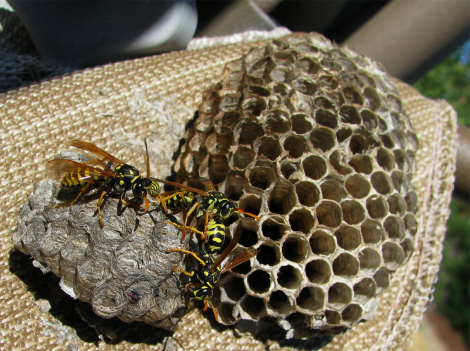
Behind the active nest is another larger one, apparently abandoned––or maybe the young have already emerged from it.

A few days later both nests had been knocked down by some creature that probably ate the wasps and any eggs or pupae; nothing left but one dead wasp.
In North America there are 22 species of paper wasps, genus Polistes, according to Wikipedia. [More about paper wasps, including their life cycle: 1, 2, and Bugguide has photos of about 18 different species from N. America.] They are quite common around our place, and generally ignore us if we do the same. I’ve gotten stung twice this summer though: once when removing a nest made in the recess of the car door hinges; and once when I was replacing a hummingbird feeder without noticing the wasp clinging to the bottom––I touched it and was stung. (Paper wasps feed on nectar, so the hummingbird food attracts them; they also prey on caterpillars and other “garden pests” so they’re generally considered “beneficial insects” in our narrow human way of thinking.) I caused both of these incidents, so I have no gripe against the wasps, just a resolve to be more careful. As you can see, these wasps let me get quite close with the camera.

Don’t expect such tolerance from some other insects that look very similar. Hornets and yellowjackets are irascible and can sting more than once. Stings from any, including the paper wasps, can cause severe reactions (anaphylactic shock) in allergic individuals.
A few wasp-related byways
More good pictures of paper wasps, taken by a backyard naturalist in Michigan, are here. The common wasp builds quite large nests, also of paper, but they are spherical and the cells are not visible as they are in paper wasp nests.
And here’s something I enjoyed discovering: a bird, Pernis apivorus, which may have wasp repellent. It’s called “Honey Buzzard”, but it is not a buzzard and feeds more on wasps (adults and pupae) than on bees. It’s believed to have some chemical on its feathers that dissuade wasps from stinging!
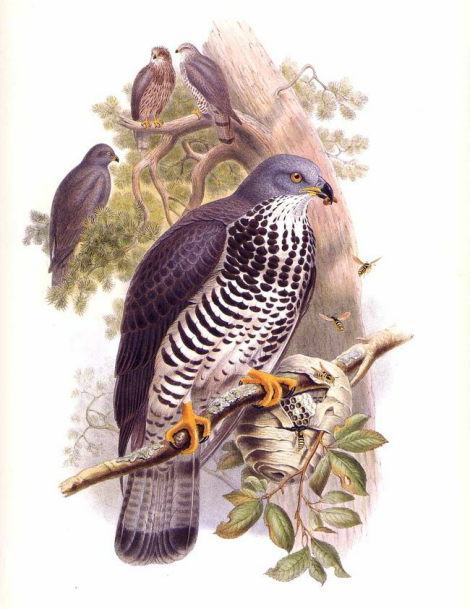
[Painting by John Gould, English ornithologist and artist]
This beauty winters in Africa and summers in Europe and Asia, so we won’t be seeing it around our house. It has a very unusual display in flight: “The most striking version of their soaring displays involves a characteristic wing quivering which looks as if the bird is clapping its wings together above its head.”
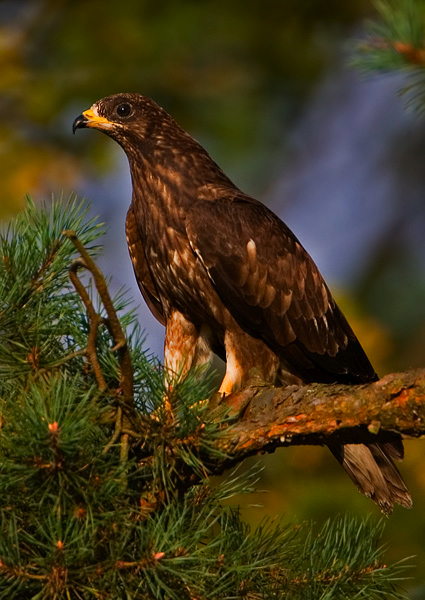
[Photo of a wasp-eating Honey Buzzard in Sweden, by Omar Brännström]




 nosleepingdogs