Sunny slope wildflowers, Southern Oregon

Despite an unseasonable snowfall last week, two days later we found some uncommon wildflowers blooming on a sunny slope bordering a forest road.

We’d noted the leaves of these delphiniums (larkspurs) the week before, and now they were in full bloom
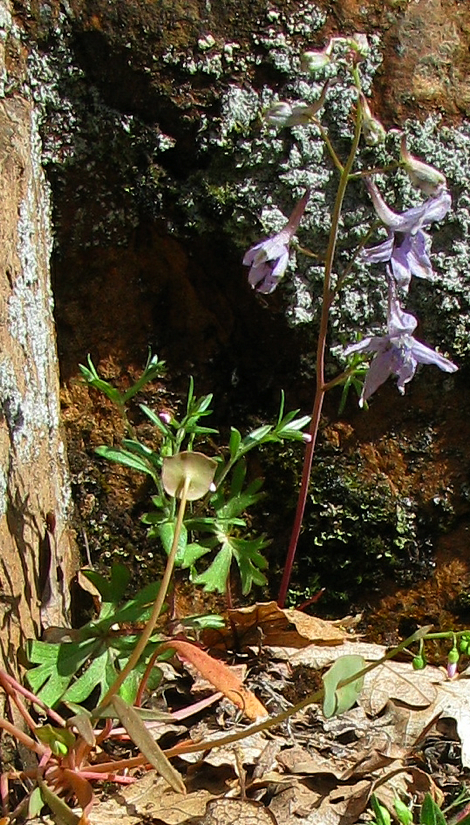
Frit Delpg purple close-up.jpg

The majority were white, like these

Frit Delph close-up.jpg

but according to the experts only two white species (Delphinium leucophaeum and D. pavonaceum ) occur west of the Cascade Mountains, and neither are found south of the Williamette Valley (in northern Oregon). Their range may be restricted to the area of a temporary lake formed after one or more of the catastrophic Missoula Floods which occurred around 15,000 years ago, when glacier dams broke releasing huge quantities of water and silt, over parts of what’s now Oregon and Washington.

Delphinium menziesii occurs in our county, but it’s dark purple with a more finely divided leaf. Maybe the ones we saw are Delphinium andersonii, which does seem to have light blue to very pale almost white flowers, and a three-lobed leaf like the ones we saw.

An exciting find was this fritillary, a member of the lily family.

Fritillary close-up2.jpg

Wikipedia says that “fritillary” comes from the Latin term for a dice-box (fritillus), and probably refers to the checkered pattern, frequently of chocolate-brown and greenish yellow, that is common to many species’ flowers. (And there’s a group of butterflies so named for the same reason.) The checkered pattern is visible on both the bud and opened bloom above.

Fritillary 1.jpg

At least 3 species are found around here; this one is Fritillaria recurva, the Scarlet Fritillary. The nearby town of Jacksonville has a festival every year in honor of the rare species found near there, Fritillaria gentneri, which has darker red flowers. And we have a few times seen, on our own property, Fritillaria affinis or Chocolate lily, which has bell-shaped greenish flowers with brown markings. We don’t have any photos of it, but here’s one from USDA
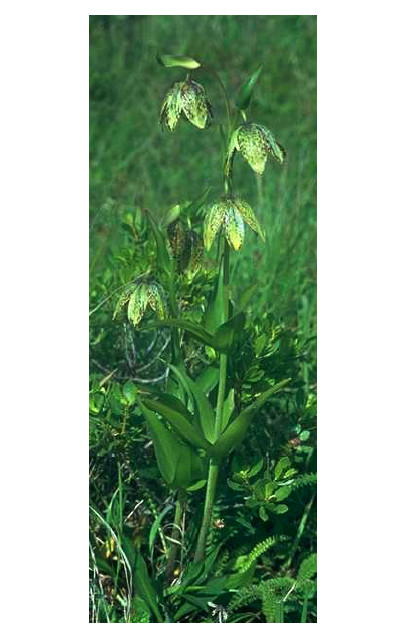
Fritillaria affinis1.jpg

Their account notes that the root bulbs are edible, though bitter, and were an item of trade for tribes in this area. F. affinis is quite variable in flower color, sometimes showing the reverse of the ones we’ve seen: purplish-brown flowers with green or yellow “dice”, as below.

Fritillaria affinis2.jpg

We also saw two other wildflowers more familiar to us: shooting stars,
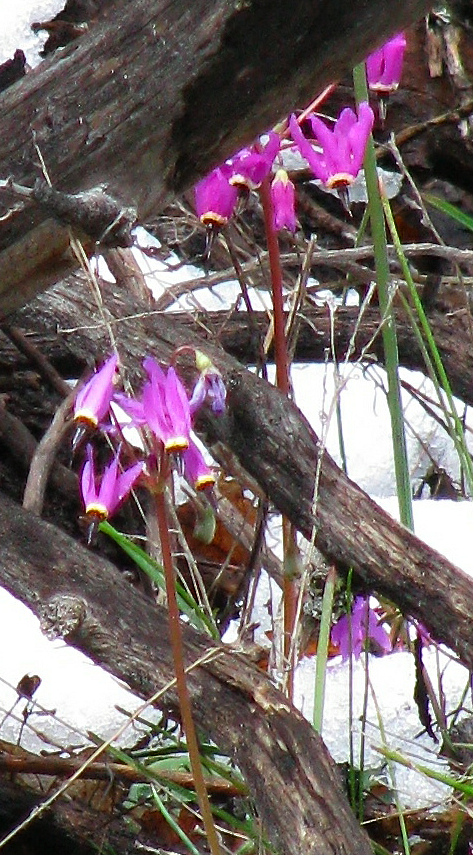
Frit Shooting Stars1.jpg

always one of the more abundant flowers this time of year,

Frit Shooting Stars 2.jpg

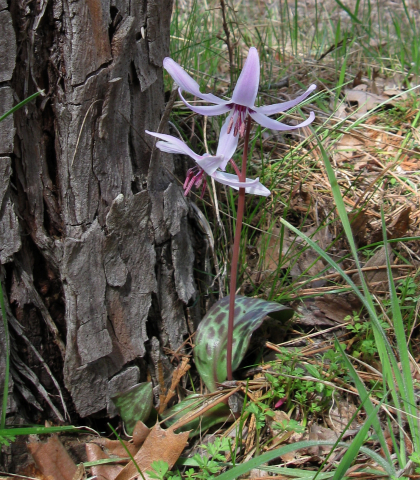
and our beloved Trout Lilies (Erythronium hendersonii), delicate and demure plants with a very brief duration of bloom.

Frit Erythronium 2.jpg

They range in color from nearly white to a darker violet-pink. Flowers are borne so close to the ground that it’s hard to get a look from underneath.

Frit Erythronium close-up from below.jpg

The mottled leaves are the reason for some of the common names—Trout Lily, Fawn Lily—and I think they are as beautiful as the flowers, in their way.

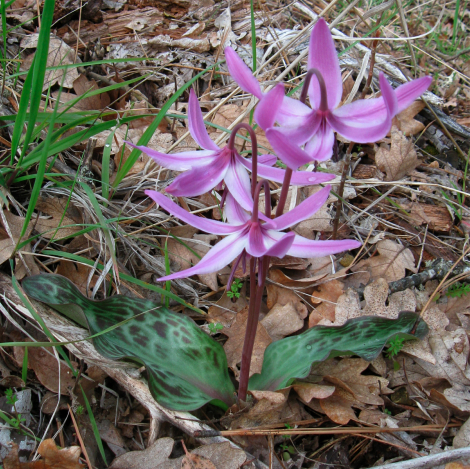
Frit Erythronium leaves.jpg

Frit Erythronium 3.jpg

Hydraulic mining scars, wildflowers, dogs, and poison oak, a short early-summer walk in the Siskiyous

[I’ve made brief corrections to this post regarding aspects of hydraulic mining, after a commenter pointed them out to me. And a more recent post goes into matters at more length, on points where I was wrong, and others on which I disagree with the commenter.]

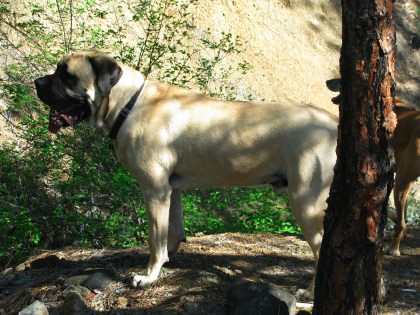
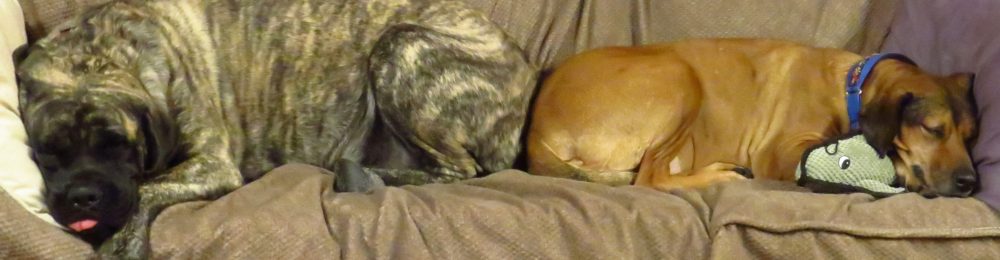
We took our new English Mastiff Jack for his first off-leash walk in the woods this morning. He is a 3 1/2 year old rescue who has been with us for nearly a month now. He has settled in very well, comes when called at home even if he is barking at the UPS guy, and so we thought he was ready for an off-leash ramble. Our elderly female Rhodesian Ridgeback went too.

The nearby Gin Lin Trail is named for a Chinese mine owner and “traces the remains of a late-nineteenth-century hydraulic gold mining operation in what was known as the Palmer Creek Diggings, now a part of the Rogue River National Forest.” [more info]

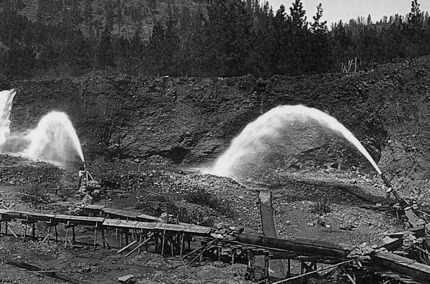
Hydraulic mining used huge pressurized streams of water to turn hillsides or mountainsides into slurry that could be run through sluice boxes to trap the gold. The photo below shows a large-scale operation in action, somewhere in this area of the Oregon Siskiyous, in the latter half of the 19th century. For scale, notice the tiny figure of a man wearing a white shirt, tending the left-hand water hose.

HydraulicMining1.jpg

The tremendous destruction takes geologic time, not human time, to heal. Huge clefts are made in the land, piles of big rocks and new hills of “processed” dirt are put anyplace convenient, and the subsoil brought up doesn’t support plant life as well as the now-buried topsoil did. All this is easily seen along the Gin Lin Trail.

GinLinDitch.jpg

The picture above shows a steep slope of discarded material a steep-sided ditch, probably hand-dug to accommodate the miners’ equipment—sluice boxes or water pipes. Both the angle of the slope, and the composition of the material itself, are hostile to plant growth. Even on the top where it is closer to level, trees and shrubs are not as numerous or healthy as in undisturbed areas.

Miners blasted away tons of earth trying to follow layers of gold-bearing gravel laid down by ancient rivers. This picture (below) shows a cut made by their work, at the point where they stopped. making ditches like this.

Dan&GinLinSlope.jpg

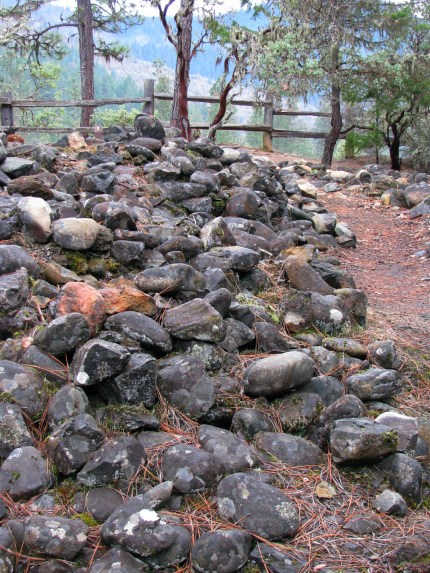
And here’s some of the big river rocks moved as the mining went on.

GinLinRockpile.jpg

The gold being sought had been deposited by watercourses running down to the river below, seen in the background of this picture. was in layers of Tertiary-era gravel, laid down in the bottoms of rivers 40 – 100 million years ago. Since then the river bottoms have been pushed up by geological forces, and cut through by new drainage systems. The ancient rivers may have had no connexion to existing rivers, since drainage patterns have changed.

GinLinRiver1.jpg

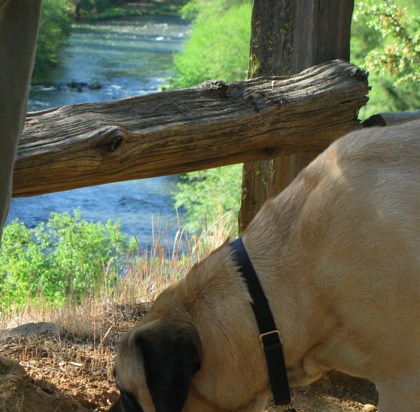
Looking over the fence, from the same spot as the previous picture.

GinLinRiver2.jpg

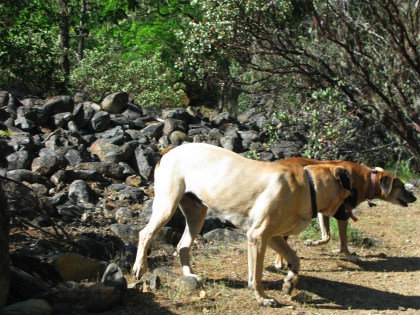
The dogs had a good time, and Jack stayed close and came when called, as we expected.

GinLinJack1.jpg
GinLinJack2.jpg

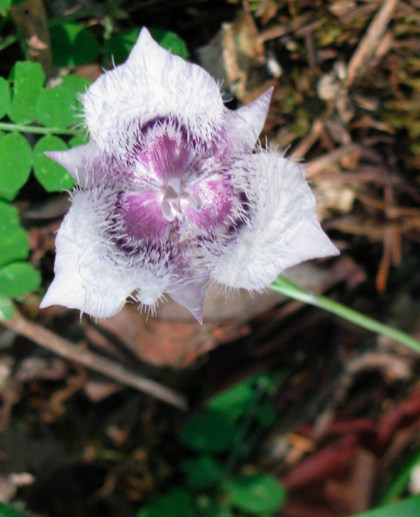
Because of the mining, it isn’t the best place for wildflowers, but we saw a few. This is Elegant Cat’s Ear (Calochortus elegans); the common name refers, I believe, to the fuzziness and triangular shape of the flower petals. This doesn’t show the plant’s leaves but there’s a good photo on Flickr that does.

Cat'sEarFlower.jpg

Lupines don’t mind disturbed soil as much as many other plants do.

GinLinLupine.jpg

I think this is the Yellowleaf Iris, Iris chrysophylla.

GinLinIris.jpg

And below, Iris bracteata, Siskiyou Iris. [caveat: I’m no expert on wildflowers so my identifications are not guaranteed! This USFS page has photos, range maps, and descriptions of the Pacific Coast iris species.] In our experience, this yellow-flowered iris is less common around here than Iris chrysophylla, the Yellowleaf Iris.

GinLinSiskiyouIris.jpg

Below is my least favorite native plant around here, the glossy-leafed Poison Oak, Toxicodendron diversilobum.

GinLinPoisonOak.jpg

In spring its leaves are usually glossy like this, and may be reddish too. On another plant it would be attractive but to me, the shiny fresh leaves are as ominous as the froth on a bodysnatcher pod.

bodysnatcherswp04.jpg

We found it along most of the trail, flourishing as if it had been thickly planted and then fertilized and tended. If only my plants at home looked so good! Ravines were choked with it, and of course the dogs wanted to go running down into such places. I don’t think I’ve ever gotten poison oak from a dog’s coat, in all these years of living here, but there’s always a first time. I’ve often gotten it from secondary sources like clothing or even the touch of someone else’s hand. (In a post last year I described something that helps lessen the itching and make the blisters go away faster.)

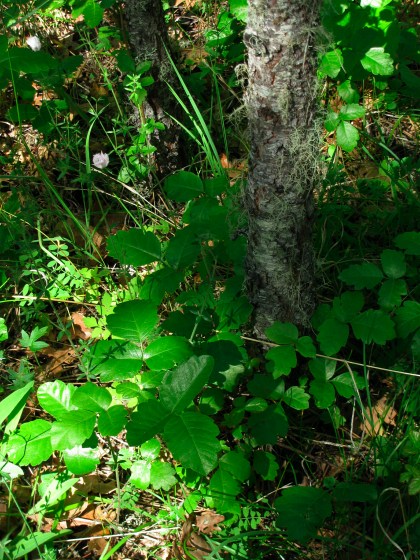
The damned stuff was everywhere. Every plant visible in the photo below is poison oak.

GinLinPoisonOak2.jpg

Finally the trail ahead was overgrown with it and we gave up and headed back. The dogs ran ahead, enjoying the downhill rush, and got out of sight as we neared the small parking area, where I heard excited voices. It turned out to be the teenage park maintenance crew and their adult supervisor, cruising the areas to do things like gather up garbage strewn around by animals during the night. They were excited by the sudden appearance of a dog who outweighed most of them, and Jack had been pleased to see them but hadn’t bowled anyone over or been a pest. He’s a sweet affable guy except when defending his home turf, and even then has a good sense of proportion.

We loaded up our tired dogs, filled their water dish in the car, and headed home.

Jack&BrookDrinking.jpg

Thirsty dogs drink from the birdbath.

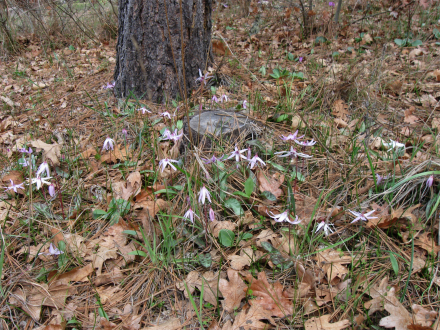
Spring beauty: Erythroniums (Trout Lilies)

These elegant and delicate plants flower for a week or so, set seed (which are carried deep underground by ants, where some germinate) and vanish within weeks, spotted leaves and all, until next year. The leaves are beautiful in themselves, and give several Erythronium species their common names, Trout Lily and Fawn Lily. They may also be called dog’s-tooth violet and adder’s-tongue, for reasons unknown to me. Here we have Erythronium hendersonii, the only purplish species. Others are white, pink, or yellow. Species found in southern Oregon include E. hendersonii, E. oregonum, E. californicum, E. montanum (Avalanche Lily), E. citrinum (Citrus Fawn Lily or Cream Fawn Lily), E. howellii, and E. klamathense/klamathensis.

These pictures were taken April 3 and 4, 2009.

Erythronium CRborder.jpg
erythroniumByTree.jpg

Erythronium2.jpg

ErythroniumPatch.jpg

erythronium leaf2.jpg

Flowering birches

Springtime, and the birch tree at our back door is laden with blossoms.

DSCF0048-400w.jpg

This year I took a really close look at these, and then looked up more about them.

catkins -400h.jpg

Birches are pollinated by the wind, like corn, but a different design: the male pollen-bearing parts are the pendulous ones in this photo (right), while the much smaller female “catkins” appear from between a pair of leaves and curve upward. On our trees (Betula populifolia, I believe) the female catkins begin to droop downward with age, like all of us––the object intruding into the upper left of the picture is an older female catkin, nearly horizontal. In Britain the long male catkins are also called “lamb’s tails.” They bear a lot of pollen; a week ago when they were new my dark blue vest showed long golden streaks after brushing against them.

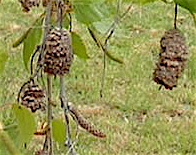
After pollination the female flowers will get larger, droop down, and gradually fall apart, loosing the scale-like seeds. Other species have winged seeds but not this one. Some of the male and female catkins survive into the next year. Below are some from last spring, still on the tree among the new ones. The old female catkins are shorter, thicker, & shaggy looking; rub one between your fingers and it easily comes apart into minuscule seeds and scales. The male catkins change with age too, becoming smaller, and hard to break up, almost feeling varnished on the outside.

Birches produce seeds abundantly and in our yard a couple of seedlings spring up each year in places that get water during the dry summers. It’s easy to see why they are known as early colonizers both after fires (secondary succession), and simply moving into wetlands or heath areas (primary succession).

DSCF0009.JPG

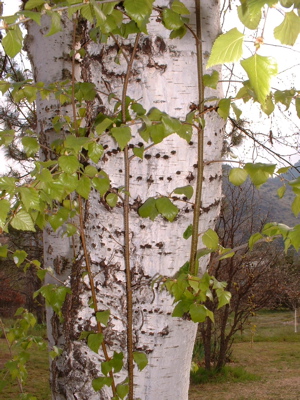
This tree also bears horizontal rows of holes, at which we have seen woodpeckers, either downy (Picoides pubescens) or hairy (Picoides villosus), probably drinking the birch’s sweet sap. The woodpeckers make the holes but others may come to them when they are exuding sap, and once I did see a hummingbird drinking there. Now that would be a great photo!

birchbark 300w.jpg