Animals encourage us to slow down

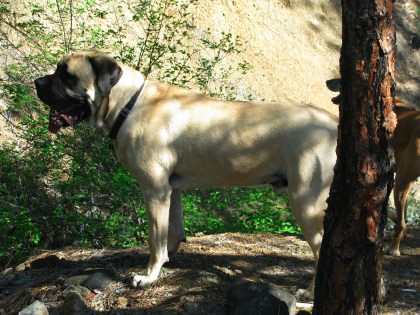
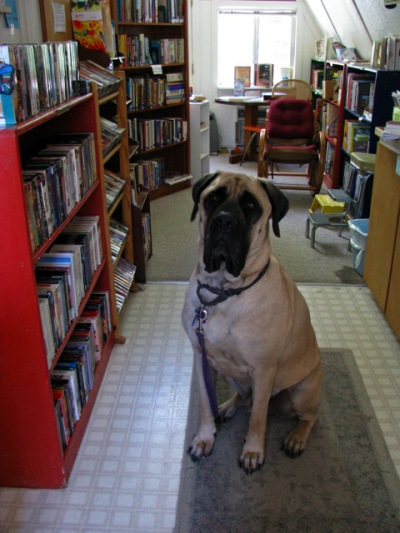
Jack the mastiff came with me today for my volunteer time at the local library’s Friends’ bookstore, in a small a-frame building by the library. He’s very good there, usually sleeps but is always listening for someone at the door, so I try to get to the door first and alert people to the presence of a large dog. So far our customers have all been fine with him being there, and his calm sweet demeanor earns him lots of pets.

Jack at the a-frame.jpg

He did get excited on his second visit, when he first noticed the fake cats perched on several shelves. The one with real fur (rabbit fur I think) was especially interesting to him and he approached it with a mixture of caution and curiosity that was funny to watch.

Jack & fake cat.jpg

As we drove home it was a fine cool fall day, and I found myself slowing down to 30 on the rural road so that Jack could put his head out the window. At 45 or 50 mph he doesn’t like it very much, and there’s some risk from objects (insects, debris) that might hit him in the eye. So we motored home at an unusually slow rate, each appreciating the day in our way. Too much pointless hurrying in life!

Here’s Jack when we stopped to get the mail. He’s looking around for any neighbor dogs that may come out to bark at him, that is one thing he is not calm about.

Jack, head out of car.jpg

Hydraulic mining scars, wildflowers, dogs, and poison oak, a short early-summer walk in the Siskiyous

[I’ve made brief corrections to this post regarding aspects of hydraulic mining, after a commenter pointed them out to me. And a more recent post goes into matters at more length, on points where I was wrong, and others on which I disagree with the commenter.]

We took our new English Mastiff Jack for his first off-leash walk in the woods this morning. He is a 3 1/2 year old rescue who has been with us for nearly a month now. He has settled in very well, comes when called at home even if he is barking at the UPS guy, and so we thought he was ready for an off-leash ramble. Our elderly female Rhodesian Ridgeback went too.

The nearby Gin Lin Trail is named for a Chinese mine owner and “traces the remains of a late-nineteenth-century hydraulic gold mining operation in what was known as the Palmer Creek Diggings, now a part of the Rogue River National Forest.” [more info]

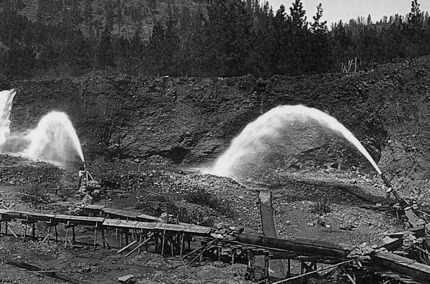
Hydraulic mining used huge pressurized streams of water to turn hillsides or mountainsides into slurry that could be run through sluice boxes to trap the gold. The photo below shows a large-scale operation in action, somewhere in this area of the Oregon Siskiyous, in the latter half of the 19th century. For scale, notice the tiny figure of a man wearing a white shirt, tending the left-hand water hose.

HydraulicMining1.jpg

The tremendous destruction takes geologic time, not human time, to heal. Huge clefts are made in the land, piles of big rocks and new hills of “processed” dirt are put anyplace convenient, and the subsoil brought up doesn’t support plant life as well as the now-buried topsoil did. All this is easily seen along the Gin Lin Trail.

GinLinDitch.jpg

The picture above shows a steep slope of discarded material a steep-sided ditch, probably hand-dug to accommodate the miners’ equipment—sluice boxes or water pipes. Both the angle of the slope, and the composition of the material itself, are hostile to plant growth. Even on the top where it is closer to level, trees and shrubs are not as numerous or healthy as in undisturbed areas.

Miners blasted away tons of earth trying to follow layers of gold-bearing gravel laid down by ancient rivers. This picture (below) shows a cut made by their work, at the point where they stopped. making ditches like this.

Dan&GinLinSlope.jpg

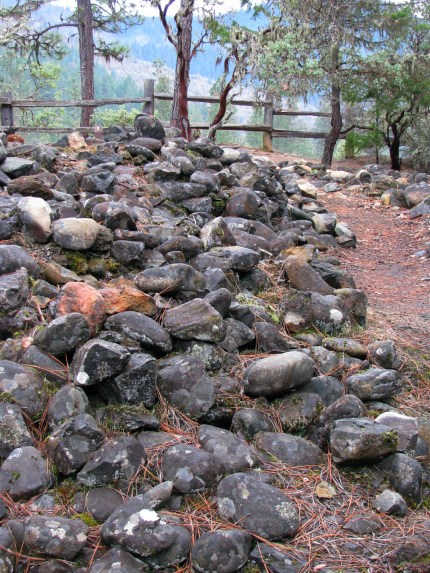
And here’s some of the big river rocks moved as the mining went on.

GinLinRockpile.jpg

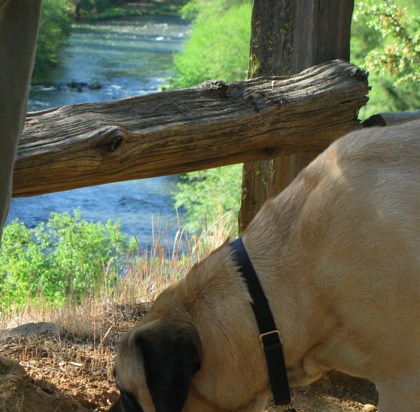
The gold being sought had been deposited by watercourses running down to the river below, seen in the background of this picture. was in layers of Tertiary-era gravel, laid down in the bottoms of rivers 40 – 100 million years ago. Since then the river bottoms have been pushed up by geological forces, and cut through by new drainage systems. The ancient rivers may have had no connexion to existing rivers, since drainage patterns have changed.

GinLinRiver1.jpg

Looking over the fence, from the same spot as the previous picture.

GinLinRiver2.jpg

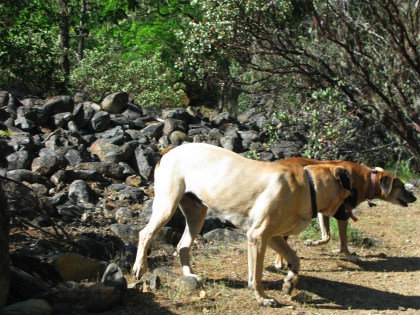
The dogs had a good time, and Jack stayed close and came when called, as we expected.

GinLinJack1.jpg
GinLinJack2.jpg

Because of the mining, it isn’t the best place for wildflowers, but we saw a few. This is Elegant Cat’s Ear (Calochortus elegans); the common name refers, I believe, to the fuzziness and triangular shape of the flower petals. This doesn’t show the plant’s leaves but there’s a good photo on Flickr that does.

Cat'sEarFlower.jpg

Lupines don’t mind disturbed soil as much as many other plants do.

GinLinLupine.jpg

I think this is the Yellowleaf Iris, Iris chrysophylla.

GinLinIris.jpg

And below, Iris bracteata, Siskiyou Iris. [caveat: I’m no expert on wildflowers so my identifications are not guaranteed! This USFS page has photos, range maps, and descriptions of the Pacific Coast iris species.] In our experience, this yellow-flowered iris is less common around here than Iris chrysophylla, the Yellowleaf Iris.

GinLinSiskiyouIris.jpg

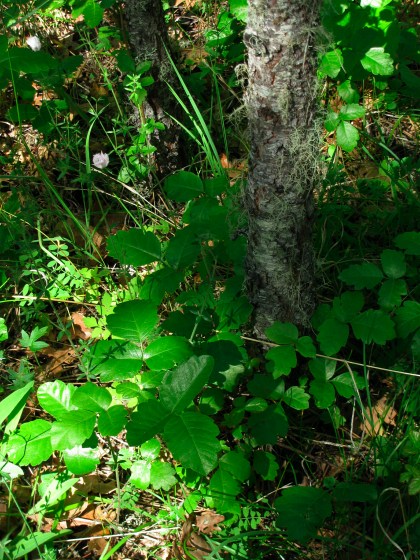
Below is my least favorite native plant around here, the glossy-leafed Poison Oak, Toxicodendron diversilobum.

GinLinPoisonOak.jpg

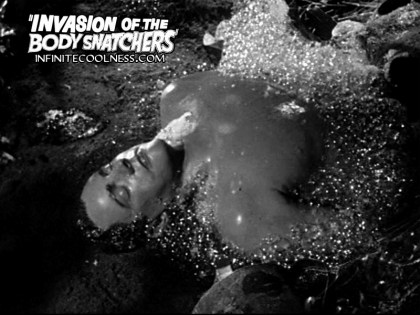
In spring its leaves are usually glossy like this, and may be reddish too. On another plant it would be attractive but to me, the shiny fresh leaves are as ominous as the froth on a bodysnatcher pod.

bodysnatcherswp04.jpg

We found it along most of the trail, flourishing as if it had been thickly planted and then fertilized and tended. If only my plants at home looked so good! Ravines were choked with it, and of course the dogs wanted to go running down into such places. I don’t think I’ve ever gotten poison oak from a dog’s coat, in all these years of living here, but there’s always a first time. I’ve often gotten it from secondary sources like clothing or even the touch of someone else’s hand. (In a post last year I described something that helps lessen the itching and make the blisters go away faster.)

The damned stuff was everywhere. Every plant visible in the photo below is poison oak.

GinLinPoisonOak2.jpg

Finally the trail ahead was overgrown with it and we gave up and headed back. The dogs ran ahead, enjoying the downhill rush, and got out of sight as we neared the small parking area, where I heard excited voices. It turned out to be the teenage park maintenance crew and their adult supervisor, cruising the areas to do things like gather up garbage strewn around by animals during the night. They were excited by the sudden appearance of a dog who outweighed most of them, and Jack had been pleased to see them but hadn’t bowled anyone over or been a pest. He’s a sweet affable guy except when defending his home turf, and even then has a good sense of proportion.

We loaded up our tired dogs, filled their water dish in the car, and headed home.

Jack&BrookDrinking.jpg

Thirsty dogs drink from the birdbath.

Happy to be drooled on

Drool is back in our lives, finally; and wisps of fur in the corners, and the need to refill the water dish every few hours. We have a new mastiff.

Our beloved English Mastiff Bart, whose picture is at the top of this blog, died in February of old age at eleven and a half, very old for a mastiff. There will never be another Bart, but we knew after only a short time with him that we wanted a mastiff in our household always. We got Bart at 8 weeks but decided this time that a mastiff puppy was more than we were ready to handle, with us being older and my husband facing knee replacement surgery next month. Enter breed rescue: programs run by devoted volunteers for each dog breed, aimed at re-homing dogs of their breed.

These folks want the dogs’ new homes to work, since the dogs have already been through at least one sad parting (and sometimes neglect or worse, as well). We filled out extensive applications, with references; and someone in our area came to meet us and check out our surroundings. Is there a fenced yard? Are there stairs to the house that would be a problem for a mastiff when he’s old? Other pets, livestock? Feeling of stability? Would-be owners’ attitudes and familiarity with the breed, and commitment required? All that stuff and more. We passed, and last weekend we travelled to visit prospective young males in foster homes. The third one we visited was the right one for us, and we drove home with our new mastiff Jack.

JackHeadShot090426.jpg

We weren’t looking for a dog that resembled Bart, but it turned out that way. Jack is “fawn” like Bart, but is taller and longer-bodied. He has the same steady intelligent gaze, calm manner, and affectionate nature, that Bart did. He’s a little over three, and his previous home gave him good socialization and some training––age and training were important to us: a rambunctious rowdy 150-lb dog does not mix well with recovery from knee surgery.

Our elderly Rhodesian Ridgeback Brook went along on the trip, and got to spend a couple of hours with Jack after we decided (early in our visit) that he was the one.

Jack&Brook0904.jpg

She went from growling at him to following him around to sniff him, and they rode home uneventfully in the back of the SUV together. We did have to convince Jack not to ride in the front seat, right at the beginning, but that was easy. He is easy-going and wants to please. Essential, in a dog his size! English Mastiffs are protective of their owners’ person and property but have been bred for a long time to have a calm and gentle temperament. A mastiff’s size and formidable appearance mean that he or she rarely needs to give more than a look or a bark, to warn off some stranger. Responsible breeders (of any dog breed) pay as much attention to temperament as to physical characteristics. You want a dog who is healthy and reliable in both regards, mens sana in copore sano.

JackSmall090426.jpg

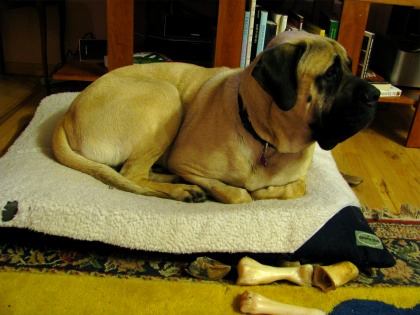
Jack has tried out all the dog beds in the house but has not gotten up on the couch even though he sees Brook up there. Until we can clip his long bear-claw-like nails, it is just as well. He hadn’t let the foster home’s vet draw blood for a heartworm test but our vet got one easily (and it was negative), with the old Cheez Wiz method (dog is busy licking the cheese-like substance out of the nozzle, and nothing else matters!) but by the time we got to the nail clipping part he’d had enough cheese and resisted. No growls, just pulling away, and believe me he is strong. We use a dremel for dog nails so I have left it on the floor the past two evenings to introduce him to it, and have also been getting him used to me holding his paws and touching his nails. He’s making progress, but no telling if that will hold when the actual clipping/grinding occurs. He has tried to eat the sandpaper cylinder off the grinder but I can’t interpret that, except he isn’t backing away from it any more.

Jack’s original home was with a couple and their teen-age daughter. He was the husband’s dog but when the marriage broke up the husband abandoned him, then the wife had to sell the house in order to give the husband his share of the money. She had a dog of her own, and could not keep Jack, BUT she was savvy enough to know about, or find out about, a breed rescue organization with a local presence. Friends of Rescued Mastiffs is a national organization, non-profit, providing care, foster homes, and re-homing to mastiffs. They deal with dogs from situations like Jack’s, dogs found as strays or in shelters, ones seized for neglect, and from puppy mills (both young ones and breeding stock). Good rescue organizations like FORM also check out the dogs to see if they are suitable for a new home, and what the conditions might be (OK with cats? other dogs? too rambunctious to be around small children at this age? needs someone who can do extensive training?). There are other good organizations helping mastiffs, but FORM was Jack’s salvation. We count ourselves very lucky to have found Jack and he seems to be settling in very happily with us. We’ll be sending photos and a report to the regional coordinator, in hopes she can pass the word on to the woman and girl who loved Jack and had to give him up. He has obviously been well loved and cared for.

No breed of dog is “for everyone” and English Mastiffs are no exception. They occupy a lot of space; fur and drool will find their way onto your furniture, clothing, etc.; and they want to be with you all the time. That’s usual for dogs, though, they aren’t toys with an on/off switch you can pay attention to only when you feel like it.

Giant dog breeds have shorter life spans than smaller dogs, and if they need medication or surgery the bills will be big too. That’s another reason to check out breeders carefully, see the parents, ask about testing for hip/elbow/eye problems that may be inherited. Visit someone with one or more mastiffs and see how it feels to be around such big dogs. Talk about the pros and cons. Think about your situation: how much time do you have to spend with a dog (for whom you will be the center of life)? How much space, indoors and out? We have a big house and fenced area, but our newly acquired 2005 Trail Blazer seems a bit crowded now with Brook and Jack in it!

Do you have plans to move, or have a baby? Dogs and babies are not at all mutually exclusive; pit bulls were reportedly used as “nanny” dogs to watch over toddlers a hundred years ago, and an adult mastiff who has been properly socialized is gentle, tolerant, and completely reliable around children. But you may not have enough time to do justice to both a new dog and a new baby; certainly you need to see how your dog of any breed behaves around children–does he or she get excited so that body or tail could knock a child over? Is the dog able to resist “taking candy from a baby”? and so on. None of these are reasons to give away your dog before having a baby, but they are factors in getting a dog, or in planning how your dog will be able to be around your children especially when dog or child is very young.

Educate yourself before acquiring any breed of dog! Even mixed breed dogs usually have some discernible breed heritage, and shelter employees or friends who really do know a lot about dogs, can be helpful. An as example, terriers and sheepdogs have higher energy levels than many other breeds: not a good choice for a dog that will spend a lot of time alone.

JackWithBall090426420.jpg

Oregon’s “Puppy Mill” bill: ineffective and wrongly aimed

In an earlier post I discussed some of the problems I see with two bills now in the Oregon legislature, HB 2470 the supposed anti-puppy mill law, and HB 2852 which is ostensibly aimed at increasing public safety from “dangerous dogs”.

The latter bill may be dead, and that is a good thing. But HB 2470 lives on, and I have closely examined the available version and have more to say about why it should also be forgotten. [I am still commenting on the original version. I have heard that changes have been made in committee but apparently the text of those changes is not available to the public. However, the bill is so fundamentally flawed that it would need to be rewritten completely to become both effective and beneficial, in my opinion, and I doubt that that has happened.]

What’s wrong with Oregon’s “anti-puppy mill” bill

We already have the laws needed to shut down puppy mills

Oregon animal cruelty laws currently contain requirements which would put puppy mills out of business, if enforced.

 (6) “Minimum Care” means care sufficient to preserve the health and well-being of an animal and, except for emergencies or circumstances beyond the reasonable control of the owner, includes, but is not limited to, the following requirements:

(a) Food of sufficient quantity and quality to allow for normal growth or maintenance of body weight.

   (b) Open or adequate access to potable water in sufficient quantity to satisfy the animal’s needs. Access to snow or ice is not adequate access to potable water.

   (c) For a domestic animal other than a dog engaged in herding or protecting livestock, access to a barn, dog house or other enclosed structure sufficient to protect the animal from wind, rain, snow or sun and that has adequate bedding to protect against cold and dampness.

   (d) Veterinary care deemed necessary by a reasonably prudent person to relieve distress from injury, neglect or disease.

   (e) For a domestic animal, continuous access to an area:

    (A) With adequate space for exercise necessary for the health of the animal;

    (B) With air temperature suitable for the animal; and

    (C) Kept reasonably clean and free from excess waste or other contaminants that could affect the animal’s health.
[ORS Chapter 167 – Offenses Against Public Health, Decency and Animals. 167.310 Definitions for ORS 167.310 to 167.351. As used in ORS 167.310 to 167.351]

I’ve never heard of a puppy mill that could come anywhere close to meeting these requirements. Hard to make a profit following those rules. Yet the existing criminal law has not been effective in ending puppy mills in this state. Why not?

1. Puppy mills hide in rural areas.
2. There is no funding for enforcement.
3. There is apparently no requirement for licensing of breeding establishments, so their location can remain unknown to authorities. Without licensing, there is no possibility of a regular inspection program like that for, say, food-handling establishments; and of course there’s no funding for such an inspection program either. Hence enforcement of the existing law depends on law enforcement rather than inspectors. Unless violations are reported by a witness or are visible from outside the property, law enforcement may not be able to enter the premises legally.

So what do we need? To do it right, licensing of breeding facilities (at a nominal cost), and funding for inspection. A couple of the provisions in HB2470 would provide some help, notably the requirement that “puppy dealers” provide purchasers with written documentation about the health, and origin of the dog––but the negatives in the bill far outweigh the positives. And “puppy dealers” as defined in the legislation wouldn’t apply to pet stores which sell the product of puppy mills!

HB 2470 is wrongly aimed

As far as I can tell, it systematically exempts pet stores, the main sales points for puppy mill “product”, from the standards of care and the health and documentation requirements, as well as from responsibility if a puppy turns out to have a health problem. The bill distinguishes between a pet store

SECTION 1. (1) As used in this section:

(b)(A) “Retail pet store” means a retail establishment open to the public that sells, or offers to sell dogs.
(B) “Retail pet store” does not mean a person that sells or offers to sell only dogs:
(i) That were bred or raised by the person; or
(ii) Are kept primarily for the purpose of reproduction.

and a pet dealer

SECTION 2. As used in sections 2 to 12 of this 2009 Act:

(3)(a) “Pet dealer” means a person that during a 12-month period sells, offers for sale, barters or exchanges more than the greater of:
(A) Twenty dogs; or
(B) Three litters of dogs.

All the subsequent requirements of the bill apply to pet dealers and not to pet stores.

Pet stores are not required to provide documentation to buyers giving the mill-produced puppy’s vet record, name and address of breeder or broker, and a guarantee of current health. Why not? What possible justification can there be for this?

HB 2470 also exempts pet stores from the “lemon law” portion of the bill. This part requires breeders, but not pet stores, to reimburse pet owners for dogs that have certain problems within two years of purchase. Sometimes that would be fair. But it makes the seller responsible for any “disease, illness or condition adversely affecting the health of the dog that existed in the dog before or at the time the customer acquired the dog”, or “a congenital or hereditary defect adversely affecting the health of the dog or requiring hospitalization or nonelective surgical procedures”. There is no provision here as to whether the condition or defect could reasonably have been known to the seller. The most careful screening of breeding stock, whether of a pure-bred dog or a cow or horse, cannot rule out every single genetic (hereditary) defect. Similarly, a puppy from a responsible breeder can receive all vaccinations, be checked by a veterinarian, and still possibly have some undetected condition that will affect its health in future.

Exemption of pet stores makes a mockery of the claim that the bill is aimed at shutting down puppy mills. Reducing demand, from the pet stores, is crucial to making puppy mills less profitable. Instead, those most affected will be the responsible breeders who are most easily located, not the secretive puppy mills, whether in Oregon or in the Midwest, which hide behind brokers, internet sales, and pet stores.

Unintended consequences

For boarding kennels:

”SECTION 1. …(2) A person may not possess, control or otherwise have charge of at the same time more than 25 sexually intact dogs that are four months of age or older.”

Foreseeable consequences

I’m not going to get into the motivations of some of the supporters of this bill, including allegations that it is part of PETA’s agenda to eliminate the “animal slavery” of pet ownership by driving breeders out of business. But it is predictable that HB 2470 will have far more effect on responsible breeders than on puppy mills. The responsible ones are out in the open, easy to find, unlike puppy mills. You are much less likely to have a problem with a dog from a responsible breeder, few of whom make a profit from their hobby. These breeders welcome potential puppy buyers to their homes to see the parents of the puppies, to interact with the puppies before they are 8 weeks old and ready for new homes, and to watch puppy temperament testing; they also choose male and female carefully when planning a breeding, with specific goals for the breed, do testing (genetic, x-ray, etc.) so as to avoid breeding dogs that carry heritable defects, and keep extensive records on their dogs.

An article in the Oregonian featured a woman who had purchased a puppy which turned out to have severe health problems due to bad care and bad breeding. That is a heartbreaker for the owner and the dog. But she bought it from a broker. Try to find that broker, probably in another state, and get him to comply with the bill’s “lemon law” provision. So, how much of the problem of true “lemon” puppies will be addressed, and how many good local breeders will be harassed by owners when a problem develops months or years later? I can leave my puppy outside 23 hours a day, and when it turns into a barking unsocialized dog, claim that it had an inherited genetic defect causing this behavior. Under the law, there’s no provision for evaluating claims against breeders.

I have some personal experience over two decades with breeders of two different dog breeds. They taught me right away that it is not simply a transaction to them: they decide if my household is suitable for one of their puppies, they require spaying or neutering to keep ill-bred or surplus pups of their breed out of the shelters and out of the wrong hands, they urge me to keep in touch and call with questions, they have me sign a contract which includes notifying the breeder if I can no longer keep the dog––even if it is 10 years later––so that they can accept it back for placement in a suitable home.

What happens at a pet store if I go in and buy a puppy? None of this, that is for sure! Those “doggies in the window” are there for a reason, to promote impulse buying of a live animal which will be a serious commitment for a decade or more. Pet store employees have no reason to talk a customer out of buying, say, a high-energy pup when the person says they want a quiet couch potato to watch tv with. If those cute puppies go unsold too long, they certainly do not go back to the breeder for placement; they get dumped or drowned or sold out out of the back of a truck. Yet this industry isn’t required to change one bit by HB 2470.

I know not all AKC breeders are so responsible as the ones I have dealt with and known. I have some ideas about that, which I’ll put in another post. But to burden this group with new legal restrictions under the guise of shutting down puppy mills, while exempting the pet stores which market the pups bred under cruel and unhealthy conditions, this makes no sense. And the lack of funding for enforcement ensures that breeders out in the open will be the actual subjects, while the unspeakably vile and carefully hidden puppy mills continue to grind out misery.

dogFontFigures.jpg

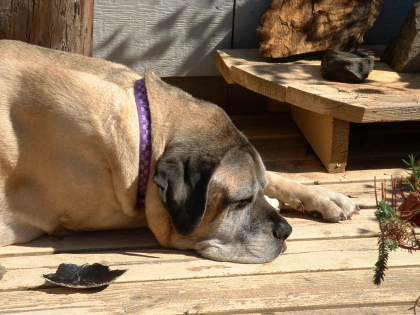
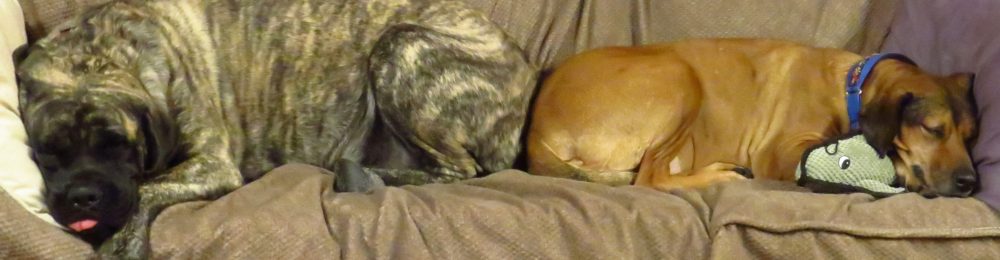
In the couch potato class, our beloved English Mastiff Bart was a champion, as in all else. We lost him in February to consequences of old age (he was 11 and a half).
BartSleepingDeck.jpg

BartSleepCouch.jpg