Sunny slope wildflowers, Southern Oregon

Despite an unseasonable snowfall last week, two days later we found some uncommon wildflowers blooming on a sunny slope bordering a forest road.

We’d noted the leaves of these delphiniums (larkspurs) the week before, and now they were in full bloom
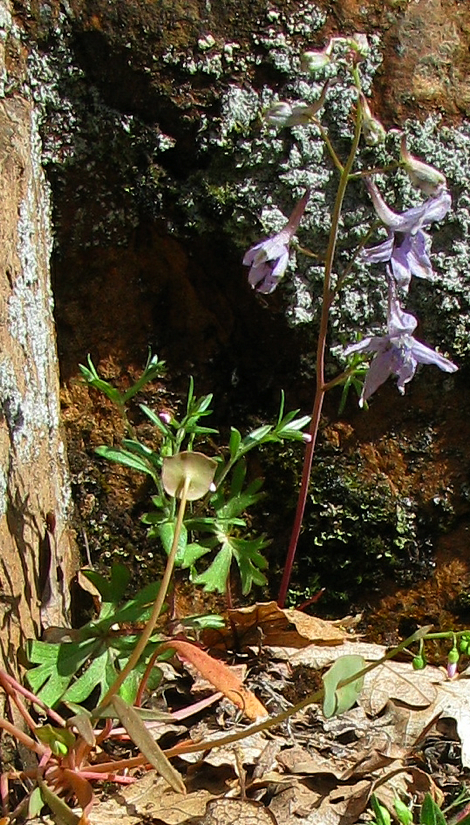
Frit Delpg purple close-up.jpg

The majority were white, like these

Frit Delph close-up.jpg

but according to the experts only two white species (Delphinium leucophaeum and D. pavonaceum ) occur west of the Cascade Mountains, and neither are found south of the Williamette Valley (in northern Oregon). Their range may be restricted to the area of a temporary lake formed after one or more of the catastrophic Missoula Floods which occurred around 15,000 years ago, when glacier dams broke releasing huge quantities of water and silt, over parts of what’s now Oregon and Washington.

Delphinium menziesii occurs in our county, but it’s dark purple with a more finely divided leaf. Maybe the ones we saw are Delphinium andersonii, which does seem to have light blue to very pale almost white flowers, and a three-lobed leaf like the ones we saw.

An exciting find was this fritillary, a member of the lily family.

Fritillary close-up2.jpg

Wikipedia says that “fritillary” comes from the Latin term for a dice-box (fritillus), and probably refers to the checkered pattern, frequently of chocolate-brown and greenish yellow, that is common to many species’ flowers. (And there’s a group of butterflies so named for the same reason.) The checkered pattern is visible on both the bud and opened bloom above.

Fritillary 1.jpg

At least 3 species are found around here; this one is Fritillaria recurva, the Scarlet Fritillary. The nearby town of Jacksonville has a festival every year in honor of the rare species found near there, Fritillaria gentneri, which has darker red flowers. And we have a few times seen, on our own property, Fritillaria affinis or Chocolate lily, which has bell-shaped greenish flowers with brown markings. We don’t have any photos of it, but here’s one from USDA
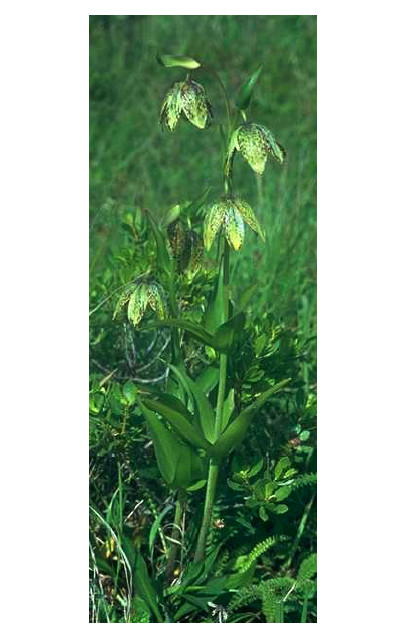
Fritillaria affinis1.jpg

Their account notes that the root bulbs are edible, though bitter, and were an item of trade for tribes in this area. F. affinis is quite variable in flower color, sometimes showing the reverse of the ones we’ve seen: purplish-brown flowers with green or yellow “dice”, as below.

Fritillaria affinis2.jpg

We also saw two other wildflowers more familiar to us: shooting stars,
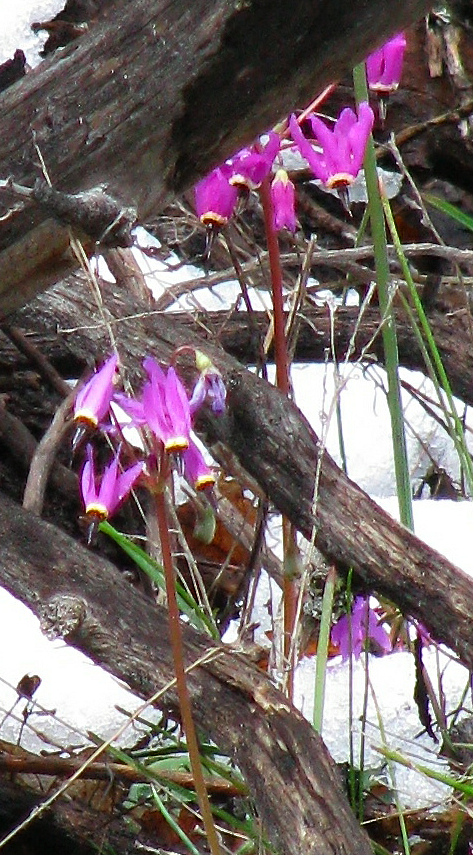
Frit Shooting Stars1.jpg

always one of the more abundant flowers this time of year,

Frit Shooting Stars 2.jpg

and our beloved Trout Lilies (Erythronium hendersonii), delicate and demure plants with a very brief duration of bloom.

Frit Erythronium 2.jpg

They range in color from nearly white to a darker violet-pink. Flowers are borne so close to the ground that it’s hard to get a look from underneath.

Frit Erythronium close-up from below.jpg

The mottled leaves are the reason for some of the common names—Trout Lily, Fawn Lily—and I think they are as beautiful as the flowers, in their way.

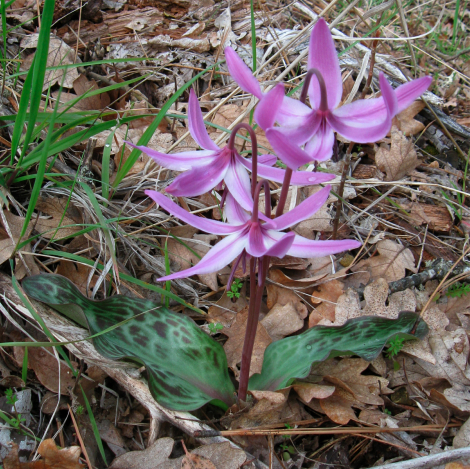
Frit Erythronium leaves.jpg

Frit Erythronium 3.jpg

Ground Cones and Witches’ Butter

The forest road we’ve been walking on has not provided much in the way of wildlife sightings—two flickers, and various mammalian scat—but here are two odd “plants” seen this week. One’s a fungus, the other a plant with no chlorophyll. Let’s look at that one first:

GroundCone1CR.jpg

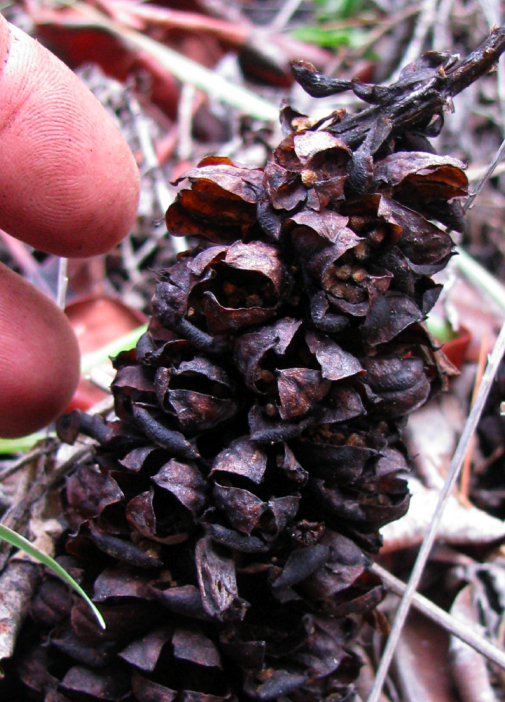
This is the ground cone (Boschniakia strobilacea), which we found pushed up through duff near maple and madrone trees.

GroundCone2CR.jpg

These belong to a group of organisms that are considered plants, although they have no chlorophyll and hence don’t make their living through photosynthesis. The larger group to which they belong is that of heterotrophic plants,

meaning “other-feeding”, since they must get their nutrition from other organisms.

Heterotrophic plants are divided into one of two groups, based upon how they obtain their food. The first of these two groups are parasitic plants. As parasites, they obtain their organic carbon from a host green plant directly through the use of structures called haustoria [rootlike outgrowths]. Wildflowers such as ground cone … are examples of root parasites. US Forest Service

Ground cones may not look like it but they are flowering plants; the ones we found today were from last spring, so they had flowered and gone to seed. Last spring they probably looked like this:

GroundConeFlowering.jpg

Photo by Russell Towle, taken in the Sierra Nevada (N. fork of the American River).

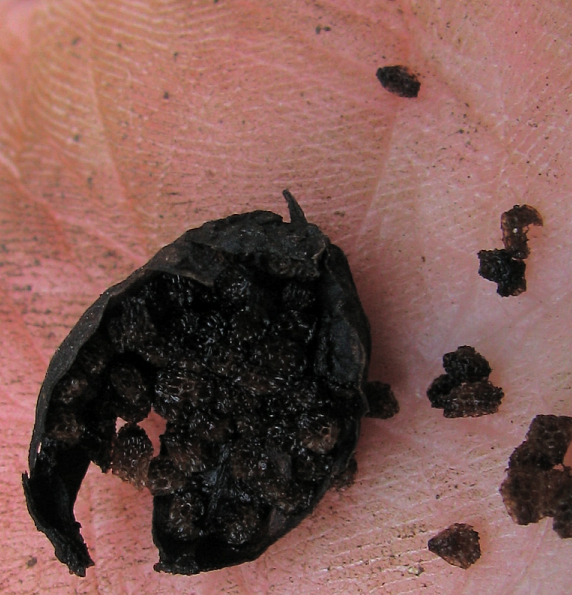
Here is one of the seed pods and contents.

GroundConeSeedsCR.jpg

The pod, though swollen with moisture, was still less than a quarter inch in diameter before I broke it open.

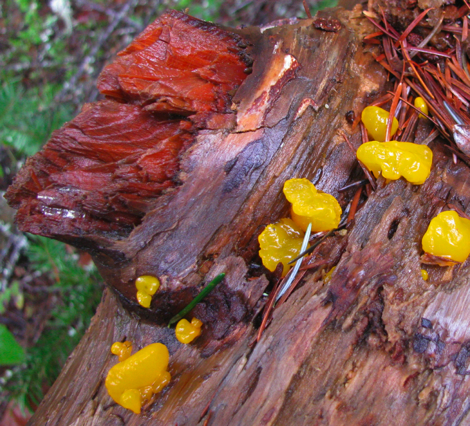
Our other find was a gelatinous fungus with the colorful and descriptive name of witches’ butter.

Witches' butter 1CR.jpg

I think this is Dacrymyces palmatus; similar-looking yellow-orange fungi, with the same common name, are found as parasites growing on other fungi, rather than directly on wood like this. And the witches have “butter” that is black in color too (Exidia recisa, see photo here).

Witches' butter 2CR.jpg

These are the fruiting bodies, like a conventional mushroom, though I could not find out in a brief search of the net exactly how the spores disperse.

Ice structures on leaves

FrostyWalkJack.jpg

It’s been a bit colder here than usual the past few days, with night-time lows in the high teens and freezing fog some nights. Yesterday Jack the mastiff and I walked up Star Gulch Road, which goes along a stream with several private gold-panning claims on it. But it was way too cold for panning!

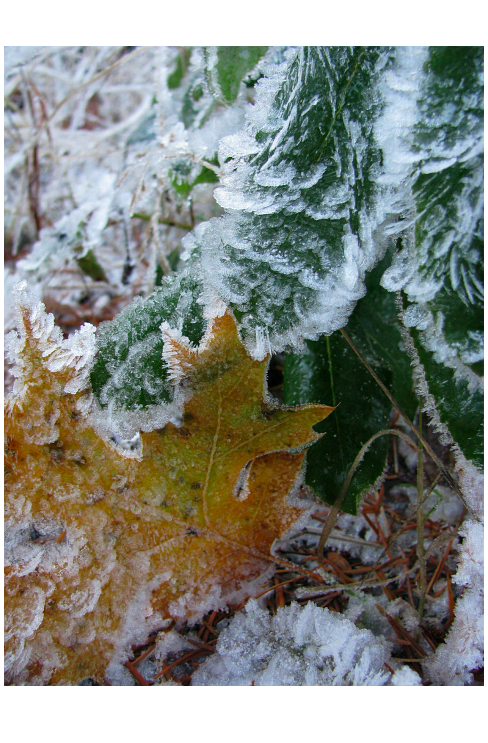
Nights of heavy frost had enrobed the vegetation in dense but delicate icy structures.

FrostyWalkIceLeaf1.jpg
FrostyWalkIceLeaf3a.jpg
FrostyWalkIceLeaf2a.jpg

Jack and I each pursued our personal obsessions. His are: following wherever I go but arriving there first, and of course sniffing around the woods to see what creatures have been there. Mine, that morning, were: walking fast enough to stay warm, interspersed with stopping and kneeling to take photos. Jack probably thinks the camera is some sort of mechanized human sniffer when I put it up close to things. Well, he’s right, in a way. I’m afraid I do see more when I take the camera, and certainly the camera remembers things better than I can.

Sometimes Jack responds oddly to objects; a statue of a horse or animal is approached cautiously and sniffed at full extension, ready to leap away. On this walk he saw a large wooden “Put out your campfire” sign, on 2 wooden posts, and reacted as if it were some strange beast. He barked at it until we got up to it then very carefully checked it out. Well, if it had been an animal it would have been quite a big one, easily six feet tall with legs made of four by fours, so I guess I understand his caution if not his failure to discern its true nature. Or, maybe it was really some entish thing just pretending to be a sign . . . you never know.

Threshing grain at the historic farm

ThreshingTossing.jpg

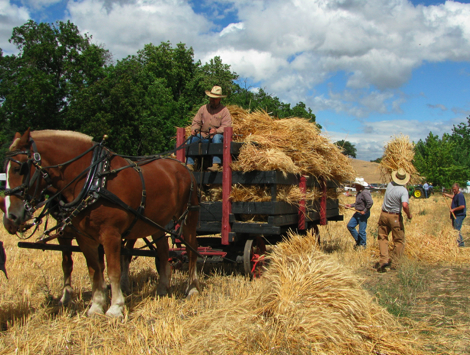
Here’s the old-style threshing of the grain at Hanley Historic Farm, Oregon; the beautiful golden “stooks” of gathered and bundled grain stalks appeared in an earlier post.

StooksFarmhouse.jpg

These stooks of hand-cut wheat, composed of bundles each tied with a stalk of wheat, sat out for weeks drying, and waiting for the Harvest Day Event on September 4, when the draft horse enthusiasts and old ag machinery collectors would join forces.

ThreshingSign.jpg

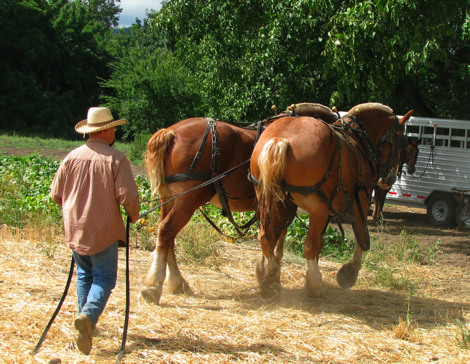
First the big placid draft horses made their way down the field, stopping to let workers with hay-rakes pitch (that’s “pitch” as in “pitchfork”) the stooks up onto the wagon, seen in the first picture. Once the wagon’s full, it heads back to the “home” end of the field.

ThreshingWagonFull.jpg

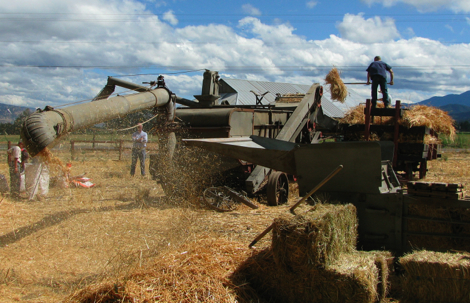
There, the old threshing machine awaits, attended by half a dozen or more other people who will fork the grain from the wagon onto a moving belt.

But first, line up the wagon next to the working area.

ThreshingHorsesByMachine.jpg

Then the horses are unhitched and led away; I thought perhaps this particular team did not like the noise of the machine, which was considerable. In 1900 or whenever this machine was made, a farmer’s team would probably be accustomed to the machine after a couple of acres had been worked, and would wait–––or two wagons could be used, hitching the team to an empty wagon to continue collecting the grain while the full wagon was threshed.

ThreshingHorsesUnhitched.jpg

The entire machine is long, with belt-driven parts to move the unthreshed grain into the whirling blades that knock the grain off the stalks. The next step separates grain from chopped straw or chaff.

ThreshingEntireMachine.jpg

It may be a machine, but it is fed one fork of grain at a time.

ThreshingWomanWithFork.jpg

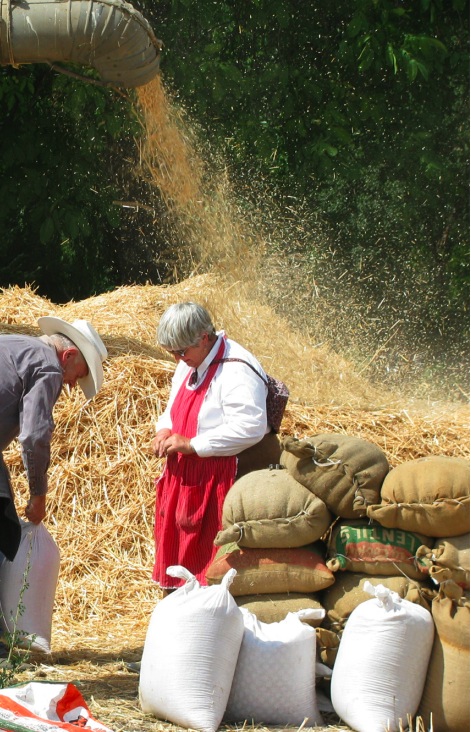
Streams of grain and chaff are blown through long pipes: the chaff into a pile, the grain into heavy cloth bags.

ThreshingBagsFilling.jpg

As on every farm in the history of the world, there’s work for kids old enough to know the routine.

ThreshingKidBagging.jpg

The filled bags are hand-sewn shut.

ThreshingBagsSewn.jpg

Once these threshing machines came into use, horses provided the power for only some of the work. The thresher itself ran from a steam, or later gasoline, engine powering the main belt. This day, a more modern machine was used for the Power Take-Off (PTO) to the thresher.

ThreshingTractorPTO.jpg

Here you can see the power belt, and the chopping teeth that actually do the threshing.

TreshingBelt&Teeth.jpg

Although the chaff is just being blown onto a pile in the background here, it is not a waste material, but would be used for bedding in stalls during the winter. Mucked-out straw would be used for fertilizing fields or maybe the kitchen garden area. These days, commercially produced wheat straw is used for decorative interior panels, making ethanol, soil amendment, animal feed (treated with urea, and with nutrients added, yuk), paper, and packaging. Many new uses are being examined. And of course, it’s still good for animal bedding.

ThreshingChaff&Bags.jpg

Our view of early machine threshing on this day didn’t show what hard work it would have been, when many acres of grain had to be gotten in before the weather changed, when teams of horses brought a continuous supply of grain to the people feeding it to the machine, and the labor of bending to sew bags and then tote them away never stopped. But, unlike a lot of physical work in the industrial age, it was not what you did 50 weeks a year. There’s a pride in getting it done

ThreshingOlderMan1.jpg

and those too young to take part look on, eager to be old enough.

ThreshingKidLookingOn2.jpg

And when the belt stops moving, the old hands find a spot in the shade.

ThreshingOldGuysRestCR.jpg