Transcendental Refreshment: Golden Peony and two poems

AmerTanka112center2.jpg

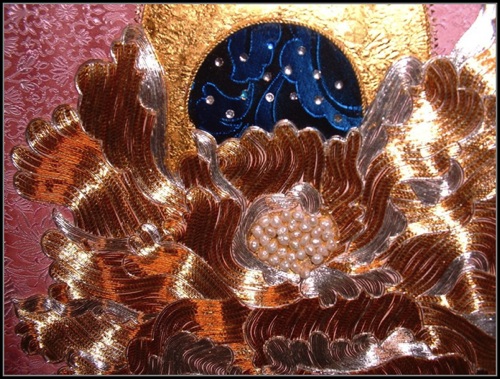
above, center peony detail of the textile work American Tanka 112 by Dan Barker. Gold and silver thread, gold leaf and pearls on fabric. See more here.

Wild Geese by Mary Oliver

You do not have to be good.
You do not have to walk on your knees
for a hundred miles through the desert, repenting.
You only have to let the soft animal of your body
love what it loves.
Tell me about despair, yours, and I will tell you mine.
Meanwhile the world goes on.
Meanwhile the sun and the clear pebbles of the rain
are moving across the landscapes,
over the prairies and the deep trees,
the mountains and the rivers.
Meanwhile the wild geese, high in the clean blue air,
are heading home again.
Whoever you are, no matter how lonely,
the world offers itself to your imagination,
calls to you like the wild geese, harsh and exciting–
over and over announcing your place
in the family of things.

© Mary Oliver

I Looked Up

I looked up and there it was
among the green branches of the pitchpines—

thick bird,
a ruffle of fire trailing over the shoulders and down the back—

color of copper, iron, bronze—
lighting up the dark branches of the pine.

What misery to be afraid of death.
What wretchedness, to believe only in what can be proven.

When I made a little sound
it looked at me, then it looked past me.

Then it rose, the wings enormous and opulent,
and, as I said, wreathed in fire.

© Mary Oliver

from Owls and other Fantasies, poems and essays (2003), by Mary Oliver.

More of her poetry can be found online at Poet Seers

Whales too polluted to be eaten by Faroe Islanders

faroeIslMap2.jpg

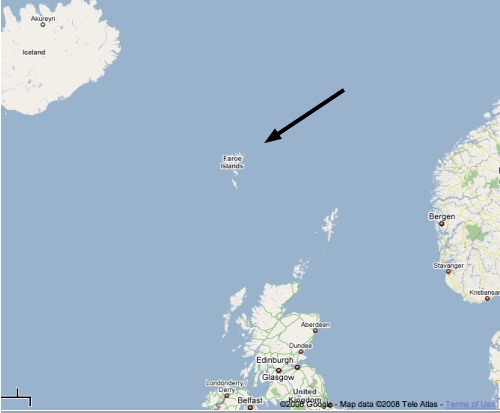
You’d think living in the Faroe Islands, rainy chunks of basalt about midway between Norway and Iceland, would keep you out of the way of serious industrial pollution. We all know better these days, of course, but still: such a remote location!

New Scientist reports (28 November 2008) that the medical officers on the Faroe Islands have recommended an end to the consumption of whale meat from the thousands of pilot whales killed each year by islanders. It’s a traditional food which has kept off starvation in the past, but now the whales contain dangerous levels of mercury, PCBs, and DDT derivatives.

Tests on the people themselves have revealed “damage to fetal neural development, high blood pressure, and impaired immunity in children, as well as increased rates of Parkinson’s disease, circulatory problems and possibly infertility in adults.”

Mercury appears to be the pollutant causing the worst health problems, and the Faroese studies increase concerns about the risks of low levels of mercury in other populations.

faroeIslChurch.jpg

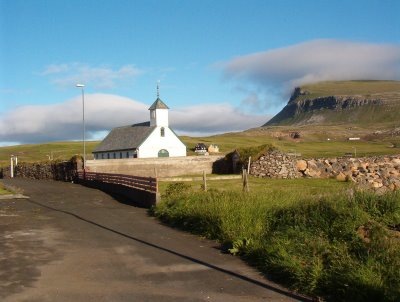
Above, Church on the Faroe Islands. Photo source.

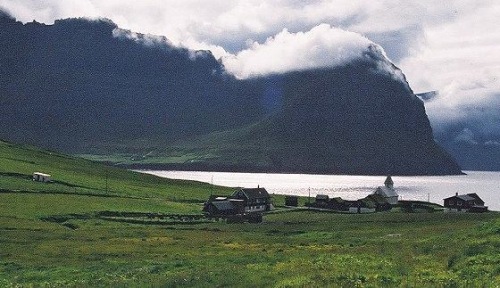
Below, a settlement on one of the 18 small islands. “Faroe” means “sheep”; early settlers brought sheep and oats to the islands, which are also home to many seabirds including puffins. Photo source.

faroeIslScene.jpg

Autumn

This October afternoon the sun was mild enough that I could go out and soak it up, just lying on the deck, resting my head on the book I had brought along. Somewhere within earshot quail moved along in the golden-dry grasses, and I considered, in between dozing, whether their calls were more like “kee kee KEE” or “we’re here HERE”. When I looked up after an hour or so of moving crablike to keep in the light, I noticed how low the sun was already in the southern sky; it’s as if four months have skipped by me untasted, as I stayed in to avoid the heat, came out briefly to sit in the hot shade, ran in and out setting sprinklers to try to nurse the plants through the dry hot summer.

I was reminded of February in Portland (Oregon), where one can easily go a month in winter without seeing the sun through grey and misty skies. Portland is not all that rainy, measured in inches, but measured in sunny days from October to May it can feel like Scotland without the wind (though that’s a climate I’ve only read about). There are usually three or four days in early February when the sun appears, to encourage the world, and I remember going out then as I did today to turn my body to the sun, driven by hunger for its warmth, even though here it’s been blazing for months.

A flock of tiny birds–kinglets perhaps–swept through the trees and I heard their little sounds. When the late afternoon breeze came up and I roused myself to use eyes instead of only ears, it seemed the birds were moving from tree to tree to stay in the light and warmth. I filled up the mineral-encrusted pyrex pan that serves as a bird-waterer; there was some rain the past two days but the earth drank up the moisture, eager for it as I was for the sun. We all feel the dark coming on apace.

There is more sunlight in the back part of the yard and I follow it, wandering around. The dogs follow me, drawn in varying degrees by companionability, the responsibility of guarding me, and curiosity as to what the two-legged hunter may turn up. The back is dusty and rocky, spiky dry weeds divided by gopher-plowed patches. A pattern catches my eye; I stoop and find the carcass of a goldfinch as dry and fleshless as the weeds. He seems not the remains of a creature done with life, but a form ready to be filled: pour flesh and guts in through the gape in the breast where the sternum is revealed bare, perfect, curved; pop in that bit of a brain that sits behind the huge eyes–one can look through one side of the skull and see daylight out the other, so large are a bird’s eyes, far larger than the tiny part that shows–and then restore those marvelous eyes and nerves, preen the feathers straight, and off he might fly.

A little river walk in the Siskiyous

This morning before the day heated up too much we took the more spry of our two old dogs and headed out for a little walk. The border between Oregon and California is only about 15 miles from us by road; after crossing into California the roads are unpaved but not bad, and follow various river branches up in the Siskiyou Mountains.

The place where we parked was just before a bridge over a small river and then we hiked up along that river, crossing to the other side when our way was blocked. In August the water is low, but we saw plenty of winter driftwood lodged nearly ten feet above the current water level.

BridgeView.jpg

View upriver, from the bridge

It was mostly shady and cool and the rocks were great: huge outcroppings of basalt that may have continued down and under the river into the very roots of the earth, and smaller boulders of other types. We thought they were great; our dog Brook found them rough going at some points but did fine, finding her own route uphill from us at some points. Crossing a river, even such a small one, was new to her; I think she was a city dog before we got her as a rescue at age 5, and in the 6 years since we have seldom gone hiking with the dogs. Dan goes goldpanning, for fun, and has forded many a river in that pursuit, so he led the way and helped Brook out when she got too close to strong currents. She was nervous, though not too nervous to stop each time in midstream for a drink.

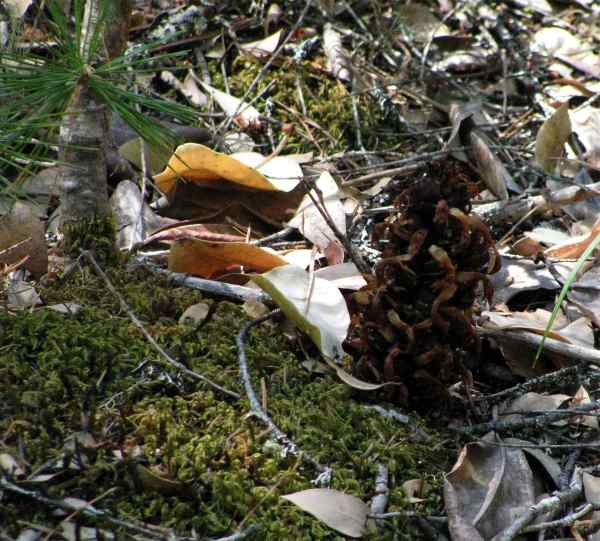
We saw an unusual plant in a flat dry area above the river: the “Ground cone” (Boschniakia species, perhaps hookeri or strobilacea). This is a parasitic plant that forms a tuberous growth upon roots of trees or shrubs, deep underground, then sends up a long flowerstalk with this pine-cone-like flower. Only the flower appears aboveground; there are no leaves.

IMG_0184_2.jpg

There was a group of perhaps ten such cones within a circle ten feet in diameter. I looked and photographed from a distance because there was poison oak around and I’m very sensitive to it. But I got one shot that shows the dry flower petals, and the seeds.

groundcone2.jpg

According to descriptions I found on the web, the petals are purple, and the plant is a prolific seed-producer–“a single plant may produce more than a third of a million seeds.” [from The Natural History of Puget Sound Country, by Arthur R. Kruckeberg, in Google Books] The ten or so cones we saw may all have been from the same plant. The flowers are said to be hermaphroditic, having both male and female parts, so they can self-fertilize.

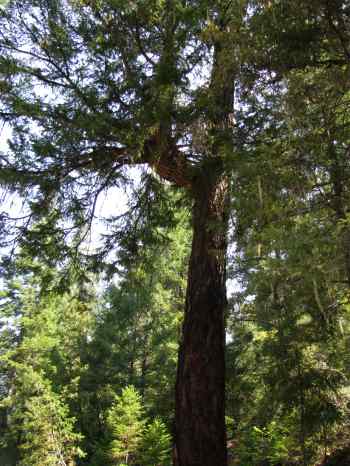
Not far away was a very robust Douglas fir with a branch that was almost another trunk, in size. Below, within the reach of idiots with spray paint, “Felix” had immortalized his contempt for nature in bright red letters (hidden by shadow and rough bark, in the photo). If I had surprised him at his little task, could anyone blame me if I tied him to the trunk and carefully spraypainted him?
dougfir1.jpg

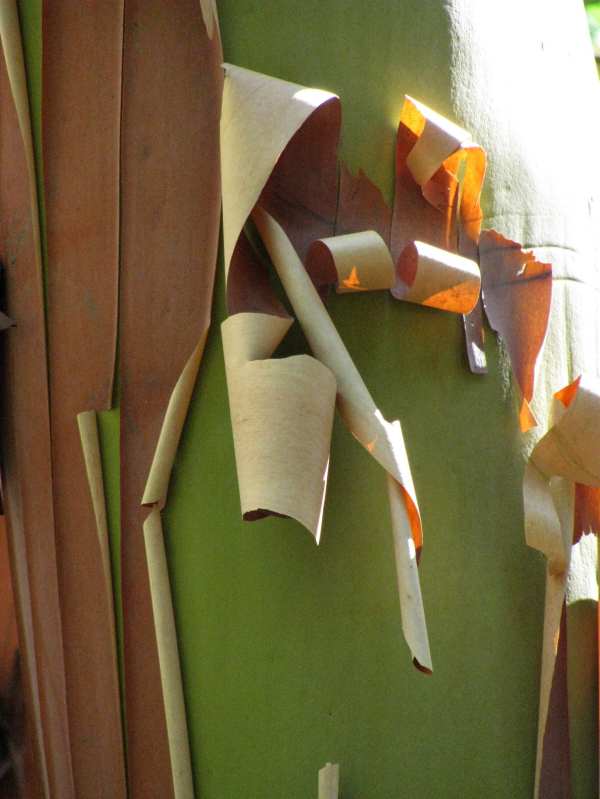
In open areas there were madrones, which have bark that peels in gorgeous patterns and colors.

madronebark1.jpg
madronebark4.jpg

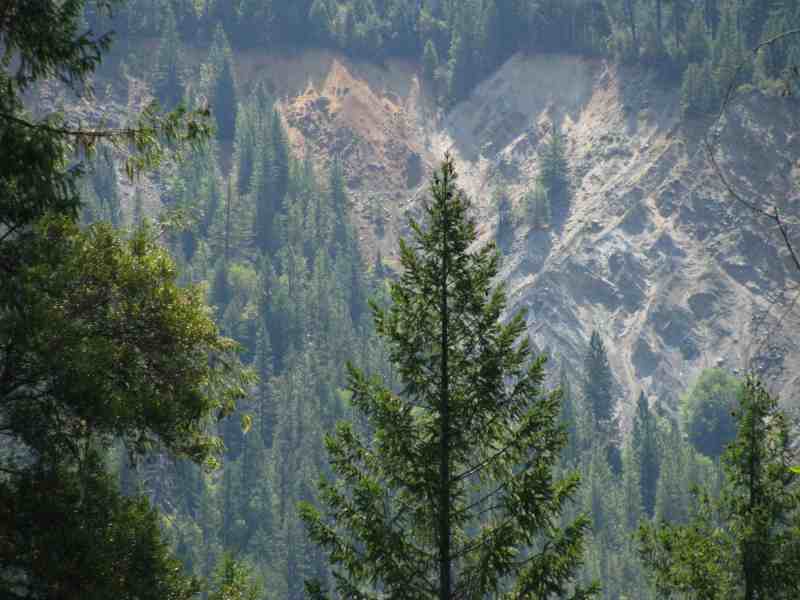
Back at the road, we went past the car to take a look each way from the bridge. In one direction, traces of old hydraulic mining could be seen.

hydraulic_damage.jpg

In Gold Rush days, and again in the 1930’s, gold miners of all sorts were around here, from humble individual panners to gangs that tore aside mountain-sides with pumps and hoses to sort out gold from the dirt and rock. The damage to this hillside must have been done at least 70 years ago; a few trees have managed to take root but the slopes remain mostly bare and prone to further erosion or landslide. This is public land and I think hydraulic mining is restricted, but with the high price of gold we are seeing more dredgers in the rivers. They use a big suction hose to vacuum up sediment and small rocks for sorting; one person runs the hose while another often works underwater moving big rocks to get at what’s underneath. Dangerous and destructive, a double thrill.

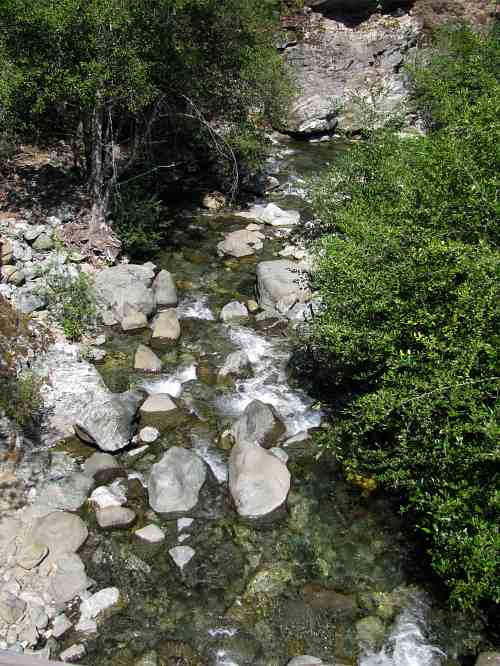
But down below this little river carried on, looking just fine.

river2.jpg

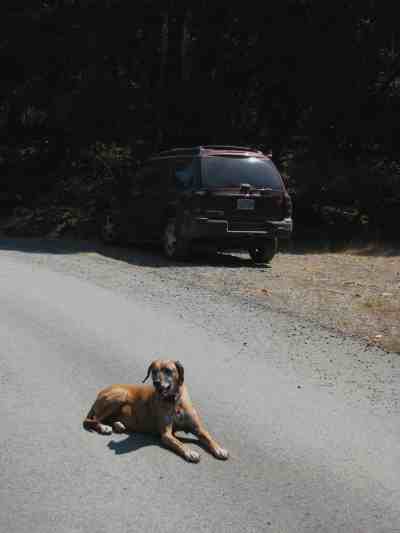
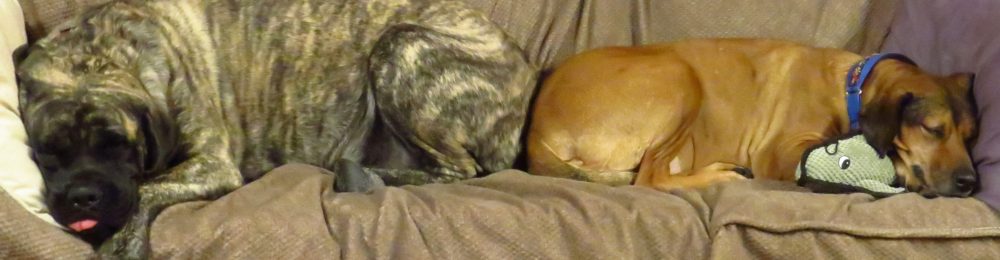
It’s hypnotizing to watch the water go over the rocks. But our dog Brook felt she’d scrambled over enough rocks for one morning. As soon as she determined we were just loitering on the bridge, not continuing across it, she waited in the road between the bridge and the car, and we finally gave in and headed home.
Brookinroad.jpg