
Of all the birds I’ve encountered in literature, the skylark has been most intriguing. First, because to the writers it is so powerfully representative of freedom, inspiration, hope, and joy; and secondly, because we don’t have them here in North America except for rare solitary “vagrants”, and introduced populations in British Columbia and on San Juan Island in Washington State. Every time I read an ecstatic poem about skylarks, I wondered why this bird, among all of Britain’s songbirds, evoked such emotion.
There are an abundance of poems to and about skylarks; I’ve collected some and put them here, with the less familiar ones at the top. For more, in a wide range of quality, see pp. 53+ in The Bird-Lovers’ Anthology (a Google book), or this search at Bartleby.com.
I had always made the facile assumption that the source of this bird’s literary mystique must be that it had an unusually beautiful song. Certainly it’s not known for its plumage; as befits a ground-nester, the skylark has cryptic coloration, with streaky earth-tones.

Image by Daniel Pettersson (under creative commons license)
What about the song? It’s unusually varied––
Bird songs are among the most complex sounds produced by animals and the skylark (Alauda arvensis) is one of the most complex of all. The songs are composed of ‘syllables’, consecutive sounds produced in a complex way, with almost no repetition. The male skylark can sing more than 300 different syllables, and each individual bird’s song is slightly different.
and in captivity, skylarks have shown remarkable ability as mimics.
My neighbor has an English skylark that
was hatched and reared in captivity. The bird is a most persistent
and vociferous songster, and fully as successful a mimic as the
mockingbird. It pours out a strain that is a regular mosaic of
nearly all the bird-notes to be heard, its own proper lark song
forming a kind of bordering for the whole.
American naturalist John Burroughs (in Birds and Poets)
But perhaps they are not, in themselves, especially melodious. Burroughs goes on to criticize the skylark’s own song:
His note is rasping and harsh, in point of melody, when
compared with the bobolink’s. When caged and near at hand, the
lark’s song is positively disagreeable, it is so loud and full of
sharp, aspirated sounds.
And when I listened to the song myself, it seemed pretty enough but insufficient to stir so many hearts so deeply. You can hear it online: Portland Bird Observatory site ; or on Soundboard ––choose the one titled “Sky lark male song”, 33 seconds long.
I embarked on an exploration of the skylark, to find out the basis of its literary renown, and here’s what I found.
Thou only bird that singest as thou flyest,/Heaven-mounting lark…

Photo © Martin Cade, Portland Bird Observatory site
First the basics: the Eurasian Skylark (Alauda arvensis) is larger than a house sparrow, and smaller than a starling; breeds from Britain to Siberia, and south to India and North Africa; and nests on the ground in open areas: meadows, salt marshes, heaths and farmland. The nest is a cup on the ground made from grass and hair.
Unlike most perching birds, the male sings in flight, and what a flight: he starts up suddenly from the ground, goes up high in the sky––50 to 100 meters––and hovers there for a few minutes, then plummets down to land on the ground. And all this time he is singing: while he rises so high that he may be scarcely visible, while he stays aloft, while he plunges to the earth again. “…drowned in yonder living blue/The lark becomes a sightless song “ (Tennyson, In Memoriam).
Experiencing the Skylark’s song
So, what moves the heart so much, when the skylark sings?

Jules Breton, Le chant de l’alouette (“Song of the Skylark”), 1884</
I think we can sum it up this way: early, sudden, humble, ascendant, prolonged.
Early
If you get up very early in Britain from April to August, and out into an area of grassland, farmlands, or marsh, this is likely the most prominent bird you will hear, starting even before the sun rises. (They sing throughout the day, but it’s most striking in the hush of dawn.)
The bird sings not from a perch but while flying, so the song emerges from the sky above, as the night flees and the first glow of dawn appears. It becomes associated with all the possibilities of a new day, the freshness of dawn, the light banishing darkness.
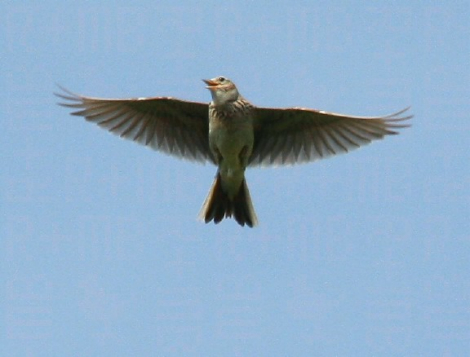
(Photo)
“I rose early. I went into my garden before breakfast and stood listening, but towards the common there was nothing stirring but a lark.”
H.G. Wells, War of the Worlds
“Though there was nothing very airy about Miss Murdstone, she was a perfect Lark in point of getting up. She was up (and, as I believe to this hour, looking for that man) before anybody in the house was stirring.”
Charles Dickens, David Copperfield
To hear the lark begin his flight,
And singing startle the dull Night,
From his watch-tower in the skies,
Till the dappled dawn doth rise.
John Milton, L’Allegro, l. 41
[Spring] When … merry larks are ploughmen’s clocks…
Shakespeare, Love’s Labour’s Lost V, ii.
The association of the lark with dawn is so strong, poets even credit him with summoning the sun:
The busy day,
Waked by the lark, hath roused the ribald crows.
Shakespeare,Troilus and Cressida, IV, ii
The skylark is early in another way too, beginning to sing in the first part of summer (it’s considered to provide “the quintessential sound of an early British summer”), so it represents the end of…no, not the end of wintry weather––that makes reappearances even in summer––but the prospect of some warmer sunny days. Don’t take this lightly; drizzle, rain, fog and chill are so dominant that the climate was once described by a tongue-in-cheek booster, “writing on one of those raw, damp, sodden English winter days”, as “the best in the world because it is just depressing enough and, though beastly, not too beastly” thereby contributing to a hearty vigor. (Mary Borden, “In Defense of the English Climate”, Harper’s Magazine June 1930)
Being associated with the idea of summer is more powerful than we post-industrial urban humans can easily comprehend. The arrival of spring and summer meant not just longer days and better weather, but the beginning of another growing season, an end to the monotonous diet and shortages of winter, the return of birds and flowers, birthing season for livestock, easier travel between farms and villages.
Sudden
Only the lark leaps out of ruts like a live dart, and rises, swallowed by the heavens. Then the sky feels as though the Earth itself has risen.
Gabriela Mistral, The Lark
And now the herald lark
Left his ground-nest, high tow’ring to descry
The morn’s approach, and greet her with his song.
John Milton, Paradise Regained, bk. II, l. 279
Humble yet ascendant
This is a small brown bird, which nests on the ground and seeks invisibility there.
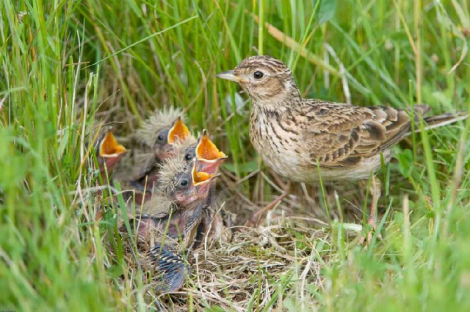
Photo, Pensthorpe Nature Center.
(Drawing of a skylark constructing the hollow and lining it with grass). There’s a terrific commercial photo of a startled skylark rising from the nest as several well-grown chicks call in protest.
Its nest, eggs, and chicks are vulnerable to trampling and to all sorts of predators including rats (infra-red photo below; if you have trouble making out the parent bird, on the left, look for the bright white dot of the eye).

Yet it abandons its reclusive habits, to deliver a long song while ascending and hovering in the sky. It’s unclear how much time the male spends at the nest, but he does fly up almost vertically from his unseen location on the ground when beginning his song display.

Higher still and higher
From the earth thou springest,
Like a cloud of fire…
Shelley, To a Skylark
Perhaps John Burroughs, whose critical judgment of the skylark’s song was quoted earlier (“…positively disagreeable, it is so loud…”), would have liked it better had he been hearing it while the bird was far overhead, instead of nearby in a cage.
Several poets have drawn particular attention to the skylark’s two worlds, sky and earth. It soars, sings, then drops to a point unseen on the ground where mate and nest have remained. Wordsworth says “Type [model] of the wise, who soar, but never roam—/True to the kindred points of Heaven and Home.”
With regard to ascendant flight, The Royal Society for the Protection of Birds says on a page for children that “Quite often, a skylark will fly over to the other side of the field before launching itself upwards into the sky. This is to trick you into thinking that it is nesting somewhere else, to keep its nest site a secret.” Since singing isn’t mentioned, maybe this is the (non-singing) female reacting to someone getting too close. The sudden rise of the singing male is nearly always a feature of his literary appearances.
Prolonged
The song generally lasts 2 to 3 minutes, quite long by birdsong standards, and is often even longer later in the season. What a great effort is put forth by this bird (which weighs only 30-45 g), singing continuously while he is zooming up into the air, holding steady aloft, and plummeting down!
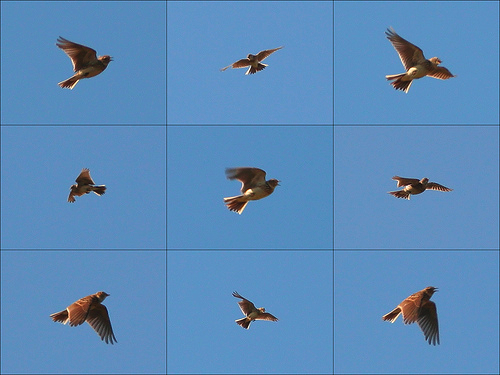
Photo montage by Mark Kilner, (under creative commons license).
Putting all this together, imagine standing in a field near dawn,

listening to birdsong pouring down from the sky for two minutes or four, a very long time, as the singer rises, hovers, swoops above you, often visible only as a speck in the blue. Finally he plummets to the ground and is lost to view. (Photo, dawn in the Lake District)
The human listener is drawn upwards, inspired, filled with joy.
Aside from inspiring humans, what might be the function of the Skylark’s song?
Male birds sing mostly to proclaim their territory. For Alauda arvensis, with its long and varied song, there is a refinement to this:
”Dialect features are used for N–S recognition in a territorial species with a large repertoire”––or in other words,
Uttering the song serves to mark a male’s territory; listening to nearby songs lets him know exactly who’s where. It has been shown that neighboring skylarks have similarities in their songs, “common sequences of syllables “, which aren’t found in the songs of males from outside the area. When a resident male hears a song lacking the shared phrases, he reacts more strongly to defend his turf (and mate) because he knows the singer is a stranger and more of a threat than one of his familiar neighbors who already have established territories. It makes me wonder, when a stranger succeeds in settling in, how long does it take him to acquire the local dialect? Or is that a rare event, with vacant territories being claimed by the offspring of local pairs?
In an interesting turn of phrase, this phenomenon is called “the ‘dear-enemy effect’ … a reduced aggression from territorial animals towards familiar individuals, generally neighbours, with whom relationships have already been established”, presumably in order to conserve energy.
Singing as a conspicuous show of vigor
The long effortful singing serves as a proof of fitness: to potential mates before the breeding season, and at all times to potential predators such as merlins––small falcons that specialize in hunting songbirds. (Merlin, Falco columbarius, Photo)
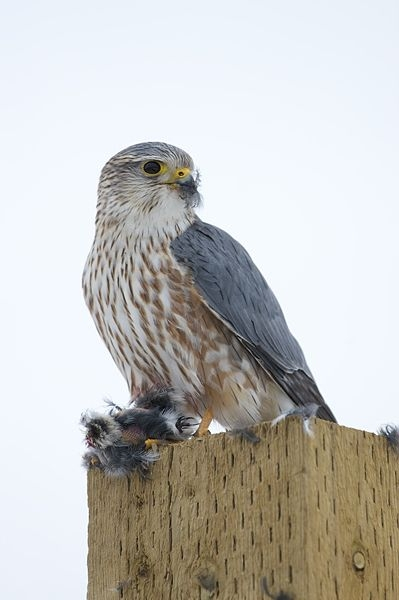
The male lark continues to sing even as he is being chased by aerial hunters like kestrels and merlins. A study of anti-predation behaviors found that “[m]erlins chased non- or poorly singing skylarks for longer periods compared to skylarks that sang well. A merlin was more likely to catch a non-singing than a poorly singing than a full-singing skylark.” [the repetition of ‘than’ is in the original, perhaps indicating a descending likelihood of being caught]
Conservation status of the Skylark
The skylark population in Britain and Western Europe has dropped precipitously over the past 30 years; I found estimates for Britain ranging from 50% lost, to 70% lost. In some areas they are gone completely. The decline is most likely caused by the move to from spring to winter sowing of cereals such as barley and wheat, which deters late-season nesting attempts––second and third clutches––and may reduce winter survival because there are fewer fields of stubble. For nesting and foraging, the birds prefer areas with low cover; ideal vegetation height is 20-50 cm. I would think that the use of pesticides is probably a factor also since the young are fed on insects. Use of previously fallow ground for biofuels further reduces their nesting areas.
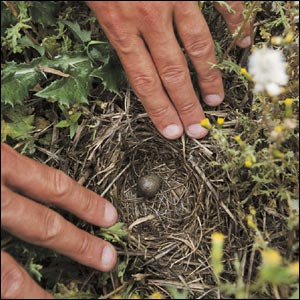
(Photo BBC)
Since this problem was recognized, farmers have been encouraged to leave unsown “skylark plots” in the midst of their fields and so far results are “encouraging”, in that the rate of decline is not so sharp. [More on skylark conservation in Britain here; Royal Society for the Protection of Birds report, The State of the UK’s Birds 2008 here.]

Skylark set-aside plot.

Aerial view of skylark plots.
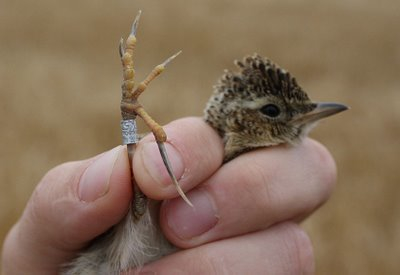
Recently fledged juvenile skylark after banding.
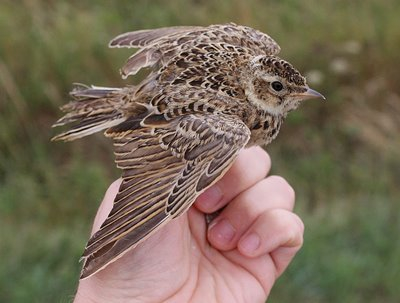
Banded skylark about to be released. These birds were caught by startling them up into pre-set mist nets. Both photos from Mark Thomas, Bucktonbirder.
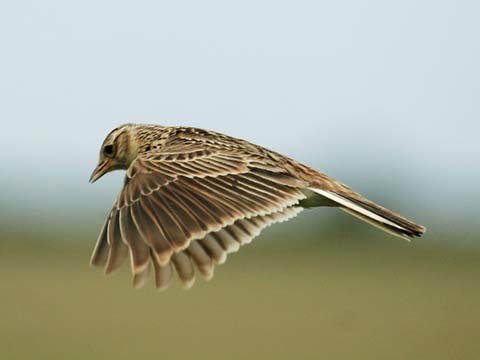
Skylark, Blackbush Fen, 6th July 2007, © Peter Beesley; Cambridgeshire Bird Club.
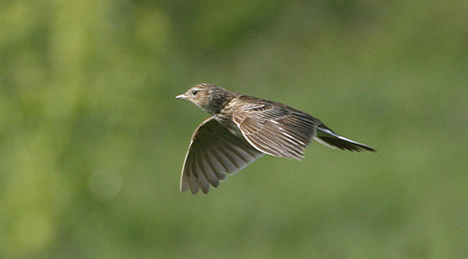
Skylark, Dorset, photo © Charlie Moores.
I can’t leave the subject of the skylark without mentioning Ralph Vaughan Williams’s lyrical work for violin and orchestra, The Lark Ascending. It is said to have been inspired by George Meredith’s long poem of the same name, but surely the ground had been prepared by Williams’s own experience of the skylark’s song and flight in his native England. If you look on iTunes you can find one offering of the entire 14 minute piece, for $0.99; the rest require you to buy an album. Or hear it on Youtube; many choices are there, including these: London Symphony Orchestra , 5 minute excerpt; or entire, in two audio installments, Orchestre de Chambre I Musici de Montréal, part 1, part 2.









 nosleepingdogs


