What matters most to BP

This’ll fix things:

As for BP, it has taken steps to beef up its PR operation, in an attempt to limit the damage to its reputation. The company has recruited as head of the firm’s US media relations Anne Womack-Kolton, the former press secretary to Dick Cheney.

from this morning’s UK Guardian

True, the company’s public relations since the explosion have been terrible: suppressing and lying about things that will become known eventually anyway, and ridiculous efforts to play down the seriousness of the oil spill. Tony Hayward, BP CEO, “told Fox News sister network Sky News on Tuesday [May 18] that he is largely unconcerned:

I think the environmental impact of this disaster is likely to be very, very modest. It is impossible to say and we will mount, as part of the aftermath, a very detailed environmental assessment as we go forward. We’re going to do that with some of the science institutions in the U.S. But everything we can see at the moment suggests that the overall environmental impact of this will be very, very modest.

After BP has squandered any potential public credibility, the most silver-tongued revolving-door lobbyist-cum-government appointee (such as Ms. Womack-Kolton) will be hard pressed to reverse the tide. We all know which tide they really truly care most about, when it comes to the tide of financial-world and public opinion, vs. the tide of oil.

Young heron dying, SM.jpg

Young heron dying in oil-soaked marsh. Photo by GERALD HERBERT / AP. Copyright by photographer and AP, not used with permission.

What is so special about the skylark? (that’s the bird, not the car)

Of all the birds I’ve encountered in literature, the skylark has been most intriguing. First, because to the writers it is so powerfully representative of freedom, inspiration, hope, and joy; and secondly, because we don’t have them here in North America except for rare solitary “vagrants”, and introduced populations in British Columbia and on San Juan Island in Washington State. Every time I read an ecstatic poem about skylarks, I wondered why this bird, among all of Britain’s songbirds, evoked such emotion.

There are an abundance of poems to and about skylarks; I’ve collected some and put them here, with the less familiar ones at the top. For more, in a wide range of quality, see pp. 53+ in The Bird-Lovers’ Anthology (a Google book), or this search at Bartleby.com.

I had always made the facile assumption that the source of this bird’s literary mystique must be that it had an unusually beautiful song. Certainly it’s not known for its plumage; as befits a ground-nester, the skylark has cryptic coloration, with streaky earth-tones.

skylark, worm in mouth.jpg

Image by Daniel Pettersson (under creative commons license)

What about the song? It’s unusually varied––

Bird songs are among the most complex sounds produced by animals and the skylark (Alauda arvensis) is one of the most complex of all. The songs are composed of ‘syllables’, consecutive sounds produced in a complex way, with almost no repetition. The male skylark can sing more than 300 different syllables, and each individual bird’s song is slightly different.

and in captivity, skylarks have shown remarkable ability as mimics.

My neighbor has an English skylark that
was hatched and reared in captivity. The bird is a most persistent
and vociferous songster, and fully as successful a mimic as the
mockingbird. It pours out a strain that is a regular mosaic of
nearly all the bird-notes to be heard, its own proper lark song
forming a kind of bordering for the whole.
American naturalist John Burroughs (in Birds and Poets)

But perhaps they are not, in themselves, especially melodious. Burroughs goes on to criticize the skylark’s own song:

His note is rasping and harsh, in point of melody, when
compared with the bobolink’s. When caged and near at hand, the
lark’s song is positively disagreeable, it is so loud and full of
sharp, aspirated sounds.

And when I listened to the song myself, it seemed pretty enough but insufficient to stir so many hearts so deeply. You can hear it online: Portland Bird Observatory site ; or on Soundboard ––choose the one titled “Sky lark male song”, 33 seconds long.

I embarked on an exploration of the skylark, to find out the basis of its literary renown, and here’s what I found.

Thou only bird that singest as thou flyest,/Heaven-mounting lark…

SkylarkInDeadGrass.jpg

Photo © Martin Cade, Portland Bird Observatory site

First the basics: the Eurasian Skylark (Alauda arvensis) is larger than a house sparrow, and smaller than a starling; breeds from Britain to Siberia, and south to India and North Africa; and nests on the ground in open areas: meadows, salt marshes, heaths and farmland. The nest is a cup on the ground made from grass and hair.

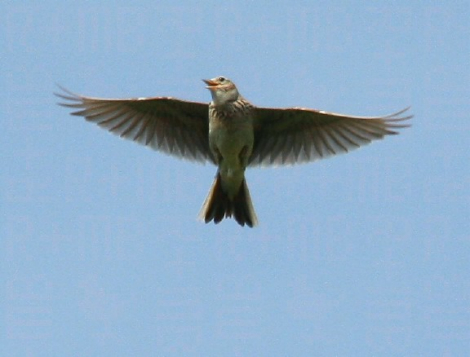
Unlike most perching birds, the male sings in flight, and what a flight: he starts up suddenly from the ground, goes up high in the sky––50 to 100 meters––and hovers there for a few minutes, then plummets down to land on the ground. And all this time he is singing: while he rises so high that he may be scarcely visible, while he stays aloft, while he plunges to the earth again. “…drowned in yonder living blue/The lark becomes a sightless song “ (Tennyson, In Memoriam).

Experiencing the Skylark’s song

So, what moves the heart so much, when the skylark sings?

SkylarkDawnBretonPainting.jpg

Jules Breton, Le chant de l’alouette (“Song of the Skylark”), 1884</

I think we can sum it up this way: early, sudden, humble, ascendant, prolonged.

Early

If you get up very early in Britain from April to August, and out into an area of grassland, farmlands, or marsh, this is likely the most prominent bird you will hear, starting even before the sun rises. (They sing throughout the day, but it’s most striking in the hush of dawn.)

The bird sings not from a perch but while flying, so the song emerges from the sky above, as the night flees and the first glow of dawn appears. It becomes associated with all the possibilities of a new day, the freshness of dawn, the light banishing darkness.

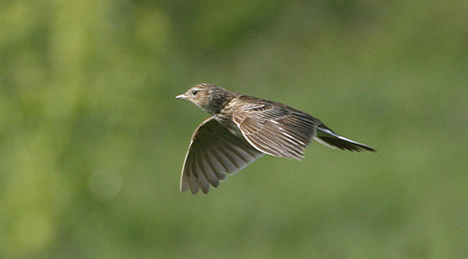
skylarkInFlight3.jpg

(Photo)

“I rose early. I went into my garden before breakfast and stood listening, but towards the common there was nothing stirring but a lark.”
H.G. Wells, War of the Worlds

“Though there was nothing very airy about Miss Murdstone, she was a perfect Lark in point of getting up. She was up (and, as I believe to this hour, looking for that man) before anybody in the house was stirring.”
Charles Dickens, David Copperfield

To hear the lark begin his flight,
And singing startle the dull Night,
From his watch-tower in the skies,
Till the dappled dawn doth rise.
John Milton, L’Allegro, l. 41

[Spring] When … merry larks are ploughmen’s clocks…
Shakespeare, Love’s Labour’s Lost V, ii.

The association of the lark with dawn is so strong, poets even credit him with summoning the sun:

The busy day,
Waked by the lark, hath roused the ribald crows.
Shakespeare,Troilus and Cressida, IV, ii

The skylark is early in another way too, beginning to sing in the first part of summer (it’s considered to provide “the quintessential sound of an early British summer”), so it represents the end of…no, not the end of wintry weather––that makes reappearances even in summer––but the prospect of some warmer sunny days. Don’t take this lightly; drizzle, rain, fog and chill are so dominant that the climate was once described by a tongue-in-cheek booster, “writing on one of those raw, damp, sodden English winter days”, as “the best in the world because it is just depressing enough and, though beastly, not too beastly” thereby contributing to a hearty vigor. (Mary Borden, “In Defense of the English Climate”, Harper’s Magazine June 1930)

Being associated with the idea of summer is more powerful than we post-industrial urban humans can easily comprehend. The arrival of spring and summer meant not just longer days and better weather, but the beginning of another growing season, an end to the monotonous diet and shortages of winter, the return of birds and flowers, birthing season for livestock, easier travel between farms and villages.

Sudden

Only the lark leaps out of ruts like a live dart, and rises, swallowed by the heavens. Then the sky feels as though the Earth itself has risen.
Gabriela Mistral, The Lark

And now the herald lark
Left his ground-nest, high tow’ring to descry
The morn’s approach, and greet her with his song.
John Milton, Paradise Regained, bk. II, l. 279

Humble yet ascendant

This is a small brown bird, which nests on the ground and seeks invisibility there.

skylark Nest2.jpg

Photo, Pensthorpe Nature Center.
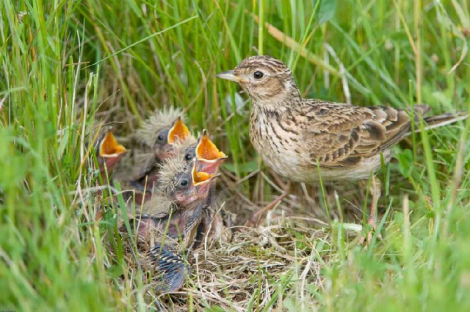
(Drawing of a skylark constructing the hollow and lining it with grass). There’s a terrific commercial photo of a startled skylark rising from the nest as several well-grown chicks call in protest.

Its nest, eggs, and chicks are vulnerable to trampling and to all sorts of predators including rats (infra-red photo below; if you have trouble making out the parent bird, on the left, look for the bright white dot of the eye).

skylarkDefendingNestFromRat.jpg

Yet it abandons its reclusive habits, to deliver a long song while ascending and hovering in the sky. It’s unclear how much time the male spends at the nest, but he does fly up almost vertically from his unseen location on the ground when beginning his song display.

skylarkInFlightBlurry.jpg

Higher still and higher
From the earth thou springest,
Like a cloud of fire…
Shelley, To a Skylark

Perhaps John Burroughs, whose critical judgment of the skylark’s song was quoted earlier (“…positively disagreeable, it is so loud…”), would have liked it better had he been hearing it while the bird was far overhead, instead of nearby in a cage.

Several poets have drawn particular attention to the skylark’s two worlds, sky and earth. It soars, sings, then drops to a point unseen on the ground where mate and nest have remained. Wordsworth says “Type [model] of the wise, who soar, but never roam—/True to the kindred points of Heaven and Home.”

With regard to ascendant flight, The Royal Society for the Protection of Birds says on a page for children that “Quite often, a skylark will fly over to the other side of the field before launching itself upwards into the sky. This is to trick you into thinking that it is nesting somewhere else, to keep its nest site a secret.” Since singing isn’t mentioned, maybe this is the (non-singing) female reacting to someone getting too close. The sudden rise of the singing male is nearly always a feature of his literary appearances.

Prolonged

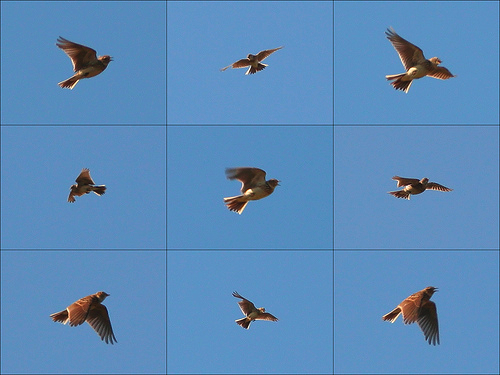
The song generally lasts 2 to 3 minutes, quite long by birdsong standards, and is often even longer later in the season. What a great effort is put forth by this bird (which weighs only 30-45 g), singing continuously while he is zooming up into the air, holding steady aloft, and plummeting down!

SkylarkInFLightMontage.jpg

Photo montage by Mark Kilner, (under creative commons license).

Putting all this together, imagine standing in a field near dawn,

SkylarkDawn3.jpg

listening to birdsong pouring down from the sky for two minutes or four, a very long time, as the singer rises, hovers, swoops above you, often visible only as a speck in the blue. Finally he plummets to the ground and is lost to view. (Photo, dawn in the Lake District)

The human listener is drawn upwards, inspired, filled with joy.

Aside from inspiring humans, what might be the function of the Skylark’s song?

Male birds sing mostly to proclaim their territory. For Alauda arvensis, with its long and varied song, there is a refinement to this:

”Dialect features are used for N–S recognition in a territorial species with a large repertoire”––or in other words,

Uttering the song serves to mark a male’s territory; listening to nearby songs lets him know exactly who’s where. It has been shown that neighboring skylarks have similarities in their songs, “common sequences of syllables “, which aren’t found in the songs of males from outside the area. When a resident male hears a song lacking the shared phrases, he reacts more strongly to defend his turf (and mate) because he knows the singer is a stranger and more of a threat than one of his familiar neighbors who already have established territories. It makes me wonder, when a stranger succeeds in settling in, how long does it take him to acquire the local dialect? Or is that a rare event, with vacant territories being claimed by the offspring of local pairs?

In an interesting turn of phrase, this phenomenon is called “the ‘dear-enemy effect’ … a reduced aggression from territorial animals towards familiar individuals, generally neighbours, with whom relationships have already been established”, presumably in order to conserve energy.

Singing as a conspicuous show of vigor

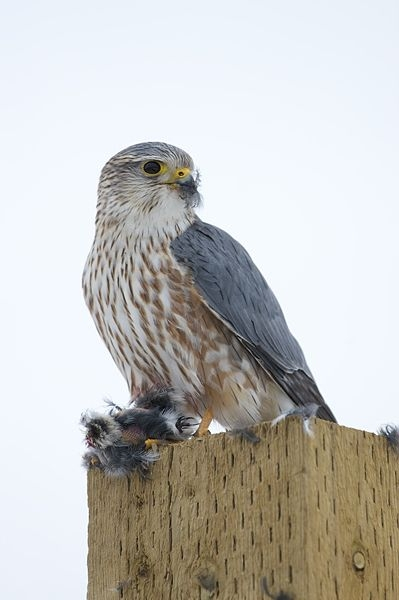
The long effortful singing serves as a proof of fitness: to potential mates before the breeding season, and at all times to potential predators such as merlins––small falcons that specialize in hunting songbirds. (Merlin, Falco columbarius, Photo)

SkylarkMerlinOnPost.jpg

The male lark continues to sing even as he is being chased by aerial hunters like kestrels and merlins. A study of anti-predation behaviors found that “[m]erlins chased non- or poorly singing skylarks for longer periods compared to skylarks that sang well. A merlin was more likely to catch a non-singing than a poorly singing than a full-singing skylark.” [the repetition of ‘than’ is in the original, perhaps indicating a descending likelihood of being caught]

Conservation status of the Skylark

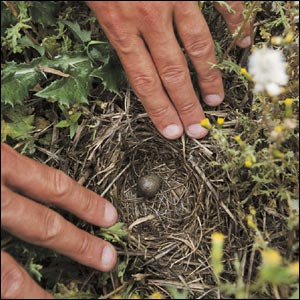
The skylark population in Britain and Western Europe has dropped precipitously over the past 30 years; I found estimates for Britain ranging from 50% lost, to 70% lost. In some areas they are gone completely. The decline is most likely caused by the move to from spring to winter sowing of cereals such as barley and wheat, which deters late-season nesting attempts––second and third clutches––and may reduce winter survival because there are fewer fields of stubble. For nesting and foraging, the birds prefer areas with low cover; ideal vegetation height is 20-50 cm. I would think that the use of pesticides is probably a factor also since the young are fed on insects. Use of previously fallow ground for biofuels further reduces their nesting areas.

SkylarkNestEggs.jpg

(Photo BBC)

Since this problem was recognized, farmers have been encouraged to leave unsown “skylark plots” in the midst of their fields and so far results are “encouraging”, in that the rate of decline is not so sharp. [More on skylark conservation in Britain here; Royal Society for the Protection of Birds report, The State of the UK’s Birds 2008 here.]

skylarkSet-asidePlotEngland.jpg

Skylark set-aside plot.

SkylarkPlotsAerialView.jpg

Aerial view of skylark plots.

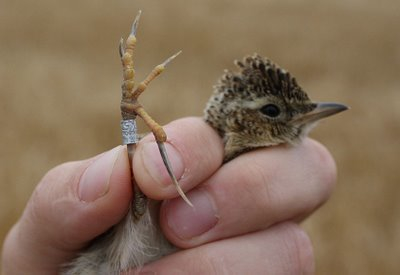
skylarkBeingBanded.jpg

Recently fledged juvenile skylark after banding.

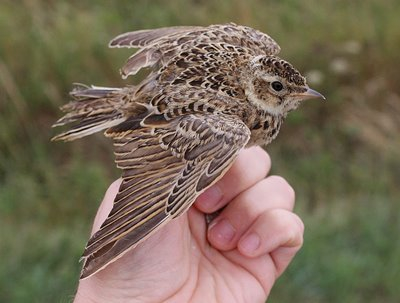
SkylarkInHand.jpg

Banded skylark about to be released. These birds were caught by startling them up into pre-set mist nets. Both photos from Mark Thomas, Bucktonbirder.

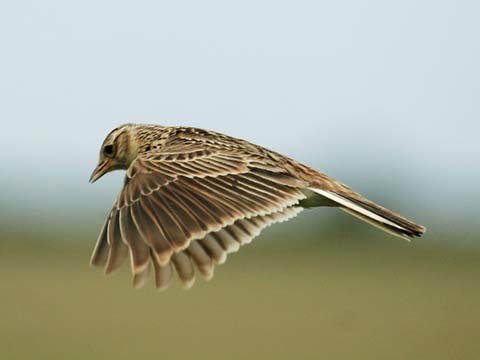
skylarkInFlight2.jpg

Skylark, Blackbush Fen, 6th July 2007, © Peter Beesley; Cambridgeshire Bird Club.

SkylarkInFlight4.jpg

Skylark, Dorset, photo © Charlie Moores.

I can’t leave the subject of the skylark without mentioning Ralph Vaughan Williams’s lyrical work for violin and orchestra, The Lark Ascending. It is said to have been inspired by George Meredith’s long poem of the same name, but surely the ground had been prepared by Williams’s own experience of the skylark’s song and flight in his native England. If you look on iTunes you can find one offering of the entire 14 minute piece, for $0.99; the rest require you to buy an album. Or hear it on Youtube; many choices are there, including these: London Symphony Orchestra , 5 minute excerpt; or entire, in two audio installments, Orchestre de Chambre I Musici de Montréal, part 1, part 2.
Home Ground: Words of our native land

Home Ground: Language for an American Landscape, edited by Barry Lopez. Trinity University Press, San Antonio Texas, 2006.

One of the language byways I find fascinating is that of terms for landforms; they’re often based on metaphors (oxbow bend in a river, neck of land), some have ancient linguistic roots, others reflect the cultural history of an area with words from the language of indigenous people or early explorers. Those who share my interest will love this book, but it also has appeal for those who enjoy American regional writing or history, or are interested in how the landforms we see come into being.

Home Ground’s entries are in alphabetical order but it’s far richer than a dictionary. Entries are signed by their authors, who are mostly American writers with particular regional roots––novelists, poets, nature writers, scientists. From them we hear not just the definition and history of the term but also more diverse notes: political (the drowning of Celilo Falls in the Columbia River, by a dam, comes up in the entry for dalles), ecological, personal, and literary (quotations from hundreds of writers including Thoreau, Jack London, T.S. Eliot, Joel Chandler Harris, Pablo Neruda, Louis L’Amour, Joyce Carol Oates).

There are no fewer than three indexes: one for authors so quoted, one for terms (with cross-references), and one for specific place names mentioned: the San Andreas Fault, Satans Slab, South Dakota. And there are short biographies of the writers who produced the entries. With all this, you can browse the book or look for something specific like every mention of the Mississippi River, all the terms relating to ice, or mentions of Herman Melville.

If you have ever wondered what the difference is between a hill and a mountain, or among the words canyon/cleft/coulee/gorge/gully/ravine, you can find out right here. Terms run the gamut of languages––ronde, tseghiizi (Navajo), névé, krummholz, cuesta, gumbo (probably from a Central Bantu dialect), nunatuk, eddy (possbily Norse), erg (Arabic) and so on (although etymology is not always included). And they vary from the words of Western science (imbricated rock) to those of other observers (coyote well, paternoster lake).

And now, a few sample entries:

tule land

Tule land is a term recorded as early as 1856, just after gold rush. It usually refers to the flats of bulrushes and other reeds along the rivers of the West Coast. In the muddy shallows along the Sacramento, for example, as the river takes its time joining the San Joaquin and approaching the San Pablo and San Francisco Bays, there are vast thickets of reeds, home to waterfowl and fur-bearing animals. Tule lands are especially common at the junctures of rivers, where the slightest breeze will set the rushes whispering and rasping over the mud and standing water. The Wintu Indians called tule land “the storehouse of instant tools” because the rushes could be used to make so many things: mats, clothes, baskets, lodges, boats, and cradles, sandals, brooms, fish traps, and talismanic images. ROBERT MORGAN

nivation hollow

In A Walk in the Woods: Rediscovering America on the Appalachian Trail,
Bill Bryson wrote: “I never met a hiker with a good word to say about
the trail in Pennsylvania. It is, as someone told a National Geographic reporter in 1987, the place ‘where boots go to die.’…Mile upon mile of ragged, oddly angled slabs of stone strewn about in wobbly piles…These require constant attentiveness if you are not to twist an ankle or sprawl on your face––not a pleasant experience with fifty pounds of momentum on your back.” Such a hiker on the Appalachian Trail in Pennsylvania might just as well have been complaining about nivation hollows. A bowl-shaped depression in the ground, a nivation hollow begins to take shape when ice forms over a shallow rock basin beneath a snow bank. The ice freezes and thaws over time. During the warm period, melted snow seeps into the bottom of the hollow. During the cooler period, the seep water freezes. The rock breaks up, weathers, and erodes. Meltwater carries away the finer rock particles and the hollow becomes larger and deeper. MARY SWANDER

fil du courant

A Cajun French term meaning “thread of the current,” fil du courant is used to describe the optimal navigation course within a bayou or river. The fil is often visible as a glassy-smooth pathway through the otherwise ripping water. Louisiana shrimpers follow the fil du courant to avoid underwater obstructions and to secure sufficient depth for skim nets that extend winglike from either side of the vessel. MIKE TIDWELL

fall line

Fall line is a phrase both metaphoric and literal. In broader terms, it means the zone where the Piedmont foothills level out into the coastal plain, where sandy soil derived from marine deposits replaces rocky rolling land. On some southeastern rivers, such as in the Carolinas and Virginia, the Fall Line is a specific place where shoals and rapids once stopped navigation from the coast because ships couldn’t pass through. Cities such as Richmond, Fayetteville, and Columbia sprang up at the head of navigation, and mills and factories were built to take advantage of the water power at the falls and rapids. The abrupt change of elevation caused industry and commerce, courts and seats of government, to take root in those areas. ROBERT MORGAN

Line drawings, by Molly O’Halloran, illustrate some of the terms, such as this one for “Quaking Bog” which shows how peat, sphagnum, geologic forms, plants and water all combine to form this floating vegetative structure that will seem solid until stepped on. [The scan is much reduced, and for some reason tinted beige, unlike the original.]

quaking bog2.jpg

Low tide at the Oregon Coast

OregonTidepool1.jpg

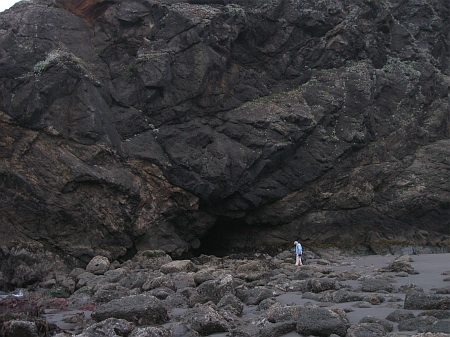
There was an unusually low tide last week, minus 2 to 2.5 feet, and we went over June 22nd to go tidepooling. Our destination was Gold Beach, on the rocky southern coast of Oregon, and our tidepooling was at Myers Rocks about 7 miles south of Gold Beach. We hoped to see nudibranchs, commonly called sea slugs––a canard, since many are so elegant and beautiful. [See Oregon nudibranch photos by others: 1, 2, 3, 4, several species, video.] But those are mostly found further north. We did see lots of sea stars, anemones, and smaller creatures, as well as a dead sea lion that had been washed up.

AnemoneGiantGreen.jpg

I posted a set of about 50 photos to a gallery on mobileme.com but was frustrated in being unable to add long enough captions, so I am using some of the photos, in smaller form, here with comments, our best efforts at identification, and a few photos found online. On mobileme I recommend using the “mosaic” viewing option from among those at the bottom of the screen; this will show thumbnails at the right, and you can click on any one to see it full-size, then either return to the mosaic view or continue in slideshow form.

Traces in the sand

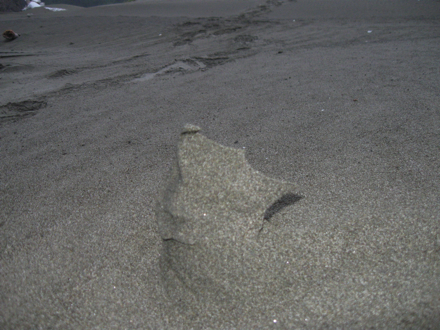
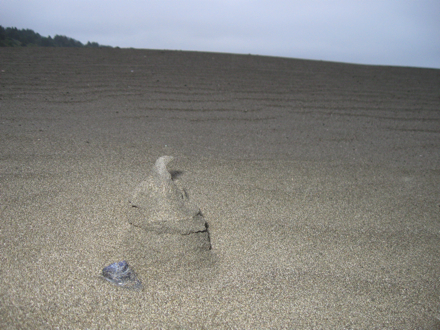
The receding tide left most stretches of sand flat and smooth as can be; other places, where the water swirled out past rocks, had wonderful ripple patterns. And then there was this odd thing sticking up like a soft-serve “ice cream” serving.

UFO sand castle1.jpg

UFO sand castle2.jpg

It was about about 10 inches tall, surrounded only by flat sand. Must have been an alien sand castle, and the builders left no tracks.

Other tracks were seen.

SandTrack.jpg

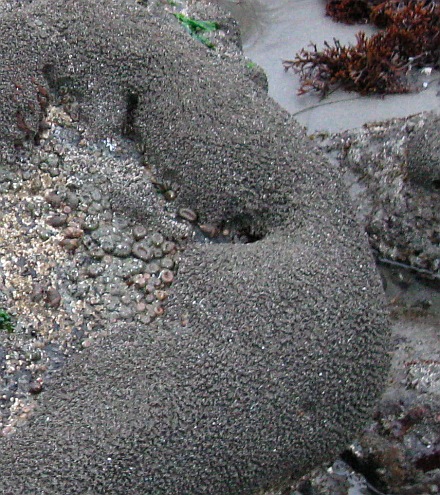
A few of the barnacle-covered rocks bore odd sandy structures, sometimes in a ring shape.

SandWithRoots1.jpg

Something held this together, but what?

SandWithRoots2.jpg

I did come across (but took no photos of) one that had crumbled a bit and when I examined a chunk it was still puzzling; mostly sand, with occasional fragile vertical rootlike things, connected to one another minimally if at all. Drawn away by things my naked eye could better appreciate, I didn’t examine this more closely but I hope someone may tell me more. There are some questions google can’t answer: googling “odd clumps of sand with rootlike things” doesn’t get much result. But of course a marine biologist, hearing that vague description, could immediately give me some likely candidates, and by asking a few more questions, probably identify it decisively. Score one for the human brain.

Sea Roaches, Barnacles, and Sea Stars

On another barnacled rock we found a scuttling little creature that made me think of a cockroach, and indeed turns out to be a Sea Roach or Rock Louse (perhaps the species Western Sea Roach, Ligia occidentalis). [Our identifications are the best we could do in a couple of hours at home, comparing our memories and photos with our field guides, including Ricketts & Hedgepeth, and also searching online, but they are open to revision. Leave a comment if you have suggestions or more information, please.]

RockLouse.jpg

There were Acorn Barnacles (a large group of species, barnacles without stalks)

AcornBarnacles2.jpg

and Gooseneck Barnacles, among Blue Mussels

GoossneckBarnacles.jpg

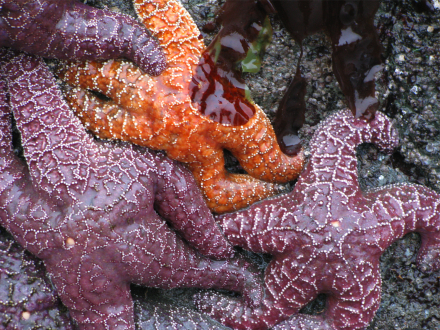
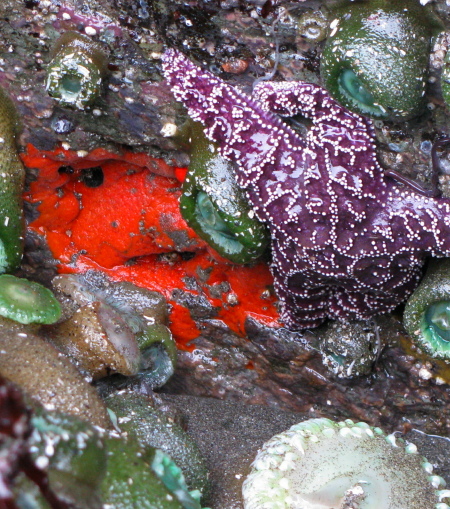
The most numerous creatures were Sea Stars, Pisaster ochraceus, generally known as the purple ochre star or ochre star (comes in brown, orange, and purple) and anemones, mostly Giant Green Anemones, Anthopleura xanthogrammica, which get their bright coloration from symbiotic, single-celled algae living within them.

SeaStars&anemones.jpg

Sea Stars get stiff and hard when the tide goes out, but their flexibility is evident from how they shape themselves to the rock.

OchreSeaStarsClustering.jpg

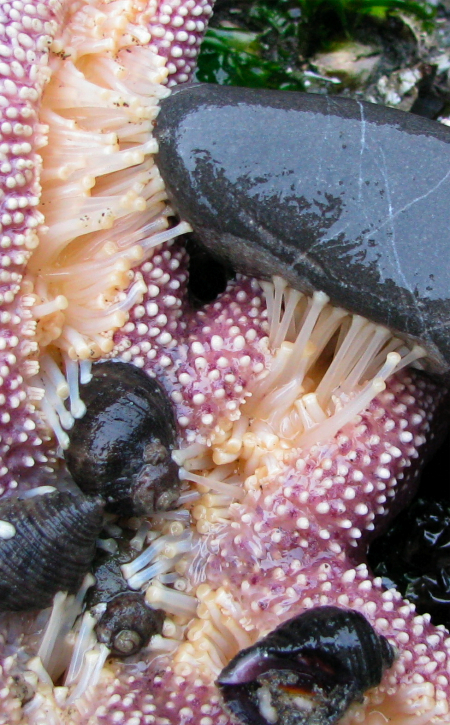
The mouth of the Sea Star is in the center, on the underside (oral side); it eats by everting its stomach through the mouth, enveloping and digesting its prey; it can pry open shellfish like clams with the hydraulically powered “suckers” or tube feet on its strong arms. The creatures inside the whelk shells being held next to the mouth, below, may be today’s lunch. Sea Stars themselves are a preferred food for sea otters.

OchreSeaStarUnderside.jpg

Closer view of the tube feet.

SeaStarCloseupTubeFeet.jpg

Below, a closeup of the top side of a Sea Star; this is the aboral side, “away from the mouth”. (Not a typo for “arboreal”!) The white things are the so-called spines though they are just little nubbins really. More about Sea Stars, 1, 2.

SeaStarCloseupTopside.jpg

Mollusks and others

Here’s a chiton, perhaps Katharina tunicata (Black leather chiton), about 1.5 inches long. Its familiars, whoever they may be, have nicknamed it “Black Katy”; knowing this, you too can be on casual terms with a mollusk!

Chiton.jpg

These are primitive creatures, protected by overlapping segments of shell that flex enough so that they can move over uneven rocks and even curl up into a ball. Most eat algae that they scrape off the rocks beneath them using a radula, a hard sawtoothed band also found in predatory marine snails and squid. The Pacific Northwest is home to the world’s largest chiton, the Gumboot Chiton, up to 13 inches long and red as a brick. Wikipedia tells us that chitons were eaten by Native Americans, prepared like abalone: beat the large “foot” part until it is somewhat tenderized.

The wormlike thing (above and to the left of the chiton) is unidentified; our research turned up lots of possibilities, including some types that run 90 feet in length and maybe twice that (thus perhaps being longer than a blue whale!), but no way to tell for sure.

Another more familiar mollusk is the whelk. When you find whelk shells not firmly attached to rocks, they usually are empty ones that have been taken over by hermit crabs, but we found this one that had come loose but still had its original inhabitant. The visible part is the foot that mollusks use to attach themselves.

Whelk.jpg

The bright red-orange creature below (we saw only one) is, we think, Ophlitaspongia pennata (Red encrusting sponge). Sometimes found with it is “a well-camouflaged little red nudibranch (Rostangea pulchra) on it or Rostangea’s red spiral eggcase”. But we didn’t see those.

Ophlitaspongia pennata (Red encrusting sponge).jpg

Plant life revealed by the low tide

Sea Grass,

seagrass.jpg

Kelp (actually not plants but algae, see below)

kelp1.jpg

an unidentified vining sand plant,

pinkSandFlower.jpg

and Sea Palms (Potelsia palmaeformis).

seaPalms.jpg

These Sea Palms, enlarged here, actually looked like silhouetted seabirds when I took the picture. Only when I enlarged it on the computer did I see what they really were. Wikipedia tells more: “Potelsia is a genus of kelp. There is only one species, P. palmaeformis. It is found along the western coast of North America, on rocky shores with constant waves. It is one of the few algae that can survive and remain erect out of the water; in fact it spends most of its life cycle exposed to the air. It is an annual, and edible, though harvesting of the alga is discouraged.” This made me look further, since if I ever knew that seaweeds were algae, I had forgotten. On algae, the Big W says “Algae, singular alga, (Latin for “seaweeds”), are a large and diverse group of simple, typically autotrophic organisms, ranging from unicellular to multicellular forms. The largest and most complex marine forms are called seaweeds. They are photosynthetic, like plants, and “simple” because they lack the many distinct organs found in land plants. For that reason they are currently excluded from being considered plants.” So, all that explains why these seaweedy things were up so high––the tide was low, but not so low that these seapalms would have been normally submerged, and I wondered about that. And now you know that if you want to call somebody really simple, you’d better liken him to an alga rather than a potato.

Birds and mammals

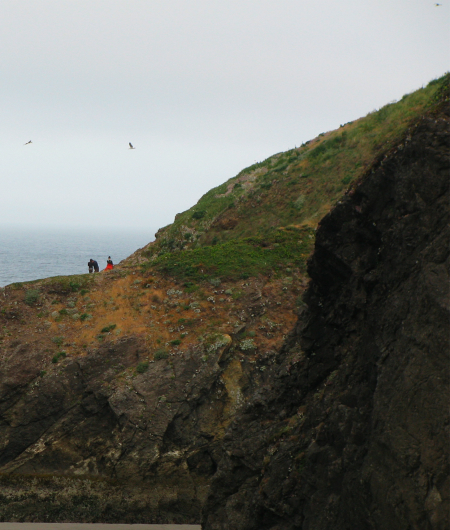
The bigger offshore rocks are nesting grounds for various sea birds, but none came near us. We were passed by a group of enthusiastic sea bird researchers in chest-high waders and rubber boots, off to climb one of the rocks and poke into nest burrows,

researchers.jpg

and later that afternoon we saw many Brown Pelicans, either on their way along the shoreline, or actually circling and diving for fish. Cormorants came for the fish too, riding the swells farther out than the diving pelicans, until they saw what they wanted. Also in the afternoon, as we walked and looked for agates (pretty rocks collected, many; agates, 3), we watched two seals close inshore, looked like a mother and youngster. All of these were beyond range of our cameras, but wonderful to see. It was sunny, hardly windy at all, and pleasurable to alternate between having warm bare feet above the surf line, and then chasing the churn of retreating sea-polished rocks and getting caught by knee-high icy waves.

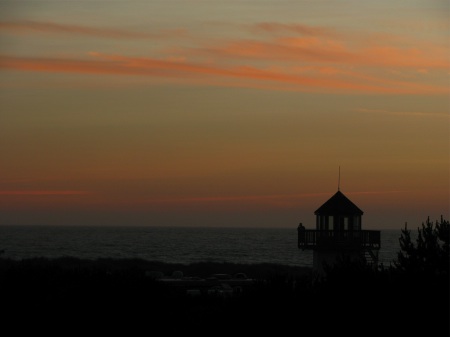
WARNING: Next are several scenic photos, then a section of pictures I took of the dead sea lion we found on the beach as we left. If you do not want to see these, stop at the picture of the sunset.

CynNearRocks.jpg

Gravity has its way with an anemone, when the water is not there to support it.

SeaStarAnemoneSagging.jpg

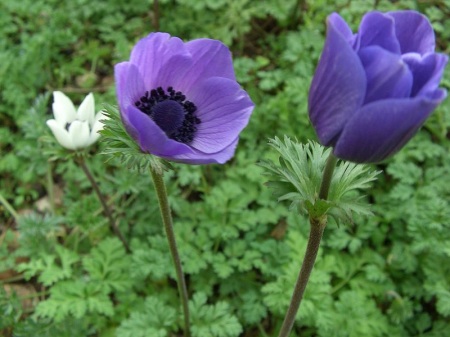
Another thing I learned while writing this, and as a logophile I found my ignorance embarrassing, is that there is no such word as anenome. I thought maybe anenomes were the flowers and anemones were the sea animals with toxic stingers, but anenome is as non-existent a word as George W.’s “nucular”. These,

800px-Anemone_coronaria_L_1.jpg

and these,

Anemone-Hakusanitige.jpg

are anemones too, land plants rather than marine animals: Anemone coronaria (top) and Anemone narcissiflora (bottom) Photos from Wikimedia Commons.

SunsetOcean.jpg

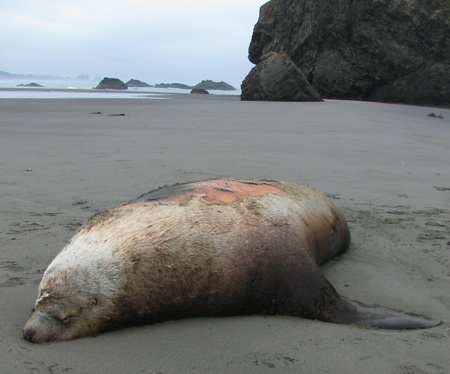
Steller Sea Lion, Eumetopias jubatus, dead on the beach

StellerSeaLionDead1.jpg

This sea lion bore several wounds that could have been the result of shotgun slugs––ocean fishermen resent the voracious consumption of salmon and other species by sea lions. In recent years, both this species and the California sea lion (Zalophus californianus) have gotten lots of bad ink and acrimony for their opportunistic predation on salmon when the fish bunch up at the dams on the Columbia River, on their way to reproduce and die. Of course the losses to sea lions are miniscule compared to the damage caused over the past century by overfishing, dams blocking rivers, and habitat destruction from logging (which damages fish breeding habitat in various ways including erosion that silts up rivers and streams).

We also thought these might be wounds made by sea gulls pecking their way in to eat what is, for a bird, a huge miraculous mountain of meat. But a fish and wildlife guy that we talked to later said the carcasses must be “pretty ripe” and rotten before a gull can pierce the thick skin. We wanted the f & w people to know, partly in case these were bullet wounds, and the man we talked to said they would send someone down with a metal detector. Both species of sea lion are protected by law.

This was a sad thing to see, especially if the death was caused by humans. If the animal had been alive we would of course have gotten it whatever help and protection we could. But it was too late for that, and what we were left with was an unusual opportunity for a close look. So what follows is not ghoulish or callous, though it may be unpleasant viewing for some.

The Steller Sea Lion is quite different in appearance from the California Sea Lion. The former has a blocky head and thick neck. The latter is sleeker, more gracile, with a slender muzzle, and is the model of what we think of when we hear the phrase “trained seal” although of course “true” seals––such as harbor seals––don’t have the ability to rotate their hind legs forward and “walk on all fours” that a “trained seal” demonstrates. True seals have to lunge and wriggle, on land; sea lions actually walk. Steller Sea Lion males may reach lengths of 11 feet and weigh 600-1100 kg (1300-2500 lbs). This specimen (sex unknown) was only about 6 feet long. The photo below shows the small external ear which is a distinguishing feature of the group of species known variously as eared seals, fur seals, or sea lions (Otariidae).

StellerSeaLionDeadEar.jpg

The closed eye, the lid of which appears swollen and damaged, is at left; the little comma-shaped ear is in the upper right.

StellerSeaLionDeadBack.jpg

Above, a view from the back shows one of the large holes. There were 5 holes visible. It seemed to us that none were close enough together to be wounds from the teeth of some big sea-lion-eating predator, such as an orca. Large areas of orange-ish skin are visible where the fur is gone, perhaps worn off by rubbing against the sandy bottom. The animal’s tiny tail can be seen between the two rear flippers. I took some close-ups of the claws visible on these flippers:

StellerSeaLionDeadClaw1.jpg

and here, on the other rear flipper, which was more damaged .

StellerSeaLionDeadClaw2.jpg

I found it hard to appreciate what they might have looked like in life, but was able to find a great photo online taken through the glass at the Sea Life Center in Seward, Alaska.

SeaLionFLipper.jpg

It was still hard for me to visualize the use of these claws, since they do not stick out past the end of the flippers, nowhere near. But here’s another great photo of an aquarium sea lion scratching, from flickr, and you can see how the flexible flipper can fold to allow the claws to stick out and scratch that itch. I cropped the photo to zoom in on the flipper. I think this is a California Sea Lion, based on the narrower snout.

SeaLionScratching.jpg

Finally, the front flipper of the Steller Sea Lion found dead near Myers Rocks.

StellerSeaLionDeadFrontFlipper.jpg

To end on a less somber note, there is a protected set of offshore rocks, called Rogue Reef Rocky Shore Area, about ten miles north of where we were: “More than 1,800 threatened Steller sea lions (45% of Oregon state total) use this reef, forming the largest pupping site for this species in the U.S., south of Alaska. Over 300 harbor seals are also found here. Approximately 4,000 common murres and more than 500 Brandt’s cormorants nest here” too.

In fact,

These rocks are part of the Oregon Islands National Wildlife Refuge which includes all of the state’s coastal rocks, reefs and islands (a total of 1,853) and two headland areas and spans 320 miles of the Oregon coast. All of the island acreage is designated National Wilderness, with the exception of 1-acre Tillamook Rock and Lighthouse, and public access is closed, to protect the birds and marine mammals.

Thirteen species of seabirds nest on this refuge [along the length of the state], including Common Murres, Tufted Puffins, Leach’s and Fork-tailed Storm-petrels, Rhinoceros Auklets, Brandt’s, Pelagic and Double-crested cormorants, and Pigeon guillemots. Harbor seals, California sea lions, Steller sea lions and Northern elephant seals use refuge lands for breeding and haulout areas. [Source]