Wildflowers of gold and royal purple, and a dance invitation

We’ve been busy lately helping to organize a benefit Country Dance (and dinner) for our local library, and wildflower walks have been displaced by trips to the restaurant supply store, gathering raffle prizes, and other tasks. But yesterday, when I parked to do my volunteer time at the friends of the library bookstore, there was a dramatic purple and gold display covering a berm of pushed-up soil and rock. These are the sort of flowers that are so common we disregard them, or even call them “weeds” when they appear where we don’t want them.

Poppies&Vetch.jpg

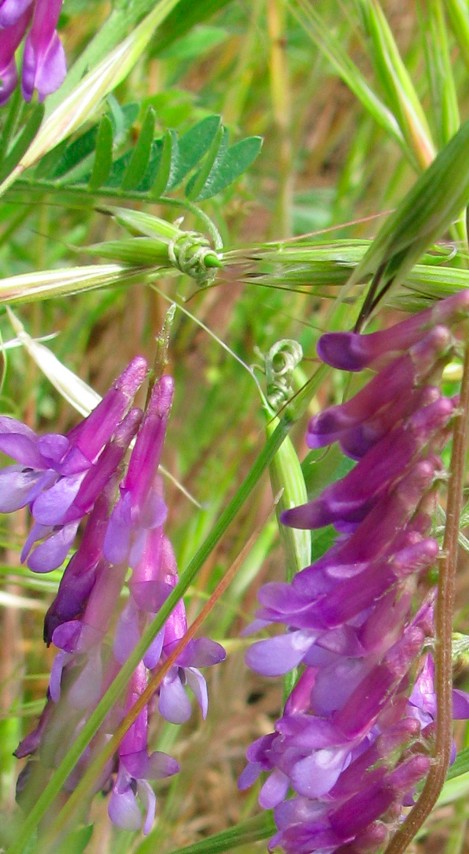
Everybody recognizes the California poppy (Eschscholzia californica). The deep purple flowers are a vetch introduced from Europe , probably Tufted Vetch (Vicia cracca), that is more than a weed—it’s an invasive non-native. It has long sprawling vines with tendrils that climb and bind, and likes disturbed ground. On the good side, it’s used as forage for cattle, provides nectar for bees and butterflies, and like other legumes it adds nitrogen to the soil. Below, its tendrils have looped around the seeds of a wild grass that I know only as foxtail, though it has single seeds (noted for working their way into the flesh of dogs) rather than the plumy seedheads that are rightfully called foxtail.

Poppies&Vetch3.jpg

Now that you’ve read this far, let me invite you to our benefit dance this Saturday evening, at the Upper Applegate Grange, 4 miles from Ruch, Oregon. We’ll have the Oregon Old Time Fiddlers (6 to 8 pm) and bluesmen David Pinsky & the Rhythm Kings (8 to 11 pm) making music for listening or dancing. There will be dinner, raffles, the Finest Hat Contest with a great prize, activities for kids, and it all helps our library. To be precise, we’re raising money to “buy” hours on Saturday, because the budget from the county doesn’t provide any hours on Saturday. Each year we have to raise $12,300. Come and bring your friends!

More details can be found here: go to the More Events page. Or if you live too far away to attend, you can make a contribution or a monthly pledge on the Pledge Form page. [Due to the way the site is hosted, I can’t post a separate url for these two pages; you need to go the main page and use the links there.]

Here’s a picture inside our rural library:

Lisa4.jpg

Cheetah or armadillo? Check your reaction speed

You may not like the results, but here’s a quick test of your eye-hand response speed. It’s a little game on the BBC’s site, part of their section on the human body. This part is about sleep, because being tired increases reaction time. Your job is to use a dart gun when sheep at one side of the screen

Sheep.png

make a run for the other side. The dart gun will stop them in their tracks.

sheep2.png

Don’t get an itchy trigger finger, though, because a false move costs you 3 seconds of time in which sheep can run across with impunity. At the end—5 sheep—you’ll get a rating, and a list of your exact times to the thousandth of a second.

These are the fastest sheep I ever saw, and my rating never rose above Ambling Armadillo. Use the link above rather than the one on the BBC’s main Sleep page, because that one goes to a small screen version which gives you even less time to nail those pesky sheep.

Too bad the BBC isn’t using this as an opportunity to collect data; if we all gave our age and sex, they’d have a big sample for correlating those factors with reaction time. How long the time is, depends on mental processing speed; it’s in your brain, not your muscles (although while darting sheep I found that my index finger clicked my laptop trackpad button faster than my thumb, which is usually what I click with in normal computing). Some of the brain-game sellers say their games improve reaction time, and that seems quite believable; athletes practice to increase their reaction speed, and pianists get faster with practice. I’d be interested in knowing how much of the improvement from computer brain games is transferable to non-game situations, though. And naturally the fastest reaction times occur when there is only one action to be chosen: you’re going to be faster using the dart gun against the sheep, than responding to a complex driving emergency where you must decide whether to swerve or brake, how much, and how fast.

Reaction times become longer with age (after the late 20’s, according to this literature review on reaction times), fatigue, distraction, and a variety of other factors. And, when times are measured in thousandths of a second, a single individual will exhibit quite a bit of variation even in a single testing session. The literature review cited was done in 2008 and seems to be a good summary of what’s known.

Looking for more about reaction times, I found another online test which doesn’t have any cute sheep but does track and display the data from all users. It’s not broken down by age or sex, though. The site’s owner says that, based on 2,656,058 clicks recorded thus far, the average (median) reaction time is 215 milliseconds. But some people can regularly post times of 130ms. This test not only rejects clicks that jump the gun (before the signal is given), it only counts data of 100ms and above, in order to avoid skewing the data with “lucky clicks”, when someone’s brain issues an order to click before seeing the signal but then the signal occurs just before their finger performs the movement.

Let us marvel for a moment at the process, which involves multiple neurons structured like this.

Neuron.jpg

Diagram from Wikipedia, where a larger version can be seen.

Communication within a single neuron is electrical, but that between neurons is chemical, so neuron A has to make and release a chemical to pass a message on to other neurons.

Axon.jpg

A signal propagating down an axon to the cell body and dendrites of the next cell. (Wikipedia)

And this is just the transmission part of reaction time. The processes involved in choosing an action…well, my neurons are boggled enough for one day.

Siskiyou iris and Striped coralroot, a good wildflower walk!

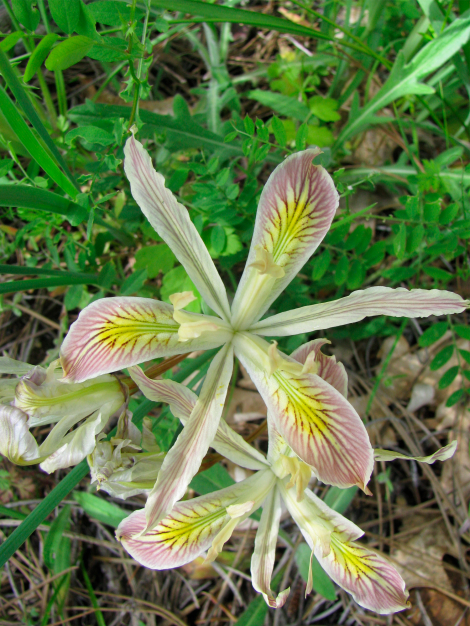
Change happens fast in the spring. We walked Saturday along a road we’d been on a week ago, and most of the flowers we saw had not been in bloom seven days earlier. The most abundant flowers were Siskiyou irisIris bracteata.

IrisSiskiyouCR.jpg

They vary in color from white to light yellow, and sometimes the reddish-brown veins are so numerous that they seem to tint the petals.
IrisSiskiyouBrownish2.jpg

Delphiniums were few and tattered, but some were much deeper in color than we’ve seen before. This is Menzies’ larkspur, Delphinium menziesii, we think.

DelphiniumDarkOld.jpg

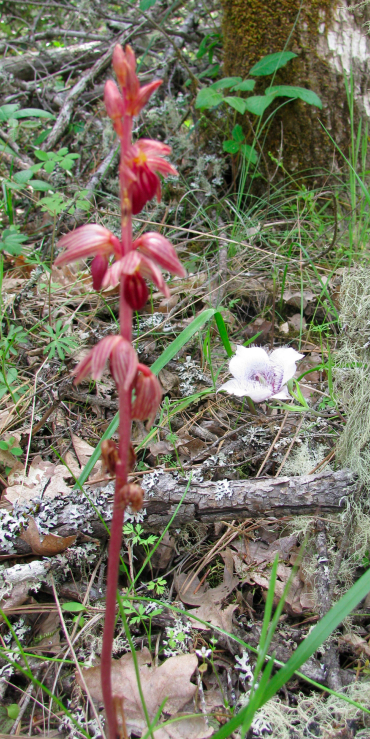
A rare sighting was of this Striped coralroot, Corallorrhiza/Corallorhiza striata, in the orchid family. We looked hard for others but saw only the one. It is a plant, but it is incapable of photosynthesis, and has no chlorophyll.
StripedCorealroot.jpg

When I was taking biology these sorts of plants were called saprophytes and it was believed that they got their grits by digesting organic material, as some fungi can do. This outdated theory is still found online. Now it is known (until further notice) that no plant can digest organic material through its roots (1), and the former saprophytes have been found to be parasitic either upon other plants, or upon fungi. Corallorrhiza striata dines upon nutrients produced by fungi, plugging into their mycelium, the underground structures of branching threadlike hyphae—the “body” of the fungus that produces the aboveground mushrooms we see.

(1) Wikipedia says “It is now known that no plant is physiologically capable of direct breakdown of organic matter”; I added “through its roots” above, because there are carnivorous plants that do digest insects they catch, either through secreting digestive enzymes or through some other means. How this fits in to current theory about plants digesting organic material, I don’t know.

StripedCorelrootCloseup.jpg

Plants like the coralroot are called myco-heterotrophs (2); the fungi they parasitize are the hosts. As far as we know, this is a parasitic relationship, with no benefits to the fungi. Many orchids are such parasites, others are only partially dependent on parasitism (producing the rest of their nutrients by photosynthesis), and some are “ordinary” photosynthesizing plants. Some myco-heterotrophs parasitize only specific fungi; for instance, Corallorhiza maculata sips only from Russula mushrooms, or I should say from their mycelium. Quite likely many species of myco-heterotroph have specialized in this way, we just don’t know the associations yet. For those interested in growing such orchids the parasitism presents a huge difficulty, since the ordinary requirements of a green plant—sun, water, nutrients in soil—will not sustain life in these non-photosynthesizing plants. Yet another reason, if more were needed, to avoid digging up or buying such plants (unless you are absolutely certain they were not taken from the wild).

(2) myco = fungus, heter = other, troph = nourishment

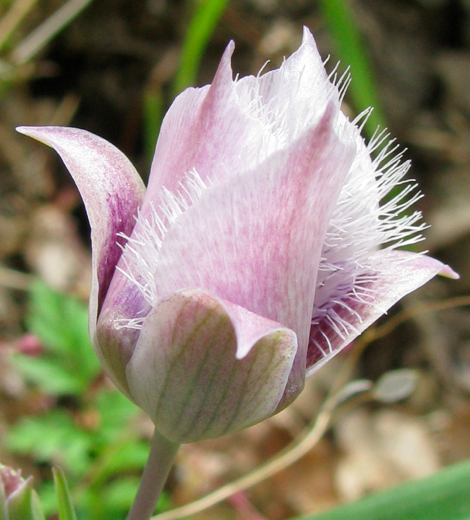
In the background of the coralroot (first photo) can be seen another flower that we saw dozens of today, with the engaging common name Elegant cat’s-ear (Calochortus elegans).

Elegant cat's ear1.jpg

It repays closer examination.

Elegant cat's ear2.jpg

The pointed tips of the petals, or perhaps the fuzziness, give rise to the common name. This is the type species of the genus, discovered in 1806 by Meriweather Lewis on the Lewis and Clark expedition near what is today Kamiah, Idaho. Many are known by the common name of Mariposa lily; see one here.

The Calochortus genus contains a relatively large number of rare, localized, and endemic taxa, so don’t disturb any you find: they may be part of a very small population. One such is found only along the Umpqua River in SW Oregon. They seem to be more sensitive to soil type than to other aspects of habitat, with some preferring serpentine soils, which characteristically have high concentrations of toxic heavy metals. Although heavy metals like nickel, lead, and zinc are toxic to most plants, some can withstand them, perhaps taking them up to protect against pathogens and pests. Still, it’s an interesting puzzle why certain species would preferentially grow where toxic metals are found in abundance.
Elegant cat'sEar5.jpg

Look into the center of this unassuming little flower:

Elegant cat's ear3.jpg

How wonderful the digital camera is, enabling us to take home such magnified images of small beauties, so we can look our fill at them.

Bugloss fiddleneck, Amsinckia lycopsoides.jpg

Above is a more assertive plant: native to much of western North America from California to British Columbia, it has spread as far as New England, thriving in the disturbed soils of many habitats. It’s a roadside hitchhiker, an “invasive non-native” as far away as Australia, and toxic to livestock; for its sins it carries the dismal name of Bugloss fiddleneck, Amsinckia lycopsoides. (3)

(3) Bugloss, from Ancient Greek βούγλωσσον (bouglōssos, name of a plant: Anchusa italica), βούς (bous, “ox”) + γλωσσον (glosson, “tongue”)

Hooker's Indian Pink, Saline hookeri MOREPINK.jpg

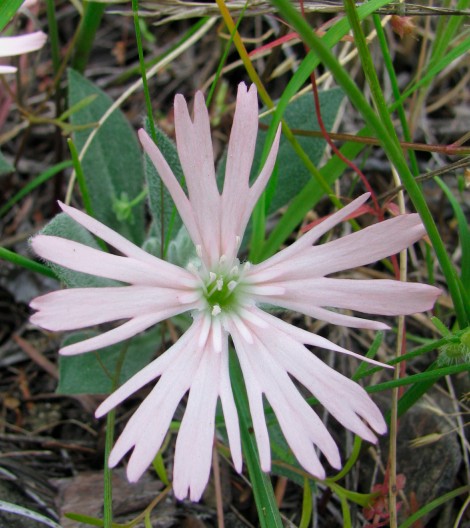
Hooker’s Indian Pink, Saline hookeri, varies from nearly white to dark pink; the California species, Indian pink (Silene californica) is much darker, nearly a chinese red.
Hooker's Indian Pink, Saline hookeri - 2.jpg

Look at the symmetry in those petals.

The Hooker after whom it is named is the immensely influential British botanist William Jackson Hooker (1785-1865), first director of the Royal Botanic Gardens at Kew. His son Joseph Dalton Hooker, who grew up attending his father’s lectures, also became a renowned botanist and was the second director of Kew. He classified the plants that Darwin collected on the Beagle, and the two scientists became close friends. Many New World plants are named after one or the other of the Hookers, though only the son visited our hemisphere.

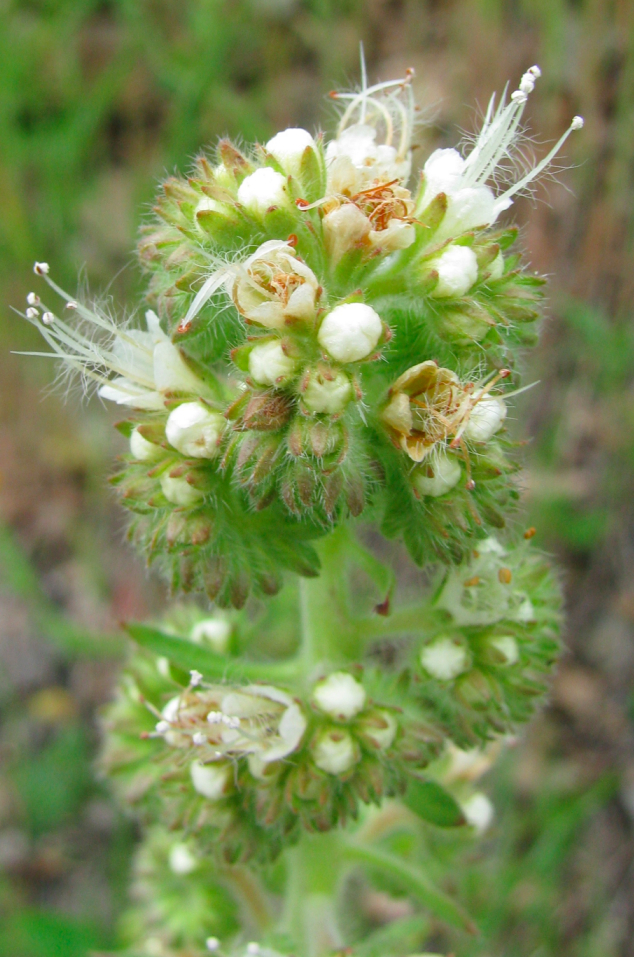
This post grows long, but we saw so many great flowers! Just one more: Phacelia heterophylla, or Variable-Leaf Scorpion-Weed, is as the botanists say an an erect, unbranched herb (herb, meaning neither a grass nor a woody plant).
Phacelia heterophylla .jpg

Naturally I was curious why the plant was called “scorpionweed”. Online explanations refer to “the way the stem curls like a scorpion’s tail”, as in the picture below of another species that’s found in Arizona.

PhaceliaBlue.jpg

photo from www.micktravels.com.

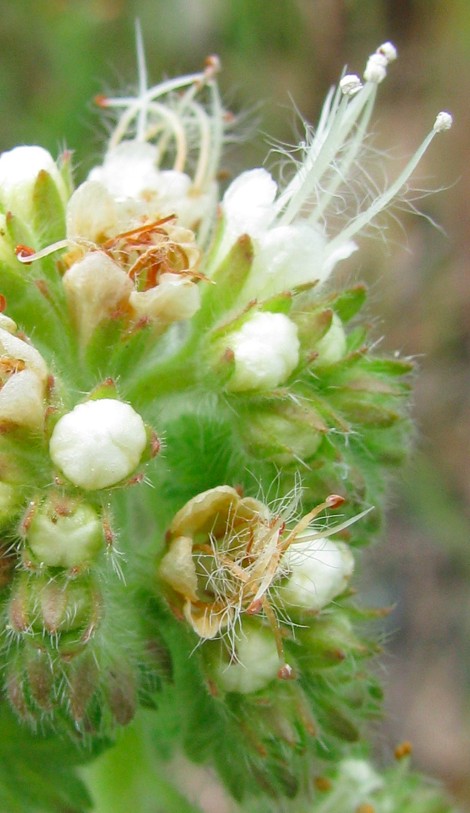
That species has blooms only along one side of the stem, while the one we saw has blooms surrounding the stem in a way that would make such a curling habit unlikely. Maybe the dramatic name has just spread to various members of the Phacelia genus whether it applies or not. Or, another possibility is that “scorpion” might refer to the ability of some members of the family to cause a skin rash, like poison oak or ivy, in some people. All those tiny hairs do look itchy!
PhaceliaCR.jpg

No unusual wildlife sightings on this walk, not like the day we saw four osprey (one was doing an odd behavior, I do have to write about that soon). One caterpillar, unidentified:

Caterpillar.jpg

and our hiking buddy Jack, here near a giant tree marked with what we hope is the sign for “Seed tree, do not cut”.


Jack&Tree.jpg

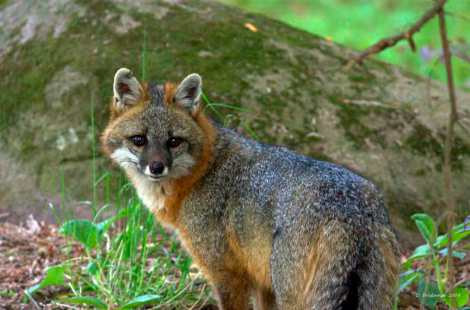
Fox vs. dog, no contest

We were walking down a gravel road when, perhaps a hundred yards ahead of us, a grey fox crossed the road at a dead run, from a brushy area on the left of the road to a wooded area on the right side. The wooded area wasn’t very big; at its edge a long open grassy stretch began and continued to where we stood, and beyond.

Our mastiff Jack was off down the road instantly, turning into the woods where the fox had gone. Like us, he thought the fox would prefer the cover of the forest, or perhaps keep going away from the road, through the wooded area and up the steep brushy slope at the back.

Not so: while Jack remained in the woods sniffing around, here came the fox out of the trees and down the long open strip paralleling the road. He was completely exposed, and heading right toward us. Maybe he’d zigged and zagged a bit after entering the woods, to give Jack some scent to follow, but very soon he’d made a hard right to leave the confined area for a place where he could gain a lot of yardage on his pursuer.

By the time Jack followed his nose and reached the grassy area, the fox was long gone past us and out of sight; our exhilarated dog ran after him quite a ways before giving up. Then he came back to the woods to snuff up that interesting smell some more. I can imagine his satisfaction: finally, he had a visual sighting to go with one of the mysterious smells he’s found on our walks. And the fox, well, he proved his legendary cleverness once again.

GreyFox2.jpg

Photo by dbriz