Views of a lion skull

Recently I had the opportunity to photograph a lion’s skull. Since there seem to be few detailed photos of this subject online, I’m posting several here.
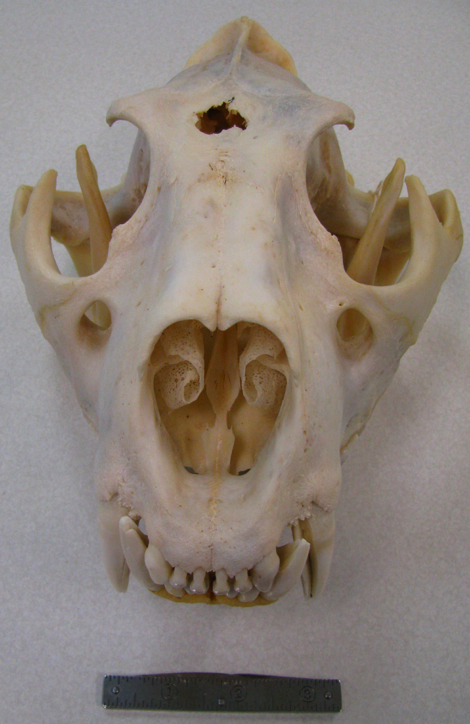
LionSkull3.jpg

The ruler at the bottom is 3.5 inches (89mm) long. I don’t know the age or sex of this animal, only that it was an African lion. The ragged hole on top of the skull is a bullet hole; more about that later.

The large openings flanking the nasal cavity, and beneath the huge eye-sockets, puzzled me. Turns out they are the passageways into the eye area for the infraorbital nerve, artery, and vein (technically, each of these two openings is termed the “infraorbital foramen”). The infraorbital foramen is indicated by the arrow in the anatomical illustration below, from the University of Wisconsin’s digital collection of Veterinary Anatomical lllustrations.

In searching out what these openings were, I came across the information that Asiatic lions often have divided infraorbital foramina, with a bony bridge across the opening. Most African lions have the single open foramen seen in the skull I photographed. It is believed that the modern lion originated in Africa, and some researchers think that a severe population bottleneck at some point in the recent past of Asiatic lions may have allowed this variation to become common.

LionSkullAnatomicvalIllustration.jpg

[]Thanks to Bibliodyssey for the post on these great illustrations.

LionSkullTeeth.jpg

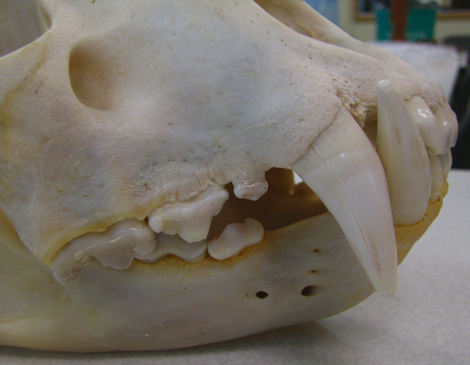
The longitudinal grooves or clefts in the upper canines seem odd, though I found similar ones on another skull pictured online. Most of the lion skull images online were casts, replicas, and lack these grooves.

LionSkullSideView.jpg

On the side of the lower mandible, insertion openings for nerves or blood vessels are clearly visible.
LionSkullSideView2.jpg

Turbinate bones and the air we breathe

Few skulls or replicas online show something I was especially interested in, the delicate turbinate bones within the nasal cavity. These are thin bony structures, with a rich blood supply, found in all modern warm-blooded animals. Here they show a complex scrolled shape that is marvelous to see.

LionSkullTurbinateBones1.jpg

The turbinates are also seen in the first photo; the close-up above is taken from a lower vantage point, looking farther into the nasal cavity.

What is the function of these unusual structures? The tissue covering the turbinate bones warms, cleans, and humidifies air as it is inhaled; the air exhaled from the lungs, which has picked up even more heat and moisture there, is cooled to reclaim moisture and prevent dehydration. The turbinate system also benefits the sense of smell. Humidifying the incoming air is necessary to “preserve the delicate olfactory epithelium needed to keep the olfactory receptors healthy and alert” (Wikipedia); the turbinates also increase the surface area of the inside of the nose and direct air upward toward the olfactory receptors. And, in humans at least, the tissues are what get swollen and obstruct our breathing, when we have allergic reactions.

The dinosaur connexion

The turbinates interested me because I remember reading speculation, in Digging Dinosaurs by palaeontologist Jack Horner, that dinosaurs were endothermic, warm-blooded––and he based this partly on indications that some skulls showed signs of turbinate bones (I don’t recall what exactly he described). However, that book was published in 1988, and it appears that subsequent researchers have failed to substantiate his suggestion. The delicate turbinate bones rarely survive as part of fossilized skulls; for example, none have been found in fossils of ancient birds’ skulls, even though the birds must have been warm-blooded. Some dinosaurs have thin tubular nasal spaces, as do present-day reptiles, and it is argued that those with narrow nasal cavities couldn’t have had turbinate bones. The question is not settled, but the current consensus seems to be that dinosaurs were not warm-blooded. For point-by-point summaries of the controversy, these seem good: The Evidence for Ectothermy in Dinosaurs (cold-blooded) and The Evidence for Endothermy in Dinosaurs (warm-blooded). Wikipedia considers some additional points in Physiology of dinosaurs.

Cause of death of this lion

The lion skull had been lent for a display in our local library, by the US Fish and Wildlife Service Forensics Laboratory in Ashland Oregon. It’s the only lab in the world devoted to crimes against wildlife, and I’ll say more about it in another post. The skull had been evidence in a despicable case: an individual bought up lions (they breed easily in captivity) from roadside zoos, put them in small enclosures and sold the right to shoot them. My grim theory is that the “hunters” were required not to shoot at the head, so that more shots could be taken at the living lion, before the highest-paying customer delivered the coup de grace in a shot to the top of the head. First, that would yield the most money for the scumbag, and second, it would have been very difficult to make this shot to the top of the head of a lion still standing.

At least the person running this was tried, and convicted with the assistance of the Wildlife Lab. Highly unlikely that he received a sentence I’d regard as sufficient, though.
LionRembrandt2.jpg

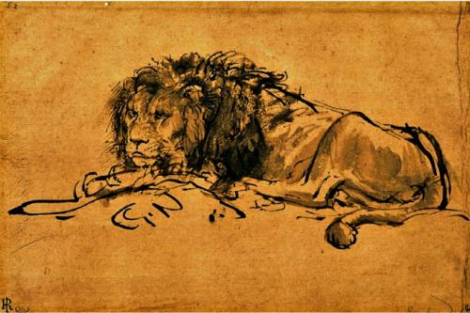
A Cape Lion (Panthera leo melanochaitus, now extinct) in a drawing of the Dutch artist Rembrandt Harmenszoon van Rijn. Circa 1650-52. Location: Louvre, Paris. Source, Wikimedia Commons.
Paper wasps and their nest

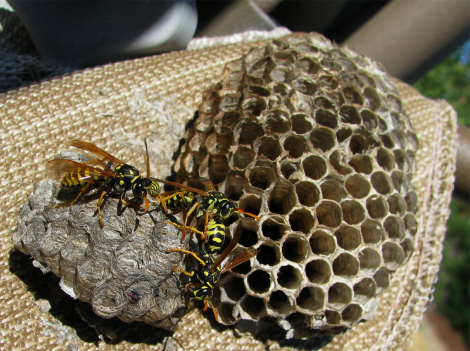
I found a group of paper wasps working on a nest, on top of our porch swing.

PaperWaspsWideview.jpg

Behind the active nest is another larger one, apparently abandoned––or maybe the young have already emerged from it.

PaperWaspsVert.jpg

A few days later both nests had been knocked down by some creature that probably ate the wasps and any eggs or pupae; nothing left but one dead wasp.

In North America there are 22 species of paper wasps, genus Polistes, according to Wikipedia. [More about paper wasps, including their life cycle: 1, 2, and Bugguide has photos of about 18 different species from N. America.] They are quite common around our place, and generally ignore us if we do the same. I’ve gotten stung twice this summer though: once when removing a nest made in the recess of the car door hinges; and once when I was replacing a hummingbird feeder without noticing the wasp clinging to the bottom––I touched it and was stung. (Paper wasps feed on nectar, so the hummingbird food attracts them; they also prey on caterpillars and other “garden pests” so they’re generally considered “beneficial insects” in our narrow human way of thinking.) I caused both of these incidents, so I have no gripe against the wasps, just a resolve to be more careful. As you can see, these wasps let me get quite close with the camera.

PaperWaspEye.jpg

Don’t expect such tolerance from some other insects that look very similar. Hornets and yellowjackets are irascible and can sting more than once. Stings from any, including the paper wasps, can cause severe reactions (anaphylactic shock) in allergic individuals.

A few wasp-related byways

More good pictures of paper wasps, taken by a backyard naturalist in Michigan, are here. The common wasp builds quite large nests, also of paper, but they are spherical and the cells are not visible as they are in paper wasp nests.

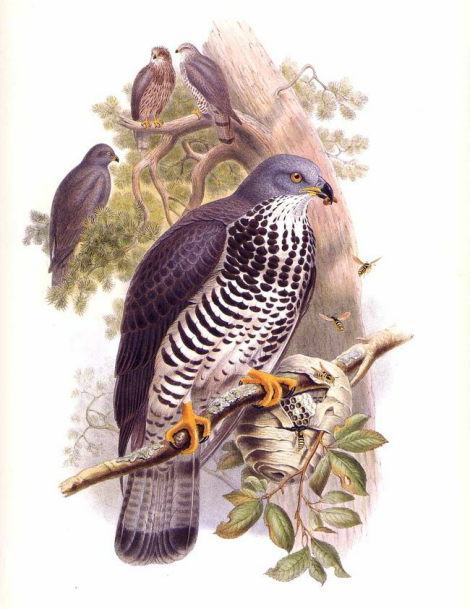
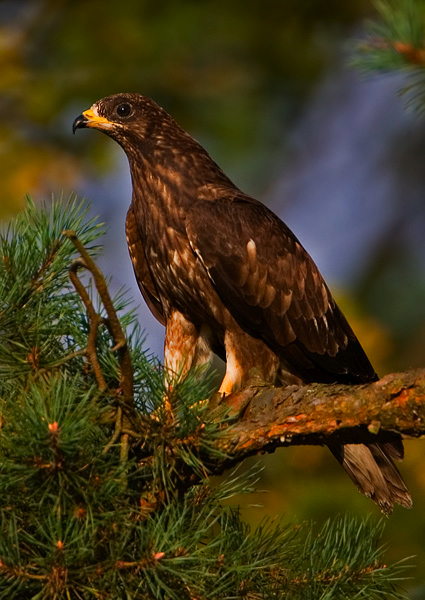
And here’s something I enjoyed discovering: a bird, Pernis apivorus, which may have wasp repellent. It’s called “Honey Buzzard”, but it is not a buzzard and feeds more on wasps (adults and pupae) than on bees. It’s believed to have some chemical on its feathers that dissuade wasps from stinging!

PaperWaspsHoneyBuzzard.jpg

[Painting by John Gould, English ornithologist and artist]

This beauty winters in Africa and summers in Europe and Asia, so we won’t be seeing it around our house. It has a very unusual display in flight: “The most striking version of their soaring displays involves a characteristic wing quivering which looks as if the bird is clapping its wings together above its head.”

PaperWaspsHoneyBuzzard2.jpg

[Photo of a wasp-eating Honey Buzzard in Sweden, by Omar Brännström]

Bees in the garden, and strange habits of gophers

Mint is fine as a culinary herb, but plant it in the ground and it’s like having a tapeworm: you’ll never get rid of it and it just gets bigger. I keep pulling and slashing away at the mint planted by a previous resident, to no avail. The tiniest piece of root or stem will grow a new plant if it finds a little water. Stems flop to the ground and root, new plants pop up from seed or wandering underground invasive roots. And somehow it even hangs on, once established, here in the long hot dry summer.

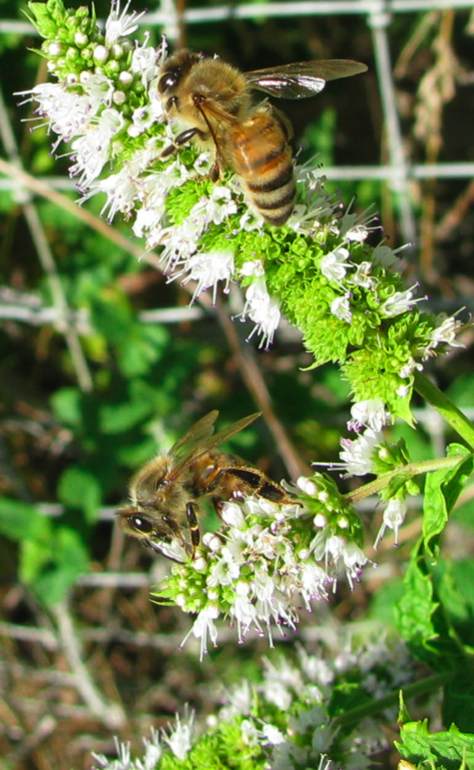
And here it is, in bloom! I was irked until I saw how much “our” honeybees were enjoying the flowers. (I’ve posted before about the small hive of honeybees in a cavity in a dead oak tree on our place.)

BeesOnMint1CR.jpg

The wire fence in the background encircles our vegetable garden; the mint just loves it in there, where there’s regular watering. If only the gophers would use the mint as a garnish for the vegetable plants they devour: every single sweet pepper plant (7 plants!) was sucked down into the ground by the gophers this year. It happens overnight as if the plants walked away, but dig and you will find remans. And the gophers tunnel around the roots of other plants which they don’t seem to eat, but the plants die anyway.

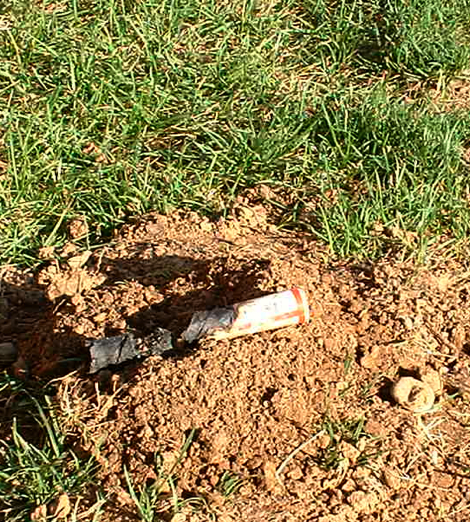
For ten years I waged war against the gophers until the futility of it sank in. I tried everything: a trap––lots of work to dig in the stony dry ground looking for a straight open run of tunnel, and the trap never caught one anyway; gassing them with exhaust via a pipe from the car to a tunnel opening (yes, there is a specialized flexible pipe sold just for this purpose, I’m not the only anti-gopher fanatic out here)––results apparently nil, though how can you tell?; curses and exhortations; and dozens and dozens of sulfurous poison gas bombs, like big firecrackers that you light and stick into a tunnel you’ve excavated, then cover it up so the smoke goes through the tunnel system. Or that is the theory. Within a few uses the gophers were changing their tunnels: adding right angles and frequent backfilled partitions. Even stranger, they often dug back to the site of a “Gopher Gasser”, then up to the surface, and left me a message:

BeesGopherEjecta.jpg

That’s the carefully ejected remnant of the “Gopher Gasser” placed right on top of the new pile of dirt! If you look closely you can imagine the little thought balloon above it…

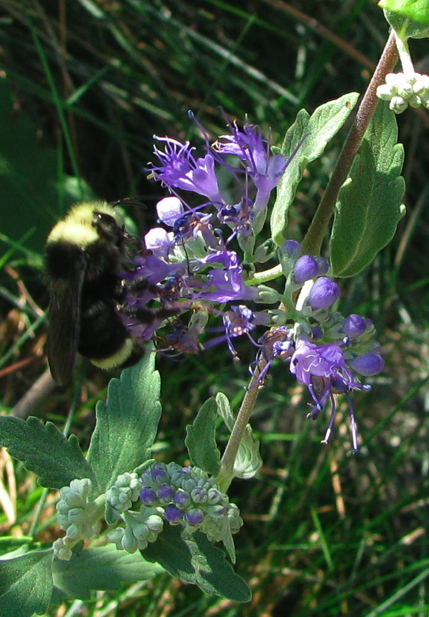
After seeing the bees busy in the mint I checked out their activity elsewhere. This is one of the big “bumblebees” or so we call them, on a Caryopteris plant (a hybrid cross between C. incana and C. mongholica ‘Bunge’, with cultivars such as “Bluebeard” or “Blue Mist Spiraea”).

BeesOnPurpleCR.jpg

There were honeybees on this plant too, but more of the big guys.

BeesCaryopteris2.jpg

One was clinging upside down, sheltering under a leaf because the sprinkler had been on this plant earlier.

BeesShelterBeneath.jpg

I like to watch the industrious behavior of the bees; if only I could feel that way about the gophers. Well, maybe a mint julep would help…

Visit to a California Eucalyptus grove

Growing up in Northern California, I always had a special fondness for the eucalyptus; various species have been planted there, mostly as windbreaks. They grow fast, are evergreen, and haqve fragrant leaves and varicolored bark that peels away in great strips.

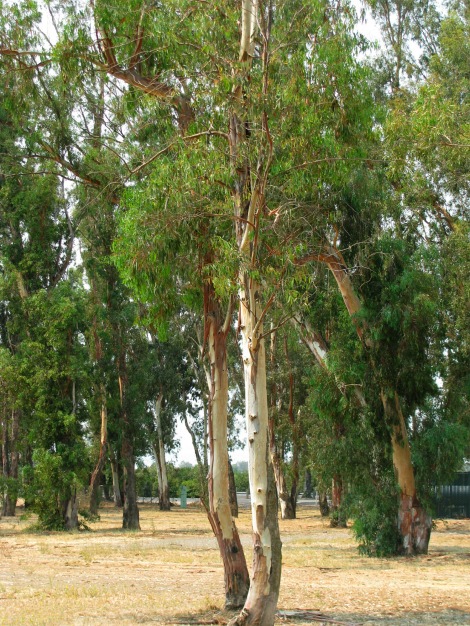
So last week as we headed home from Sacramento, up I-5 to Southern Oregon, I wanted to stop and get close to some eucalyptus again. We left it a little late, and settled for a planting at a rest stop, on the northern edge of where eucalyptus flourish. These were not as densely planted as many groves, but then you can appreciate the individual trees more.

EucalyptusGrove.jpg
EucalyptusMulti-trunk2.jpg

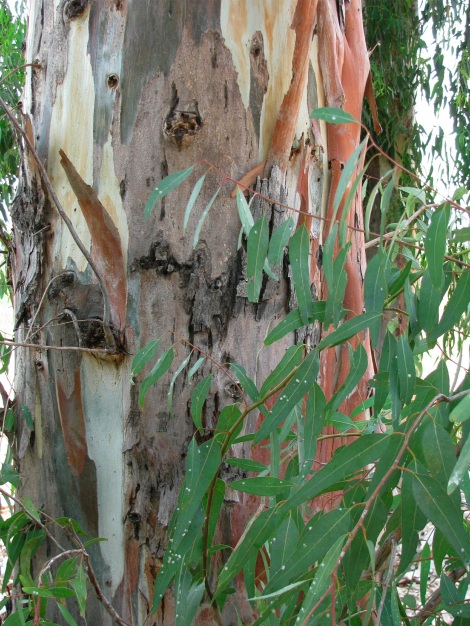
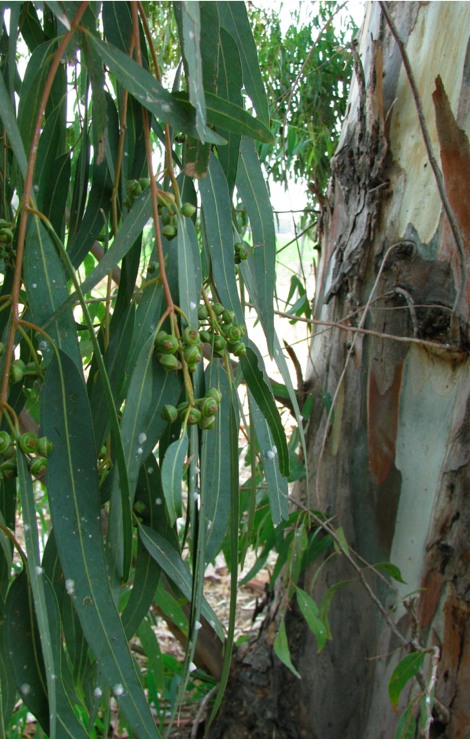
These trees were afflicted with scale, which you can see as small white spots on the narrow leaves.

EucalyptusBark&Scale.jpg

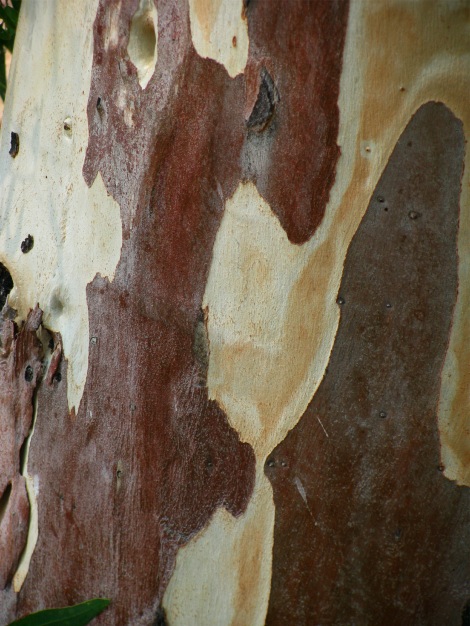
Bark patterns are always fascinating; like the madrones of Southern Oregon, eucalyptus trees present masterpieces of natural form wherever you look.

EucalyptusBarkLongTrunk.jpg

Wildlife

You can’t expect to see much in 20 minutes, during the hottest part of the day, among trees next to a freeway rest stop, but we found a bit.

In the picture below, a woodpecker’s work can be seen at the top.

EucalyptusBarkWoodpecker.jpg

We found traces of some sort of beetles under peeling areas of thick bark, and these are probably what the bird was hunting.

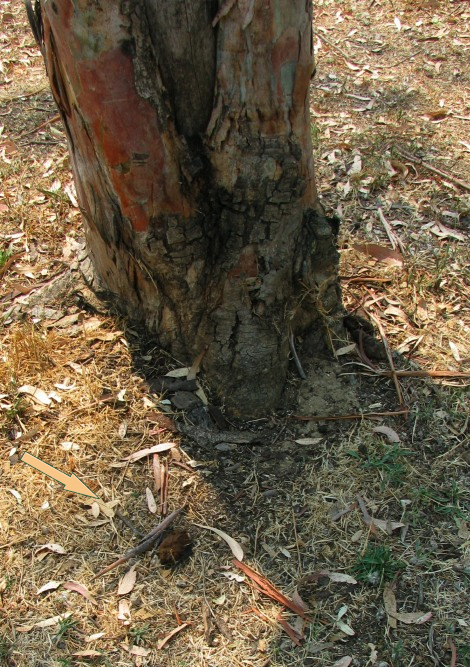
At night, other insect hunters emerge; at mid-day they were sleeping high in the trees invisible to us, but one who had died lay beneath a roost tree. (Traces of droppings, along twenty feet of the tree’s trunk, indicated the presence of multiple individuals.)

EucalyptusBat+TreeCR+ARROWY.jpg

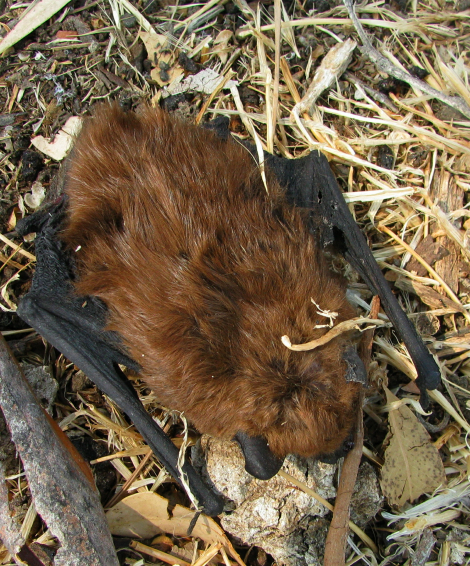
We did not examine him or her, and I’m not sure what the species may be.

EucalyptusBatCR.jpg

A good guess would be the little brown bat, Myotis lucifugus: it’s very common, it is the right size and color, and has small dark ears as this one does. Or maybe California Myotis (or “California Bat”), Myotis californicus. I am really just guessing––one source says there are 24 species of bats in the state of California. The small ears and lack of a “leaf-nose” structure do rule out a few candidates.

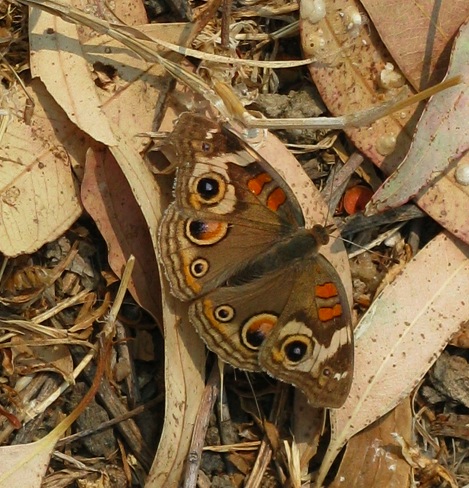
The butterfly we saw and photographed we do have an identification for, though: the Common Buckeye, Junonia coenia:

EucalyptusButterfly.jpg

I didn’t recognize it, and located a useful list of California butterflies with links to photos and information on each species. Then it turned out that Dan knew what it was all along, but it was fun to look through butterfly photos and have the Eureka! of seeing it. Maybe I will remember it better that way. The Common Buckeye probably isn’t resident where we saw it; the Butterfly Site says it lives along the coasts as far north as Central California in the West and North Carolina in the East and that:

Adults from the south’s first brood migrate north in late spring and summer to temporarily colonize most of the United States and parts of southern Canada.

That’s a lot of traveling for this tiny seemingly fragile creature.

Eucalyptus seedpods

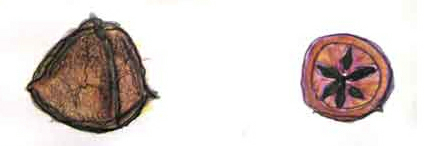
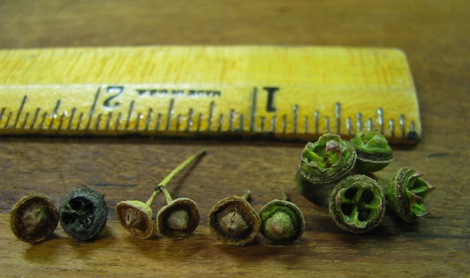
I wanted to collect some seeds to grow at home, and had in mind the seed pods that are up to an inch long and look like this (source of drawing), though the ones I wanted are silvery-grey in color.

eucalyptusSeedpodDrawing.jpg

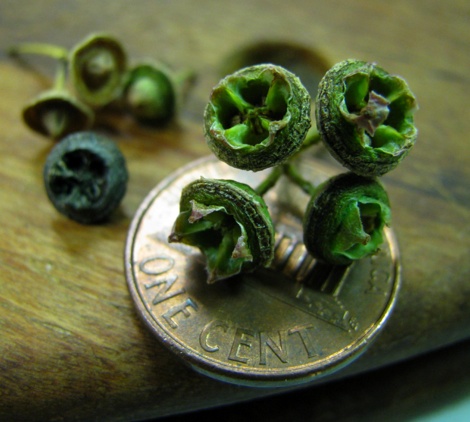
But the trees at the rest stop were a different species, with very different seed pods.

EucalyptusSeeds&Ruler.jpg
EucalyptusSeedsOnPenny.jpg

I’ll give them a try and maybe in ten years I’ll have my own eucalyptus grove.

EucalyptusSeedsScaleBark.jpg