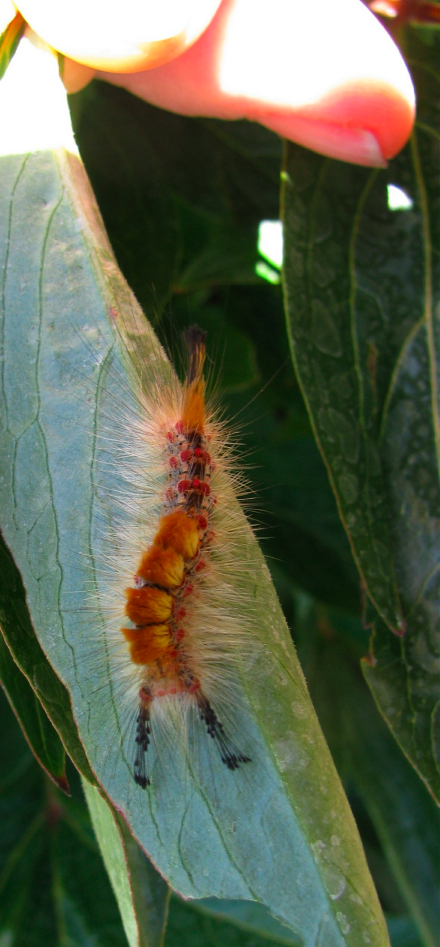
Neat (but voracious) caterpillar, Orgyia pseudotsugata

We found this caterpillar on a ground peony in our garden this morning.

Orgiya_pseudotsugata1.jpg

It is the larval form of the Douglas Fir Tussock Moth, Orgyia pseudotsugata. They are, like most caterpillars, voracious eaters and can have a devastating effect on Doug fir forests. Spraying, of pesticides or pheromones such as microbial insecticide Bacillus thuringiensis, and insect growth regulators, is often used against tussock moth infestations. Human activities, such as monoculture forest plantations, suppression of forest fires, and elimination of potential predators, have encouraged tussock moth proliferation.
Orgiya_pseudotsugata2.jpg

We were able to make a pretty firm identification of the caterpillar thanks to a terrific book, Lepidoptera of the Pacific Northwest: Caterpillars and Adults, by Jeffrey C. Miller and Paul Hammond. [Forest Health Enterprise. H.J. Andrews Publication Number 3739. December 2003. The authors work at Oregon State University in Corvallis.] Each page has a good photo of the caterpillar and adult forms of one species, with descriptions of appearance and ecology, such as what plants they are likely to be found on. Great book! Your tax dollars at work!

You can view or download the book as sections in pdf form. This moth is on page 175 of this pdf section. The book, an oversize paperback, is published by the USDA Forest Service, and was available several years ago (& still may be), free or very cheap, from
Richard C. Reardon rreardon@fs.fed.us
USDA Forest Service
180 Canfield St.
Morgantown WV 26505

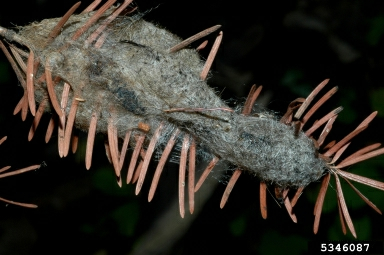
Here’s a photo of the cocoon form, woven around dead Doug fir needles. [Photo by William M. Ciesla, Forest Health Management International] Lots more information and photos of Orgyia pseudotsugata here and here.
Orgyia_pseudotsugata_cocoon.jpg

The Douglas Fir (Pseudotsuga menziesii) is an extremely common forest species in the West, a primary source of lumber, and is the state tree of Oregon. Notice the distinctive cone. [Image from Encarta.]
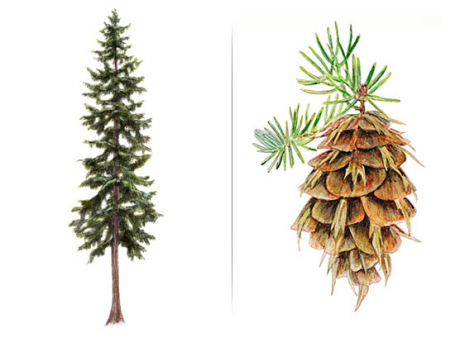
Pseudotsuga_menziesii.jpg

Small Oregon Port hosts giant cruise ships

Astoria, Oregon, is a port town of about 10,000 at the mouth of the mighty Columbia River. It’s rich in history, and calls itself “the oldest American settlement west of the Rockies”. Lewis and Clark wintered near here at a fort they built after reaching the Pacific in 1805; the town itself began as a fur-trading site for John Jacob Astor; it is the site of the Astoria Column, a 125-foot (38 m)-tall column with an observation deck at the top and a spiral frieze all the way up depicting events of Oregon history; fancy Victorian homes dot its hills, remnants of the fortunes that were made in lumber, shipping, and salmon fishing. But it’s a small port these days. Many big cargo ships bypass Astoria, going up the Columbia to off-load at Portland, and timber exports have declined. For years Astoria has been wooing cruise ship traffic, putting $10M into piers to accommodate the larger cruise ships. The Port has organized volunteer “cruise hosts” to lead tours and make visitors feel at home.

This year the preparations really paid off, as ships cancelling their planned stops at Mexican ports due to the H1N1 flu are looking for alternatives, and Astoria was ready. The scheduled 13 ships stopping in Astoria expanded to 21 for the season, and one of the biggest pulled in on May 12 for a few hours. Royal Caribbean’s Mariner of the Seas is 1,020 feet long and carries 2,700 passengers. The Port’s marketing director said that about 80% of cruise passengers generally disembark when the ships stop.

There were tours for all sorts of interests: history and bicycling at Fort Clatsop (the Lewis and Clark overwintering site which has been re-created in replica, with historic re-enactors); galleries, shops, and restaurants; the Columbia River Maritime Museum; Seaside and Cannon Beaches; “Shot in Astoria”, a tour of locations where movies have been recently filmed; a refurbished 1920’s vaudeville and movie theatre; the great view from the Astoria Column, high on its 600-foot hill, and more. And just walking around taking in the river, the ocean, the hills and the city, is worth a visit.

AstoriaColumnTop3.jpg

Top of the Astoria Column, photo by Terry Richard/The Oregonian.

And perhaps best of all was eleven-year old Tyler Delay selling messages in a bottle! Are they bottles for the visitors to toss in the ocean, having added their own notes inside, or mysterious ones that Tyler has scoured up himself in years of beachcombing? Guess we’ll have to go to Astoria to find out.

AstoriaMessageinABottle.jpg

Photo by Ross William Hamilton for The Oregonian, accompanying The Oregonian’s article (from which most of this information is derived). Sorry this photo isn’t as good as it should be; it wasn’t part of the online article and was scanned from the newspaper.

Spring beauty: Erythroniums (Trout Lilies)

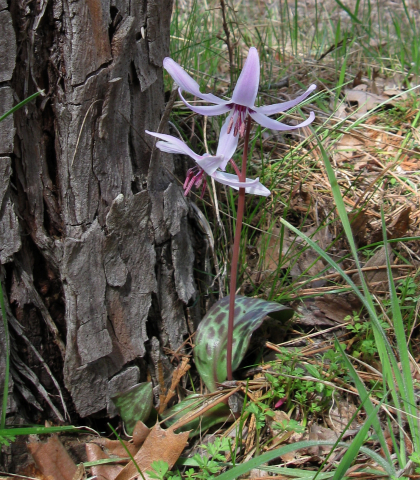
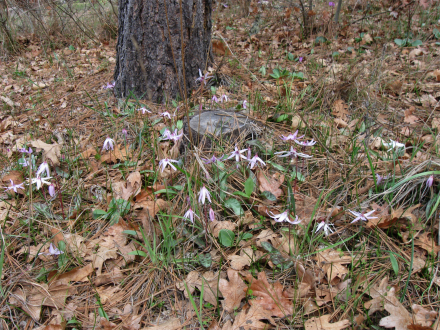
These elegant and delicate plants flower for a week or so, set seed (which are carried deep underground by ants, where some germinate) and vanish within weeks, spotted leaves and all, until next year. The leaves are beautiful in themselves, and give several Erythronium species their common names, Trout Lily and Fawn Lily. They may also be called dog’s-tooth violet and adder’s-tongue, for reasons unknown to me. Here we have Erythronium hendersonii, the only purplish species. Others are white, pink, or yellow. Species found in southern Oregon include E. hendersonii, E. oregonum, E. californicum, E. montanum (Avalanche Lily), E. citrinum (Citrus Fawn Lily or Cream Fawn Lily), E. howellii, and E. klamathense/klamathensis.

These pictures were taken April 3 and 4, 2009.

Erythronium CRborder.jpg
erythroniumByTree.jpg

Erythronium2.jpg

ErythroniumPatch.jpg

erythronium leaf2.jpg