Here’s a funny comics-version, from 2D goggles. Actually it is about mathematician Ada Byron Lovelace (1815 – 1852), but we all know that women never get top billing!
The comic was made for “Ada Lovelace Day”, to promote a film (to be offered to local stations by PBS) about this remarkable woman, and the film-makers need our help:
letters of support from people who have been influenced in some way by Ada and who are willing to help publicise the film, be a part of the interactive website, perhaps show the film, or contribute in any other way.
Rosemarie says, “I need letters from people stating how important a film like Ada is and how they through their networks can help to publicize the film. It would be great if the women have organizations they work or belong to. If they are software developers or computer experts, this would be great. It would be best if they were Americans, as the NSF (National Science Foundation) is American.”
If you’re not American, letters would still be useful of course! The deadline is the end of October.
Please write to:
Rosemarie Reed
On the Road Productions International, Inc.
310 Greenwich Street, 21F
New York, NY 10013
Or email Rosemarie directly, rreed40148@aol.com.
After some thought, I decided to write a letter based on my experiences giving books to kids at the food pantry, and the unabated gender gap I see in kids’ interest in science and math. Sure, the older kids are computer users, but computers are fun personal devices; they still display an aversion to math and science, especially the non-biological sciences. A few boys get drawn in by technology, but I don’t see it in girls. [I have a small sample size, I admit, and it is a rural area.]
Who was Ada Lovelace?
Ada Byron Lovelace was the daughter of Lord Byron (his only legitimate child); she married a nobleman, and was part of the social whirl of that class, dancing and entertaining. [Photo below from Wikipedia]
Wikipedia tells us that
During a nine-month period in 1842-43, Lovelace translated Italian mathematician Luigi Menabrea’s memoir on Babbage’s newest proposed machine, the Analytical Engine. With the article, she appended a set of notes. The notes are longer than the memoir itself and include (Section G), in complete detail, a method for calculating a sequence of Bernoulli numbers with the Engine, which would have run correctly had the Analytical Engine ever been built. Based on this work, Lovelace is now widely credited with being the first computer programmer and her method is recognised as the world’s first computer program.
However, biographers debate the extent of her original contributions. Dorothy Stein, author of Ada: A Life and a Legacy, contends that the programs were mostly written by Babbage himself. Babbage wrote the following on the subject, in his Passages from the Life of a Philosopher (1846):
I then suggested that she add some notes to Menabrea’s memoir, an idea which was immediately adopted. We discussed together the various illustrations that might be introduced: I suggested several but the selection was entirely her own. So also was the algebraic working out of the different problems, except, indeed, that relating to the numbers of Bernoulli, which I had offered to do to save Lady Lovelace the trouble. This she sent back to me for an amendment, having detected a grave mistake which I had made in the process.
The level of impact of Lovelace on Babbage’s engines is difficult to resolve due to Babbage’s tendency not to acknowledge (either orally or in writing) the influence of other people in his work. However, Lovelace was certainly one of the few people who fully understood Babbage’s ideas and created a program for the Analytical Engine, indeed there are numerous clues that she might also have suggested the usage of punched cards for Babbage’s second machine since her notes in Menabrea’s memoir suggest she deeply understood the Jaquard’s Loom as well as the Analytical Engine. Her prose also acknowledged some possibilities of the machine which Babbage never published, such as speculation that “the engine might compose elaborate and scientific pieces of music of any degree of complexity or extent”.
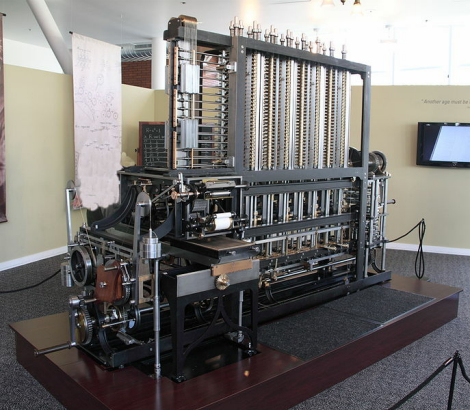
The Difference Engine becomes reality after 150 years
Babbage never built his mechanical computer, but the London Science Museum did make a working version. It was finished in 1991 for the 200th anniversary of Babbage’s birth.
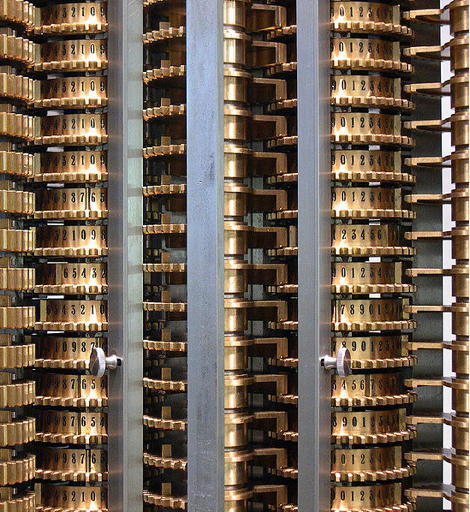
A view of “some of the number wheels and the sector gears between columns”
Difference Engine model photos source.
Ada Lovelace, “The Right Honourable the Countess of Lovelace”, gave birth to three children (the firstborn was named Byron), and died at 37 of uterine cancer and being bled by her doctors.
Let’s support that film, with letters or emails to demonstrate demand for stations to show it! Here’s the email again, rreed40148@aol.com.
More about girls being turned off to math and science
Feminist Chemists cites a 2008 study by the American Mathematical Society:
In elementary school, girls do as well as or better in math than boys. In middle school, girls with an inclination for math begin to lose interest and fall behind, mostly due to peer pressure and societal expectations. Throughout middle and high school, social stigma and lack of appropriately challenging educational opportunities for the mathematically precocious becomes a hard reality in most American schools. Consequently, gifted girls, even more so than boys, often camouflage their mathematical talent to fit in well with their peers.
A study published in June by the National Academy of Sciences found
“It’s not an innate difference in math ability between males and females,” says Janet Mertz, a UW-Madison professor of oncology and one of the authors of the article that analyzes and summarizes recent data on math performance at all levels in the United States and internationally. “There are countries where the gender disparity in math performance doesn’t exist at either the average or gifted level. These tend to be the same countries that have the greatest gender equality.”
Gender bias and expectations are not the only thing we have to worry about. It’s not just girls––boys are losing interest too, according to the AMS research:
”The U.S. culture that is discouraging girls is also discouraging boys,” says Janet Mertz, a University of Wisconsin-Madison professor of oncology and the senior author of the study. “The situation is becoming urgent. The data show that a majority of the top young mathematicians in this country were not born here.”
[NOTE: While Janet Mertz was one of the authors on each study, the PNAS and AMS studies are two different projects. The latter, published Oct. 10 in the Notices of the American Mathematical Society, was a comprehensive analysis of decades of data on students identified as having profound ability in math (Science News Oct. 13, 2008). The other study was published June 1, 2009 in the Proceedings of the National Academy. It looked at US and international data on students of all levels of ability, to answer three key questions: “Do gender differences in math performance exist in the general population? Do gender differences exist among the mathematically talented? Do females exist who possess profound mathematical talent? The answers, according to the Wisconsin researchers, are no, no and yes.” (Science News June 2, 2009).
You may remember the remarks of Lawrence Summers in 2005 (he was then President of Harvard, and is now an economic adviser to President Obama), to the effect that innate differences between men and women might be one reason fewer women succeed in science and math careers. These two studies would support the conclusion that if innate differences do influence women’s lack of success in these fields, the differences are not in mathematical ability. Maybe we should look at “innate differences” in aggressiveness and willingness to withstand unduly competitive or even hostile treatment from colleagues and superiors. Or at insecurity and discomfort, innate or not, which arise in male academics and administrators when females display ability, competence, and promise. A few decades ago women rarely appeared in symphony orchestras unless they played the harp; auditions behind screens changed that! Did our musical ability transform itself overnight? Probably not. ]
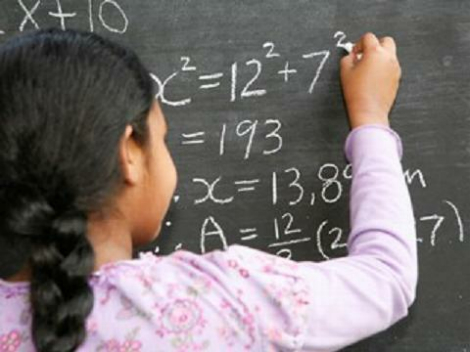
[Photo from another good article on the AMS study]
Send an email for Ada and our kids, and consider how you yourself might interact with kids about math and science. Take a trip to the Science Museum if you are fortunate enough to live near one, read a book together, in general don’t act as if math and science are boring geek fare. Even if a lot of it is beyond you, as higher math seems to be beyond me, that doesn’t have to be true for the kids you know. Since I was in college, math has become much more important in biological sciences, ecology, even social sciences like history, so if I were a history major today I would probably need to take at least an introductory statistics class.
We all need to model a respect and interest for learning, to the kids around us. Kids start out as voracious learners: have you tried to learn another language lately? Hard, right? Babies do it, and young kids pick up second languages easily. They’re always learning, not just skills and processes but attitudes too, so let’s not convey bad attitudes about learning, reading, thinking!



















 nosleepingdogs
