Spring in the Siskiyous: more great wildflowers

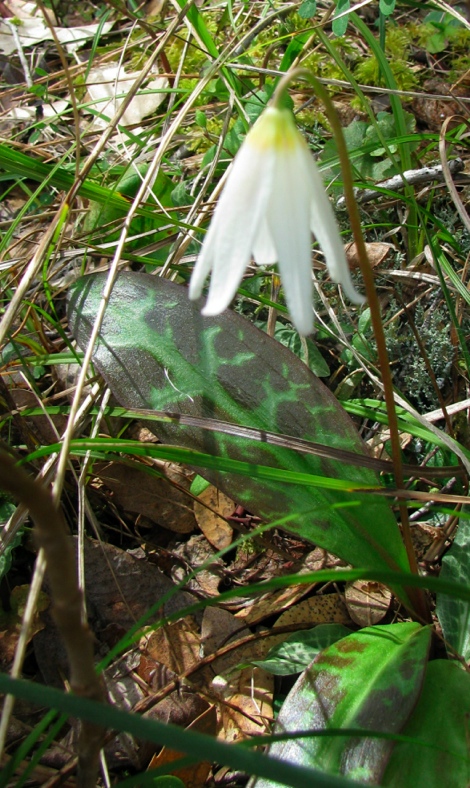
In a previous post I showed off one local member of the species Erythronium, E. hendersonii, with pinkish/purplish flowers. This morning up on the middle fork of the Applegate River we found something different, which is probably Erythronium citrinum S Watson, the pale fawn lily.

Another possibility is E. oregonum but Flora of North America says that species is found at altitudes of 0 – 500 m, with E. citrinum at 100 – 1300 m and we found these at 750 m or higher. In addition, the Pacific Bulb Society mentions unusually dark leaves being common on E. citrinum and we saw those. In the end, though, I’m no botanist and won’t wager anything on my identifications of Erythronium species, particularly given what Flora of North America says in the article on citrinum:

Plants lacking auricles on inner tepals are sometimes segregated as Erythronium howellii, Howell’s fawn-lily, but they do not appear to differ from typical E. citrinum in any other characters.
Erythronium citrinum intergrades with E. californicum and E. hendersonii, occasional populations or individuals displaying intermediate or recombined characteristics. [and no, “tepals” is not a typo but a botanical term for one variety of what the rest of us lump together as “petals”]

Anyway, here’s what we saw, beautiful by any name.
EOregonum2.jpg

The plants are a bit larger and more robust than the pink-flowered E. hendersonii, and the petals are white touched with yellow at the base.

E. oregonum1.jpg

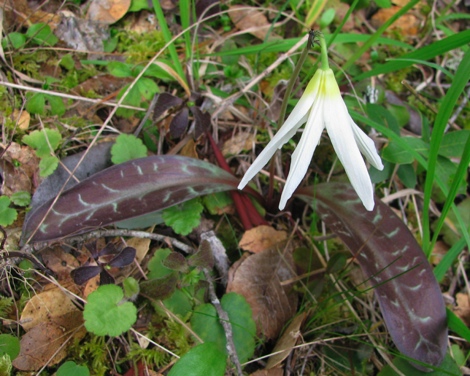
The mottling of the leaves is more pronounced than the leaves of E. hendersonii, and a few plants had nearly chocolate-colored leaves.
EOregonum3.jpg

Here’s one more close-up; perhaps someone can make an ID from it.

E. citrinum closeup.jpg

Another species with a white flower touched with yellow is Erythronium montanum, the avalanche lily, but its leaves are plain green, not spotted. The photo below is from Wikipedia. There’s a fantastic close-up of its flowers at the Botany Flower of the Day site.

EOregonum,montanum.jpg

Rattlesnake plantain, Goodyera oblongifolia, also has distinctively marked leaves, which grow in rosettes flat to the ground. It’s at the left in the picture below, with a damaged erythronium leaf on the right.

EOregonum& Rattlesnake plantain1.jpg

The common name “plantain” simply refers to the broad leaves; actually Goodyera oblongifolia is a member of the orchid family, with a spire of small white flowers. I can’t remember ever seeing it in bloom.

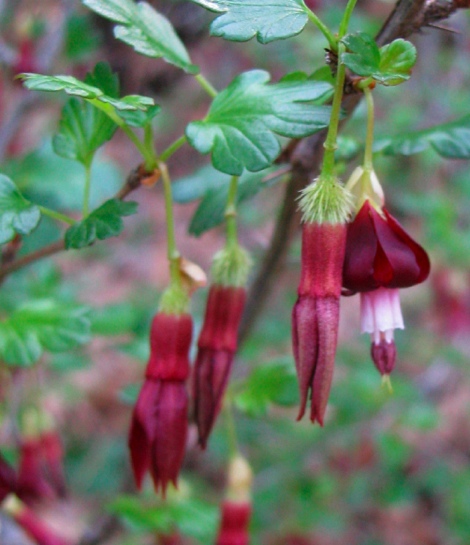
Yesterday, in a moist environment above the Applegate River, we found this beauty:
ECitrinumRibes.jpg

It’s a member of Ribes, the gooseberry or currant family, probably Ribes roezlii, the shiny-leaved gooseberry. Mostly evergreen, with thorns. Wild gooseberries/currants are edible, according to what I read, though some including R. roezlii have berries that are prickly or hairy (photos).

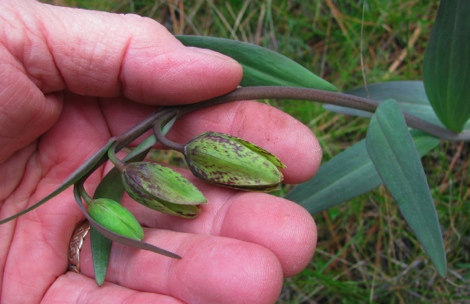
In this wetter area, there were also several of the chocolate lily, Fritillaria affinis, mentioned in a previous post in connexion with the scarlet fritillary seen on an earlier walk.
ECitrinumFritillary1.jpg

The flowers weren’t open quite yet but are still striking.

ECitrinumFritillary2.jpg

Here’s a plant with a handsome and unusual leaf, as yet unidentified.
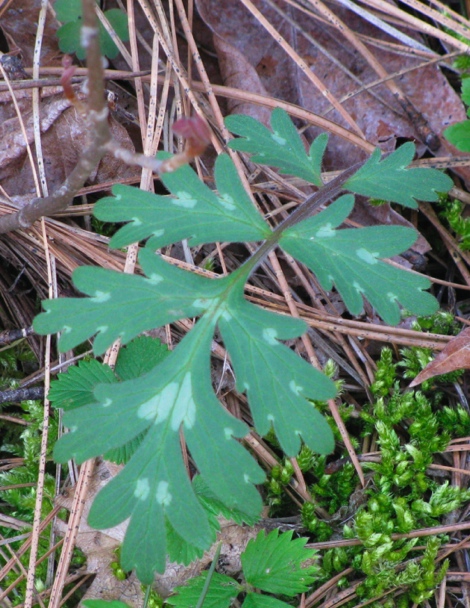
ECitrinumMysterleaf.jpg

Finally, here’s a sweet little wildflower, Viola nuttallii (Nuttall’s violet, Yellow prairie violet). We saw it yesterday in that moister environment overlooking the river.

ECirtrinumViolet.jpg

It’s a food plant for the larva of the Coronis Fritillary butterfly, Speyeria coronis, seen below.
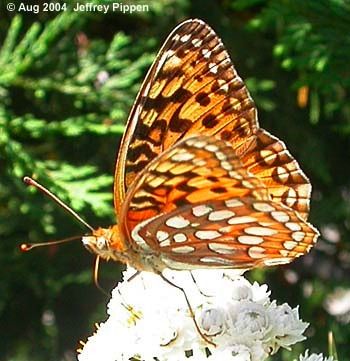
ECitrinumButterfly.jpg

(Photo by Jeffrey Pippen)

We’ve marked down a couple of spots to revisit in a few days, to find out what sort of flowers will appear from some unknown plants. Most of them look lily-ish, just a couple of large linear leaves. What surprises do they hold? even the Shadow doesn’t know, unless he’s keyed out these plants. I’ll wait and be surprised.
Calypso orchid sighting

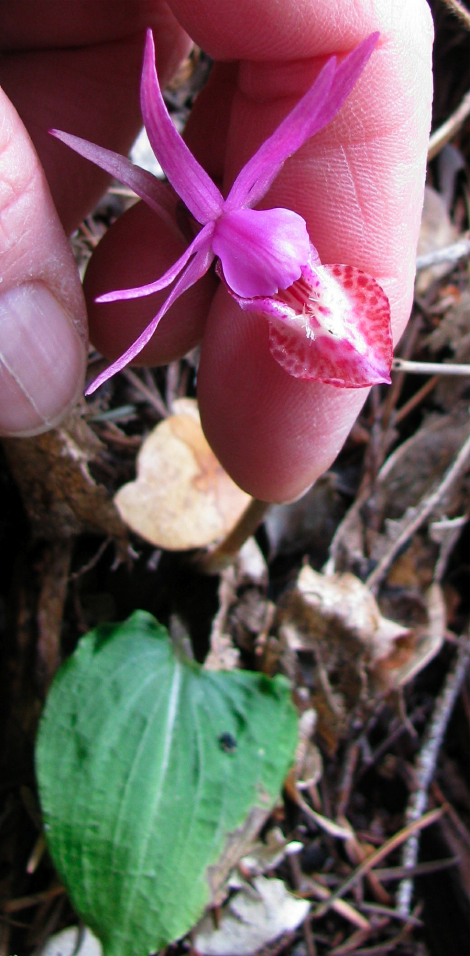
Finding a calypso orchid on our walk Saturday was a surprise, because its expected habitat is undisturbed moist old-growth forest. The place where we were walking is anything but that: it’s right beside a paved forest road, and over the past 150 years or so there has been much disturbance by a succession of loggers, hydraulic miners, gold panners and dredgers, hikers, hunters, and brush clearing for fire suppression. We spotted the orchid as we returned to the road from looking at other flowers lower on the slope, and it was growing within 5 feet of the pavement. Our interest attracted Jack the mastiff who wanted to see what we were looking at, and then we had to protect the flower from his big feet.

Calypso orchid1.jpg

The full name is Calypso bulbosa var.occidentalis, or the Pacific or Western Fairy Slipper; there’s a paler variety in the eastern US, Calypso bulbosa var. americana, or the Eastern Fairy Slipper. (The Washington Native Orchid Society has a good description of both with photos, here.) And its actual distribution is circumpolar, with two other varieties being found in Eurasia and Japan (map).

I enjoy identifying what we see, plant or animal, not so that I can check it off my life list (I don’t have one) but because then I find out more about it. Doing a bit of research for this post, I found that the Calypso orchid requires a mycorrhizal partner—a fungus that extracts extra nutrients from the soil which the plant, with its single leaf, is unable to generate. These partnerships between fungi and plants are, as we are coming to discover, common. Only painstaking investigation can detect them. The relationships are specific, a particular fungus with a particular plant species. It’s one reason why many wild plants have proven nearly impossible to transplant to gardens.

Regardless of your motives or expertise, please leave wildflowers where you find them; many are struggling enough with various human-caused disturbances. The flower you pick may be the only one the plant will produce for this year or several years, so picking it means no chance of producing seeds. And for the Calypso orchid and others, it’s even worse: picking or disturbance can mean the death of the plant

The Calypso orchid is being rapidly exterminated in populated areas due to trampling and picking. The corms are attached by means of delicate roots. These roots can be broken by even the lightest tug of the stem. Hence, when the flower is picked the plant usually dies. [WNOS page]

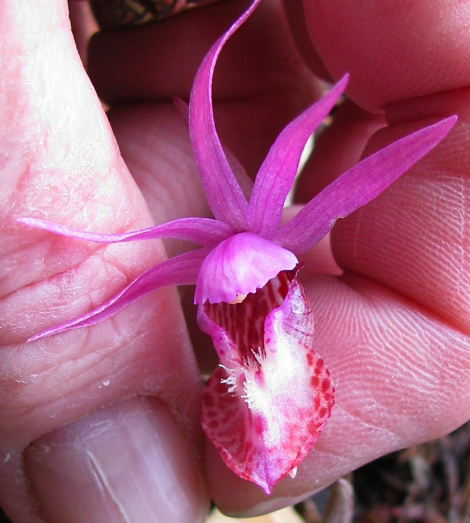
The Calypso orchid produces no nectar but fools bees into visiting with—depending on which expert is talking—its color, shape, fragrance, or the tiny hairs on the flower (visible below).

Calypso2.jpg

One who has studied this phenomenon in the eastern variety of Calypso orchids claims that the bees learn by experience not to bother with these unrewarding flowers, after visiting a few Calypsos and thereby cross-pollinating them. Only queen honeybees live very long, so each spring there’s a new population of worker bees to be fooled by Calypso, the orchid named after a sea nymph who loved Odysseus and kept him on her island for seven years, while he longed to be on his way back home. The name means “hidden” or “I will conceal” in Greek, and presumably refers to the orchid’s inconspicuous habit, close to the ground in shaded spots.

Sunny slope wildflowers, Southern Oregon

Despite an unseasonable snowfall last week, two days later we found some uncommon wildflowers blooming on a sunny slope bordering a forest road.

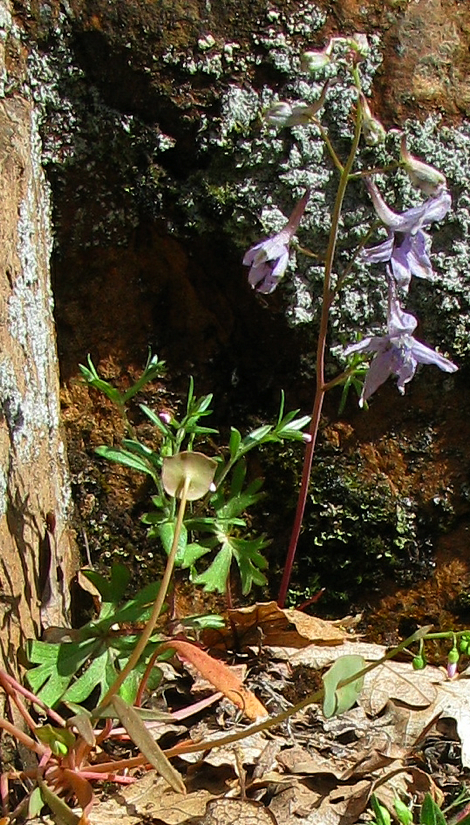
We’d noted the leaves of these delphiniums (larkspurs) the week before, and now they were in full bloom

Frit Delpg purple close-up.jpg

The majority were white, like these

Frit Delph close-up.jpg

but according to the experts only two white species (Delphinium leucophaeum and D. pavonaceum ) occur west of the Cascade Mountains, and neither are found south of the Williamette Valley (in northern Oregon). Their range may be restricted to the area of a temporary lake formed after one or more of the catastrophic Missoula Floods which occurred around 15,000 years ago, when glacier dams broke releasing huge quantities of water and silt, over parts of what’s now Oregon and Washington.

Delphinium menziesii occurs in our county, but it’s dark purple with a more finely divided leaf. Maybe the ones we saw are Delphinium andersonii, which does seem to have light blue to very pale almost white flowers, and a three-lobed leaf like the ones we saw.

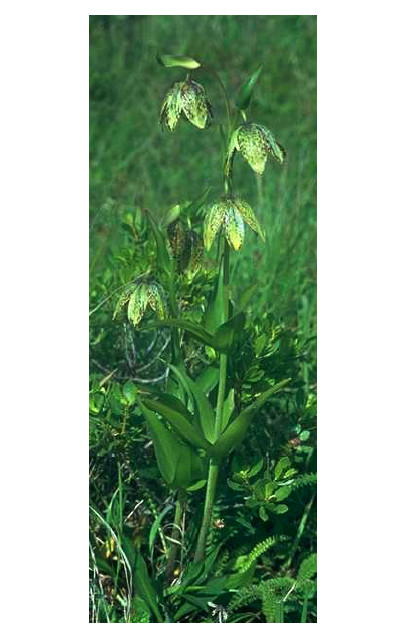
An exciting find was this fritillary, a member of the lily family.

Fritillary close-up2.jpg

Wikipedia says that “fritillary” comes from the Latin term for a dice-box (fritillus), and probably refers to the checkered pattern, frequently of chocolate-brown and greenish yellow, that is common to many species’ flowers. (And there’s a group of butterflies so named for the same reason.) The checkered pattern is visible on both the bud and opened bloom above.

Fritillary 1.jpg

At least 3 species are found around here; this one is Fritillaria recurva, the Scarlet Fritillary. The nearby town of Jacksonville has a festival every year in honor of the rare species found near there, Fritillaria gentneri, which has darker red flowers. And we have a few times seen, on our own property, Fritillaria affinis or Chocolate lily, which has bell-shaped greenish flowers with brown markings. We don’t have any photos of it, but here’s one from USDA

Fritillaria affinis1.jpg

Their account notes that the root bulbs are edible, though bitter, and were an item of trade for tribes in this area. F. affinis is quite variable in flower color, sometimes showing the reverse of the ones we’ve seen: purplish-brown flowers with green or yellow “dice”, as below.

Fritillaria affinis2.jpg

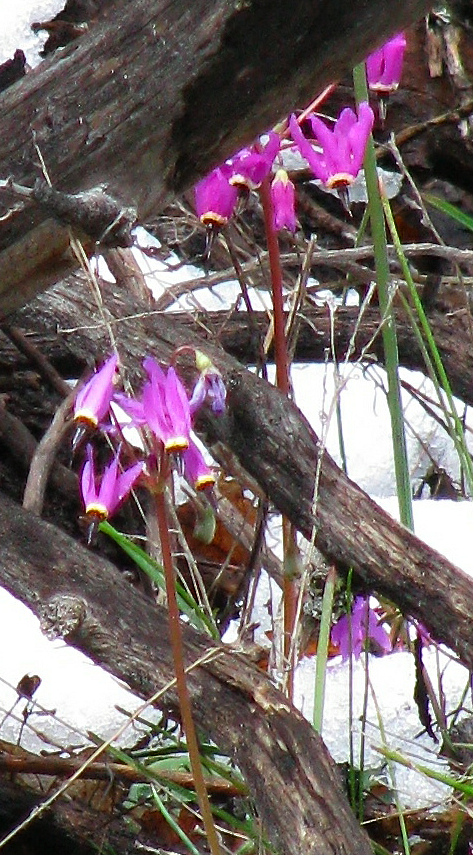
We also saw two other wildflowers more familiar to us: shooting stars,

Frit Shooting Stars1.jpg

always one of the more abundant flowers this time of year,

Frit Shooting Stars 2.jpg

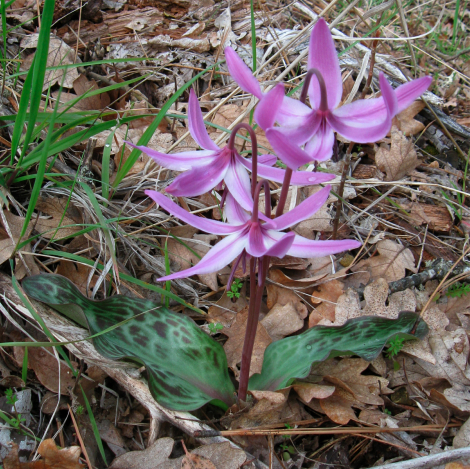
and our beloved Trout Lilies (Erythronium hendersonii), delicate and demure plants with a very brief duration of bloom.

Frit Erythronium 2.jpg

They range in color from nearly white to a darker violet-pink. Flowers are borne so close to the ground that it’s hard to get a look from underneath.

Frit Erythronium close-up from below.jpg

The mottled leaves are the reason for some of the common names—Trout Lily, Fawn Lily—and I think they are as beautiful as the flowers, in their way.

Frit Erythronium leaves.jpg

Frit Erythronium 3.jpg