No glaciers on the news

Last night I wanted to see footage on television of the huge island of ice that has broken off of the Petermann glacier in Greenland. It’s the biggest such event in the Arctic for 50 years, launching a massive iceberg that has four times the area of Manhattan and is 600 feet thick. “The so-called “ice island” covers a hundred square miles (260 square kilometers) and holds enough water to keep U.S. public tap water flowing for 120 days.”

I thought that some enterprising Greenlander, perhaps from the Greenland Ice Patrol which monitors ice movement for shipping safety, would surely have gotten aloft and sent us all some live footage showing the area, but apparently not. Merging two clichés, one about cable tv and the other about big-box stores, I thought: “500 channels, but never what you want”.

Online, of course, there are photos like these from NASA.

NASArealcolor2.jpg

Real color photo from NASA. I added the orange line around the breakaway ice island. Source.

NASAfalsecolor.jpg

False color photo from NASA. Source.

And I did find about two seconds of overhead video on YouTube. It’s about 20 seconds into the video, and most of the rest is talking heads taking sides on whether the event is connected to global warming/climate change. Maybe yes, maybe no, does it really matter if each individual event can be connected? Good for politicians and talk-shows.

In the Antarctic, however, there seems to be quite a clear pattern. Nearly all of the world’s glacier ice, 91%, is located there. An international scientific partnership including the US Geological Survey (and the British Antarctic Survey, with the assistance of the Scott Polar Research Institute and Germany’s Bundesamt fűr Kartographie und Geodäsie) has found that

every ice front in the southern part of the Antarctic Peninsula has been retreating overall from 1947 to 2009, with the most dramatic changes occurring since 1990. The USGS previously documented that the majority of ice fronts on the entire Peninsula have also retreated during the late 20th century and into the early 21st century.

The ice shelves are attached to the continent and already floating, holding in place the Antarctic ice sheet that covers about 98 percent of the Antarctic continent. As the ice shelves break off, it is easier for outlet glaciers and ice streams from the ice sheet to flow into the sea. The transition of that ice from land to the ocean is what raises sea level. [report dated 2/22/10]

Since 1950, total Antarctic ice loss exceeds 9,652 square miles. Temperatures on the Antarctic Peninsula have risen faster than in any other area in the southern hemisphere – a rise that translates to more than five degrees Fahrenheit since the middle of the last century.
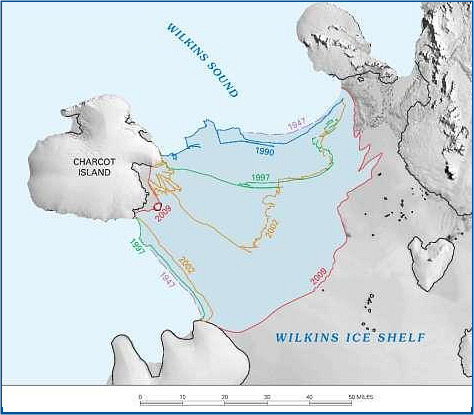
AntarcticPeninsulaIceLossMap.jpg

This image shows ice-front retreat in part of the southern Antarctic Peninsula from 1947 to 2009. Distance bar may be hard to read: it’s 50 miles in 10 miles increments. USGS scientists are studying coastal and glacier change along the entire Antarctic coastline. The southern portion of the Antarctic Peninsula is one area studied as part of this project, and is summarized in the USGS report, “Coastal-Change and Glaciological Map of the Palmer Land Area, Antarctica: 1947–2009” (map I–2600–C). (Credit: Image courtesy of U.S. Geological Survey). Source.

It is expected that loss of the floating ice shelves will allow the land-based ice to flow faster toward and into the ocean. If the Greenland Ice Sheet were to melt completely, it is estimated that it would add about 23 feet (7 meters) to current sea level. The West Antarctic Ice sheet is believed to be less stable than that covering East Antarctica, because the ice of East Antarctica lies on rock that is above sea level and is thought unlikely to collapse. But the West Antarctic Ice Sheet (WAIS) is on rock below sea level:

“Not just a bit below sea level, it’s 2,000 meters below sea level,” said David Vaughan, a principal investigator with the British Antarctic Survey. “If there was no ice sheet there, this would be deep ocean, deep like the middle of the Atlantic.”

Some scientists have theorized that this makes the WAIS inherently unstable. If the ice sheet retreats beyond a certain point, a positive feedback mechanism should, they say, lead to runaway retreat that would not stop until most of the ice sheet disappears. [Source.]

The Western Antarctic Ice Sheet contains 13% of all the ice on the Antarctic continent, enough to raise current sea levels around 11 feet (3.3 meters). And when the Intergovernmental Panel on Climate Change (IPCC) made its climate change predictions, including the “mid-range projection” (mid-range meaning, not the best-case nor the worst-case scenario) that seas will rise 17 inches (44 centimeters), they did not include what the effects would be, if polar ice sheets began to melt faster than in the decade of 1993-2003. This was done because there wasn’t enough known about ice sheet melting and its change over time. The Antarctic Ice Sheet is 6 miles thick in places, so it’s not easy to know what is going on under it and finding out has only recently seemed important to those who fund such expensive research.

Finally, the aspect that has seemed to many the most frightening about climate change predictions: the unknown potential for interactions between complex systems such as wind currents and ocean currents, which could conceivably multiply foreseen effects. (Or, if we were amazingly lucky, cause them to cancel one another out; but we won’t know until it’s too late to do anything about it.) For example, it’s believed that the melting of Antarctic ice shelves is caused by warmer water flowing up underneath the ice. But this water is not from melting ice; rather it comes from deep within the ocean, and climate change may be making it warmer by one of those unforeseen linkages:

Antarctica is encircled by atmospheric currents that largely insulate it from the rest of Earth’s climate and keep it colder than it otherwise would be. Jenkins’ model showed that these circumpolar currents, sometimes called “Westerlies,” “the Screaming 50s,” or “the Roaring 40s,” actually push surface waters out away from the continent. This results from the Coriolis Force, the byproduct of Earth’s rotation that causes cyclonic systems to turn counterclockwise in the northern hemisphere and clockwise in the southern hemisphere. As surface water is pushed away, warm deep water rises to replace it.

If the atmospheric currents speed up, more water is pulled up. Indeed, observations indicate these atmospheric currents have sped up in recent decades in response to global warming. So increased upwelling seems likely.

[Read more in this article which goes into deeper detail than many accounts of climate research for lay persons. It reports on the 2007 the West Antarctic Links to Sea-Level Estimation (WALSE) international workshop.]

It’s this sort of unforeseen multiplier-effect between two systems (each one of which,by itself, strains our capacity to make accurate mental and statistical models), that makes me think efforts to mitigate, and prepare for, climate change should be at the top of every developed nation’s agenda. Of course it’s not at the top of any nation’s agenda, and won’t be, until the effects are severe—not just “extreme weather” like last week’s flooding and unusual heat waves, but unmistakeable (and irreversible) such as significant rise in sea levels. By then secondary results, such as mass migration of tens of millions trying to flee drought and famine, will be well under way and our primate brains will be where they are most comfortable, dealing with what’s right in front of them. Near-term possibilities are construed concretely, long-term ones abstractly, and the consequences of that upon human action are pretty much as you’d expect. Psychologists even have a name for this, “temporal construal”.

We are told that Homo sapiens mostly evolves culturally now, rather than physically. Yet human cultures in industrial nations are mostly under the control of corporate interests which manufacture and sell us “culture” in a form that serves their ends. Government, also, serves them. If corporations were subject to natural selection we wouldn’t have seen no-strings bailouts for banks and financial institutions, instead there would have been widespread failures. If American culture is poorly adapted for survival in coming conditions, and if the few run it for their short-term gain, then chances for “our” success seem slim. Humans are slippery devils, though, enduring and resourceful. And there are still a few groups of hunter-gatherers and nomads left who may well prove far more resilient than any of our proud nations.

Algae poses threat to humans as well as animals

Health departments have been trying to inform swimmers and pet owners that they should avoid water with visible algae, since ingesting it can cause severe and sudden illness including convulsions or even death. In our state, three dogs died last year after swimming at a reservoir. One died before his owner could even get him to the car, another died on the way to the vet.

Now, a recent report in the ProMED health tracking network calls our attention to human risks that don’t involved either entering or drinking the algae-contaminated water.

One man, whose dog died after a swim in the lake, was hospitalized last week [week of 19 Jul 2010] after he gave the dog a bath. Within days, the 43-year-old man began having trouble walking and lost
feeling in his arms and feet.

“We weren’t swimming in the lake because it’s disgusting,” said the
victim’s wife, whose husband, is still having trouble with memory loss and fatigue. “Our dog was just covered in that sludge, and my husband washed him.” Washington Examiner, July 30, 2010.

According to one doctor treating the Ohio man, his neurological problems may be permanent. But he’s better off than his dog, who died despite having the algae washed off.

The algae are in the “blue-green algae” family, and are actually not algae but photosynthesizing bacteria, called cyanobacteria. Blooms, or overgrowths, in bodies of water (fresh or saltwater) are encouraged by temperature change and increases in nutrients, often from agricultural runoff into the water. The cyanobacteria, like some algae, make toxins harmful to fish and mammals. Humans have been aware of this mostly through being poisoned by eating shellfish, which concentrate the toxins. The familiar warnings about “red tides” and issuance of “shellfish advisories” result from these conditions.

While it has been known that skin contact with toxic algae could produce illness in humans, the severe results from relatively small exposure—simply washing an algae-slimed dog—seem to be worse than expected.

The lake in Ohio is Grand Lake St. Marys; it’s the largest inland lake in the state by area, but is extremely shallow, with an average depth of only 5 to 7 feet. This shallow lake warms up more, and doesn’t dilute the runoff of agricultural fertilizer and livestock waste as much as if it held more water. Recent algae blooms have killed so many catfish that crews were shovelling up the dead fish. With the lake surrounded by warning signs, the area’s $160 million tourism industry has declined, and a boat race that draws about 30,000 people in late August each year has been cancelled.

Some algae are harmless, but there are many different algae or bacteria that can produce dangerous levels of toxins when they bloom. Some are more harmful than others but it’s foolish to take chances: keep yourself, and children and pets, well away from any water that has a visible algae presence. This can be greenish, reddish, or other colors. Or it can appear as just cloudiness or discoloration in the water, as foam or scum floating on top, as mats on the bottom, or actual filaments or pellets. And don’t let kids or pets wander to areas of a river, stream, or lake that you have not closely checked.

Algae by rocks.jpg

Source.

An Ohio factsheet sums up the methods of exposure, and known symptoms:

Skin contact: Contact with the skin may cause rashes, hives, or skin blisters (especially on the lips and under swimsuits).

Breathing of water droplets: Breathing aerosolizing (suspended water droplets-mist) from the lake water-related recreational activities and/or lawn irrigation can cause runny eyes and noses, a sore throat, asthma-like symptoms, or allergic reactions.

Swallowing water: Swallowing HAB-contaminated water can cause:
◦ Acute (immediate), severe diarrhea and vomiting
◦ Liver toxicity (abnormal liver function, abdominal pain, diarrhea and vomiting)
◦ Kidney toxicity
◦ Neurotoxicity (weakness, salivation, tingly fingers, numbness, dizziness, difficulties breathing, death)   Source.

Splashing of water in eyes, or inhaling droplets of contaminated water, can get the toxin into your system. One of the toxins from cyanobacteria, Saxitoxin is “reportedly one of the most toxic, non-protein substances known. It is known that the LD50 (median lethal dose) in mice is 8 micrograms/kilogram. Based on
a human weighing approx. 70 kg (154 lb), a lethal dose would be a
single dose of 0.2 mg.” [Source, ProMED report.]

How much is two-tenths of a milligram? There are a thousand milligrams in a gram, and a dime or a paper clip each weigh about 1 gram. So an amount of toxin weighing the same as two ten-thousandths of a paper clip may be lethal.

Algae,feet in water.jpg

Source.

These “Harmful Algal Blooms” can occur in large or small bodies of water; often, but not always, they are in areas where the waterflow is slow (near shore) or nonexistent (stagnant). Small pools or puddles separate from the main body of water can contain algal growth. Even in tiny amounts the toxins can have devastating and sudden effects of humans or animals.

Eating fish or shellfish from contaminated waters is dangerous too. Cooking does NOT render toxins safe.

Algal blooms can be very transient, appearing and disappearing in a matter of days to weeks. If you spot a possible instance and there are no warning signs, it may not have been found yet. Stay away from the water and call your local or state health department so they can track outbreaks, and put up signs.

For the state of Oregon, current advisories can be found online here. The HAB team can be reached by email at Hab.health@state.or.us, by phone: 971-673-0440; Toll Free: 877-290-6767; or by fax: 971-673-0457. Other states should have similar programs; your city or county health department ought to be able to tell you more.

Why are these toxic algae blooms becoming more common?

The short answer is, better growing conditions for algae. They thrive in warm water, and temperatures are going up. Nutrients (nitrogen and phosphorus) from human activities pour into streams, lakes, rivers, and the ocean, and act like Miracle-Gro for the algae. Sources include runoff from fields treated with fertilizer or manure, spraying partially treated sewage sludge, sewage overflows, and runoff from pastures.

What can be done?

Rising temperatures, that’s a big one. Let’s just look at eutrophication or over-nutrification of water, since that’s something where local efforts can have relatively immediate local effects. Obviously, better treatment of sewage (including livestock waste) and reduced use of fertilizers (in agriculture, on golf courses, in parks, and in our own personal yards) are important steps to work on. On July 1st, 16 states will begin enforcing laws that require dishwasher detergents to be almost phosphate-free. That’s a small but significant improvement; the legislator who introduced the bill into the Pennsylvania legislature estimated that 7% to 12% of the phosphorus entering sewage plants came from automatic dishwashing detergents. New guidelines from the federal Clean Water Act to reduce nitrogen and phosphorus have provided more impetus to these particular efforts.

Not so obvious steps:

At least one study found that use of organic fertilizers led to less nitrogen runoff than use of chemical fertilizers.

Remediation of areas where nitrogen is stored in soil, from decades of deposition by one means or another, is possible but expensive and slow.

And years of research is showing us, surprise surprise, that intact aquatic communities slow the trickle-down of nutrient pollution (from, say, creeks to streams to rivers to a lake) and seem to enable a body of water to better resist eutrophication. Dr. David Schindler (Professor of Biological Sciences, University of Alberta) has studied the problem for decades including 37 years of work on Lake 227, a small pristine lake in the Experimental Lakes region of northern Ontario. He says, for example, that overexploitation of piscivorous (fish-eating) fish seems to increase the effects of eutrophication. (His earlier work energized the campaign to reduce phosphorus pollution.)

A study along the Georgia coast suggests that tidal marsh soils protect aquatic ecosystems from eutrophication, caused by the accumulation of nutrients. And they sequester large amounts of carbon, helping us slow down climate change. I would expect similar results with regard to freshwater wetlands and marshes. When I was a zookeeper I worked with mechanical incubators for bird eggs, none of which was as reliable as one of those “bird-brained” hens of whatever species. We are told that the appropriate native herbivores—bison, wildebeest, and so on—produce more meat per acre and do less damage than introduced species like cattle. And now we’re coming around to seeing that oldmothernature is better at water purification than we are, if we leave existing systems intact (but we never do).

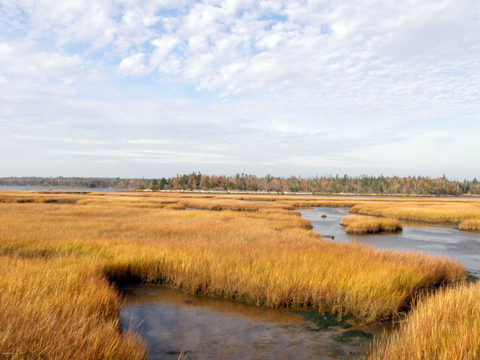
Salt Marsh.jpg

Salt Marsh near Dartmouth, Nova Scotia; more good photos of this marsh here.

Unclear on the basic concept: White House Press Secretary on Gulf oil spill

As President Obama made his tour of the Gulf region on Monday, White House Deputy Press Secretary Bill Burton told reporters aboard Air Force One that BP would move forward in creating an escrow account to ensure, “that all the people who are affected by BP’s oil spill are made whole.”
from politicsdaily.com, June 14, 2010.

What kind of a disconnected nitwit can use the phrase “made whole” about this? Believe it or not, there are some things money can’t change. All the money in the world cannot turn back the clock and make the ocean clean, bring back to life the millions of dead creatures—the tiny ones we never see also suffered, also died, and from our myopic human standpoint they are important because they’re part of the web of life that makes shrimp for us to catch and eat.

This isn’t “just words”, this is a perversion of thinking that is at the root of our modern lostness. Minds so separated from the real “buzzing blooming confusion” of life, that they are hardly here in the same world with the oiled pelicans and the devastated fishermen. Yet like aliens from some distant galaxy they walk among us and their power is immense, to act in our world, control what we know, run our government like a puppet theatre.

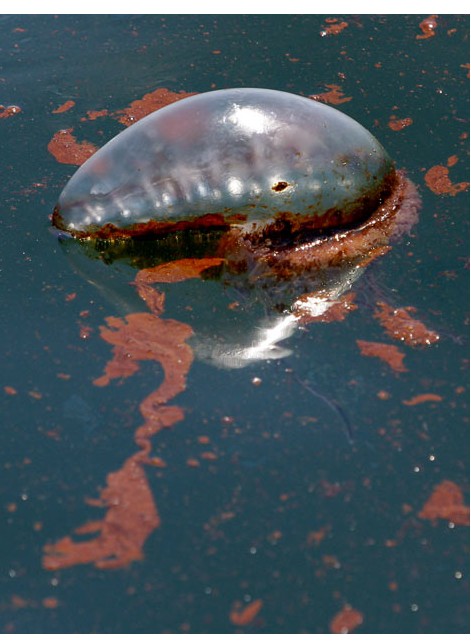
jellyfish.jpg

A dead jelly fish floats in oil in the Gulf of Mexico near Venice, LA. AP photo from Telegraph (UK).

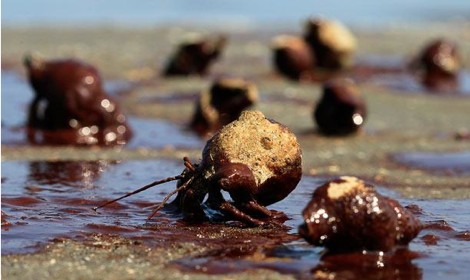
hermitCrabs.jpg

Hermit crabs struggle to cross a patch of oil on a barrier island near East Grand Terre Island, LA. AP photo from Telegraph (UK).

Home Ground: Words of our native land

Home Ground: Language for an American Landscape, edited by Barry Lopez. Trinity University Press, San Antonio Texas, 2006.

One of the language byways I find fascinating is that of terms for landforms; they’re often based on metaphors (oxbow bend in a river, neck of land), some have ancient linguistic roots, others reflect the cultural history of an area with words from the language of indigenous people or early explorers. Those who share my interest will love this book, but it also has appeal for those who enjoy American regional writing or history, or are interested in how the landforms we see come into being.

Home Ground’s entries are in alphabetical order but it’s far richer than a dictionary. Entries are signed by their authors, who are mostly American writers with particular regional roots––novelists, poets, nature writers, scientists. From them we hear not just the definition and history of the term but also more diverse notes: political (the drowning of Celilo Falls in the Columbia River, by a dam, comes up in the entry for dalles), ecological, personal, and literary (quotations from hundreds of writers including Thoreau, Jack London, T.S. Eliot, Joel Chandler Harris, Pablo Neruda, Louis L’Amour, Joyce Carol Oates).

There are no fewer than three indexes: one for authors so quoted, one for terms (with cross-references), and one for specific place names mentioned: the San Andreas Fault, Satans Slab, South Dakota. And there are short biographies of the writers who produced the entries. With all this, you can browse the book or look for something specific like every mention of the Mississippi River, all the terms relating to ice, or mentions of Herman Melville.

If you have ever wondered what the difference is between a hill and a mountain, or among the words canyon/cleft/coulee/gorge/gully/ravine, you can find out right here. Terms run the gamut of languages––ronde, tseghiizi (Navajo), névé, krummholz, cuesta, gumbo (probably from a Central Bantu dialect), nunatuk, eddy (possbily Norse), erg (Arabic) and so on (although etymology is not always included). And they vary from the words of Western science (imbricated rock) to those of other observers (coyote well, paternoster lake).

And now, a few sample entries:

tule land

Tule land is a term recorded as early as 1856, just after gold rush. It usually refers to the flats of bulrushes and other reeds along the rivers of the West Coast. In the muddy shallows along the Sacramento, for example, as the river takes its time joining the San Joaquin and approaching the San Pablo and San Francisco Bays, there are vast thickets of reeds, home to waterfowl and fur-bearing animals. Tule lands are especially common at the junctures of rivers, where the slightest breeze will set the rushes whispering and rasping over the mud and standing water. The Wintu Indians called tule land “the storehouse of instant tools” because the rushes could be used to make so many things: mats, clothes, baskets, lodges, boats, and cradles, sandals, brooms, fish traps, and talismanic images. ROBERT MORGAN

nivation hollow

In A Walk in the Woods: Rediscovering America on the Appalachian Trail,
Bill Bryson wrote: “I never met a hiker with a good word to say about
the trail in Pennsylvania. It is, as someone told a National Geographic reporter in 1987, the place ‘where boots go to die.’…Mile upon mile of ragged, oddly angled slabs of stone strewn about in wobbly piles…These require constant attentiveness if you are not to twist an ankle or sprawl on your face––not a pleasant experience with fifty pounds of momentum on your back.” Such a hiker on the Appalachian Trail in Pennsylvania might just as well have been complaining about nivation hollows. A bowl-shaped depression in the ground, a nivation hollow begins to take shape when ice forms over a shallow rock basin beneath a snow bank. The ice freezes and thaws over time. During the warm period, melted snow seeps into the bottom of the hollow. During the cooler period, the seep water freezes. The rock breaks up, weathers, and erodes. Meltwater carries away the finer rock particles and the hollow becomes larger and deeper. MARY SWANDER

fil du courant

A Cajun French term meaning “thread of the current,” fil du courant is used to describe the optimal navigation course within a bayou or river. The fil is often visible as a glassy-smooth pathway through the otherwise ripping water. Louisiana shrimpers follow the fil du courant to avoid underwater obstructions and to secure sufficient depth for skim nets that extend winglike from either side of the vessel. MIKE TIDWELL

fall line

Fall line is a phrase both metaphoric and literal. In broader terms, it means the zone where the Piedmont foothills level out into the coastal plain, where sandy soil derived from marine deposits replaces rocky rolling land. On some southeastern rivers, such as in the Carolinas and Virginia, the Fall Line is a specific place where shoals and rapids once stopped navigation from the coast because ships couldn’t pass through. Cities such as Richmond, Fayetteville, and Columbia sprang up at the head of navigation, and mills and factories were built to take advantage of the water power at the falls and rapids. The abrupt change of elevation caused industry and commerce, courts and seats of government, to take root in those areas. ROBERT MORGAN

Line drawings, by Molly O’Halloran, illustrate some of the terms, such as this one for “Quaking Bog” which shows how peat, sphagnum, geologic forms, plants and water all combine to form this floating vegetative structure that will seem solid until stepped on. [The scan is much reduced, and for some reason tinted beige, unlike the original.]

quaking bog2.jpg