Recently overheard…

at our neighborhood restaurant: a woman in her 30’s, addressing the man she was with: “Now Bush, he’s a Republican, right? and that other one, Clinton, was a Democrat?”

The man’s rejoinder, I could not hear, more’s the pity.

H.L. Mencken, an idol of my youth, is said to have written (though I can’t find a source for it) “No one in this world, so far as I know — and I have researched the records for years, and employed agents to help me — has ever lost money by underestimating the intelligence of the great masses of the plain people. Nor has anyone ever lost public office thereby.”

In this case the woman may be of normal intelligence, but raised by coyotes out in the Great American Desert.

A tough day for horses

Yesterday was a beautiful late-spring day (our usual hot weather has been happily delayed) and we went to a draft horse pulling contest, and then to visit my father where we watched the Belmont Stakes broadcast.

I don’t follow horse racing, but I had seen something about recent controversy in the sport including concern over the favorite in the Belmont Stakes, Big Brown, being run with a hoof-crack. Had he won as expected he would have been the first Triple Crown winner since 1978. Unfortunately something was amiss with Big Brown, and his jockey pulled him up well before the end so that he finished last. Maybe it was the hoof-crack, maybe something else; his trainer and the vets passed him as fit, and my layman’s opinion that he was favoring one leg going from the barn to the track may have been my imagination. Perhaps more details will be released.

I also took offense at the commercial linkage of the horse “Big Brown” to UPS: the mounted track employee who accompanied this horse and his jockey on the pre-race parade had “UPS” prominently on his windbreaker and I had a brief glimpse of a banner above the starting gates reading “What can Brown do for you?” Will the Sport of Kings follow so many other public events in this regard, so that we can look forward to Pepsi’s Belmont Stakes or Jim Beam’s Kentucky Derby? Then jockeys can wear big corporate logos on their silks, and the horses can even be re-named for the main sponsor product. “And in the stretch it’s Burger King leading, Windows Vista and GoDaddy.com moving up, and Scott’s TurfKing Fertilizer in fourth…” Well, maybe the dramatic failure of the Big Brown/UPS advertising opportunity will delay this.

At the draft horse pull

The draft horse pull promised to be a much different event. It was held at a local historic farm as part of a Saturday festival with old tractor displays, a pony ride, goats for toddlers to feed grass to, wagon rides, and demonstrations of crafts like lace-making and woodcarving. The pony ride wasn’t the commercial event with dispirited horses plodding around day after day, but one steady horse being led around by a remarkably attentive teenage kid who was very gentle and responsible. The riders ranged from the nine-year old with pink cowboy boots to youngsters not even walking yet, who waved their arms and babbled happily as moms walked alongside.

In a draft horse pull, the horses–teams of two in this case–are hitched to a weighted “sled” which they pull for 27.5 feet down a 20 foot wide track. The weight is increased until finally only one team can pull it.

drafthorsesled.jpg

This pull started with a 1000 pound sled, adding 1000 pounds after each round. In the first couple of rounds the horses were calm, just walking away with the weight. As they got warmed up and the weights increased, most of the teams became eager and excited, pulling hard as they approached the sled.

drafthorsesled2.jpg

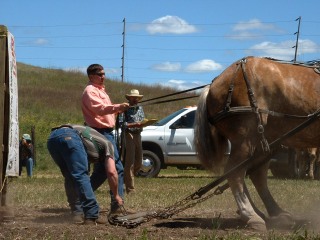
Hitching the teams to the sled became a tricky business. The horses were ready to surge forward all on their own, unexpectedly. The pulling parts of the harness are attached to a crossbar (whiffletree, I think it is called) on the ground behind the horses. It’s visible in the picture below of a team not hitched to the sled.

whiffletree.jpg

The driver controls the team while another person gets between them and the sled to fasten the sled’s cable to the whiffletree.

whiffletree2.jpg

whiffletree3.jpg
whiffletree4.jpg

This is one of those jobs like being a choker-setter in logging, requiring timing, alertness, experience and some luck to get it done right without getting caught in the explosive movement of powerful forces. Sometimes it takes a third person in front of the horses to restrain them from starting forward; occasionally the person in the danger spot has to jump back and then try again. The audience was urged to keep still to avoid any sounds the horses might interpret as a signal to start.

whiffletree5.jpg

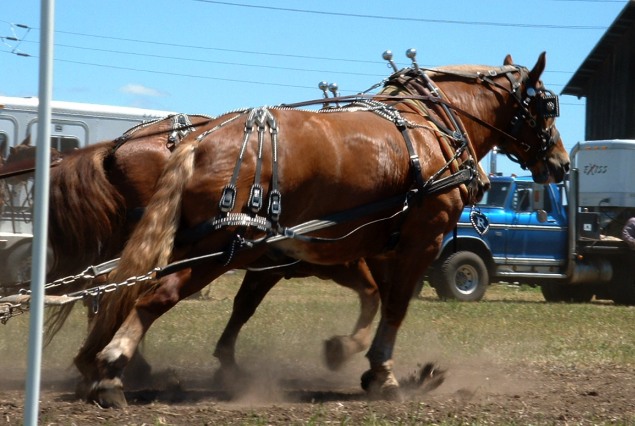
By the time the weight of the sled is up to 5000 pounds, equalling the average weight of one of these two-horse teams, it’s getting difficult to drag and the horses really throw themselves into it with all their amazing muscle power.

drafthorsesurge1.jpg
strength3.jpg
strength4.jpg

But in too many of the teams we saw, the two horses weren’t pulling equally: one was doing most of the work, sometimes really seeming to struggle, while the other was shirking. As someone in the crowd remarked, “That’s what they mean by “not pulling your weight!”” Some of the hard workers were rearing up slightly and actually throwing their body weight forward against the harness, hindquarters making a powerful effort, while their team-mates just leaned into it a bit.

uneven1.jpg

I don’t have any expertise in this and so I looked for factors I might not be considering. The distance being pulled is very short as compared to real pulling jobs in logging or farm work, giving the driver little time to give commands, and also perhaps the horses are accustomed to taking a little more distance to get evened out. On the other hand, these draft horse owners travel widely to competitions just like the one we saw, so it should be a major part of training to have both horses pulling evenly right away. The horses know very well the nature of the event, and the lazy ones have apparently figured out that such a short pull won’t last long enough for them to be called on their lack of effort. In fact I only heard one driver giving any verbal commands, and this was at 6 or 7000 pounds. His team had trouble getting started and he urged them on individually by name. They worked together and moved the sled.

We were both disturbed enough to leave, my husband first and me a few minutes later during the 7000 pound pulling. By the sound of things the event continued for another few rounds–another half-ton added each round–and for us, at least, it could only have become more difficult to watch. I am contacting some draft horse people to find out more about this; if I’ve misinterpreted what I saw, I’ll correct this post.

And no, I’m not a PETA member or an “animal rights” fanatic. In fact I don’t believe animals have rights in the sense that people have rights. I believe we human beings have strong moral obligations to avoid causing suffering to other humans and to animals and that these obligations must be backed up by well-enforced laws. Some animals like horses and dogs have been bred to be working partners and companions of humans, and we train them to do certain things, but there is no need for cruelty or the imposition of suffering in the work or the training. I’m not a vegetarian, but I believe we have an obligation to treat all animals in human care with compassion and expertise. Two examples of the “expertise” part: –Temple Grandin’s work to design slaughterhouses in accordance with the behavior and perceptions of livestock animals so as (for instance) to avoid having to force them through frightening passages or over walkways with poor traction where they fall. –A horse-owning neighbor’s account of the actual impact of recent “humane” legislation to ban horse slaughterhouses in the US: old and unwanted horses being simply abandoned on public or unfenced land, and the transportation of horses, in packed trucks, to slaughterhouses not in their own state…but across several states to Mexico, where there are no real humane standards enforced.

Defensive chainsawing

Here in wildfire country, it’s all about “defensible space” around your house, created by “fuel reduction.” We’re in the foothills of southern Oregon’s Siskiyou Mountains at about 2300 ft.; it’s dry, and rocky, and wildfires are a fact of life.

Shortly after we moved here I overheard someone say, at the local grocery store, “Plans for summer trips? No, we never go anywhere in the summer in case of wildfire.” This sounded pretty paranoid but I understand it better now that we’ve been here 12 years and seen two fires come close enough to worry about.

Pine-oak woodlands and mixed conifer stands seem to be the climax trees in our area, but 150 years of logging, farming, and road-building have caused a lot of disturbance. On our property, oaks, Douglas fir, and sun-loving Pacific madrones are the most common native trees. The madrones, which would be shaded out by dense mature forest, are often multi-trunked especially when resprouting after being cut; some of the oaks are the same. This results in brushy growths that can feed fire close to the ground. Shrubs like manzanita (Arctostaphylos sp.) and buckbrush (Ceanothus cuneatus) are very common and both are superb fuel for fires. We cleared one area ourselves, early on, of many pickup loads of buckbrush ranging to 5 feet tall. We burned them soon after cutting and even green they burned like gasoline.

Since that early effort of ours, the agencies concerned with fires and forests have gotten much more aggressive about fuel reduction on private as well as public lands. Small acreage homeowners like ourselves present a real problem to those fighting wildfires, since we expect our property, lives, and livestock to be protected and the fire-fighting resources–people, planes, equipment–are always stretched thin. Because we are part of the problem, we have been encouraged to be part of the solution as well by creating defensible zones around structures and along driveways, and having acreage “treated” to reduce fuel loads. In practice this means removing brush and dead trees, increasing distance between trees, and “limbing them up” by cutting branches that start below 6-10 feet.

The local fire district has a program to reimburse landowners for the costs of fuel reduction and we have participated in this twice. Someone comes out from the fire district to do a walk-around with you, discussing how fires travel and what changes you need to make, then you can either hire the work done or do it yourself, and upon a second inspection, be reimbursed on a per-acre basis for satisfactory completion. The amount is about $300/acre.

The financial aid means that it is possible for property owners to do fuel reduction even if they can’t do this strenuous job themselves. And when wildfires threaten private property, certified defensible properties will be given priority if there aren’t enough resources to protect everything.

Our first project was along the driveway and around the house. It included work we did ourselves (such as screening the open space between our large deck and the ground to prevent wind-blown sparks from igniting the dry wood from underneath) and work we paid for (the chain-saw removal of trees and brush and later burning of the brush piles).

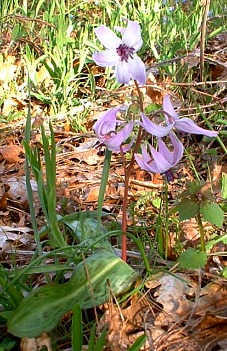
This spring we heard the grants were available again and decided to have fuel reduction done on most of the rest of our 5 acres. This was a decision that we made with regret; the cleaned-up look, which some call a “parklike setting” of spaced-out trees with little growing between them, is not pleasing to our eye, provides less cover and food for wildlife, and will change the mix of wildflowers we enjoy. Twelve years of benign neglect has allowed the land to recover from various affronts and we’ve seen a significant increase in our favorite wildflower, the ephemeral Erythronium hendersonii (Henderson’s Fawn Lily, but we call it Trout Lily–both terms refer to the mottled leaves), and others.

troutlily.jpg

However, thinking of our house becoming a pile of cinders was incentive enough. It is also true that big wildfires fed by abnormal accumulations of fuel are a long-term loss to wildlife here, where dry weather and poor soils make plant recovery slow; and both times we have chosen the more expensive method of selective hand-thinning by chainsaw over the cheaper way of clearing acres with whirling blades mounted on eco-buster caterpillar tractors. That method, as we saw when BLM used it next to (and actually on) our land, leaves a blasted wasteland that reminded me of photos of WWI France where months of artillery shelling turned forests into craters studded with splintered trunks rising at angles from the trampled mud.

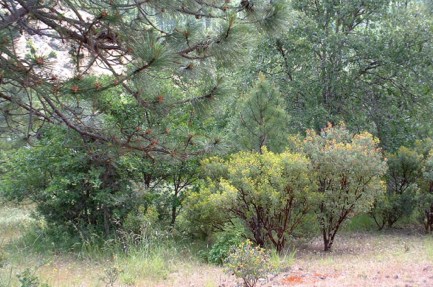
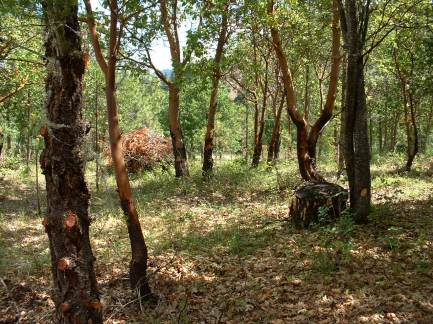
The latest clearing work has been completed, although warm weather arrived too soon for the piles to be burned; they’ll have to wait until the rains start in the fall. I didn’t think to take any “before” pictures, but for comparison the photo below is of an area untreated since we cut buckbrush a decade ago. It’s less dense than the treated areas were, before clearing, and has little madrone, but the growth of manzanita and oak clumps is similar.

denser1.jpg

The next photo is of a just-cleared section; the whitish band near the center is the driveway which would not have been visible at all before the thinning and limbing-up. The indistinct brown blob just to the left of the driveway (but closer) is a pile of branches and brush to be burned. A few piles will be left for the small creatures to shelter in, and a few large dead trees were left standing. The man who did the work is well experienced and at our request left a little extra brush where he thought the fire district would approve it.

cleared1.jpg

Nanotech intro for the rest of us

nanocover.jpg

Book cover image from Amazon.

Nano, the emerging science of nanotechnology. Ed Regis.

I picked this book up at our Friends of the Library bookstore for a quarter, though when I saw the publication date of 1995 I had second thoughts. How could so old a book, on such a fast-moving aspect of technology, be worth reading?

But when I started it I was immediately drawn in, and after finishing it conclude that for us non-scientists, as well as for those interested in the background and implications of the whole “nano” idea, the book is well worthwhile. The focus is on Eric Drexler, who as an MIT engineering undergrad in 1976 formulated the basic idea of assembling substances or structures one molecule or atom at a time, and became what Apple used to call an evangelist for the idea for the succeeding decades.

Drexler was not the first to discuss the possibility of such constructions––that honor goes to the ingenious mind of Richard Feynman who broached the topic in a 1959 lecture––but he expanded upon it, foresaw not only multiple uses but also some of the social/economic consequences of a technology which could lead to all of us having tabletop “matter assemblers” which could produce anything, from a ribeye steak to car parts, using just about any old “stuff” as raw material. And Drexler organized others into a bi-coastal league of nano-fans to brainstorm, research, and support the vision. At least, he did that after the first few years when anxiety about the social impact, or the possibility of runaway assemblers covering the earth with “grey goo,” led him to keep the idea more or less under wraps.

Ed Regis is an experienced science writer of the sort that used to be dismissed as “popularizers,” because they write for the general reader, one who’s interested, educated, but not schooled in the particular branch of science under discussion. He writes for publications like the NY Times, Wired, and Scientific American, as well as writing books. He’s good at what he does.

This book, for example, explains Brownian motion (the jumping about that individual particles, from atoms to pollen grains, do when suspended in liquid) and the workings of scanning tunnelling microscopes (which proved able to manipulate individual atoms), and other such things, well enough that I was able to explain them to someone else. That doesn’t mean I have any real inkling of the physics or mathematics of it all but I have a degree of layman’s understanding which enables me to follow the discussion, and I can build on it if I wish to read more.

Brownian motion was early raised as a theoretical objection to the concept of moving atoms around to construct molecules: how could you do it if your atoms wouldn’t stay put? An early response was, “If our own cells can make molecules, then it can be done.” A later response was the demonstration that it had been done; researchers pushed atoms around to make letters and pictures. Since then, other researchers have used enzymes or gene-altered microorganisms to tailor-make specific molecules.

Regis includes a lot of what could be disparaged as unscientific human interest detail–personalities, anecdotes–but to me this added more than just readability, it added another dimension. The original concerns about the human future which motivated Drexler to think about fundamental technological change, the ability of a high school student to make his own scanning tunneling electron microscope, the accounts of scientific rivalries and misunderstandings, these have a place in a popular account of a technology that is so mind-boggling and promises or threatens such far-reaching upheavals in society.

As I finished, the question in my mind was “Why haven’t I heard more about huge strides in this technology in the years since the book’s publication in 1995?” I’m looking into that question now, with much more comprehension than I had before reading Regis’s book.

Further information

Books by Ed Regis at Amazon

Nanotech site interview of Regis

Same site’s links to articles, current uses, etc.