I get “headline summaries” of health-related research from docguide.com, and one of last week’s headlines was “Vitamin B Combination Plus Folic Acid May Reduce Risk of Age-Related Vision Loss”. Age-related macular degeneration, or AMD, is pretty common on older people: one large study found that people in middle-age have about a 2 percent risk of getting AMD, but this risk increased to nearly 30 percent in those over age 75. There are increased-risk factors such as gender (female), race (white), smoking, obesity, and family history of the disease.
My husband’s mother has AMD, so I’ve seen its effects and I immediately went to read the article as summarized at docguide:
Taking a combination of vitamins B6 and B12 and folic acid appears to decrease the risk of age-related macular degeneration (AMD) in women, according to a study published in the February 23 issue of Archives of Internal Medicine.
William G. Christen, Brigham and Women’s Hospital, and Harvard Medical School, Boston, Massachusetts, and colleagues conducted a randomised, double-blind trial involving 5,442 women aged 40 years and older who already had heart disease or at least 3 risk factors. Of these, 5,205 did not have AMD at the beginning of the study.
In April 1998, the women were randomly assigned to take a placebo or a combination of folic acid 2.5 mg per day, vitamin B6 50 mg per day, and vitamin B12 1 mg per day. Participants continued the therapy through July 2005 and were tracked for the development of AMD through November 2005.…
Women taking the supplements had a 34% lower risk of any AMD and a 41% lower risk of visually significant AMD. “The beneficial effect of treatment began to emerge at approximately 2 years of follow-up and persisted throughout the trial,” the authors wrote.
Because the findings apply to the early stages of disease development, these supplements appear to represent the first identified way––other than not smoking––to reduce the risk of AMD in individuals at an average risk. “From a public health perspective, this is particularly important because persons with early AMD are at increased risk of developing advanced AMD, the leading cause of severe, irreversible vision loss in older Americans,” wrote the authors.
Beyond lowering homocysteine levels, potential mechanisms for the effectiveness of B vitamins and folic acid in preventing AMD include antioxidant effects and improved function of blood vessels in the eye, the authors noted. [or see the full text as published in Archives of Internal Medicine]
A reliable study?
As you can see, this study has a lot of factors that give its findings credence: a large sample size (albeit all female), random assignment of the subjects to receive vitamins or placebo, and double-blinded protocol (neither the participants nor the medical professionals working with them knew whether they were taking placebo or vitamins). And the study lasted for 7 years, allowing time both for the development of AMD, and for the vitamins’ preventive action, if any, to have an effect. Longer is generally better in epidemiological studies; given the expense of long-term studies, though, 7 years is longer than many. The authors caution that “… our findings could be due to chance and need to be confirmed in other populations” but that doesn’t indicate misgivings on their part, it’s a standard caveat of good scientists. One swallow does not make a summer, as Aristotle observed. Being able to replicate results is a fundamental part of the scientific method.
One non-random element was that the women “already had heart disease or at least 3 risk factors” for it, so they may be expected to have a higher than average incidence of circulatory problems. If that means they had a greater-than-average risk of getting AMD, which is in part a circulatory disease, then the efficacy of the vitamins may appear more dramatic than if administered to a truly random population where only some individuals have heart disease or risk factors for heart disease.
Practical implications
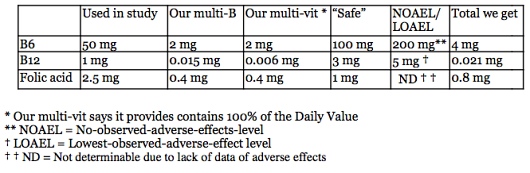
What about the amounts of B6, B12, and folic acid that were given? I went at once to see how much we get from the two vitamins we take each day, a multi-B and a regular multi-vitamin/mineral combination. Here’s what I found out:
The supplements we take at our house supply much less than the amounts used in the study.
That brings up two new questions:
Would it be safe to take such high levels? and
How much do we need to take to get the effect (assuming that the effect seen in the study is real)?
The second question is easier to answer: we don’t know. The study used high amounts, no doubt to be more certain of seeing any possible connexion. Lower levels might work, but that must await another study.
The first question has no definitive answer either. If you want my guess, it is that yes, it’s probably safe, but I’ve never even played a scientist on TV, so who am I to say? Below, I present the results of some quick research on safe levels of these vitamins, which indicate that probably the high levels are safe.
But first let’s consider some common-sense indicators. We can give some weight to where the authors work: Brigham and Women’s Hospital, Harvard Medical School; Departments of Biostatistics and Epidemiology, Harvard School of Public Health; and the National Eye Institute, Bethesda. The study participants were female health care professionals, not poor women in a remote country. While the potential conflict of interest statements at the end of the article reveal some funding from pharmaceutical companies, such companies generally don’t make much from vitamin preparations because they can’t really be patented to prevent others from selling similar products. Cynically, I conclude that respected ivy-league docs, with fellow health-care professionals as their guinea pigs, and no big money to tempt them, are probably not going to take risks by knowingly pushing the limits on safe levels of the study drugs.
Now for some numbers. The “Safe” levels in the chart above are from the Council for Responsible Nutrition, self-proclaimed to be “the leading trade association representing dietary supplement manufacturers and ingredient suppliers”. Those levels are conservative.
Two other kinds of data are known as NOAEL: No-observed-adverse-effects-level, and
LOAEL: Lowest-observed-adverse-effect level. Vitamin B6 has been tested up to levels of 200 mg/day without seeing any adverse effects, and for B12 up to 5 mg/day has been given before adverse effects were observed. These levels are well above the amounts used in the study. For folic acid, while “safe” levels have been named, there appears to be no research which has established NOAEL or LOAEL. [data from US Government sources compiled by Judy A. Driskell, Professor of Nutritional Science and Dietetics at the University of Nebraska]
Another reassuring fact is that all three of these vitamins are water-soluble, so they do not accumulate in the fatty tissues; excess is excreted in the urine.
Why are supplements necessary for these vitamins?
No one is likely to get the amounts used in the study, solely from unsupplemented foods. (See US Government charts of food nutrients, B6, B12, Folic Acid (folate).)
For example, to get 50 mg of B6, you’ll need to eat about 70 bananas or medium baked potatoes––and these are the two foods highest in that vitamin. Cold cereals are highly fortified, but it takes about 30 cups of fully fortified cereal to give you 50 mg, according to the government chart. For 2.5 mg of folic acid, get to work on putting away more than 2 pounds of cooked beef liver each day, or about 5 cups of fully fortified breakfast cereal.
If you are like me, you are wondering how people were ever healthy when all they had to eat was plain old food without any vitamin supplements, and no fortified cereal, bread, and milk. One answer, of course, is that our forebears often did suffer from vitamin deficiencies. It wasn’t just sailors on long voyages getting scurvy. And some conditions, like AMD, turn up more frequently now because more people live to the age where they occur. It is intriguing to wonder, though, what other factors may be at work when mega-levels of nutrients (far beyond those found in food) seem to protect against ailments. Perhaps the overall nutrient and micro-nutrient levels of our food are lowered by depleted soil in which crops (including animal feedstuffs) are grown, loss of nutrients during shipping and storage, and other elements of the modern commercial food business. Maybe we don’t get some as yet unknown nutrients which potentiate our use of other nutrients.
For my part, I’m going looking for supplements with higher doses of these three B vitamins. I may not end up with quite the levels used in the study, but I’ll see how close I can get within the limits of budget and willingness to swallow a bunch of pills.



 nosleepingdogs