Hydraulic mining scars, wildflowers, dogs, and poison oak, a short early-summer walk in the Siskiyous

[I’ve made brief corrections to this post regarding aspects of hydraulic mining, after a commenter pointed them out to me. And a more recent post goes into matters at more length, on points where I was wrong, and others on which I disagree with the commenter.]

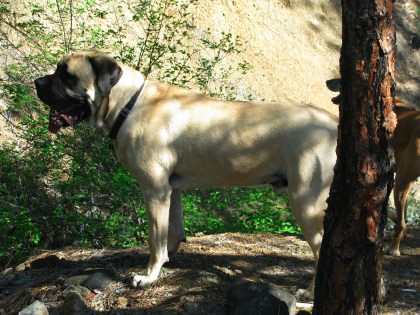
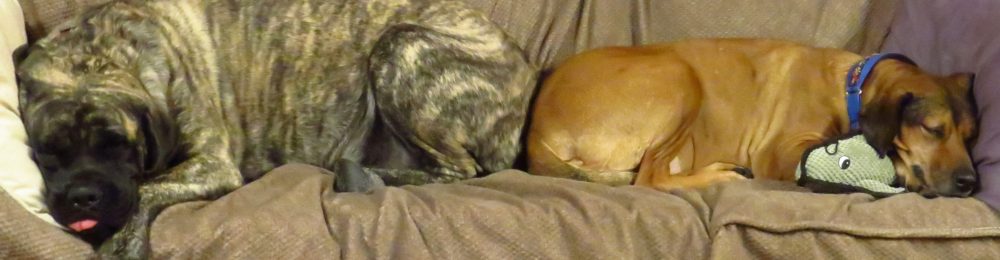
We took our new English Mastiff Jack for his first off-leash walk in the woods this morning. He is a 3 1/2 year old rescue who has been with us for nearly a month now. He has settled in very well, comes when called at home even if he is barking at the UPS guy, and so we thought he was ready for an off-leash ramble. Our elderly female Rhodesian Ridgeback went too.

The nearby Gin Lin Trail is named for a Chinese mine owner and “traces the remains of a late-nineteenth-century hydraulic gold mining operation in what was known as the Palmer Creek Diggings, now a part of the Rogue River National Forest.” [more info]

Hydraulic mining used huge pressurized streams of water to turn hillsides or mountainsides into slurry that could be run through sluice boxes to trap the gold. The photo below shows a large-scale operation in action, somewhere in this area of the Oregon Siskiyous, in the latter half of the 19th century. For scale, notice the tiny figure of a man wearing a white shirt, tending the left-hand water hose.
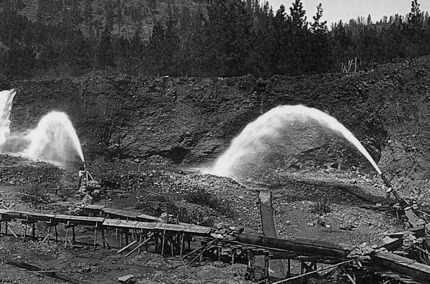
HydraulicMining1.jpg

The tremendous destruction takes geologic time, not human time, to heal. Huge clefts are made in the land, piles of big rocks and new hills of “processed” dirt are put anyplace convenient, and the subsoil brought up doesn’t support plant life as well as the now-buried topsoil did. All this is easily seen along the Gin Lin Trail.

GinLinDitch.jpg

The picture above shows a steep slope of discarded material a steep-sided ditch, probably hand-dug to accommodate the miners’ equipment—sluice boxes or water pipes. Both the angle of the slope, and the composition of the material itself, are hostile to plant growth. Even on the top where it is closer to level, trees and shrubs are not as numerous or healthy as in undisturbed areas.

Miners blasted away tons of earth trying to follow layers of gold-bearing gravel laid down by ancient rivers. This picture (below) shows a cut made by their work, at the point where they stopped. making ditches like this.

Dan&GinLinSlope.jpg

And here’s some of the big river rocks moved as the mining went on.
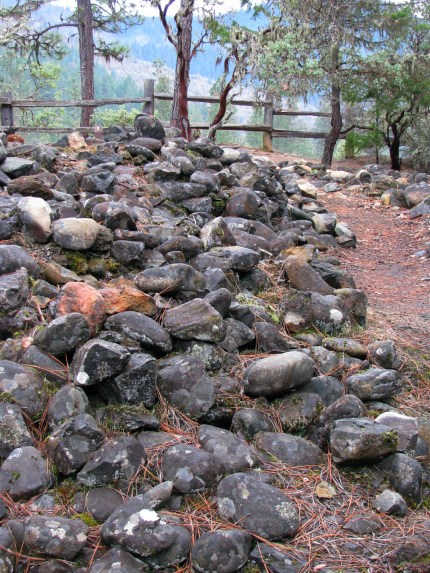
GinLinRockpile.jpg

The gold being sought had been deposited by watercourses running down to the river below, seen in the background of this picture. was in layers of Tertiary-era gravel, laid down in the bottoms of rivers 40 – 100 million years ago. Since then the river bottoms have been pushed up by geological forces, and cut through by new drainage systems. The ancient rivers may have had no connexion to existing rivers, since drainage patterns have changed.
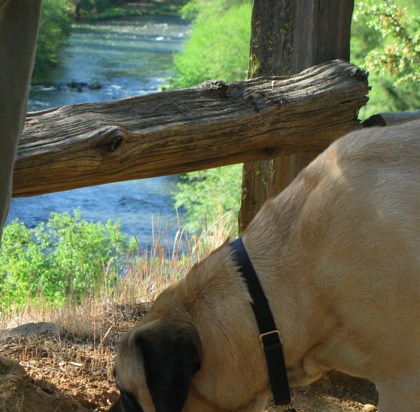
GinLinRiver1.jpg

Looking over the fence, from the same spot as the previous picture.

GinLinRiver2.jpg

The dogs had a good time, and Jack stayed close and came when called, as we expected.
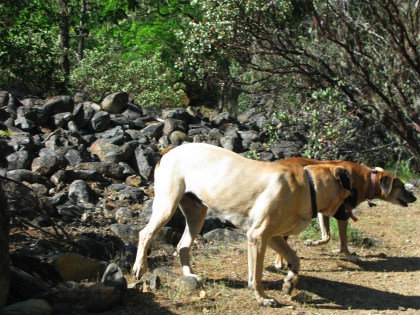
GinLinJack1.jpg
GinLinJack2.jpg

Because of the mining, it isn’t the best place for wildflowers, but we saw a few. This is Elegant Cat’s Ear (Calochortus elegans); the common name refers, I believe, to the fuzziness and triangular shape of the flower petals. This doesn’t show the plant’s leaves but there’s a good photo on Flickr that does.
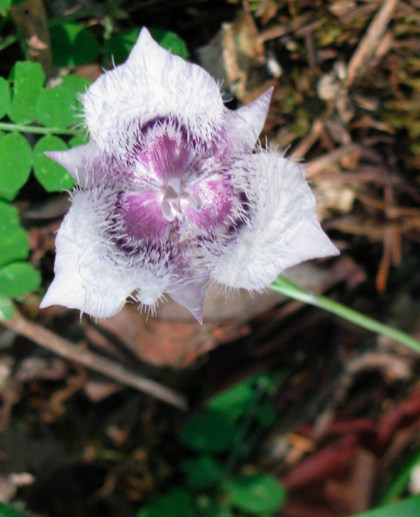
Cat'sEarFlower.jpg

Lupines don’t mind disturbed soil as much as many other plants do.

GinLinLupine.jpg

I think this is the Yellowleaf Iris, Iris chrysophylla.

GinLinIris.jpg

And below, Iris bracteata, Siskiyou Iris. [caveat: I’m no expert on wildflowers so my identifications are not guaranteed! This USFS page has photos, range maps, and descriptions of the Pacific Coast iris species.] In our experience, this yellow-flowered iris is less common around here than Iris chrysophylla, the Yellowleaf Iris.

GinLinSiskiyouIris.jpg

Below is my least favorite native plant around here, the glossy-leafed Poison Oak, Toxicodendron diversilobum.
GinLinPoisonOak.jpg

In spring its leaves are usually glossy like this, and may be reddish too. On another plant it would be attractive but to me, the shiny fresh leaves are as ominous as the froth on a bodysnatcher pod.
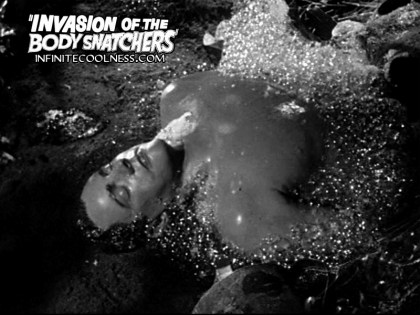
bodysnatcherswp04.jpg

We found it along most of the trail, flourishing as if it had been thickly planted and then fertilized and tended. If only my plants at home looked so good! Ravines were choked with it, and of course the dogs wanted to go running down into such places. I don’t think I’ve ever gotten poison oak from a dog’s coat, in all these years of living here, but there’s always a first time. I’ve often gotten it from secondary sources like clothing or even the touch of someone else’s hand. (In a post last year I described something that helps lessen the itching and make the blisters go away faster.)

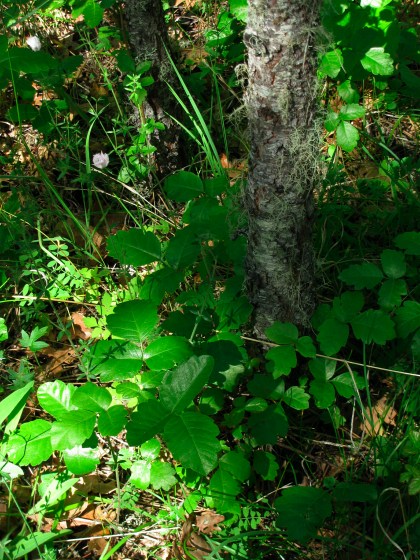
The damned stuff was everywhere. Every plant visible in the photo below is poison oak.

GinLinPoisonOak2.jpg

Finally the trail ahead was overgrown with it and we gave up and headed back. The dogs ran ahead, enjoying the downhill rush, and got out of sight as we neared the small parking area, where I heard excited voices. It turned out to be the teenage park maintenance crew and their adult supervisor, cruising the areas to do things like gather up garbage strewn around by animals during the night. They were excited by the sudden appearance of a dog who outweighed most of them, and Jack had been pleased to see them but hadn’t bowled anyone over or been a pest. He’s a sweet affable guy except when defending his home turf, and even then has a good sense of proportion.

We loaded up our tired dogs, filled their water dish in the car, and headed home.

Jack&BrookDrinking.jpg

Thirsty dogs drink from the birdbath.

More about credit cards, debt, pyramids, and eschatology

My recent post “Why I’m canceling my Bank of America credit card” brought a comment pointing out that cancelling credit cards can adversely affect one’s credit score, perhaps making it difficult to borrow for cars and houses. That may well be true, but it seems to spring from a view of credit and debt quite different from mine. Rather than dump this on the hapless commenter as a reply, I’ll say it here.

First, the companies have no incentive to restrict credit, and I expect they’ll soon be back to sending out credit apps to dogs and kindergartners. When the banks lose money through extending credit unwisely, they raise rates on the rest of us to recoup. Worst case, as now, the taxpayers bail them out, they buy each other up, write off debt, get tax breaks for losses. So I think people can safely cancel all but one or two cards, and still be able to use credit to make major purchases.

Second, I’m hoping that ordinary people, who DO have an incentive to learn from the present debacle, may start restricting their debt to large necessary items. Cars and houses usually do require going into debt. But I’m old enough to remember life without credit cards; my mom had a metal “charge-a-plate” for Macy’s, and there was layaway at some stores, but no credit cards. If you wanted something you saved up for it. If you couldn’t afford to go out to dinner, you didn’t go. To those accustomed to incurring chronic credit-card debt for indulgences, such a life may seem a bleak prospect. But actually I recall very few people growing despondent for want of cruises, concert tickets, and designer handbags.

Back in the 1980’s when I saw items at an Oregon department-type store bearing tags that said “Want me? Buy me!” and a credit card logo, I viewed it as a dangerous & selfish attitude to cultivate. Along with it came the re-definition of human beings as “consumers”.

The present economic system is a pyramid scheme because it is predicated on continual growth. We do not live in a world of infinite resources and space, therefore neither population nor consumption/production can continue to increase forever. Business interests, and even the administration, expect increased consumption to get us out of this depression. If it does, it can be only a temporary fix.

I know there are a lot of optimists out there who say not to worry about dismal stuff like the economy, climate change, and all that, because the world is going to end in 2012 (Mayan Calendar theory) or “soon” (some Christian fundamentalist theories). But I just can’t be that optimistic. Call me crazy, but what if we’ve got those Mayan numbers just a little bit wrong? Or some translator introduced an inaccuracy into the Book of Revelations? What if God has changed His mind, and now thinks it might be amusing to see how His little creatures manage with these challenges? We just can’t know. Better to keep our eyes on the ball, as it were (in this case the planet & its inhabitants) and not count on the Umpire calling the game on account of End of Time.

Why I’m canceling my Bank of America credit card

Going through a pile of mail last week I came across two items related to Bank of America.

First, the AARP newsletter had a short article about a guy collecting unemployment in (I think) New Mexico. The state issues the monthly amount via B of A debit card. When this fellow had questions, he was charged for the phone call to the bank; when he makes more than one withdrawal in a day he is charged a service fee. The amounts are small––but then, so are unemployment benefits. And whatever the amount, the fact that the bank levies these charges on unemployed people (who also have to pay taxes on their benefits) is appalling. The state also should take action, should have negotiated a different setup, but it is the Bank of America that is profiting from people for whom every dollar is precious.

Second, I received a tender missive from Bank of America, announcing that the interest rates were being raised. “The standard rate for new and outstanding balance transfers is increasing and will use the Variable Rate formula with a margin of 11.72 points” yielding an annual percentage rate (as of Feb. 2009) of 15.72%. New and outstanding purchase balances will have the same rate, and the rate for cash advances will go to 25.74%.

They calculate this rate by using the highest US Prime Rate over the preceding 3 months, as published in the Money Rates section of the Wall Street Journal. Can anyone say, “The odds always favor the house”?

Yes, banks perform a service. They must make a profit. But this is far beyond a fair profit. Banks now levy multiple charges, at least one on every stage of a transaction. Businesses pay a percentage of each transaction for the credit card processing. Every credit card user pays interest on amounts owed, sometimes even when paying the balance off in full each month. There are big late fees. Some banks (Chase, for one) have started charging a monthly maintenance fee for “processing payment and statements” [Wisebread blog].

Our local credit union issues us a VISA debit card, with no fees unless we get cash advances from an unaffiliated ATM. The credit union covers overdrafts (checks) for us by charging a line of credit so that we never will pay a bounced check fee. The credit union was not part of this reckless orgy of greed on the part of financial institutions, which has caused our economic crisis, and for which we ordinary folk are paying at every turn: taxpayer bailouts to the institutions who profited, massive unemployment, foreclosures, blighted lives as families become homeless and food pantries empty their shelves to gobsmacked crowds of the nouveau poor.

Screw the banks. Use cash, join your local credit union (credit union membership is now usually based on locality; you don’t need to work for a school, a certain corporation, or belong to a certain union, to join). And if you close an account or credit card, be sure to let the bank know exactly why. We are already paying plenty for their dishonesty and incompetence.

B of A.jpg

“Bank of America helps build strong communities by creating opportunities for people — including customers, shareholders and associates — to fulfill their dreams.”
Kenneth D. Lewis
Chairman, CEO and President 1

“Infectious” vs. “contagious”

Just because we’re all hearing about H1N1 flu, and these terms are being used a lot, here’s the difference:

Infectious

1. A disease capable of being transmitted from person to person, with or without actual contact.
2. Syn: infective
3. Denoting a disease due to the action of a microorganism.

Contagious

Relating to contagion; communicable or transmissible by contact with the sick or their fresh secretions or excretions.
[from Stedman’s online Medical Dictionary]

Anthrax, for example, is infectious but not contagious. It is caused by a microorganism, the bacterium Bacillus anthracis, but it’s not “communicable or transmissible by contact with the sick or their fresh secretions or excretions”. People most often get anthrax from contact with infected hides or other animal products, and from soil where the hardy spores of the bacterium can remain for decades after being deposited by infected animals. [Such spore formation is known in only a few bacteria.]

There’s some confusion inherent in these terms because it seems that the “contact with the sick or their fresh secretions or excretions” part only applies to sick humans. You might get rabies from breathing in droplets of the saliva of an infected animal, but that is not considered to be contagion. As near as I can tell, anyway. So, since a human being with rabies doesn’t infect others, the disease is considered non-contagious.

An important factor in any contagious disease is how easily it is transmitted from one person to another. You can’t get HIV from touching the skin of an infected person, but influenza and the common cold can be transmitted that way. Shake hands with someone who just sneezed into his or her hand, and the bacteria are on your hand; when you touch your mouth, nose or eyes, the microorganisms can enter your system. TB is contagious, as is leprosy, but they are not transmitted by brief casual contact.

Right now the question about H1N1 flu is, how contagious is it? And then, how fatal is it? Influenzas mutate rapidly so the virus which seems to have originated in Mexico may be changing to something different as it spreads. Hence the reluctance of medical officials to make predictions about what is in store for the world with this disease.