Threshing grain at the historic farm

ThreshingTossing.jpg

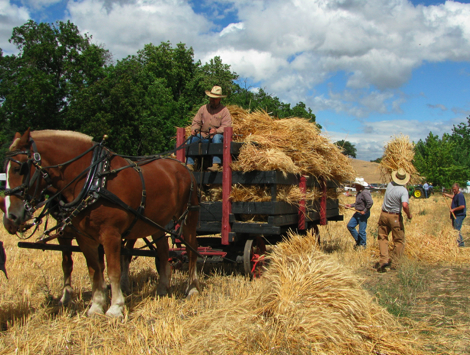
Here’s the old-style threshing of the grain at Hanley Historic Farm, Oregon; the beautiful golden “stooks” of gathered and bundled grain stalks appeared in an earlier post.

StooksFarmhouse.jpg

These stooks of hand-cut wheat, composed of bundles each tied with a stalk of wheat, sat out for weeks drying, and waiting for the Harvest Day Event on September 4, when the draft horse enthusiasts and old ag machinery collectors would join forces.

ThreshingSign.jpg

First the big placid draft horses made their way down the field, stopping to let workers with hay-rakes pitch (that’s “pitch” as in “pitchfork”) the stooks up onto the wagon, seen in the first picture. Once the wagon’s full, it heads back to the “home” end of the field.

ThreshingWagonFull.jpg

There, the old threshing machine awaits, attended by half a dozen or more other people who will fork the grain from the wagon onto a moving belt.

But first, line up the wagon next to the working area.

ThreshingHorsesByMachine.jpg

Then the horses are unhitched and led away; I thought perhaps this particular team did not like the noise of the machine, which was considerable. In 1900 or whenever this machine was made, a farmer’s team would probably be accustomed to the machine after a couple of acres had been worked, and would wait–––or two wagons could be used, hitching the team to an empty wagon to continue collecting the grain while the full wagon was threshed.
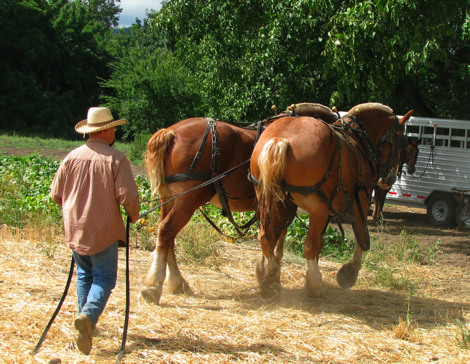
ThreshingHorsesUnhitched.jpg

The entire machine is long, with belt-driven parts to move the unthreshed grain into the whirling blades that knock the grain off the stalks. The next step separates grain from chopped straw or chaff.
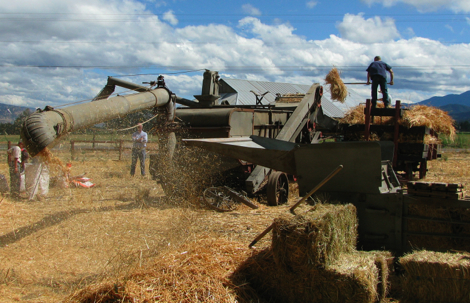
ThreshingEntireMachine.jpg

It may be a machine, but it is fed one fork of grain at a time.

ThreshingWomanWithFork.jpg

Streams of grain and chaff are blown through long pipes: the chaff into a pile, the grain into heavy cloth bags.

ThreshingBagsFilling.jpg

As on every farm in the history of the world, there’s work for kids old enough to know the routine.

ThreshingKidBagging.jpg

The filled bags are hand-sewn shut.

ThreshingBagsSewn.jpg

Once these threshing machines came into use, horses provided the power for only some of the work. The thresher itself ran from a steam, or later gasoline, engine powering the main belt. This day, a more modern machine was used for the Power Take-Off (PTO) to the thresher.

ThreshingTractorPTO.jpg

Here you can see the power belt, and the chopping teeth that actually do the threshing.

TreshingBelt&Teeth.jpg

Although the chaff is just being blown onto a pile in the background here, it is not a waste material, but would be used for bedding in stalls during the winter. Mucked-out straw would be used for fertilizing fields or maybe the kitchen garden area. These days, commercially produced wheat straw is used for decorative interior panels, making ethanol, soil amendment, animal feed (treated with urea, and with nutrients added, yuk), paper, and packaging. Many new uses are being examined. And of course, it’s still good for animal bedding.
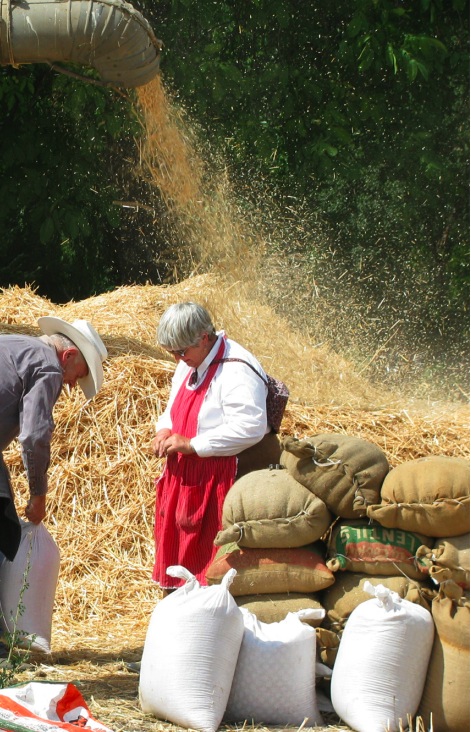
ThreshingChaff&Bags.jpg

Our view of early machine threshing on this day didn’t show what hard work it would have been, when many acres of grain had to be gotten in before the weather changed, when teams of horses brought a continuous supply of grain to the people feeding it to the machine, and the labor of bending to sew bags and then tote them away never stopped. But, unlike a lot of physical work in the industrial age, it was not what you did 50 weeks a year. There’s a pride in getting it done

ThreshingOlderMan1.jpg

and those too young to take part look on, eager to be old enough.

ThreshingKidLookingOn2.jpg

And when the belt stops moving, the old hands find a spot in the shade.

ThreshingOldGuysRestCR.jpg

Animals encourage us to slow down

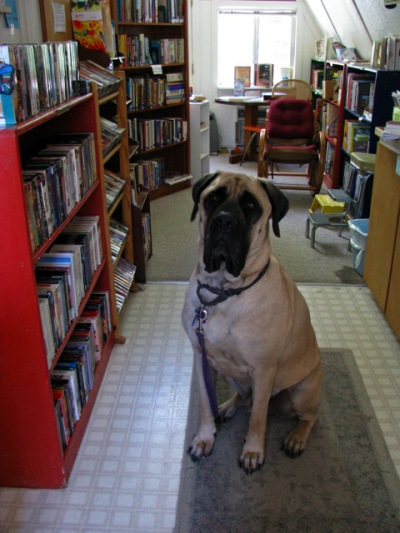
Jack the mastiff came with me today for my volunteer time at the local library’s Friends’ bookstore, in a small a-frame building by the library. He’s very good there, usually sleeps but is always listening for someone at the door, so I try to get to the door first and alert people to the presence of a large dog. So far our customers have all been fine with him being there, and his calm sweet demeanor earns him lots of pets.

Jack at the a-frame.jpg

He did get excited on his second visit, when he first noticed the fake cats perched on several shelves. The one with real fur (rabbit fur I think) was especially interesting to him and he approached it with a mixture of caution and curiosity that was funny to watch.

Jack & fake cat.jpg

As we drove home it was a fine cool fall day, and I found myself slowing down to 30 on the rural road so that Jack could put his head out the window. At 45 or 50 mph he doesn’t like it very much, and there’s some risk from objects (insects, debris) that might hit him in the eye. So we motored home at an unusually slow rate, each appreciating the day in our way. Too much pointless hurrying in life!

Here’s Jack when we stopped to get the mail. He’s looking around for any neighbor dogs that may come out to bark at him, that is one thing he is not calm about.

Jack, head out of car.jpg

Listening to what people say: no victim “deserves it”

Recently I’ve noticed, in reports of crimes against persons, an abhorrent phrase that seems to be commonly accepted: people being quoted as saying that the victim “didn’t deserve this”. Who does deserve being beaten, raped, or murdered? Ah, but maybe this person did deserve a beating––but was murdered instead. No, too subtle.

Was I imagining it? I googled “didn’t deserve to die”, the strongest usage, and quickly came up with half a dozen different instances.

Then, on the front page of the Oregonian a week or so ago, I saw this one: a driver with a blood alcohol level “approaching .30” ran his car up onto a sidewalk in broad daylight and pinned a pedestrian against a utility pole. As the drunk tried to drive away he hit the pedestrian two more times. Oh yes, and the pedestrian was blind and carrying a white cane. The driver was chased and boxed in by other drivers. Since his arrest, he had been trying to make a good impression: visiting the badly injured man, publicizing his own past volunteer work (performed while he was a bank exec), all that sort of thing. The article reported on his appearance in court for sentencing, definitely an occasion to choose one’s words carefully. What did he say, in his attempt at an apology?

“He didn’t deserve it. It was all my fault.”

Good to know that the blind man didn’t actually deserve being run over three times, we were all wondering about that.

What’s going on here?

According to my unscientific survey the phrase is used at least as often by the relatives of victims, as by those accused of the crime in question. So I conclude that this represents a general societal attitude, which tacitly regards some people as deserving to be harmed or attacked by others.

The connexion that came up in my mind was with a shift in moral education over the past three decades or so, which changed the focus from the person acting, to the person being acted upon, and from general principles of interpersonal behavior, to principles regarding certain groups. In an effort to end harassment of minorities and those perceived as different, we started teaching children and adults to avoid ridiculing this or that sort of person––overweight or gay, for example. Something needed to be done, to end these long-winked-at instances of bullying and cruelty, but how much better to emphasize a universal (and positive, rather than negative) approach of being polite and compassionate. Singling out groups creates assumptions that groups not named may be fair game. “Nobody told me not to call him names, he’s an Italian/left-handed/too skinny/a nerd!”

The general approach is better all around.

Some pragmatic reasons: It’s far easier, no need to remember who you’re supposed to be kind to this week. Like deciding that you are going to stop your car whenever a pedestrian is trying to cross, instead of having to make a judgment call on the fly each time. No type of person is accidentally omitted (though of course people who are dangerous, manipulative, etc., can and often must be treated differently). Those are points of persuasion for people not so much moved by moral considerations alone (to me it’s surprising how often there are practical reasons which could be used to bolster the “should/ought” arguments).

Moral arguments include: putting responsibility where it belongs, on the act-or instead of the act-ee; promoting human community rather than division; generally strengthening the moral rule which is one that makes human interchange run much more smoothly and harmoniously.

Then, from a different angle, there’s Shakespeare’s take what the just deserts of a human being, “poor bare, forked animal”, may be

HamletOnJustDeserts.jpg

Home Ground: Words of our native land

Home Ground: Language for an American Landscape, edited by Barry Lopez. Trinity University Press, San Antonio Texas, 2006.

One of the language byways I find fascinating is that of terms for landforms; they’re often based on metaphors (oxbow bend in a river, neck of land), some have ancient linguistic roots, others reflect the cultural history of an area with words from the language of indigenous people or early explorers. Those who share my interest will love this book, but it also has appeal for those who enjoy American regional writing or history, or are interested in how the landforms we see come into being.

Home Ground’s entries are in alphabetical order but it’s far richer than a dictionary. Entries are signed by their authors, who are mostly American writers with particular regional roots––novelists, poets, nature writers, scientists. From them we hear not just the definition and history of the term but also more diverse notes: political (the drowning of Celilo Falls in the Columbia River, by a dam, comes up in the entry for dalles), ecological, personal, and literary (quotations from hundreds of writers including Thoreau, Jack London, T.S. Eliot, Joel Chandler Harris, Pablo Neruda, Louis L’Amour, Joyce Carol Oates).

There are no fewer than three indexes: one for authors so quoted, one for terms (with cross-references), and one for specific place names mentioned: the San Andreas Fault, Satans Slab, South Dakota. And there are short biographies of the writers who produced the entries. With all this, you can browse the book or look for something specific like every mention of the Mississippi River, all the terms relating to ice, or mentions of Herman Melville.

If you have ever wondered what the difference is between a hill and a mountain, or among the words canyon/cleft/coulee/gorge/gully/ravine, you can find out right here. Terms run the gamut of languages––ronde, tseghiizi (Navajo), névé, krummholz, cuesta, gumbo (probably from a Central Bantu dialect), nunatuk, eddy (possbily Norse), erg (Arabic) and so on (although etymology is not always included). And they vary from the words of Western science (imbricated rock) to those of other observers (coyote well, paternoster lake).

And now, a few sample entries:

tule land

Tule land is a term recorded as early as 1856, just after gold rush. It usually refers to the flats of bulrushes and other reeds along the rivers of the West Coast. In the muddy shallows along the Sacramento, for example, as the river takes its time joining the San Joaquin and approaching the San Pablo and San Francisco Bays, there are vast thickets of reeds, home to waterfowl and fur-bearing animals. Tule lands are especially common at the junctures of rivers, where the slightest breeze will set the rushes whispering and rasping over the mud and standing water. The Wintu Indians called tule land “the storehouse of instant tools” because the rushes could be used to make so many things: mats, clothes, baskets, lodges, boats, and cradles, sandals, brooms, fish traps, and talismanic images. ROBERT MORGAN

nivation hollow

In A Walk in the Woods: Rediscovering America on the Appalachian Trail,
Bill Bryson wrote: “I never met a hiker with a good word to say about
the trail in Pennsylvania. It is, as someone told a National Geographic reporter in 1987, the place ‘where boots go to die.’…Mile upon mile of ragged, oddly angled slabs of stone strewn about in wobbly piles…These require constant attentiveness if you are not to twist an ankle or sprawl on your face––not a pleasant experience with fifty pounds of momentum on your back.” Such a hiker on the Appalachian Trail in Pennsylvania might just as well have been complaining about nivation hollows. A bowl-shaped depression in the ground, a nivation hollow begins to take shape when ice forms over a shallow rock basin beneath a snow bank. The ice freezes and thaws over time. During the warm period, melted snow seeps into the bottom of the hollow. During the cooler period, the seep water freezes. The rock breaks up, weathers, and erodes. Meltwater carries away the finer rock particles and the hollow becomes larger and deeper. MARY SWANDER

fil du courant

A Cajun French term meaning “thread of the current,” fil du courant is used to describe the optimal navigation course within a bayou or river. The fil is often visible as a glassy-smooth pathway through the otherwise ripping water. Louisiana shrimpers follow the fil du courant to avoid underwater obstructions and to secure sufficient depth for skim nets that extend winglike from either side of the vessel. MIKE TIDWELL

fall line

Fall line is a phrase both metaphoric and literal. In broader terms, it means the zone where the Piedmont foothills level out into the coastal plain, where sandy soil derived from marine deposits replaces rocky rolling land. On some southeastern rivers, such as in the Carolinas and Virginia, the Fall Line is a specific place where shoals and rapids once stopped navigation from the coast because ships couldn’t pass through. Cities such as Richmond, Fayetteville, and Columbia sprang up at the head of navigation, and mills and factories were built to take advantage of the water power at the falls and rapids. The abrupt change of elevation caused industry and commerce, courts and seats of government, to take root in those areas. ROBERT MORGAN

Line drawings, by Molly O’Halloran, illustrate some of the terms, such as this one for “Quaking Bog” which shows how peat, sphagnum, geologic forms, plants and water all combine to form this floating vegetative structure that will seem solid until stepped on. [The scan is much reduced, and for some reason tinted beige, unlike the original.]

quaking bog2.jpg