Neat (but voracious) caterpillar, Orgyia pseudotsugata

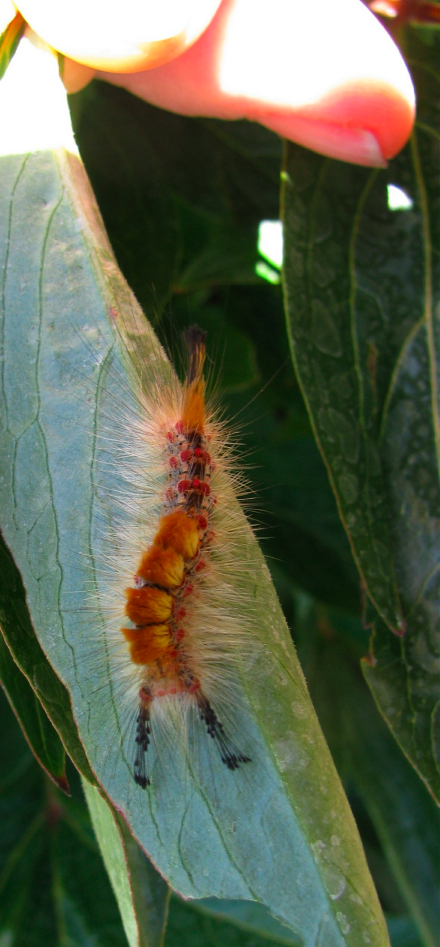
We found this caterpillar on a ground peony in our garden this morning.

Orgiya_pseudotsugata1.jpg

It is the larval form of the Douglas Fir Tussock Moth, Orgyia pseudotsugata. They are, like most caterpillars, voracious eaters and can have a devastating effect on Doug fir forests. Spraying, of pesticides or pheromones such as microbial insecticide Bacillus thuringiensis, and insect growth regulators, is often used against tussock moth infestations. Human activities, such as monoculture forest plantations, suppression of forest fires, and elimination of potential predators, have encouraged tussock moth proliferation.

Orgiya_pseudotsugata2.jpg

We were able to make a pretty firm identification of the caterpillar thanks to a terrific book, Lepidoptera of the Pacific Northwest: Caterpillars and Adults, by Jeffrey C. Miller and Paul Hammond. [Forest Health Enterprise. H.J. Andrews Publication Number 3739. December 2003. The authors work at Oregon State University in Corvallis.] Each page has a good photo of the caterpillar and adult forms of one species, with descriptions of appearance and ecology, such as what plants they are likely to be found on. Great book! Your tax dollars at work!

You can view or download the book as sections in pdf form. This moth is on page 175 of this pdf section. The book, an oversize paperback, is published by the USDA Forest Service, and was available several years ago (& still may be), free or very cheap, from
Richard C. Reardon rreardon@fs.fed.us
USDA Forest Service
180 Canfield St.
Morgantown WV 26505

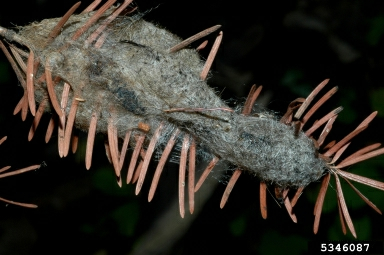
Here’s a photo of the cocoon form, woven around dead Doug fir needles. [Photo by William M. Ciesla, Forest Health Management International] Lots more information and photos of Orgyia pseudotsugata here and here.

Orgyia_pseudotsugata_cocoon.jpg

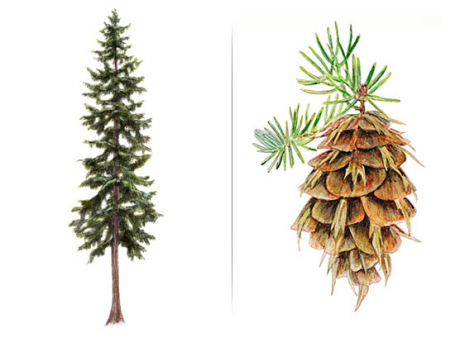
The Douglas Fir (Pseudotsuga menziesii) is an extremely common forest species in the West, a primary source of lumber, and is the state tree of Oregon. Notice the distinctive cone. [Image from Encarta.]

Pseudotsuga_menziesii.jpg

Hydraulic mining scars, wildflowers, dogs, and poison oak, a short early-summer walk in the Siskiyous

[I’ve made brief corrections to this post regarding aspects of hydraulic mining, after a commenter pointed them out to me. And a more recent post goes into matters at more length, on points where I was wrong, and others on which I disagree with the commenter.]

We took our new English Mastiff Jack for his first off-leash walk in the woods this morning. He is a 3 1/2 year old rescue who has been with us for nearly a month now. He has settled in very well, comes when called at home even if he is barking at the UPS guy, and so we thought he was ready for an off-leash ramble. Our elderly female Rhodesian Ridgeback went too.

The nearby Gin Lin Trail is named for a Chinese mine owner and “traces the remains of a late-nineteenth-century hydraulic gold mining operation in what was known as the Palmer Creek Diggings, now a part of the Rogue River National Forest.” [more info]

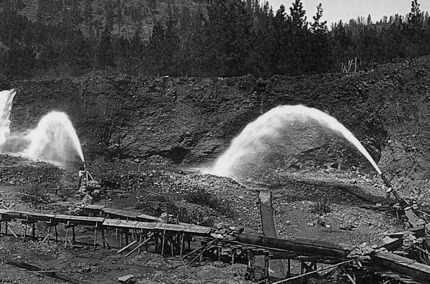
Hydraulic mining used huge pressurized streams of water to turn hillsides or mountainsides into slurry that could be run through sluice boxes to trap the gold. The photo below shows a large-scale operation in action, somewhere in this area of the Oregon Siskiyous, in the latter half of the 19th century. For scale, notice the tiny figure of a man wearing a white shirt, tending the left-hand water hose.

HydraulicMining1.jpg

The tremendous destruction takes geologic time, not human time, to heal. Huge clefts are made in the land, piles of big rocks and new hills of “processed” dirt are put anyplace convenient, and the subsoil brought up doesn’t support plant life as well as the now-buried topsoil did. All this is easily seen along the Gin Lin Trail.

GinLinDitch.jpg

The picture above shows a steep slope of discarded material a steep-sided ditch, probably hand-dug to accommodate the miners’ equipment—sluice boxes or water pipes. Both the angle of the slope, and the composition of the material itself, are hostile to plant growth. Even on the top where it is closer to level, trees and shrubs are not as numerous or healthy as in undisturbed areas.

Miners blasted away tons of earth trying to follow layers of gold-bearing gravel laid down by ancient rivers. This picture (below) shows a cut made by their work, at the point where they stopped. making ditches like this.

Dan&GinLinSlope.jpg

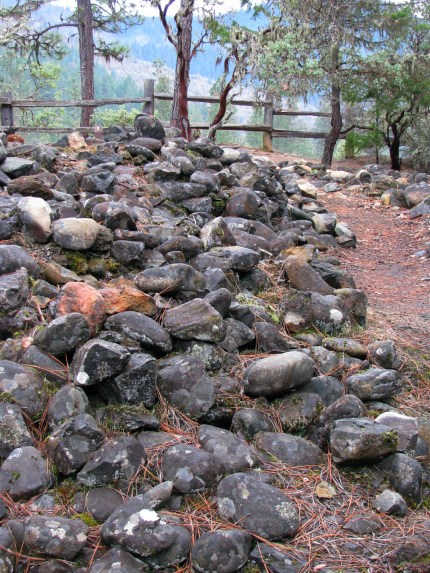
And here’s some of the big river rocks moved as the mining went on.

GinLinRockpile.jpg

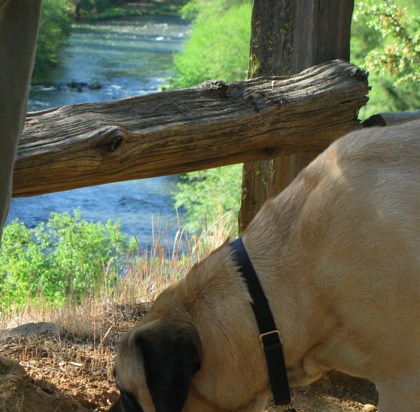
The gold being sought had been deposited by watercourses running down to the river below, seen in the background of this picture. was in layers of Tertiary-era gravel, laid down in the bottoms of rivers 40 – 100 million years ago. Since then the river bottoms have been pushed up by geological forces, and cut through by new drainage systems. The ancient rivers may have had no connexion to existing rivers, since drainage patterns have changed.

GinLinRiver1.jpg

Looking over the fence, from the same spot as the previous picture.

GinLinRiver2.jpg

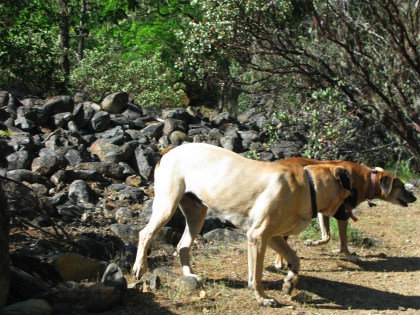
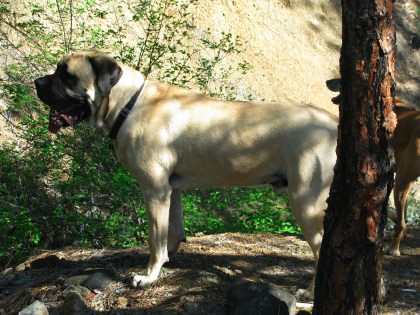
The dogs had a good time, and Jack stayed close and came when called, as we expected.

GinLinJack1.jpg
GinLinJack2.jpg

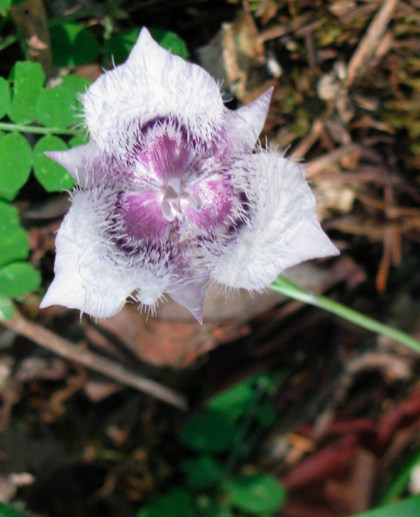
Because of the mining, it isn’t the best place for wildflowers, but we saw a few. This is Elegant Cat’s Ear (Calochortus elegans); the common name refers, I believe, to the fuzziness and triangular shape of the flower petals. This doesn’t show the plant’s leaves but there’s a good photo on Flickr that does.

Cat'sEarFlower.jpg

Lupines don’t mind disturbed soil as much as many other plants do.

GinLinLupine.jpg

I think this is the Yellowleaf Iris, Iris chrysophylla.

GinLinIris.jpg

And below, Iris bracteata, Siskiyou Iris. [caveat: I’m no expert on wildflowers so my identifications are not guaranteed! This USFS page has photos, range maps, and descriptions of the Pacific Coast iris species.] In our experience, this yellow-flowered iris is less common around here than Iris chrysophylla, the Yellowleaf Iris.

GinLinSiskiyouIris.jpg

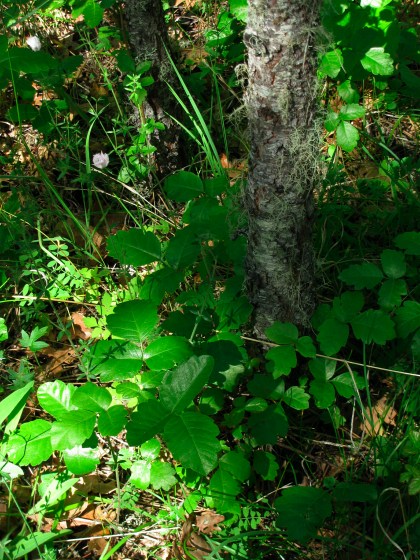
Below is my least favorite native plant around here, the glossy-leafed Poison Oak, Toxicodendron diversilobum.

GinLinPoisonOak.jpg

In spring its leaves are usually glossy like this, and may be reddish too. On another plant it would be attractive but to me, the shiny fresh leaves are as ominous as the froth on a bodysnatcher pod.

bodysnatcherswp04.jpg

We found it along most of the trail, flourishing as if it had been thickly planted and then fertilized and tended. If only my plants at home looked so good! Ravines were choked with it, and of course the dogs wanted to go running down into such places. I don’t think I’ve ever gotten poison oak from a dog’s coat, in all these years of living here, but there’s always a first time. I’ve often gotten it from secondary sources like clothing or even the touch of someone else’s hand. (In a post last year I described something that helps lessen the itching and make the blisters go away faster.)

The damned stuff was everywhere. Every plant visible in the photo below is poison oak.

GinLinPoisonOak2.jpg

Finally the trail ahead was overgrown with it and we gave up and headed back. The dogs ran ahead, enjoying the downhill rush, and got out of sight as we neared the small parking area, where I heard excited voices. It turned out to be the teenage park maintenance crew and their adult supervisor, cruising the areas to do things like gather up garbage strewn around by animals during the night. They were excited by the sudden appearance of a dog who outweighed most of them, and Jack had been pleased to see them but hadn’t bowled anyone over or been a pest. He’s a sweet affable guy except when defending his home turf, and even then has a good sense of proportion.

We loaded up our tired dogs, filled their water dish in the car, and headed home.

Jack&BrookDrinking.jpg

Thirsty dogs drink from the birdbath.

Spring beauty: Erythroniums (Trout Lilies)

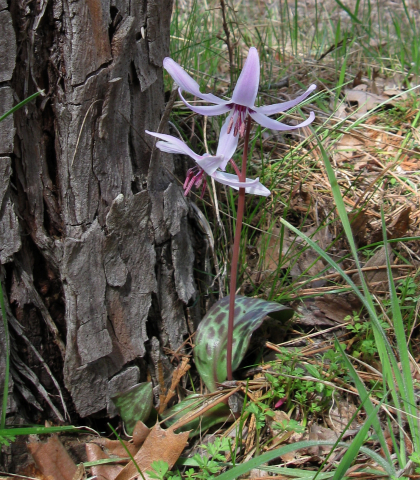
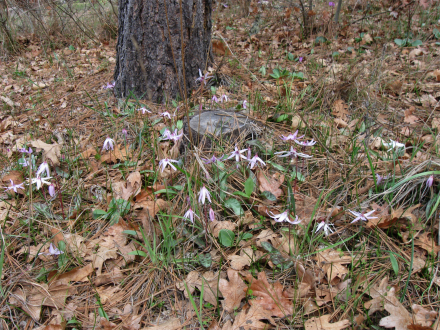
These elegant and delicate plants flower for a week or so, set seed (which are carried deep underground by ants, where some germinate) and vanish within weeks, spotted leaves and all, until next year. The leaves are beautiful in themselves, and give several Erythronium species their common names, Trout Lily and Fawn Lily. They may also be called dog’s-tooth violet and adder’s-tongue, for reasons unknown to me. Here we have Erythronium hendersonii, the only purplish species. Others are white, pink, or yellow. Species found in southern Oregon include E. hendersonii, E. oregonum, E. californicum, E. montanum (Avalanche Lily), E. citrinum (Citrus Fawn Lily or Cream Fawn Lily), E. howellii, and E. klamathense/klamathensis.

These pictures were taken April 3 and 4, 2009.

Erythronium CRborder.jpg
erythroniumByTree.jpg

Erythronium2.jpg

ErythroniumPatch.jpg

erythronium leaf2.jpg

Unusual fungus: in the Cordyceps genus?

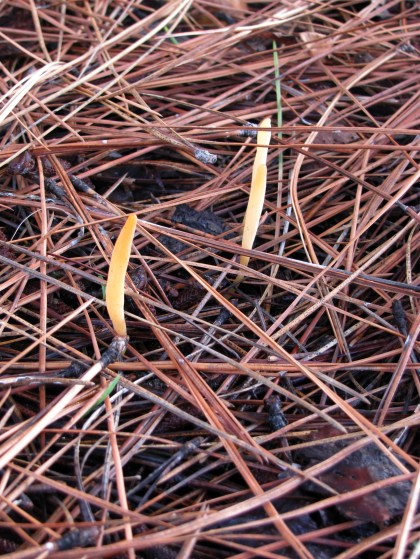
Late in December we were walking to the mailbox when my sharp-eyed husband spotted some very inconspicuous fungi growing a few feet off the gravel driveway.

Fungus1.jpg
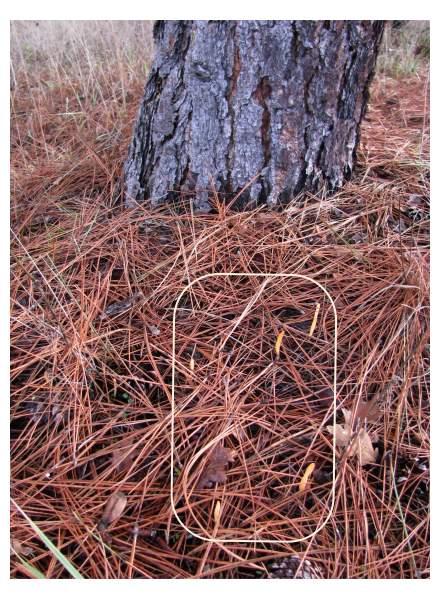
fungus_cordyceps_Group2.jpg

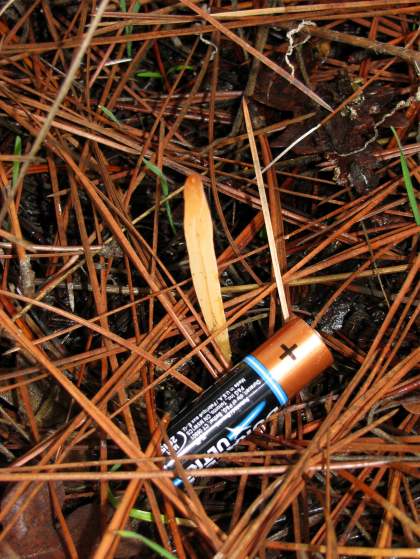
They occurred singly, but sometimes several with a square foot or so. In the photo above there are five within the white outline. You can see the approximate size, in comparison to an AA battery, below.

fungus3.jpg

We’d never seen this before, so at home I searched online to identify it, starting with my first thought: it most reminded me of a coral-type fungus popularly known as “dead man’s fingers”. With the common name to search on I easily found a good page with photo and description of Xylaria polymorpha (Dead Man’s Fingers). But no, they don’t have the amber-to-peach color, or the slim shape of what we saw. More searching, through the clubs and corals section of this site. When I found Cordyceps militaris, I thought I had it, and nothing else I turned up on this site or elsewhere came closer to matching the size and appearance of our new fungus. Also it appears aboveground now, rather than in spring.

fungus_cordyceps_militaris_01_thumb.jpg

fungus_cordyceps_militaris_03.jpg

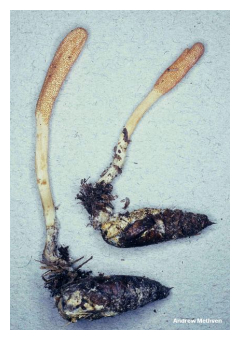
Both photos from the same page cited above, on Michael Kuo’s mushroomexpert.com site.


It’s always neat to identify things, but this tentative identification came with an added surprise regarding the host of the fungus. Kuo says,

The genus Cordyceps consists of clublike parasites that attack underground puffballs or insects. The puffball-parasitizing species are cool enough (see Cordyceps ophioglossoides for an example, and see the Key to Mycotrophs for a key to 5 North American species), but the bug parasites are astounding. They erupt from insects, bringing to mind the infamous scene in Alien in which John Hurt has a very bad meal.

Cordyceps militaris is the best-known and most frequently collected bug-killing Cordyceps, but there are dozens of “entomogenous” species in North America. The victim for Cordyceps militaris is a pupa or larva (usually of a butterfly or moth). Its mycelium colonizes the living insect and mummifies it, keeping it alive just long enough to generate the biomass it needs to produce the mushroom–a “spore factory” that allows the Cordyceps to reproduce.

With Cordyceps militaris the bug is buried in the ground or in well decayed wood, which means the mushroom collector usually sees only a little orange club with a finely pimply surface.

In the right-hand photo above you can see the pupae from which the mushrooms grew.

In fact, one species of this genus attained a queasy notoriety not long ago as the “mind-control” fungus, because it infects tropical ants and when ready to spread spores, somehow drives the ants upward on plants, where the spore body bursts in an optimal location for dissemination. You can see a YouTube video on this which was drawn from a David Attenborough presentation. The video shows ants behaving oddly, then climbing, then the disturbing progression of the fungus emerging, over time, from the head of an ant while it clings motionless to a stem. Victims of some of the many other Cordyceps species are shown––each specializes on a different insect. However, Attenborough closes with a sop to our human sensibilities: the fungi have a “positive effect” on the overall ecosystem by preventing any one species of insect from becoming disproportionately numerous. [For description and photos of other parasites which manipulate their hosts’ behavior for their own ends, including a worm that causes its terrestrial host insects to leap suicidally into water where it can then proceed to its next stage, see this page.]

After we first spotted the possible Cordyceps mushrooms there was a snow that stayed around, and only today did I get back to look for the underground host. Would it be a puffball, or pupa? I went out with camera, paring knife, ruler, and a kneeling pad to investigate. While I find the photos of the parasitized insects repellent, I was still excited about making a little discovery. Of such inconsistencies are humans composed.

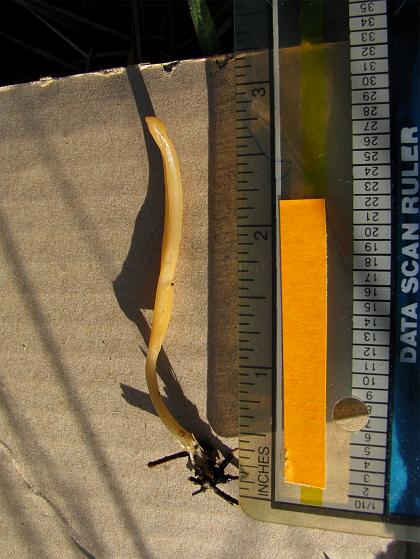
The work had to be done slowly and carefully: the mushrooms are brittle, and they have grown up through one or two inches of loosely packed pine needle bunches. Moving away the needles can break a mushroom that has emerged between the needles of a single bunch. Once the mushroom had broken off, either above or below ground, with the naked eye I could not detect any path to follow downward, no stem-like structure, no path of mycelia leading to the nutrient source. The brown things at the base on the picture below are not roots but bits of decayed pine needle, as far as I can tell.

fungus_cordyceps 5.jpg

Also, the mushrooms may angle through the ground on their way up, and whatever connexions lie underground are apparently very delicate and fragile. Digging around one with the knife and attempting to raise it along with a small clump of its surroundings did not succeed. The mushroom still came away with no visible source. The brown things at the base on the picture below are not roots but bits of decayed pine needle, as far as I can tell.

I dug deeper under where the mushroom had been, and pulled out the crumbly earth, thinking I might find the remains of puffball or insect, but I didn’t. There were little chunks of bark spiderwebbed with mycelia, and at one spot a small mass of mycelia but no way for me to link this with the aboveground mushroom.

Finally I gave up, feeling bad that I had dug up 5 of these little guys before they had dispersed their spores and I hadn’t answered my question or evolved a better technique. The host body––puffball or pupa––may be consumed, gone. Or, I might find it if I took a shovel, dug up one mushroom surrounded by a spadeful of earth, and then used archaeological delicacy to remove the soil a bit at a time. Then again, it may be another of the many Cordyceps species, growing from something completely different. Maybe another day.

In the meantime, perhaps someone else has an idea what these fungi might be: popping up in late December, near conifers in open mixed forest, recent growth, at the 2000′-2500′ level in the Siskiyous of Southern Oregon. Any suggestions?