Indian Paintbrush and Elegant Cat’s Ears

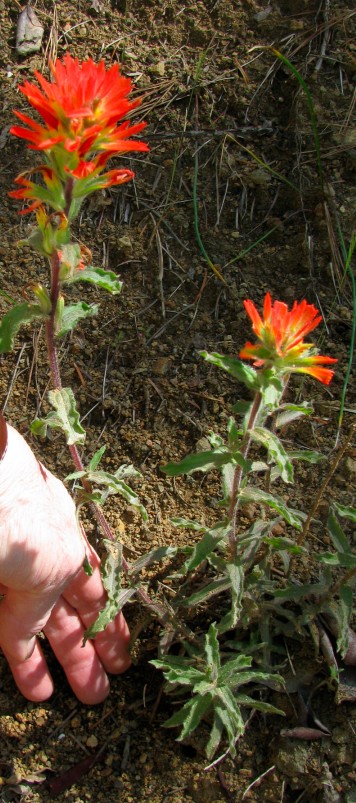
Today I revisited the Indian Paintbrush mentioned in my last post, to check it for diagnostic features of the species that it seemed most likely to be, Castilleja applegatei (Applegate’s Indian paintbrush, wavyleaf Indian paintbrush). Is this obsessive behavior? Maybe, but harmless. And I like it that trying to identify the plants we photograph makes me take a much closer look at them.

Castilleja with hand.jpg

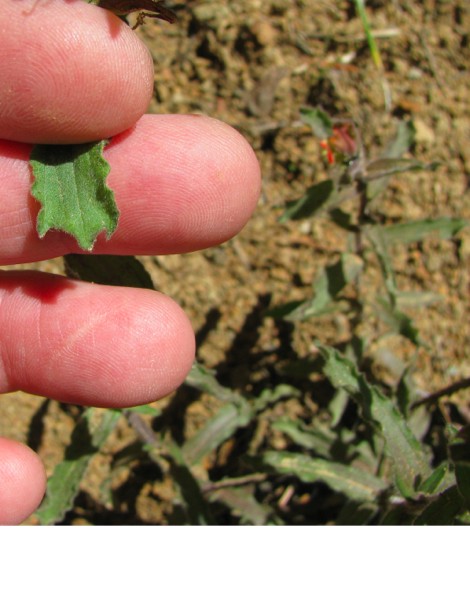
According to the Lady Bird Johnson Wildflower Center, there are 46 species of Castilleja known as “paintbrush” that are native to North America, and 17 are found in Oregon. The beauty above probably is wavyleaf Indian paintbrush, Castilleja applegatei; the wavy leaves are clearly visible in the photo, and it fits in other respects although different online sources vary on fine points. Is it the upper leaves that are often three-lobed, or the lower ones? Well, at first the narrow leaves of our plant seemed to have no lobes at all but when I uncurled the tip of an upper leaf, there were indeed three lobes.

Castilleja leaf.jpg

Lower leaves had no lobes.

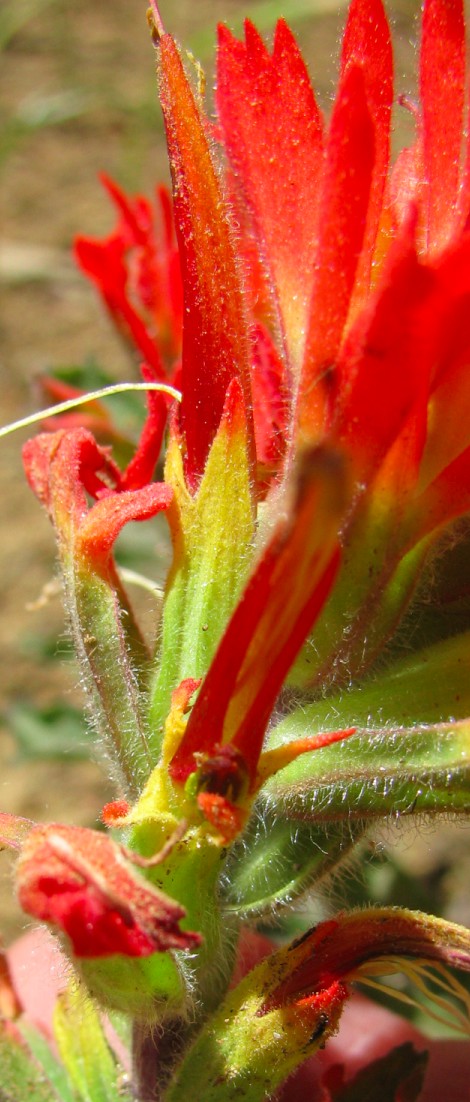
The stickiness of flower and/or leaves that some describe was not evident today, but the flower is older and perhaps has dried out a bit. The flower and leaves are covered with tiny silvery hairs.

Castilleja hairs.jpg

Many Castilleja species are root-parasites, connecting to the roots of nearby grasses or forbs. They can live either independently or as parasites (a capability which makes them “hemi-parasites”) but naturally they grow faster and bigger when receiving some nutrients from a host plant. The individual in our pictures is small, perhaps because nothing much is growing near it to parasitize.

Castilleja wide view.jpg

The small whitish flowers to the right are elegant cat’s ears, Calochortus elegans; we’ve seen more of this species this year than ever in the 14 years we’ve lived here.

Elegant Cat's Ear Bud.jpg

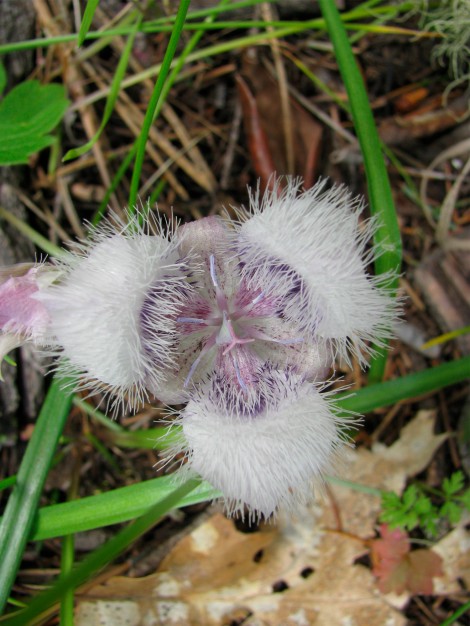
The Pacific Bulb Society’s site has 8 pages of photos and descriptions of Calochortus species; well worth browsing as this genus of lilies is notable for stunning flowers.

Elegant Cat's Ear from above.jpg

Some wildflower identification resources for the non-botanist

In working to identify wildflowers that we’ve photographed, I’ve found several good sites. (Having never studied botany, I’d have to learn a lot in order to key them out, so these are all strictly amateur identifications based on our field guides and information on the web. But I do go beyond simply looking for flowers that resemble what we’ve seen; I try to examine all the species found in our area, compare foliage, habitat, and prominent flower features such as stamen color.)

One site I recommend, especially for flowers of the Pacific Northwest, is Turner Photographics Wildflowers, where “[o]ver 7,000 wildflower photographs by Mark Turner are available… as stock photography…” While one may not reproduce the photos without permission/payment—this is how Mr. Turner makes his living, so respect that— they are a great resource because he has enabled the user to search by flower color, flower type, genus, and family. You can also browse photos by the month in which they were taken.

turner.jpg

“The photos were created throughout the Pacific Northwest and in other parts of the United States and Canada. Most are from locations in Washington or Oregon. Every plant pictured is identified by Latin and common name.” Since many wildflowers have wide ranges, you may find this site helpful even if you’re flower-watching in another part of the US or Canada. And just browsing these fine photographs is really a pleasure.

Moreover, each species has a range map, links to more information such as the USDA’s site, and a summary description:

Turner2.jpg

The CalPhotos site at UC Berkeley has a lot of photographs, “251,866 photos of plants, animals, fossils, people, and landscapes from around the world”. Once you’ve got a genus or species in mind, you can often find a variety of photos here to compare. For Indian paintbrush, Castilleja genus, there are 677 photos (there are 46 species native to North America, and 17 native to Oregon, according to one source). The photos are arranged by species

However, in a tradeoff for the size of this image database, the identifications are those provided by the photographers. “We cannot guarantee the accuracy of the identifications of the plants in this collection of photos. Many of these photos have been contributed by native plant enthusiasts who were not trained as botanists. Occasionally we discover that the plant in a photo has been incorrectly identified by the photographer, though usually the genus is correct. Typically identifications at the genus level are fairly reliable for this database. Nevertheless, mistakes do occur.” And the photos are copyright by their original photographers.

I used all three of these resources linked to above, trying to identify which Indian paintbrush we saw on May 22.

Castilleja .jpg

But I’m still not confident. We’re going back for another look tomorrow. Does it have the “sticky foliage and inflorescence” that Turner says Castilleja applegatei has? Stay tuned.

Wildflowers of gold and royal purple, and a dance invitation

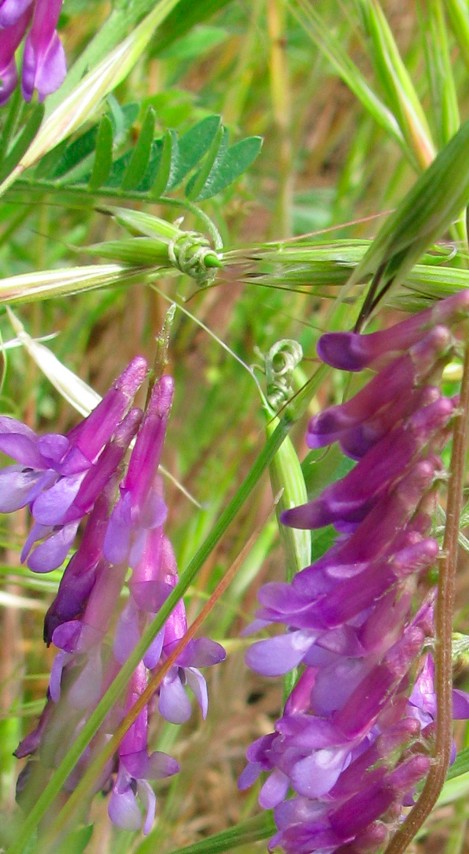
We’ve been busy lately helping to organize a benefit Country Dance (and dinner) for our local library, and wildflower walks have been displaced by trips to the restaurant supply store, gathering raffle prizes, and other tasks. But yesterday, when I parked to do my volunteer time at the friends of the library bookstore, there was a dramatic purple and gold display covering a berm of pushed-up soil and rock. These are the sort of flowers that are so common we disregard them, or even call them “weeds” when they appear where we don’t want them.

Poppies&Vetch.jpg

Everybody recognizes the California poppy (Eschscholzia californica). The deep purple flowers are a vetch introduced from Europe , probably Tufted Vetch (Vicia cracca), that is more than a weed—it’s an invasive non-native. It has long sprawling vines with tendrils that climb and bind, and likes disturbed ground. On the good side, it’s used as forage for cattle, provides nectar for bees and butterflies, and like other legumes it adds nitrogen to the soil. Below, its tendrils have looped around the seeds of a wild grass that I know only as foxtail, though it has single seeds (noted for working their way into the flesh of dogs) rather than the plumy seedheads that are rightfully called foxtail.

Poppies&Vetch3.jpg

Now that you’ve read this far, let me invite you to our benefit dance this Saturday evening, at the Upper Applegate Grange, 4 miles from Ruch, Oregon. We’ll have the Oregon Old Time Fiddlers (6 to 8 pm) and bluesmen David Pinsky & the Rhythm Kings (8 to 11 pm) making music for listening or dancing. There will be dinner, raffles, the Finest Hat Contest with a great prize, activities for kids, and it all helps our library. To be precise, we’re raising money to “buy” hours on Saturday, because the budget from the county doesn’t provide any hours on Saturday. Each year we have to raise $12,300. Come and bring your friends!

More details can be found here: go to the More Events page. Or if you live too far away to attend, you can make a contribution or a monthly pledge on the Pledge Form page. [Due to the way the site is hosted, I can’t post a separate url for these two pages; you need to go the main page and use the links there.]

Here’s a picture inside our rural library:

Lisa4.jpg

Siskiyou iris and Striped coralroot, a good wildflower walk!

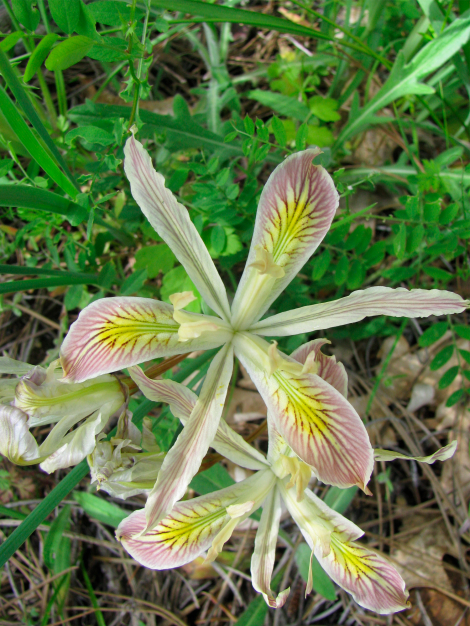
Change happens fast in the spring. We walked Saturday along a road we’d been on a week ago, and most of the flowers we saw had not been in bloom seven days earlier. The most abundant flowers were Siskiyou irisIris bracteata.

IrisSiskiyouCR.jpg

They vary in color from white to light yellow, and sometimes the reddish-brown veins are so numerous that they seem to tint the petals.
IrisSiskiyouBrownish2.jpg

Delphiniums were few and tattered, but some were much deeper in color than we’ve seen before. This is Menzies’ larkspur, Delphinium menziesii, we think.

DelphiniumDarkOld.jpg

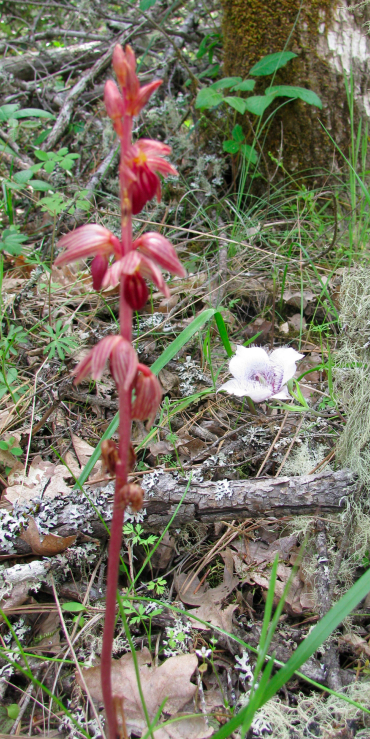
A rare sighting was of this Striped coralroot, Corallorrhiza/Corallorhiza striata, in the orchid family. We looked hard for others but saw only the one. It is a plant, but it is incapable of photosynthesis, and has no chlorophyll.
StripedCorealroot.jpg

When I was taking biology these sorts of plants were called saprophytes and it was believed that they got their grits by digesting organic material, as some fungi can do. This outdated theory is still found online. Now it is known (until further notice) that no plant can digest organic material through its roots (1), and the former saprophytes have been found to be parasitic either upon other plants, or upon fungi. Corallorrhiza striata dines upon nutrients produced by fungi, plugging into their mycelium, the underground structures of branching threadlike hyphae—the “body” of the fungus that produces the aboveground mushrooms we see.

(1) Wikipedia says “It is now known that no plant is physiologically capable of direct breakdown of organic matter”; I added “through its roots” above, because there are carnivorous plants that do digest insects they catch, either through secreting digestive enzymes or through some other means. How this fits in to current theory about plants digesting organic material, I don’t know.

StripedCorelrootCloseup.jpg

Plants like the coralroot are called myco-heterotrophs (2); the fungi they parasitize are the hosts. As far as we know, this is a parasitic relationship, with no benefits to the fungi. Many orchids are such parasites, others are only partially dependent on parasitism (producing the rest of their nutrients by photosynthesis), and some are “ordinary” photosynthesizing plants. Some myco-heterotrophs parasitize only specific fungi; for instance, Corallorhiza maculata sips only from Russula mushrooms, or I should say from their mycelium. Quite likely many species of myco-heterotroph have specialized in this way, we just don’t know the associations yet. For those interested in growing such orchids the parasitism presents a huge difficulty, since the ordinary requirements of a green plant—sun, water, nutrients in soil—will not sustain life in these non-photosynthesizing plants. Yet another reason, if more were needed, to avoid digging up or buying such plants (unless you are absolutely certain they were not taken from the wild).

(2) myco = fungus, heter = other, troph = nourishment

In the background of the coralroot (first photo) can be seen another flower that we saw dozens of today, with the engaging common name Elegant cat’s-ear (Calochortus elegans).

Elegant cat's ear1.jpg

It repays closer examination.

Elegant cat's ear2.jpg

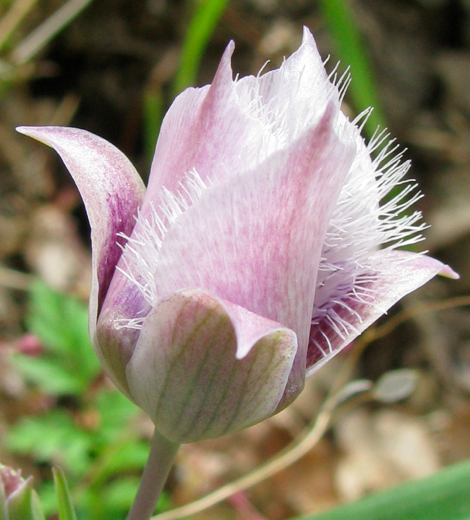
The pointed tips of the petals, or perhaps the fuzziness, give rise to the common name. This is the type species of the genus, discovered in 1806 by Meriweather Lewis on the Lewis and Clark expedition near what is today Kamiah, Idaho. Many are known by the common name of Mariposa lily; see one here.

The Calochortus genus contains a relatively large number of rare, localized, and endemic taxa, so don’t disturb any you find: they may be part of a very small population. One such is found only along the Umpqua River in SW Oregon. They seem to be more sensitive to soil type than to other aspects of habitat, with some preferring serpentine soils, which characteristically have high concentrations of toxic heavy metals. Although heavy metals like nickel, lead, and zinc are toxic to most plants, some can withstand them, perhaps taking them up to protect against pathogens and pests. Still, it’s an interesting puzzle why certain species would preferentially grow where toxic metals are found in abundance.
Elegant cat'sEar5.jpg

Look into the center of this unassuming little flower:

Elegant cat's ear3.jpg

How wonderful the digital camera is, enabling us to take home such magnified images of small beauties, so we can look our fill at them.

Bugloss fiddleneck, Amsinckia lycopsoides.jpg

Above is a more assertive plant: native to much of western North America from California to British Columbia, it has spread as far as New England, thriving in the disturbed soils of many habitats. It’s a roadside hitchhiker, an “invasive non-native” as far away as Australia, and toxic to livestock; for its sins it carries the dismal name of Bugloss fiddleneck, Amsinckia lycopsoides. (3)

(3) Bugloss, from Ancient Greek βούγλωσσον (bouglōssos, name of a plant: Anchusa italica), βούς (bous, “ox”) + γλωσσον (glosson, “tongue”)

Hooker's Indian Pink, Saline hookeri MOREPINK.jpg

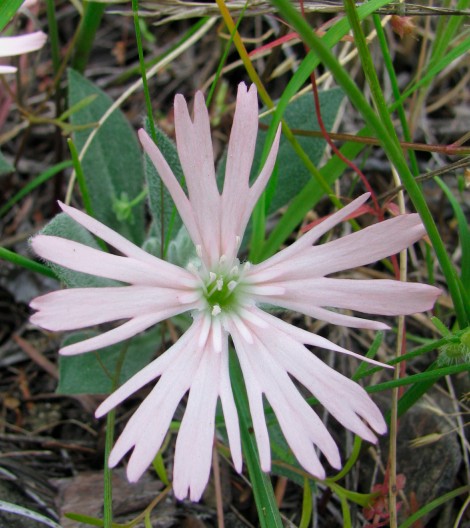
Hooker’s Indian Pink, Saline hookeri, varies from nearly white to dark pink; the California species, Indian pink (Silene californica) is much darker, nearly a chinese red.
Hooker's Indian Pink, Saline hookeri - 2.jpg

Look at the symmetry in those petals.

The Hooker after whom it is named is the immensely influential British botanist William Jackson Hooker (1785-1865), first director of the Royal Botanic Gardens at Kew. His son Joseph Dalton Hooker, who grew up attending his father’s lectures, also became a renowned botanist and was the second director of Kew. He classified the plants that Darwin collected on the Beagle, and the two scientists became close friends. Many New World plants are named after one or the other of the Hookers, though only the son visited our hemisphere.

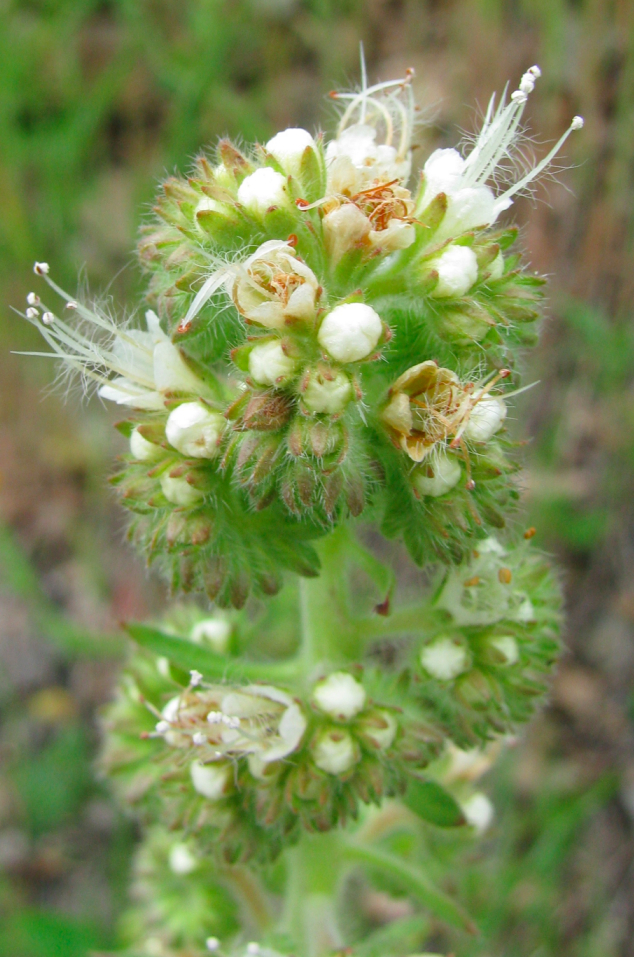
This post grows long, but we saw so many great flowers! Just one more: Phacelia heterophylla, or Variable-Leaf Scorpion-Weed, is as the botanists say an an erect, unbranched herb (herb, meaning neither a grass nor a woody plant).
Phacelia heterophylla .jpg

Naturally I was curious why the plant was called “scorpionweed”. Online explanations refer to “the way the stem curls like a scorpion’s tail”, as in the picture below of another species that’s found in Arizona.

PhaceliaBlue.jpg

photo from www.micktravels.com.

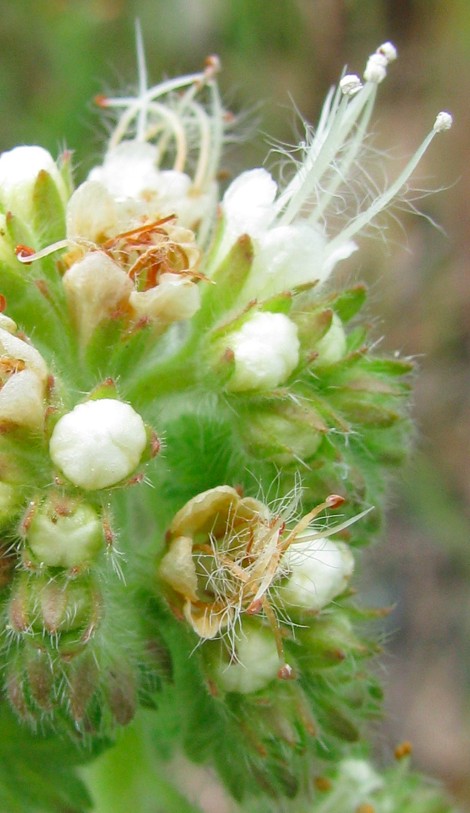
That species has blooms only along one side of the stem, while the one we saw has blooms surrounding the stem in a way that would make such a curling habit unlikely. Maybe the dramatic name has just spread to various members of the Phacelia genus whether it applies or not. Or, another possibility is that “scorpion” might refer to the ability of some members of the family to cause a skin rash, like poison oak or ivy, in some people. All those tiny hairs do look itchy!
PhaceliaCR.jpg

No unusual wildlife sightings on this walk, not like the day we saw four osprey (one was doing an odd behavior, I do have to write about that soon). One caterpillar, unidentified:

Caterpillar.jpg

and our hiking buddy Jack, here near a giant tree marked with what we hope is the sign for “Seed tree, do not cut”.


Jack&Tree.jpg