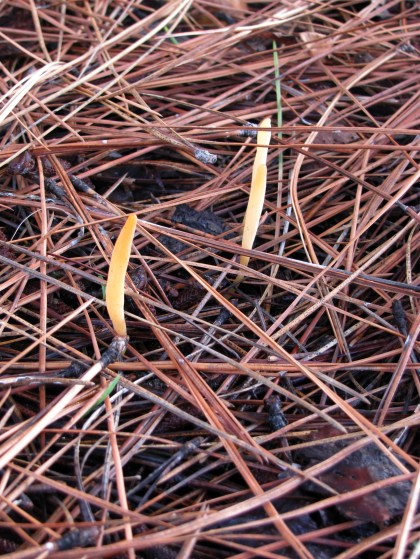
Late in December we were walking to the mailbox when my sharp-eyed husband spotted some very inconspicuous fungi growing a few feet off the gravel driveway.
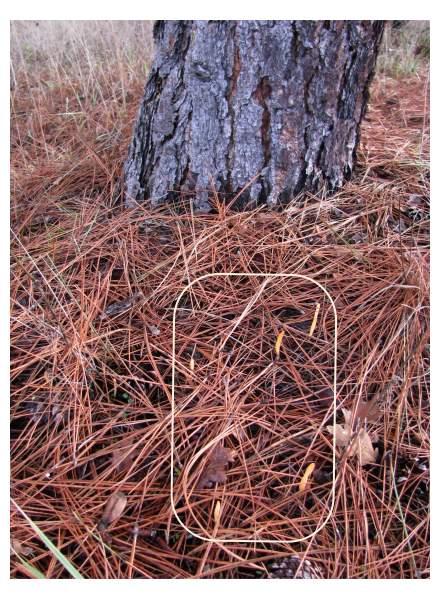
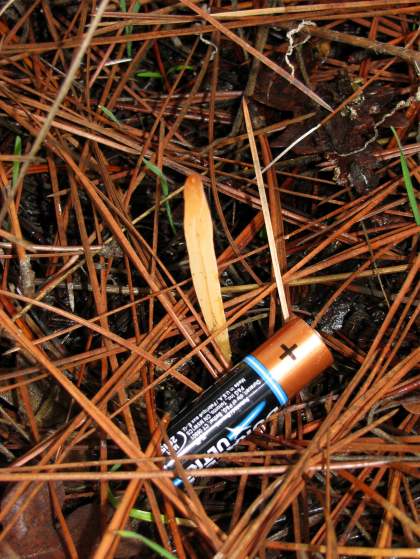
They occurred singly, but sometimes several with a square foot or so. In the photo above there are five within the white outline. You can see the approximate size, in comparison to an AA battery, below.
We’d never seen this before, so at home I searched online to identify it, starting with my first thought: it most reminded me of a coral-type fungus popularly known as “dead man’s fingers”. With the common name to search on I easily found a good page with photo and description of Xylaria polymorpha (Dead Man’s Fingers). But no, they don’t have the amber-to-peach color, or the slim shape of what we saw. More searching, through the clubs and corals section of this site. When I found Cordyceps militaris, I thought I had it, and nothing else I turned up on this site or elsewhere came closer to matching the size and appearance of our new fungus. Also it appears aboveground now, rather than in spring.

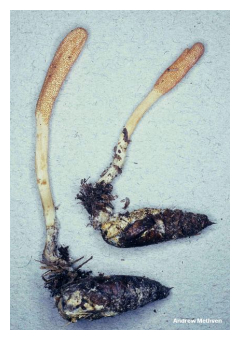
Both photos from the same page cited above, on Michael Kuo’s mushroomexpert.com site.
It’s always neat to identify things, but this tentative identification came with an added surprise regarding the host of the fungus. Kuo says,
The genus Cordyceps consists of clublike parasites that attack underground puffballs or insects. The puffball-parasitizing species are cool enough (see Cordyceps ophioglossoides for an example, and see the Key to Mycotrophs for a key to 5 North American species), but the bug parasites are astounding. They erupt from insects, bringing to mind the infamous scene in Alien in which John Hurt has a very bad meal.
Cordyceps militaris is the best-known and most frequently collected bug-killing Cordyceps, but there are dozens of “entomogenous” species in North America. The victim for Cordyceps militaris is a pupa or larva (usually of a butterfly or moth). Its mycelium colonizes the living insect and mummifies it, keeping it alive just long enough to generate the biomass it needs to produce the mushroom–a “spore factory” that allows the Cordyceps to reproduce.
With Cordyceps militaris the bug is buried in the ground or in well decayed wood, which means the mushroom collector usually sees only a little orange club with a finely pimply surface.
In the right-hand photo above you can see the pupae from which the mushrooms grew.
In fact, one species of this genus attained a queasy notoriety not long ago as the “mind-control” fungus, because it infects tropical ants and when ready to spread spores, somehow drives the ants upward on plants, where the spore body bursts in an optimal location for dissemination. You can see a YouTube video on this which was drawn from a David Attenborough presentation. The video shows ants behaving oddly, then climbing, then the disturbing progression of the fungus emerging, over time, from the head of an ant while it clings motionless to a stem. Victims of some of the many other Cordyceps species are shown––each specializes on a different insect. However, Attenborough closes with a sop to our human sensibilities: the fungi have a “positive effect” on the overall ecosystem by preventing any one species of insect from becoming disproportionately numerous. [For description and photos of other parasites which manipulate their hosts’ behavior for their own ends, including a worm that causes its terrestrial host insects to leap suicidally into water where it can then proceed to its next stage, see this page.]
After we first spotted the possible Cordyceps mushrooms there was a snow that stayed around, and only today did I get back to look for the underground host. Would it be a puffball, or pupa? I went out with camera, paring knife, ruler, and a kneeling pad to investigate. While I find the photos of the parasitized insects repellent, I was still excited about making a little discovery. Of such inconsistencies are humans composed.
The work had to be done slowly and carefully: the mushrooms are brittle, and they have grown up through one or two inches of loosely packed pine needle bunches. Moving away the needles can break a mushroom that has emerged between the needles of a single bunch. Once the mushroom had broken off, either above or below ground, with the naked eye I could not detect any path to follow downward, no stem-like structure, no path of mycelia leading to the nutrient source. The brown things at the base on the picture below are not roots but bits of decayed pine needle, as far as I can tell.
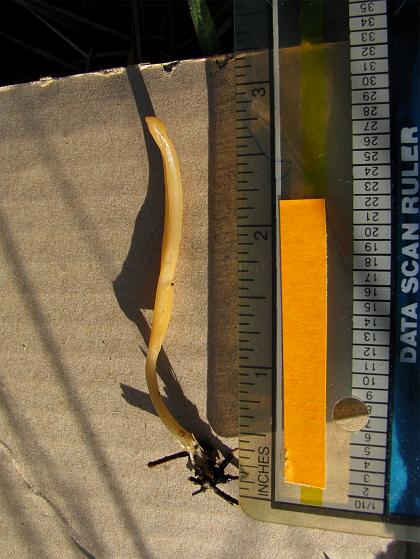
Also, the mushrooms may angle through the ground on their way up, and whatever connexions lie underground are apparently very delicate and fragile. Digging around one with the knife and attempting to raise it along with a small clump of its surroundings did not succeed. The mushroom still came away with no visible source. The brown things at the base on the picture below are not roots but bits of decayed pine needle, as far as I can tell.
I dug deeper under where the mushroom had been, and pulled out the crumbly earth, thinking I might find the remains of puffball or insect, but I didn’t. There were little chunks of bark spiderwebbed with mycelia, and at one spot a small mass of mycelia but no way for me to link this with the aboveground mushroom.
Finally I gave up, feeling bad that I had dug up 5 of these little guys before they had dispersed their spores and I hadn’t answered my question or evolved a better technique. The host body––puffball or pupa––may be consumed, gone. Or, I might find it if I took a shovel, dug up one mushroom surrounded by a spadeful of earth, and then used archaeological delicacy to remove the soil a bit at a time. Then again, it may be another of the many Cordyceps species, growing from something completely different. Maybe another day.
In the meantime, perhaps someone else has an idea what these fungi might be: popping up in late December, near conifers in open mixed forest, recent growth, at the 2000′-2500′ level in the Siskiyous of Southern Oregon. Any suggestions?






 nosleepingdogs