Yesterday’s forest walk, along an alarmingly narrow dirt road next to a hundred-foot drop, introduced us to Cyclosa conica

a spider with an unusual tactic for concealment. On its web it makes a vertical strip of reinforced filaments, called a stabilimentum, to which it adds the husks of its prey. Females often place their egg sacs in the stabilimentum too. Then the spider hides itself at the center of this little visual interference area it has made, while it waits for insects to fly into the web.
The vertical strip of insect remains is clear in the photo above, and here’s a closer look at the arachnid itself.
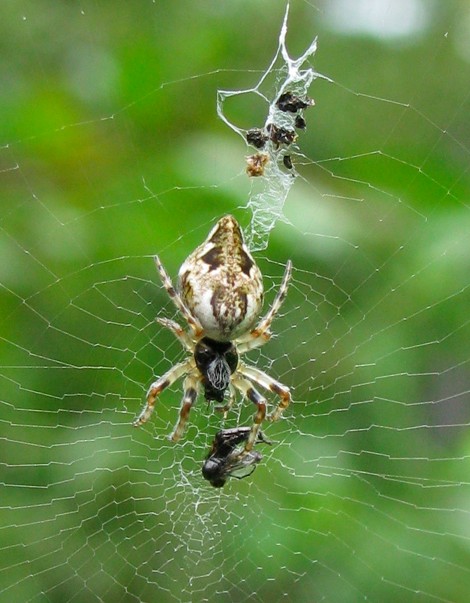
The stabilimentum is used in various forms by other orb-weaver spiders (family Araneidae, the builders of spiral wheel-shaped webs).
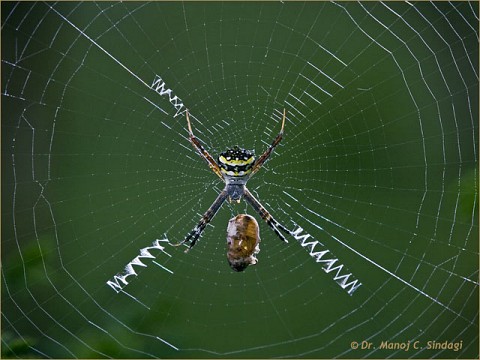
Above, the “Writing or Signature Spider”, Argiope sp., photo taken in Singapore. Source.

Above, stabilimenta of Argiope sp. take different shapes including circular and cross-shaped. Photo from Wikipedia.
What are the functions of the stabilimentum?
Various theories have been propounded as to the effect of the stabilimentum: strengthening the web, preserving the web by causing birds to avoid it, even attracting insects (although it would be natural to think that the more solid-looking stabilimentum might make the webs easier for insects to avoid). The spider we saw makes it into a “decorated” hiding place, but that is most likely an embellishment by this one species upon a structure originally serving other purposes.
In 1998 I-Min Tso, now a professor at Tunghai University in Taiwan, did a field study with Cyclosa conica (the spider we photographed) to find out whether “Stabilimentum-Decorated Webs Spun by Cyclosa Conica (Araneae, Araneidae) Trapped more Insects than Undecorated Webs”. He was able to make the comparison because where he worked (near Pellston, MI), the spiders sometimes omitted the stabilimentum (and 18 out of 24 webs with stabilimenta had no prey included in the “decoration”). This seems odd, as the stabilimentum with prey is cited as a characteristic of the genus Cyclosa, but maybe other observers have failed to notice instances of C. conica webs that lack the stabilimenta, or lack the wrapped prey within them. At any rate, Dr. Tso found that webs with stabilimenta caught more prey than plain webs even when the plain ones were larger. Similar results have been found for other species that add stabilimenta to their webs.
How might this work? At least one species, Argiope argentata (one of the Argiope spp. known as the “Writing Spider”), is said to spin special UV-reflecting silk for the stabilimentum. Theoretically this makes it more visible to insects, like the UV patterns on flowers, which tend to be “bull’s-eyes” surrounding the center where pollination takes place. In a laboratory where the light could be manipulated to contain UV radiation or not, fewer fruit flies flew to webs when the UV light was not present (webs were those of juvenile Argiope versicolor).

Seen in UV, these flowers have a wide black “target”. Photo by Tom Blegalski/TTBphoto, from geneticarchaeology.com.
Under that theory, insects would fly toward the attractive UV center of the web (the stabilimentum) and not see the less-visible “this is a spider web!” part until too late. The theory fits the Writing spider, which prefers open sunny areas, better than our C. conica, which lives in sun-and-shade forests.
But the theory may be too good to be true, given that we don’t actually know enough about insect vision and behavior, and there is even disagreement regarding how UV-reflective spider silk is. In the real world, light conditions vary from place to place and moment to moment, even as a breeze changes the orientation of a web slightly, making it difficult to assign easy labels like more visible/less visible. And the visual systems of insects vary, with many being (I venture to say) unknown. The Australian spider Argiope aetherea was found to adjust “the quantity of silk decoration… adding more silk decoration when the web was located in dim light rather than bright light.” The authors of this study cite their findings as evidence that is “[c}onsistent with the prey-attracting function”, but of course it would also be consistent with any other function that involved visual perception even without UV involvement, e.g. signaling birds to avoid the web.
As a non-scientist, I’ve probably taken this topic far enough; the visibility and function of web decorations have been argued over for a hundred years, and modern technology seems merely to guarantee that each investigator with a spectrophotometer reaches a different conclusion from the others. One article (1), in 2005, summarizes areas of difference and ambiguity, ending with a possible redirection of emphasis: “The contrast of web decorations is consistent between families and different decoration patterns, raising the exciting possibility that their shape rather than spectral properties might explain variation in receiver response.” But there’s a review of the evidence in a long article not available online (2, abstract only), and now that my curiosity is up, I’m seeking a reprint of it.
1. Bruce, Matthew J, and Astrid M Heiling and Marie E Herberstein. 2005. Spider signals: are web decorations visible to birds and bees? Biology Letters 22 September 2005. 1 (3): 299-302.
2. Herberstein, M. E. , C. L. Craig, J. A. Coddington and M. A. Elgar. 2000. The functional significance of silk decorations of orb-web spiders: a critical review of the empirical evidence. Biological Reviews of the Cambridge Philosophical Society. 75 : 649-669. [abstract]
More photos and information about Cyclosa conica
eurospiders – good photos including extreme closeups of body parts
Range map
Cyclosa is derived from the Greek “kyclos” meaning “round” possibly with reference to its orb-web. Conica refers to the conical shape of the abdomen.



 nosleepingdogs


