Freeze my head (but not yet)

After reading the latest issue of New Scientist, I think I may leave instructions to freeze my head when I die. It’s not because of any terrific new cryogenics method revealed by the magazine, but because of their series of short articles on extremophile organisms. You know, the thermophiles that can survive boiling temperatures (one microbe lived through a spell of 130° C (266° F), like the North American Wood Frog (Rana sylvatica), Painted Turtle (Chrysemys picta) hatchlings, and Woolly Bear caterpillars (Pyrrharctia isabella, which turn into the Isabella Tiger Moth) that can be frozen solid or nearly so and come to life again. Then there are the ones that can survive being dried out by “replac[ing] water molecules [in and around the cell] with sugar, turning their cytoplasm into a solid called sugar glass”. (New Scientist, 13 Nov 2010, p. 41). These are mostly small invertebrates. One in particular takes the survival prize: the tardigrade or water bear.

microphotograph of tardigrade or water bear,  phylum Tardigrada, part of the superphylum Ecdysozoa. They are microscopic, water-dwelling, segmented animals with eight legs.jpg

Microphotograph of tardigrade or water bear, in the phylum Tardigrada, part of the superphylum Ecdysozoa. They are microscopic, water-dwelling, segmented animals with eight legs. Unlike lots of microscopic animals, they do not seem to live by choice on or in humans, so you can study the photo without getting itchy. Photo source.

Because it is directly related to why I might want to freeze my head, let me quote from Wikipedia’s article on the tardigrade’s survival feats:

More than 1,000 species of tardigrades have been described. Tardigrades occur over the entire world, from the high Himalayas (above 6,000 metres (20,000 ft), to the deep sea (below 4,000 m) and from the polar regions to the equator.

The most convenient place to find tardigrades is on lichens and mosses. Other environments are dunes, beaches, soil, and marine or freshwater sediments, where they may occur quite frequently (up to 25,000 animals per litre). Tardigrades often can be found by soaking a piece of moss in spring water.

Tardigrades are able to survive in extreme environments that would kill almost any other animal. Some can survive temperatures of −273 °C (−459.400 °F), close to absolute zero, temperatures as high as 151 °C (304 °F), 1,000 times more radiation than other animals, and almost a decade without water. In September 2007, tardigrades were taken into low Earth orbit on the FOTON-M3 mission and for 10 days were exposed to the vacuum of space. After they were returned to Earth, it was discovered that many of them survived and laid eggs that hatched normally.

Below, a tardigrade in cryptobiosis (dried-out state) waiting for wetter conditions. Photo source.

a tardigrade in cryptobiosis (dried-out state) waiting for wetter conditions. The condition is called cryptobiosis.jpg

What the tardigrade means to me

The greater likelihood of…Life on Mars!

Areologists have found evidence to support the presence of surface water on Mars in earlier times (1, 2). On Earth, the one condition life seems to require is water in the environment. It can adapt to other conditions of astonishing harshness, as the extremophiles show. Therefore, if life developed upon Mars during the time of surface water, it is quite possible it has adapted to the new conditions.

One place to look for water and surviving life forms would be in the deep chasms of Mars, including Valles Marineris which is 1,860 miles long and in places reaches five miles in depth (five times the depth of the Grand Canyon). None of our probes has landed near chasms because we haven’t designed ways to explore them robotically. This is a job for human beings, and I am extremely disappointed that it hasn’t been done yet.

When I watched Neil Armstrong step onto the moon in 1969, I felt confident that the US and other nations would build on this accomplishment in what seemed a logical progression: space station, lunar base, a manned mission to Mars. I would not have believed that, 40 years after reaching the moon, only one of these elements would be up and running. That one, the International Space Station is a testament to the dedication of a few, but it’s not the robust establishment I expected; it seems to be on a precarious footing in mechanical reliability, and in international support. The other two are as far from reality as they were in 1969—no, farther, because the momentum of the 1960s has drained away, and the world faces more serious problems than it did then. What was justifiably affordable then, may not be now.

I don’t view space exploration as a luxury, or as an activity that merely satisfies our curiosity. It has much more to offer the species than that. We cannot say what we would have learned, what technologies we would have developed, had we followed the path I expected. Perhaps we would even have reached a slightly greater degree of wisdom about ourselves and or treatment of the planet, or maybe not.

But I do know how badly I want to see some questions answered, including “What life is there on Mars?”

And if looks as if, even if I eat my vegetables and exercise diligently, I may not live long enough in the normal course of events to find this out. So, freezing my head may be the only possibility. How can I let a bunch of tardigrades hear the news about Martian life, and not hear it myself?

Notes

1 Jakosky, Bruce M. et al. Mars’ volatile and climate history. Nature 412, 237-244 (12 July 2001).

2 Bowen, TA and Hynek, BM. Mars’ climate history as inferred from valley networks on volcanoes. Lunar and Planetary Science XXXIX (2008).

Etymological Notes

Rana sylvatica
rana, from Latin rana (frog); sylvatica from Latin sylvaticus (growing in the woods, wild)

Chrysemys picta
chrysemys, from Greek chrysos (gold) and emys (freshwater tortoise”)

Pyrrharctia isabella
Pyrrharctia, from Greek pyr– (fire) and arktos (bear—the animal, also used to refer to the north; here probably alluding to the hairy caterpillar, the “wooly bear”)
isabella, a word used to denote various vague colors: greyish-yellow, sand color, pale fawn, pale cream-brown or parchment; etymology uncertain but see here.

Tardigrada
Tardigrada, from Latin tardigradus (slowly stepping), from tardus (slow) and gradior (step, walk)

Ecdysozoa
Ecdysozoa, from Greek ekdusis (a stripping off) and zoon (a living being, animal; plural zoa)

Bonus for sticking with me to the end…

There’s one caterpillar just about everybody can identify, if only because of its supposed ability to predict the severity of the winter:
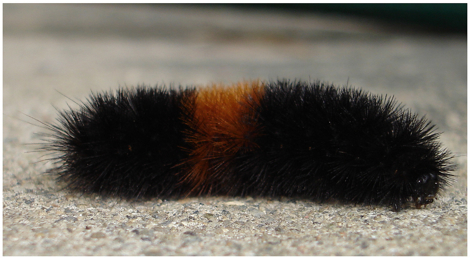
Woolly bear caterpillar, which becomes Pyrrharctia_isabella, the Isabella Moth.jpg

The Woolly Bear, of course, and the narrow band of brown on this one indicates a very tough winter to come. Photo by Rhys Alton from flickr.

But who among us knows what the Woolly Bear looks like when he or she grows up? Like this,

Pyrrharctia_isabella, Isabella Tiger Moth, which develops from the Woolly Bear caterpillar.jpg

the Isabella Tiger Moth (Pyrrharctia isabella), found in much of North America and Central America. The caterpillar overwinters, hence the ability to withstand freezing temperatures. The Woolly Bear has another distinction: the first insect known to self-medicate. It eats leaves from ragworts, groundsels and other plants that are rich in alkaloids, and these help rid it of parasites; infected caterpillars eat more of such leaves than uninfected ones. Yes, everything it seems has parasites; “Great fleas have little fleas upon their backs to bite ‘em, And little fleas have lesser fleas, and so ad infinitum”. And I, driven by the desire to know things, doubtless will need to know something else once my thawed-out brain has assimilated knowledge of our first manned mission to Mars.

Comments on some books recently read

A Whole New Mind, why right-brainers will rule the future, by Daniel Pink
Silly, puffy, fuzzy, wrong. Because of Asia, Automation, and Abundance, we are all going to prosper by being artists, designers, musicians, gestalt-masters.

Breaking Clean, by Judy Blunt
A fine book, powerful and honest and sometimes very hard to read. The author comes of generations who survived ranching in what must be one of the toughest spots in the US. She writes of her experiences growing up there, informed by her later insights. The privations, the endless work just to have a chance of doing the same next year, the way human beings grow into strange shapes to fit what is demanded of them.

A Short History of Progress, by Ronald Wright
Published a year before Jared Diamond’s Collapse, and follows a similar plan: by narrating the decline of earlier cultures due to hubris and systemic faults, the author hopes to convince 21st century homo sap to shape up and avoid disaster. Wright finds errors in Diamond’s earlier book Guns, Germs and Steel, and I found some things in Wright’s book to question. I would suggest that in general it’s very iffy to found a line of reasoning upon a particular cause for the decline of a premodern civilization. Historians of Sumer or Rome cannot agree upon causes; what hope has a non-specialist? Answer: make your case look good by cherry-picking arguments and data from authorities old and new. Give it up. But it does sell books. And yes, our civilization’s got one foot on a banana peel—conveying that message seems to be the raison d’etre for these books—and we love to read about it, witness all the sf dystopias, but I cannot believe that efforts to convince the intellect will help much, since little power is governed by that human faculty.

Slammerkin, by Emma Donoghue
London, c. 1750: barely a teenager, the daughter of a desperately poor family becomes a prostitute. A hundred years earlier, Hobbes famously described the life of humans in a state of nature, without government, as “solitary, poor, nasty, brutish, and short”. Such is the life of Mary Saunders, despite the existence of a government, because there were at the time few significant efforts to help the poor or restrain the depredations of the rich, while the legal system severely punished even small criminal acts. Rich in period flavor and well-drawn characters, though I felt that the protagonist was not as full as I’d wish: her behavior at the end seems abruptly imposed. A study in desperation. It is disgraceful to realize that one could write something not too different these days about a runaway on the streets of any large American city.

Hogarth engraving of street life among the poor.jpg

William Hogarth (1697–1764), engraving of street life among the poor.

Darwinia, by Robert Charles Wilson
Science fiction, in that subset of alternative histories where some portion of the earth’s surface is suddenly switched out for the corresponding portion from another history or universe. Same topography, but everything else is different. Interesting, but I think it fell between two stools, to use an antiquated phrase (visualize someone beginning to sit down who can’t decide which of two stools to land on, and falls in the middle, to the bar-room floor). There’s the standard adventure/discovery plotline as characters from the “old world” (ours, interrupted prior to the first World War) explore the strangenesses of the apparently uninhabited “New World”. And then the New World turns out to have a connection to some sort of Lovecraftian Other Reality. Didn’t quite connect up for me, but nonetheless I’m currently reading this author’s Mysterium, which won the Philip K. Dick Award in 1994 and turns out to have a similar plot device. [Later. Yep, about the same. ]

Solar, by Ian McEwan
This guy sure can write, in one sense of the word, but I just could not care about the characters or the plot. Since the plot had to do with developing a revolutionary system of generating electricity from solar power, I should have wanted to see what happened. But the scientist protagonist was so unlikeable. Venal and boring. I was a third of the way through, with nothing much happening on the solar electricity front, and the main character still as clueless and mopey as ever…I gave up. Three demerits to me, but art (and my list of books to read) is long and life is short.

The Mount, by Carol Emshwiller
Recently I posted about how Young Adult books are sometimes well worth adult attention. Here’s one from the adult fiction shelves, that should have had the YA label; as an adult I found it simplistic and disappointing. The author is a Grand Old Lady of science fiction.

Still Alice, by Lisa Genova
A woman discovers, at about age 50, that her increasing mental lapses are early onset Alzheimer’s, which progresses much more quickly than the Alzheimer’s of the elderly. Perhaps for the sake of irony, she’s a professor of psychology, specifically at the intersection of cognition and language. The author is a neuroscientist herself, who works with Alzheimer’s and dementia patients. Moving and informative, but maybe you should wait to read it until you are past the age at which early-onset Alzheimer’s begins.

Ship Breaker , by Paolo Bacigalupi
and
The Windup Girl, by Paolo Bacigalupi
See earlier post on YA fiction, the category of the first of these. Two looks into a post-oil, post-Big Crash future. Recommended. I liked Ship Breaker better, myself.

Platinum Pohl, by Frederik Pohl (1919- )
Short fiction by one of the masters at the top of his form. Sf.

Mouse with human brain speaks out

In the previous post, I described the one known mouse with a human brain. He’s named Clyven, and you can talk to him on the website of the hospital where research led to his creation. Or go direct to his page, here.

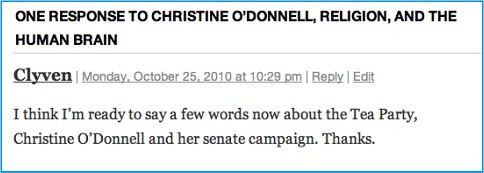
Well, imagine my surprise when Clyven himself posted a comment on that post. He was, as usual, brief and to the point:

Clyven's comment.jpg

Of course I rang Clyven up, and found him unengaged and ready to talk. He did not seem to remember our previous conversation but when I raised the subject of Christine O’Donnell, he became more animated. Here’s that portion of the brief interview:

ME: Clyven, I’d like to hear what you have to say about Ms. O’Donnell.
CLYVEN: I’m ever so pleased Christine O’Donnell spoke about me on the O’Reilly Factor back in 2007.
ME: What do you think of what she said?
CLYVEN: Aspiring Senator O’Donnell could perhaps learn a thing or two from a mouse with human cognition.
ME: And Christine O’Donnell as a person, how did she strike you?
CLYVEN: She’s funny. I think she is a witch!
ME: What are your political principles, Clyven?
CLYVEN: You should check out the main RYT Hospital web site for that: RYTHospital.com.
ME: A very politic answer, Clyven! Thank you for talking to us.

Clyven is a mouse of few words, which makes those few even more important. His gratitude for Ms. O’Donnell’s mentioning him on O’Reilly’s show may indicate that he would like to play a part on a wider stage himself. He is a native-born American, of American parents, but his crucial role in advanced biomedical research may rule out a run for office. A panel discussion, perhaps, with the two Delaware senatorial candidates? I can only hope that those whose job it is to plan such events and bring new points of view to the public, will be contacting him as soon as they’ve read this post.

O’Reilly, are you listening?

Human germ attacks already declining coral reefs

Plague, rabies, Lyme disease, bird flu and swine flu—people seem much more at risk for diseases from animals than the other way around. But it does go the other way too, and it has been discovered that such a case is responsible for a disease that has devastated coral reefs in the Caribbean.

“White pox disease” in coral is caused by a human strain of the common intestinal bacterium Serratia marcescens, which causes the hospital infection serratiosis. (Hospital infections, or nosocomial infections, happen because individuals already in poor health are exposed to pathogens by poor sanitary practices and invasive procedures such as surgery or catheterization.) [Etymological notes on scientific names are at the end of the post.]

The only coral known to be affected is Elkhorn coral (Acropora palmata), a major reef-bulding species in the Caribbean. Healthy Elkhorn coral looks like this.

Healthy Elkhorn coral (Acropora palmata).jpg

Here’s an example of Elkhorn coral infected with White pox disease.

White Pox Disease (Serratia marcescens) on Elkhorn Coral.jpg

A research team at the University of Georgia was recently awarded a $5M grant to investigate the disease in coral, which is “the first known case of such a ‘reverse zoonosis’ that involves the transmission of a human pathogen to a marine invertebrate”. Even more remarkable, in the words of James W. Porter, associate dean of the Odum School of Ecology and the team’s leader, “This bacterium has jumped from vertebrate to invertebrate, from terrestrial to marine, and from anaerobic to aerobic environments. Triple jumps like this are rare.”

In addition, according to the report in ProMED (partly drawn from this source),

The scope of the team’s research will extend beyond gaining an
understanding of the impact of white pox disease on elkhorn coral and
how to counter it. The most likely source of the pathogen for coral
reefs is under-treated human sewage, so the study will also explore
the intersection of public health practices and environmental health
outcomes.

“This investigation addresses not only environmental protection, but
also the socio-ecological determinants of coastal zone protection,”
said Porter. “This includes the cost of wastewater treatment
infrastructure. Given a reliance on tourism by most Caribbean
countries, this study addresses a disease system that is of great
economic importance and public health concern to developing nations.”

“This is science in action to save an endangered species and a threatened ecosystem,” said team leader Porter. “We are linking good public health practices to effective environmental protection.”

Elkhorn and Staghorn coral (Acroporis cervicornis) are both on the US Federal list of threatened species, and in 2008 the National Oceanic and Atmospheric Administration extended additional protection rules usually reserved for endangered species. The new rule will “prohibit the importing, exporting and taking of elkhorn and staghorn corals. Additionally, the rule prohibits any activities that result in the corals’ mortality or injury. Anchoring, grounding a vessel or dragging gear on the species is prohibited. Additionally, damaging the species’ habitat and discharging any pollutant or contaminant that harms the species violates NOAA’s new rule. The rule applies to elkhorn and staghorn coral in the Virgin Islands, Puerto Rico and Florida.” Of course the enforcement will be difficult, but it appears that it’s none too soon to reverse the decline of these reef-building species.

A recent analysis of 500 surveys of 200 reefs showed the most complex types of reef had been virtually wiped out across the entire Caribbean. What survives are mostly “flattened” reefs which provide poor habitat for fish including commercial species, and are less “effective in protecting coastal homes and villages from storm swells and tidal surges”.

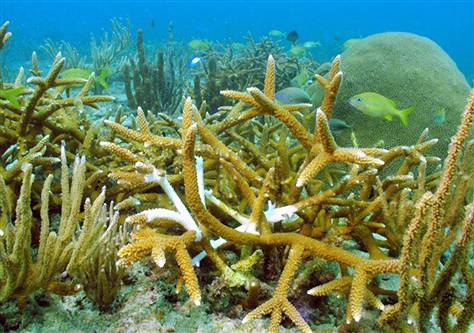
Healthy reef of staghorn coral in the Caribbean, below.

Healthy Staghorn coral (Acropora cervicornis).jpg

Source.

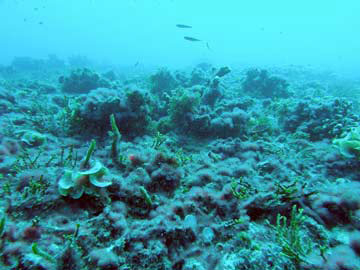
When the branched corals are killed off, low-growing corals may take their place but don’t create the rich three-dimensional habitat that the branched ones do. Algae also may increase and blanket surfaces, preventing coral growth.

Flattened coral reef, degraded by loss of branching coral).jpg

Source. Photo by Jennifer E. Smith.

Other threats to coral reefs

Coral-building animals live symbiotically with algae. Influenced by water that is too warm or cold, the corals will “expel the algae (zooxanthellae) living in their tissues causing the coral to turn completely white. This is called coral bleaching. When a coral bleaches, it is not dead. Corals can survive a bleaching event, but they are under more stress and are subject to mortality.” Rising ocean temperatures have caused wide-spread bleaching events. Warm waters also absorb more CO2, causing the water to become more acidic and that makes it more difficult for reef-building organisms to form the calcium carbon skeletons that serve as their structural basis.

Overfishing, pollution including sewage and agricultural runoff, dredging,hurricanes, and development have all damaged coral reefs. Each new injury reduces the ability of living organisms to reproduce and to withstand further assaults.

Coral reefs are among the world’s richest ecosystems, second only to tropical rain forests in plant and animal diversity. They arfe essential to fisheries, tourism, and protecting beaches from erosion. Yet “nearly two-thirds of the Caribbean’s coral reefs are threatened by human activities. Agricultural runoff, overfishing, dredging, sewage discharge (a factor in White pox disease), and the growing pace of coastal development have already degraded important reef systems, resulting not only in a tremendous loss of biodiversity but also lost revenue from declining tourism and fishing, and increased coastal erosion.” This last statement comes from the World Resources Institute, which is active many environmental fronts and is currently sponsoring a country-by-country survey of the economic values of Caribbean coral reefs and mangroves: “Supporting the sustainable management of coral reefs and mangroves by quantifying their economic value”.

Elkhorn coral & research robot.jpg

Source. Some breakage from hurricanes can be seen. Also shown is Fetch1, an autonomous underwater vehicle for research that was developed by NASA.

More about coral reefs

Global Coral Reef Alliance
EPA, Coral Reefs and your Coastal Watershed
University of Florida, Overview with photos

Etymological notes

Serratia marcescens was discovered in 1819 by Venetian pharmacist Bartolomeo Bizio, as the cause of an episode of blood-red discoloration of polenta in the city of Padua.[7] Bizio named the organism four years later in honor of Serafino Serrati, a physicist who developed an early steamboat; the epithet marcescens (Latin for “decaying”) was chosen because of the pigment’s rapid deterioration. [Wikipedia]

Acropora palmata: Acropora from the Greek, akros (high) and poros (opening, pore); palmata handlike, from Greek palma (a palm, flat hand; palm branch).

Acropora cervicornis: Acropora as above; cervicornis from the Latin cervus (deer) and cornu (horn, antler)