Sunny slope wildflowers, Southern Oregon

Despite an unseasonable snowfall last week, two days later we found some uncommon wildflowers blooming on a sunny slope bordering a forest road.

We’d noted the leaves of these delphiniums (larkspurs) the week before, and now they were in full bloom
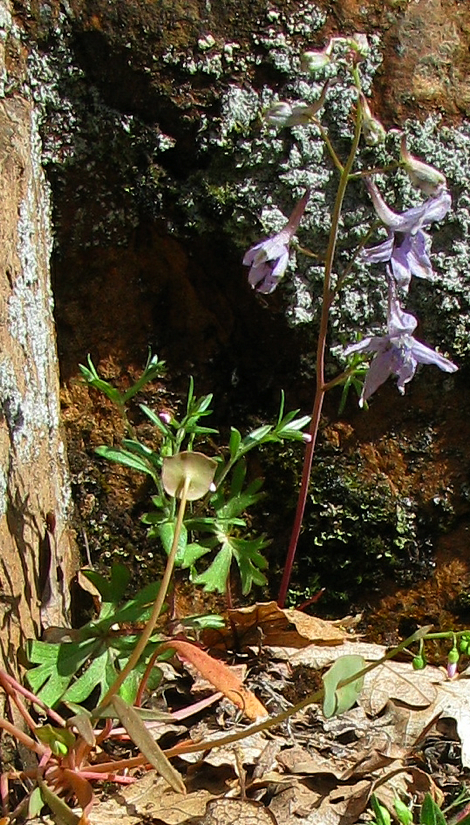
Frit Delpg purple close-up.jpg

The majority were white, like these

Frit Delph close-up.jpg

but according to the experts only two white species (Delphinium leucophaeum and D. pavonaceum ) occur west of the Cascade Mountains, and neither are found south of the Williamette Valley (in northern Oregon). Their range may be restricted to the area of a temporary lake formed after one or more of the catastrophic Missoula Floods which occurred around 15,000 years ago, when glacier dams broke releasing huge quantities of water and silt, over parts of what’s now Oregon and Washington.

Delphinium menziesii occurs in our county, but it’s dark purple with a more finely divided leaf. Maybe the ones we saw are Delphinium andersonii, which does seem to have light blue to very pale almost white flowers, and a three-lobed leaf like the ones we saw.

An exciting find was this fritillary, a member of the lily family.

Fritillary close-up2.jpg

Wikipedia says that “fritillary” comes from the Latin term for a dice-box (fritillus), and probably refers to the checkered pattern, frequently of chocolate-brown and greenish yellow, that is common to many species’ flowers. (And there’s a group of butterflies so named for the same reason.) The checkered pattern is visible on both the bud and opened bloom above.

Fritillary 1.jpg

At least 3 species are found around here; this one is Fritillaria recurva, the Scarlet Fritillary. The nearby town of Jacksonville has a festival every year in honor of the rare species found near there, Fritillaria gentneri, which has darker red flowers. And we have a few times seen, on our own property, Fritillaria affinis or Chocolate lily, which has bell-shaped greenish flowers with brown markings. We don’t have any photos of it, but here’s one from USDA
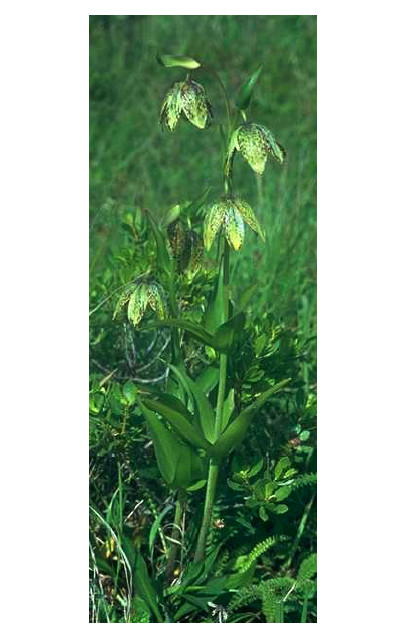
Fritillaria affinis1.jpg

Their account notes that the root bulbs are edible, though bitter, and were an item of trade for tribes in this area. F. affinis is quite variable in flower color, sometimes showing the reverse of the ones we’ve seen: purplish-brown flowers with green or yellow “dice”, as below.

Fritillaria affinis2.jpg

We also saw two other wildflowers more familiar to us: shooting stars,
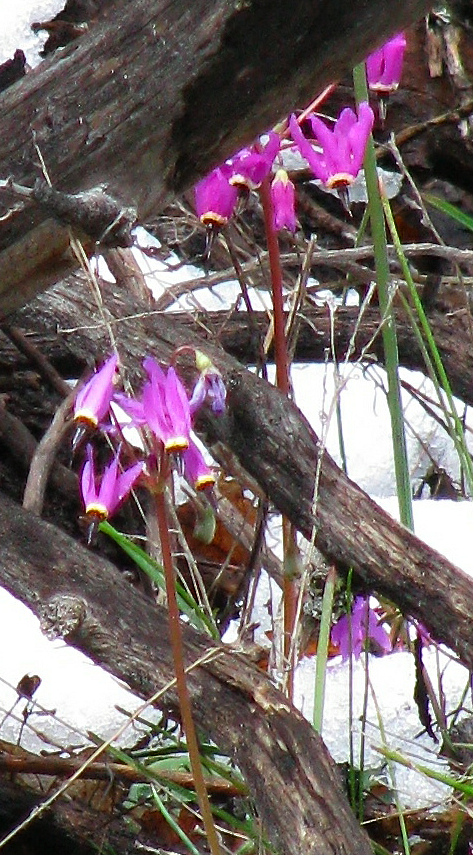
Frit Shooting Stars1.jpg

always one of the more abundant flowers this time of year,

Frit Shooting Stars 2.jpg

and our beloved Trout Lilies (Erythronium hendersonii), delicate and demure plants with a very brief duration of bloom.

Frit Erythronium 2.jpg

They range in color from nearly white to a darker violet-pink. Flowers are borne so close to the ground that it’s hard to get a look from underneath.

Frit Erythronium close-up from below.jpg

The mottled leaves are the reason for some of the common names—Trout Lily, Fawn Lily—and I think they are as beautiful as the flowers, in their way.

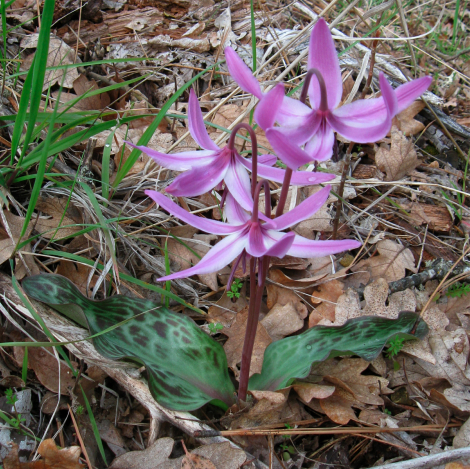
Frit Erythronium leaves.jpg

Frit Erythronium 3.jpg

Advertising, banks, and Salome of the Seven Veils

We all have our own “If I ruled the world, this is how I’d fix it” fantasies. They don’t need to be reasonable, or part of a comprehensive strategy, so they’re self-indulgent and fun. I’d ban advertising as one of my first moves, or at least restrict it to words only: no pictures, no music or jingles, just cortex stuff. Miles per gallon, nutritional content, ease of installation, peppermint flavor. Well, the advertiser could wax poetic about how his product would transform your love life, turn commuting into a Le Mans experience, and make sadness and boredom as extinct as the dodo, but if the pitch is just in words printed in black and white, how many of our fellow citizens these days would bother to read it? And if they did, how convincing would it be?

Here’s an example of what vexes me about ads:

Ads and Banks.jpg

I photographed this ad in one of those gargantuan one-stop-shopping stores which also has a house bank. In fact, their bank used to be Washington Mutual, distinguished for being “the United States’ largest savings and loan association until it became the largest bank failure in U.S. history.” [Wikipedia]

As I recall, it was a WaMu ad way back in the early 90’s that told me all was not well with the American banking industry: it showed a car racing through one of those cones-in-a-line tests of driving skill, and posting a smoking-hot speed by the simple expedient of running over most of the cones. The voice-over and text said, “We break the rules for you”. Gives you a glow of confidence, like the surgeon rushing into your operating room bloody to the elbow, saying, “I didn’t bother washing up after that bowel resection, more important to get here in a hurry for your case!” It seemed obvious to me that this was not a good philosophy for a bank. But what did I know, since it actually worked great for all the big banks, until suddenly the bottom fell out. Who could have known? Then we bailed them out, so no harm done.

Take another look at the ad. Its ostensible purpose is to encourage us to put our money in savings accounts. Seriously? How likely is that? With savings interest rates running between 1.14% and 1.44%, and annual inflation at 2.63% (or more, if you are a living person rather than a statistical construct), we’ll all be rushing to get that deal. “Lose money while you save”, what a terrific idea. No, the real intent here is to convince us rubes that the bank is a serious trustworthy institution that cares about our welfare. The face of the woman is carefully chosen to be seductive yet serious. We don’t need the financial system reform bills that the administration has asked for, we can just rely upon the banks to do the right thing. The House bill barely passed back in December, on a party-line 223-to-202 vote, and the Senate is still trying to figure out how to get it past the Republicans.

Nor should we resent the past and present behavior of the banks and investment companies. Don’t be bothered that

The nation’s six largest banks — all committed to this balls-out, I drink your milkshake! strategy of flagrantly gorging themselves as America goes hungry — set aside a whopping $140 billion for executive compensation last year, a sum only slightly less than the $164 billion they paid themselves in the pre-crash year of 2007.

Those are the words of Matt Taibbi, who has done his homework, and reports in Rolling Stone on just how the big money guys managed to: make tons of money through dishonest dealing; leave us all holding the bag of devalued real estate, foreclosures, and lost jobs; get bailed out by our tax money; and then start the same process over again, generating new excessive profits from unsound and possibly illegal investment practices. Taibbi systematically details the various con games utilized by the financial institutions.

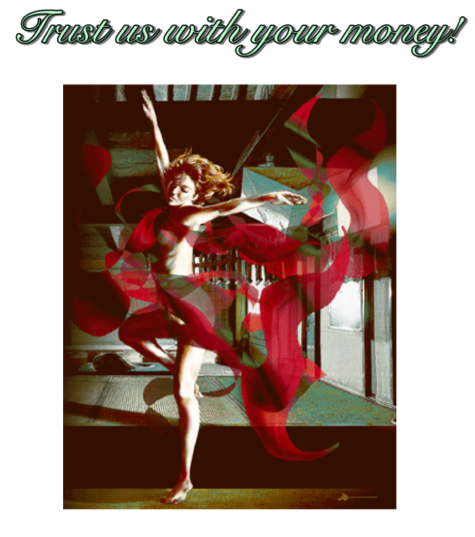
Maybe counter-ads are the answer. I could create ads instead of longing to ban them.

BanksTrust1.jpg

[painting by Laura Givens, entitled ‘Wild Abandon’]

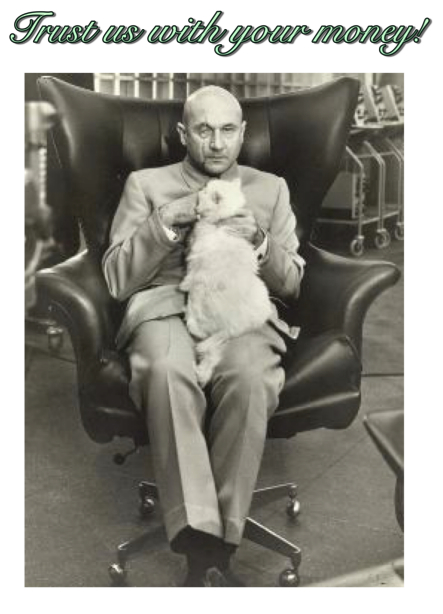
Or, for consumers who like authority figures,

BanksBlofed1.jpg

[if you’re not up on old James Bond villains, that’s Donald Pleasance as Ernst Blofeld, SPECTRE leader who has sensibly turned international banker after the Cold War ended]

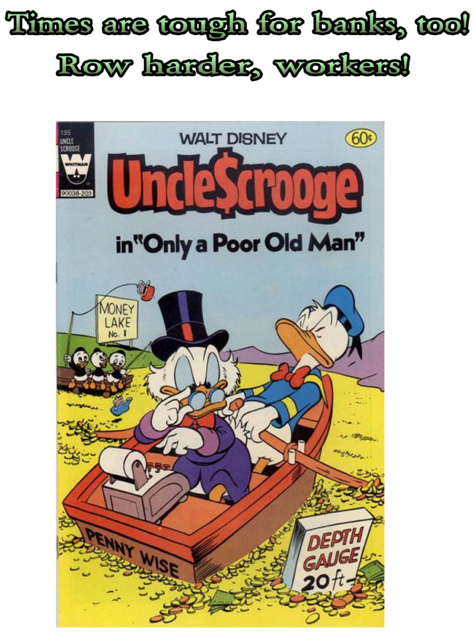
Or this,

BanksScrooge.jpg

On a more positive note, remember that there is an alternative to doing business with Scrooge, Blofeld, and Salome of the Seven Veils. Visit your local credit union. Ours offers overdraft protection (no $35 fees), various kinds of accounts, loans, and debit cards. Credit unions used to restrict membership to certain groups (teachers, employees of a certain company or industry, etc.) but now many exist to serve all the residents of a certain area. Executives don’t get million-dollar bonuses, and the emphasis is on local service and steady management.

A credit union is a cooperative financial institution that is owned and controlled by its members, and operated for the purpose of promoting thrift, providing credit at reasonable rates, and providing other financial services to its members. Many credit unions exist to further community development or sustainable international development on a local level… Credit unions are “not-for-profit” because they operate to serve their members rather than to maximize profits. [Wikipedia]

Find a credit union in your area in the phone book, or use this directory.

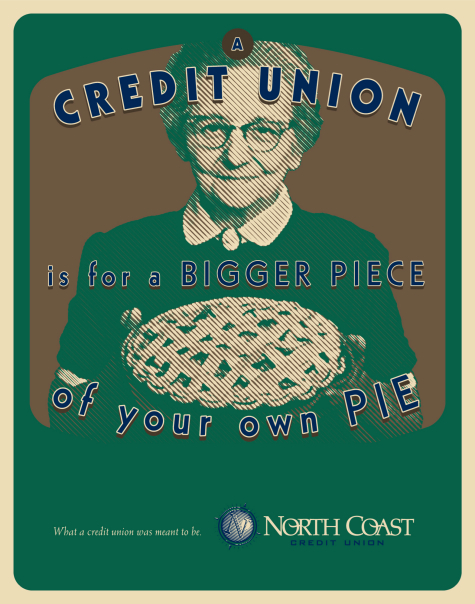
Even credit unions have to advertise. But I won’t quibble with this ad.

BankCreditUnionAd.jpg

The Button Jar

Perhaps button jars have gone the way of the darning egg (unlamented!) but I think most women used to keep one, full of the buttons removed from wornout clothing. The buttons were saved for replacing lost ones, or for sewing new garments—a pretty common thing up through the sixties. Then the clothing itself was recycled, as we would call it now, as rags for cleaning and household projects, or perhaps as quilt or blanket material.

I remember playing with my mom’s jar of buttons when I was very young; all the colors, textures, and sizes, made it fascinating. Probably she told me some of the stories about where particular buttons had come from, though I don’t remember that. I have my own small button jar, and if I’d had kids or grandkids, I would have gotten it out once in a while on a rainy day.

Mine doesn’t have such interesting buttons as my mother’s jar did; buttons are simpler and cheaper now, throwaway items, and I haven’t gone in much for fancy clothing, while my mom during her single days working in San Francisco used to save up for some special item at I. Magnin’s. Still, I’ve accumulated a good variety.

ButtonJar1.jpg

Somehow I ended up with one or two items from her collection, though: two big metal buttons with a Latin motto (“Our hope is God”, and I liked the Latin but did not absorb the sentiment) from a corduroy car coat I had in high school,

ButtonJarSpes.jpg

and (my favorite as a child) the metal wolf’s head.

ButtonJarWolf.jpg

I suppose this wolf was from a cub scout uniform, but there were no cub scouts in our extended family, so it remained mysterious in origin and attractive to the imagination.

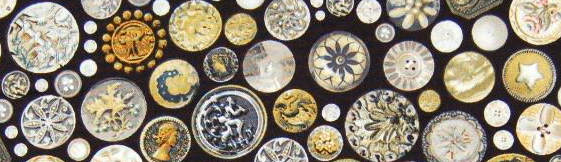
buttonJar40sButtons.jpg

Above, old buttons. Below, Watercolor “Out of the Jar V…..Antique Buttons” by Janet Mach Dutton.

ButtonJarWatercolor.jpg

If you were wondering about what a darning egg was, here’s a drawing of one so you can go to your wood-lathe and make your own [courtesy of http://www.sydneywoodturners.com.au].

Button JarDarningEgg.jpg

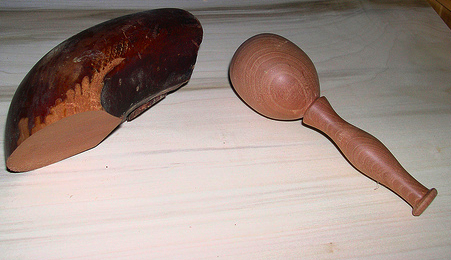
The result will be a device that goes into a sock, to provide shape and support while darning a hole. Below, one made from a piece of chestnut stair railing alongside a sample of the railing. My mother had one, lacquered black, but I don’t remember ever seeing it used.

ButtonJarDarningEgg2.jpg

Ground Cones and Witches’ Butter

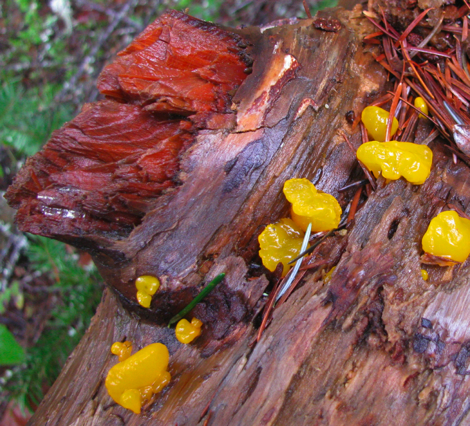
The forest road we’ve been walking on has not provided much in the way of wildlife sightings—two flickers, and various mammalian scat—but here are two odd “plants” seen this week. One’s a fungus, the other a plant with no chlorophyll. Let’s look at that one first:

GroundCone1CR.jpg

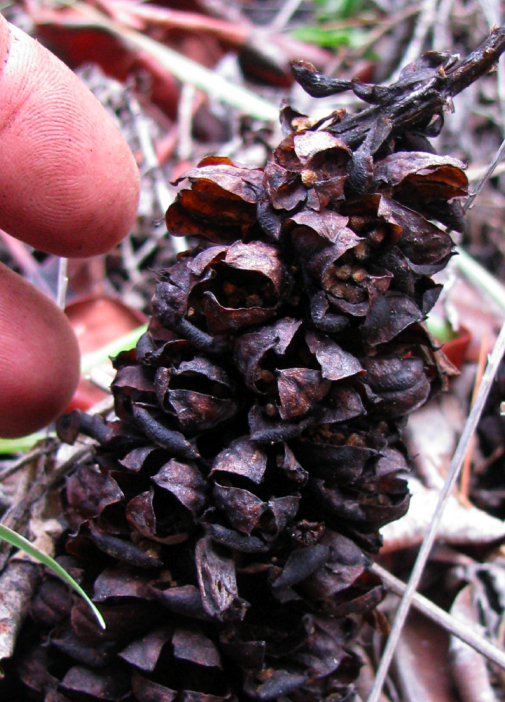
This is the ground cone (Boschniakia strobilacea), which we found pushed up through duff near maple and madrone trees.

GroundCone2CR.jpg

These belong to a group of organisms that are considered plants, although they have no chlorophyll and hence don’t make their living through photosynthesis. The larger group to which they belong is that of heterotrophic plants,

meaning “other-feeding”, since they must get their nutrition from other organisms.

Heterotrophic plants are divided into one of two groups, based upon how they obtain their food. The first of these two groups are parasitic plants. As parasites, they obtain their organic carbon from a host green plant directly through the use of structures called haustoria [rootlike outgrowths]. Wildflowers such as ground cone … are examples of root parasites. US Forest Service

Ground cones may not look like it but they are flowering plants; the ones we found today were from last spring, so they had flowered and gone to seed. Last spring they probably looked like this:

GroundConeFlowering.jpg

Photo by Russell Towle, taken in the Sierra Nevada (N. fork of the American River).

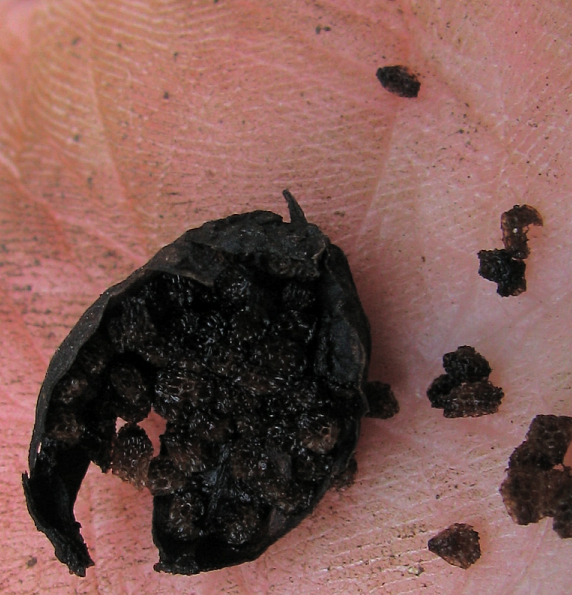
Here is one of the seed pods and contents.

GroundConeSeedsCR.jpg

The pod, though swollen with moisture, was still less than a quarter inch in diameter before I broke it open.

Our other find was a gelatinous fungus with the colorful and descriptive name of witches’ butter.

Witches' butter 1CR.jpg

I think this is Dacrymyces palmatus; similar-looking yellow-orange fungi, with the same common name, are found as parasites growing on other fungi, rather than directly on wood like this. And the witches have “butter” that is black in color too (Exidia recisa, see photo here).

Witches' butter 2CR.jpg

These are the fruiting bodies, like a conventional mushroom, though I could not find out in a brief search of the net exactly how the spores disperse.