Yellow erythronium – wildflower or cultivar?

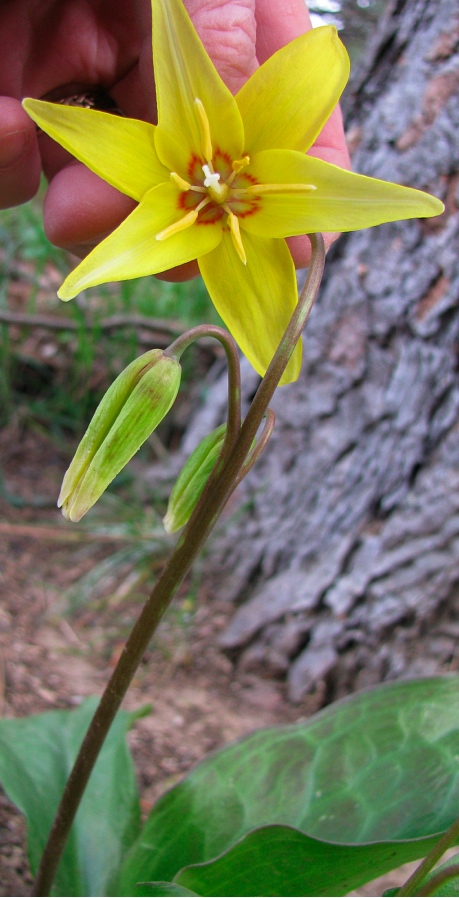
YellowErythronium2.jpg

Two or three years ago we bought this erythronium at a local nursery, Siskiyou Rare Plant Nursery, that specializes in alpine plants. For once I didn’t squirrel away the plant tags or even write things down. Their online catalog now lists no erythroniums, but maybe if I call them they’ll remember.

In the meantime, it has flourished in the shady dry place where we planted it, and is in full bloom.

YellowErythronium1.jpg

Next to it, below, is E. hendersonii, the species we see most often. There are many of them on our property which we’ve encouraged through benign neglect (and seen positive results, too, which isn’t always the case with that technique).

YellowErythronium&other.jpg

Any suggestions as to what species this yellow beauty might be? As I mentioned in my previous post, the genus is noted for hybridization or intermediate forms, so it may be a challenge. It does not look like the yellow trout lilies of the eastern US. Erythronium americanum has orange-ish stamens and more mottled foliage (see flower picture and foliage photo, with description). Erythronium umbilicatum and Erythronium rostratum have differently shaped flowers (1, 2).

Spring in the Siskiyous: more great wildflowers

In a previous post I showed off one local member of the species Erythronium, E. hendersonii, with pinkish/purplish flowers. This morning up on the middle fork of the Applegate River we found something different, which is probably Erythronium citrinum S Watson, the pale fawn lily.

Another possibility is E. oregonum but Flora of North America says that species is found at altitudes of 0 – 500 m, with E. citrinum at 100 – 1300 m and we found these at 750 m or higher. In addition, the Pacific Bulb Society mentions unusually dark leaves being common on E. citrinum and we saw those. In the end, though, I’m no botanist and won’t wager anything on my identifications of Erythronium species, particularly given what Flora of North America says in the article on citrinum:

Plants lacking auricles on inner tepals are sometimes segregated as Erythronium howellii, Howell’s fawn-lily, but they do not appear to differ from typical E. citrinum in any other characters.
Erythronium citrinum intergrades with E. californicum and E. hendersonii, occasional populations or individuals displaying intermediate or recombined characteristics. [and no, “tepals” is not a typo but a botanical term for one variety of what the rest of us lump together as “petals”]

Anyway, here’s what we saw, beautiful by any name.

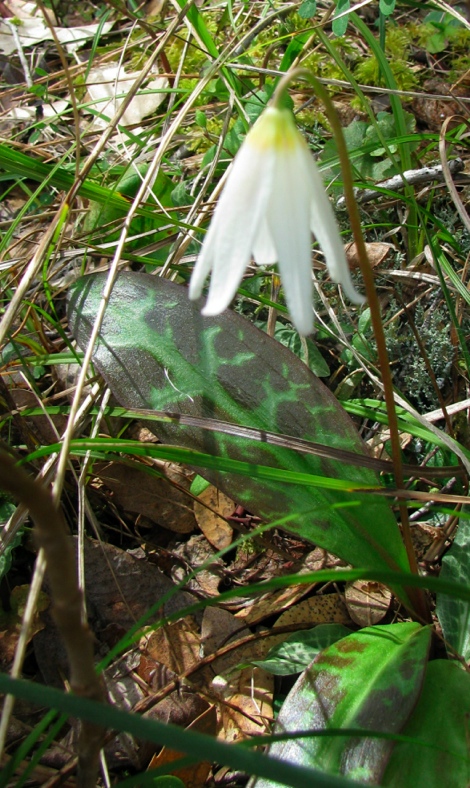
EOregonum2.jpg

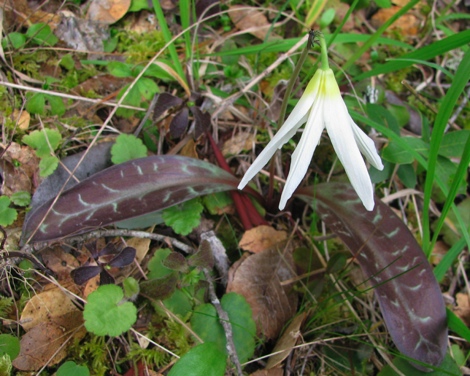
The plants are a bit larger and more robust than the pink-flowered E. hendersonii, and the petals are white touched with yellow at the base.

E. oregonum1.jpg

The mottling of the leaves is more pronounced than the leaves of E. hendersonii, and a few plants had nearly chocolate-colored leaves.

EOregonum3.jpg

Here’s one more close-up; perhaps someone can make an ID from it.

E. citrinum closeup.jpg

Another species with a white flower touched with yellow is Erythronium montanum, the avalanche lily, but its leaves are plain green, not spotted. The photo below is from Wikipedia. There’s a fantastic close-up of its flowers at the Botany Flower of the Day site.

EOregonum,montanum.jpg

Rattlesnake plantain, Goodyera oblongifolia, also has distinctively marked leaves, which grow in rosettes flat to the ground. It’s at the left in the picture below, with a damaged erythronium leaf on the right.

EOregonum& Rattlesnake plantain1.jpg

The common name “plantain” simply refers to the broad leaves; actually Goodyera oblongifolia is a member of the orchid family, with a spire of small white flowers. I can’t remember ever seeing it in bloom.

Yesterday, in a moist environment above the Applegate River, we found this beauty:

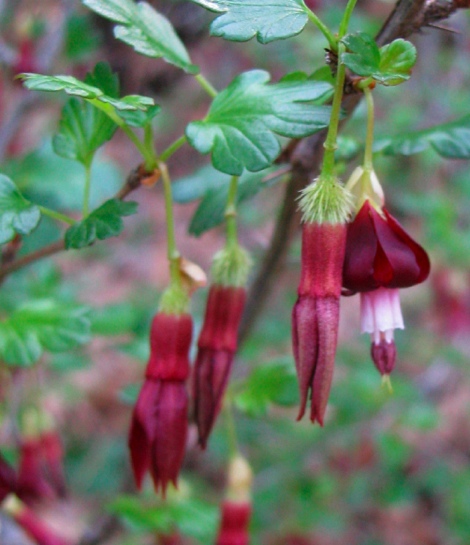
ECitrinumRibes.jpg

It’s a member of Ribes, the gooseberry or currant family, probably Ribes roezlii, the shiny-leaved gooseberry. Mostly evergreen, with thorns. Wild gooseberries/currants are edible, according to what I read, though some including R. roezlii have berries that are prickly or hairy (photos).

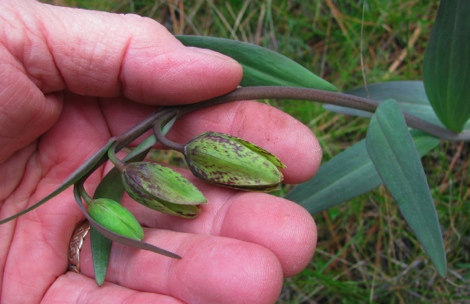
In this wetter area, there were also several of the chocolate lily, Fritillaria affinis, mentioned in a previous post in connexion with the scarlet fritillary seen on an earlier walk.

ECitrinumFritillary1.jpg

The flowers weren’t open quite yet but are still striking.

ECitrinumFritillary2.jpg

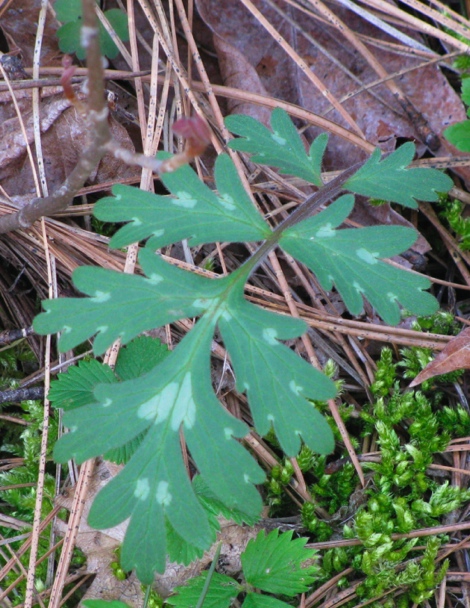
Here’s a plant with a handsome and unusual leaf, as yet unidentified.

ECitrinumMysterleaf.jpg

Finally, here’s a sweet little wildflower, Viola nuttallii (Nuttall’s violet, Yellow prairie violet). We saw it yesterday in that moister environment overlooking the river.

ECirtrinumViolet.jpg

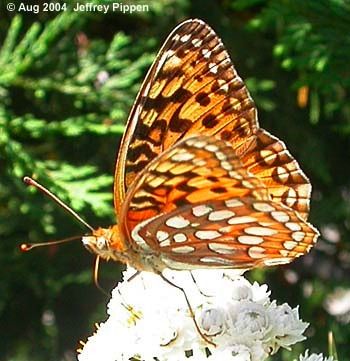
It’s a food plant for the larva of the Coronis Fritillary butterfly, Speyeria coronis, seen below.

ECitrinumButterfly.jpg

(Photo by Jeffrey Pippen)

We’ve marked down a couple of spots to revisit in a few days, to find out what sort of flowers will appear from some unknown plants. Most of them look lily-ish, just a couple of large linear leaves. What surprises do they hold? even the Shadow doesn’t know, unless he’s keyed out these plants. I’ll wait and be surprised.

Calypso orchid sighting

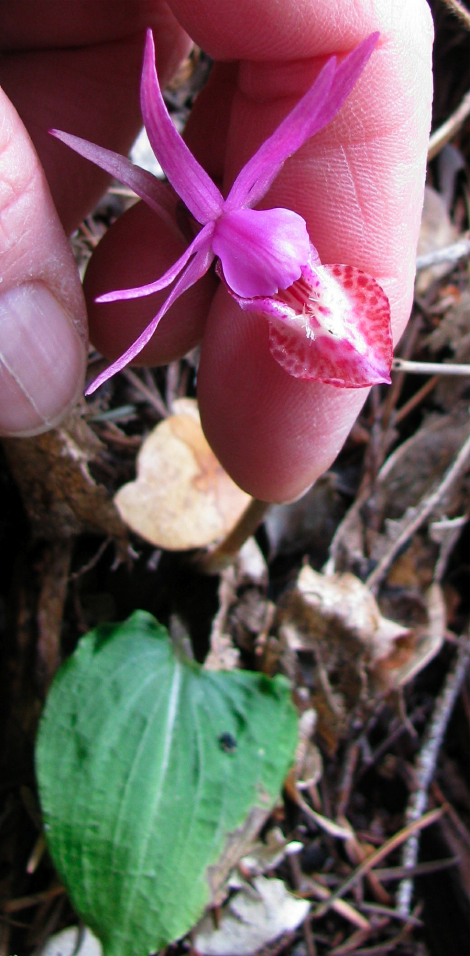
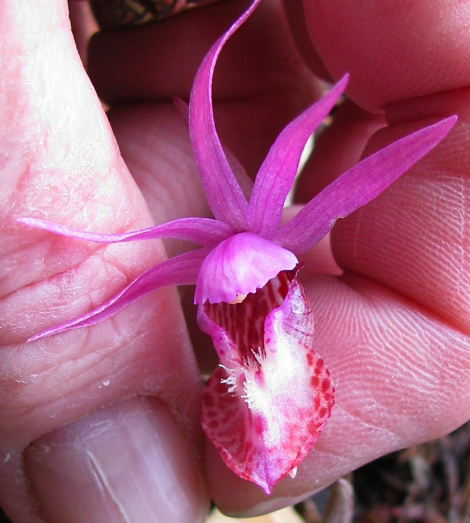
Finding a calypso orchid on our walk Saturday was a surprise, because its expected habitat is undisturbed moist old-growth forest. The place where we were walking is anything but that: it’s right beside a paved forest road, and over the past 150 years or so there has been much disturbance by a succession of loggers, hydraulic miners, gold panners and dredgers, hikers, hunters, and brush clearing for fire suppression. We spotted the orchid as we returned to the road from looking at other flowers lower on the slope, and it was growing within 5 feet of the pavement. Our interest attracted Jack the mastiff who wanted to see what we were looking at, and then we had to protect the flower from his big feet.

Calypso orchid1.jpg

The full name is Calypso bulbosa var.occidentalis, or the Pacific or Western Fairy Slipper; there’s a paler variety in the eastern US, Calypso bulbosa var. americana, or the Eastern Fairy Slipper. (The Washington Native Orchid Society has a good description of both with photos, here.) And its actual distribution is circumpolar, with two other varieties being found in Eurasia and Japan (map).

I enjoy identifying what we see, plant or animal, not so that I can check it off my life list (I don’t have one) but because then I find out more about it. Doing a bit of research for this post, I found that the Calypso orchid requires a mycorrhizal partner—a fungus that extracts extra nutrients from the soil which the plant, with its single leaf, is unable to generate. These partnerships between fungi and plants are, as we are coming to discover, common. Only painstaking investigation can detect them. The relationships are specific, a particular fungus with a particular plant species. It’s one reason why many wild plants have proven nearly impossible to transplant to gardens.

Regardless of your motives or expertise, please leave wildflowers where you find them; many are struggling enough with various human-caused disturbances. The flower you pick may be the only one the plant will produce for this year or several years, so picking it means no chance of producing seeds. And for the Calypso orchid and others, it’s even worse: picking or disturbance can mean the death of the plant

The Calypso orchid is being rapidly exterminated in populated areas due to trampling and picking. The corms are attached by means of delicate roots. These roots can be broken by even the lightest tug of the stem. Hence, when the flower is picked the plant usually dies. [WNOS page]

The Calypso orchid produces no nectar but fools bees into visiting with—depending on which expert is talking—its color, shape, fragrance, or the tiny hairs on the flower (visible below).

Calypso2.jpg

One who has studied this phenomenon in the eastern variety of Calypso orchids claims that the bees learn by experience not to bother with these unrewarding flowers, after visiting a few Calypsos and thereby cross-pollinating them. Only queen honeybees live very long, so each spring there’s a new population of worker bees to be fooled by Calypso, the orchid named after a sea nymph who loved Odysseus and kept him on her island for seven years, while he longed to be on his way back home. The name means “hidden” or “I will conceal” in Greek, and presumably refers to the orchid’s inconspicuous habit, close to the ground in shaded spots.

The iPad comes to our house

Yesterday was going to be one of those cherished days when we didn’t have to get in the car for anything. Or maybe just drive somewhere nearby to go for a walk on a forest service road. We had been expecting Dan’s iPad to be delivered, but an email had informed us a couple of days earlier that UPS doesn’t make Saturday deliveries out where we live. Sigh. Wait until Monday. Then UPS phoned: “We can’t bring it today, but we are open until 1 pm if you want to come and pick it up.” Silly question! Suddenly we wanted nothing more than to make that 25 mile trip to town.

The web is already full of accounts and reviews of the iPad, even though the official release date was only yesterday, so there’s no need for a full description of the device here. And we haven’t had it long enough for an actual review. But we’ve had it long enough to know how we like it, and that is: very very much.

The sleek design is matched by perhaps excessively minimalist instructional materials. It came with one postcard-sized piece of paper showing the external controls: Home, On/Off, etc. That was about it. And something about using iTunes to configure it. Maybe Apple expected all the early adopters to be iPhone or iPod Touch users, who would find a lot of familiar features. That’s not us (no cellphone service at our house, no need for an iPod), but we figured it out. You start out with the iPad by connecting it to your computer and opening iTunes, which detects the iPad and takes you through registration, setting up email account settings, and syncing music. An excellent user guide is on the web, readable in Safari on the iPad, but we didn’t find that out right away. An upfront referral to the user guide would have saved us some struggling, mostly with the touchscreen “gestures”. We also spent at least an hour trying to figure out how to play the music that had been synced to the iPad, until the user guide led us to an icon we hadn’t touched yet because it said “iPod”. Turns out that opens up your music library. Hunh, imagine that.

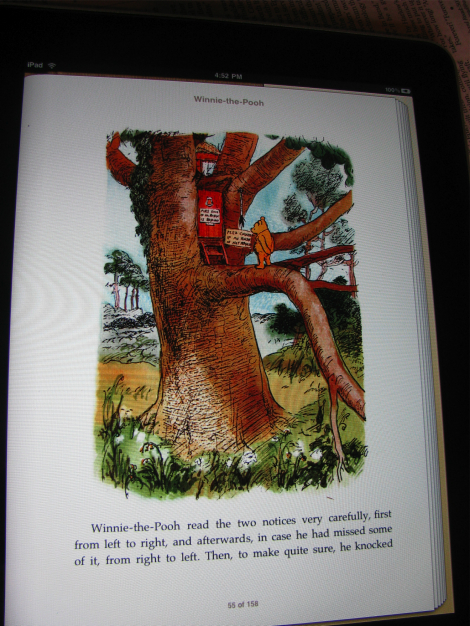
That’s all minor stuff. The iPad itself is a marvel: how easy it is to hold and use, the bright sharp screen, long battery life, intuitive operation. There it all is: your photos, the web, email, music—and Dan hasn’t even downloaded anything from the app store yet except a dictionary/thesaurus, a news reader, and the free iBooks app. This last comes with a free book, Winnie the Pooh, which seems an odd choice except that the typography and color illustrations show off the marvelous visual rendering strengths of the iPad. Some say the bright LCD screen will cause eye fatigue for readers. I can’t say yet, and the brightness is adjustable; I do think it is a great advantage to be able to read in the dark, not possible with some other e-reading devices. I’ve still got an old Palm that I keep by the bed so I can read when sleep eludes me, because it too is backlit, and I really expect the iPad will be kinder on the eyes than the small low-contrast screen of the Palm on which I have read for hours at a time.

The ability of the iPad to go from landscape to portrait mode whenever you turn it is just amazing, and makes it easy to try in an instant whether you want to read this book with one larger page shown vertically, or two smaller pages side by side. Depends on the book and how you feel at the moment, and having the choice offered and made so effortless is very nice.

In fact I’d say that’s one of the generalities I’d make about this device: it’s not just thoughtfully designed for ease of use, but for ease of use by people with different requirements. Adjustable, customizable. And that’s just out of the box. I’m sure the coming months will see lots of changes and third-party add-ons offering even more flexibility in different areas.

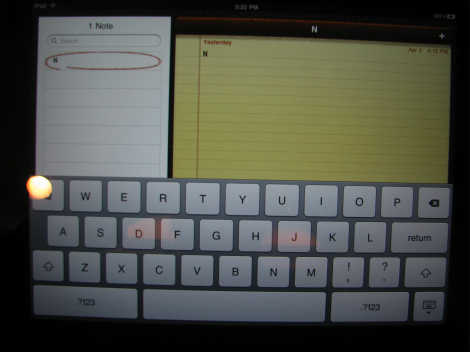
The QWERTY keypad that appears on the screen, whenever you need to type, is big enough and each key-press makes an unobtrusive but adequate sound so you know you’ve pressed it. What does that mean, “whenever you need to type”? When you touch the Search box in Safari and need to fill in a term, it appears; when you touch the “paper” of the Notepad application, it appears, and so on. This is intelligent anticipation of the user’s needs and it feels right.

The sound quality is surprisingly good, far better than that of my MacBookPro, and seems to have more volume too. We played around with the iPad well into the evening, maybe 6 hours of using the browser, looking at photos, playing music, and still had 55% of the battery power left.

Dan’s keen to get some specific apps designed for the iPhone that we have been yearning for: one is iBird Explorer Backyard: “This interactive field guide lets you search North American birds by color, shape, habitat, location, and more.” And there’s one for butterflies too. Imagine having this in your coat pocket or daypack, a field guide that can show you “birds with red markings” if that’s what you’re looking at, and play bird calls! There’s a hand-held star-guide we saw demo’ed on Rachel Maddow’s show, which gives you a labelled view of the part of the sky you are looking at—move it and the section of sky moves too. Not sure if that one is going to work for us or if it requires the iPad with 3GS, but we’ll look into it.

Okay, looking back at what I’ve written I can see people saying critically “You say it is ‘thoughtfully designed for ease of use ‘ but you couldn’t figure out how to get at your music? You must be a shill for Apple.”

I confess, I got a Mac SE in 1987 or ‘88 and it did change my life. It enabled me to do things, such as edit and lay out a magazine, producing camera-ready copy, that I would never have been able to do otherwise. The iPad gives me that same feeling as the SE, or the first laptop I got, a blue clamshell iBook: the feeling of possibilities and of a pleasure of use. After all, the Mac made computers fun to use. You could enjoy the way the machine worked, as well as enjoying what you were able to do with it. And the iPad is one more landmark on that same path.

I found myself wondering last night what computing would have developed into without Apple, if Bill Gates and Microsoft had been not just the monolith of computing but (effectively) a monopoly, the only game in town. Who can say, but I’m confident it wouldn’t have been as much fun, or unleashed the personal possibilities that the Mac has. For those too young to remember, it was the Mac that made possible the use of fonts, WYSIWYG, page-layout with Aldus Pagemaker, paint and draw programs, photos on a computer, the graphic web, and on…We went from this

iPad MSDOS.jpg

to this

iPad HelloMac.jpg

and now this

iPadWinnie.jpg

this

iPadNotes.jpg

and this (none of these hurried photos does justice to the iPad; it’s brighter, sharper, and of course not skewed or moiré-patterned)

iPadPhotos.jpg

Coming soon to our iPad:

iPadBirds.jpg

and who knows what else? It’s exciting.