Since being diagnosed in 1992 I’ve tried quite a few medications hoping they’d help the symptoms of fibromyalgia. Only two have made the cut; most of the others had no effect, or (like pregabalin and Lyrica) were too sedating to find out if higher doses would work.
Currently I take only two medications for fm: a very low dose of trazodone, an old (generic and cheap!) anti-depressant, to help me sleep, and a new anti-depressant, Cymbalta. The Cymbalta is actually for depression. I began it after the previous anti-depressant, Celexa, stopped working. I didn’t know it had stopped working, I thought I was just feeling how I felt. Dark horizons closed in on me and I saw that life really was merely a period of pointless suffering, so I told the doctor who prescribes for my depression that I thought I might as well quit taking anything and just experience reality. Afterwards I was embarrassed at my lack of insight into my own mental processes, but by its nature depression’s a condition that disables self-analysis and replaces it with the exquisite existential pain of being alive and aware. This is why depression thrives on the isolation it so effectively induces.
To be honest I must say I still feel there’s a strong intellectual case to be made that “life is merely a period of pointless suffering”… except that the medicated me retracts the word “merely”. And knows that the intellectual perspective is not the whole picture. Like an extremely protracted wait in an airport, life can be viewed as just something to endure, or you can notice what’s going on around you, help out some other travellers, go explore a different part of the airport, meet other people, and so on. Then, indeed, you die. But in the meantime, why not make the most of where you are? There are pleasures to be found, skills to master, a marvellous natural world of birds and bugs and clouds, and considerable satisfaction in doing something that lessens the overall quotient of crappiness and suffering. It’s even possible to find other people whose company you enjoy, people you love.
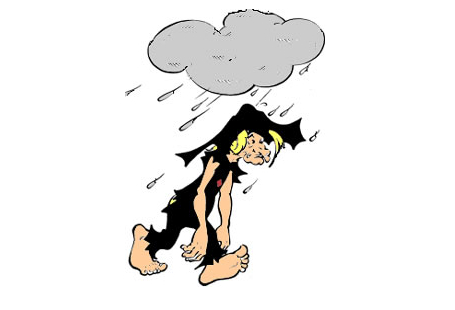
But without a functioning anti-depressant, I did not feel this way. So is it the “real me” speaking now, or just a chemical? Or was it a chemical imbalance that made me feel even worse than this guy (Joe Btfsplk, from Al Capp’s Li’l Abner)? Irrelevant hair-splitting. Unproductive line of investigation. Phooey on it.
Okay, so, Cymbalta works for me (for now) as an anti-depressant, but what about the fibromyalgia connexion? It’s touted as a drug that helps with fm pain, which is why my doc and I agreed on using it despite its expense. At first I noticed no difference. Pressure is still pain, it hurts to hold onto the steering wheel or lean against a wall or sit or stand. Then the doc asked me, after using it for the better part of a year, if it had helped the fm. Didn’t really think so. Later, I looked back over what has changed in that period and there’s one huge thing: I have been able to stick with an exercise plan of walking, to the point where I could walk 2 miles with the first mile being all uphill. And when I challenged myself after a while to walk the uphill mile without stopping I found I could. Always before, no matter how gradually I increased the exercise, within a couple of weeks (or less) my pain and exhaustion would spike so much I’d have to stop for 5 or 6 days. You never get any “training effect” that way. You’re always struggling and always being knocked back to the starting point. This fantastic feature of fibromyalgia (and of chronic fatigue syndrome) is called post-exertional malaise.
Unlike my previous anti-depressant, Cymbalta (Duloxetine) doesn’t just increase the amount of serotonin available in my system, it does the same thing for norepinephrine. What does this mean? Here’s a clue: norepinephrine is also called noradrenaline. It’s secreted by the adrenal glands and, along with adrenaline, it has actions throughout the body and also in the brain, mostly aimed at revving you up—increasing heart rate, blood pressure, and blood sugar; raising the metabolism; in general, preparing the body “to take immediate and vigorous action”.
Since even the researchers aren’t sure exactly how anti-depressants “work”, I’m not going to delve into it any further here. Suffice it to say that some part of norepinephrine’s action enables my body to deal with exercise more normally, and adapt to it. My walking muscles have gotten stronger, my aerobic endurance has increased, and I’ve even gotten to where at the top of the hill when I branch off onto a level road to cool off before the descent, I feel really good! Like I could walk for hours! That’s something I never thought I’d experience again, the enjoyment of physical exercise and of getting a little fitter each time. It’s probably partly the oft-mentioned endorphins that those smug runners get, and partly personal satisfaction at achieving the goal once again.
Each time it gets a tiny bit easier. At first when I started doing the uphill half without stopping I was flogging my body onward, unconscious of anything around me, totally absorbed in persevering. I had to sit down at the top, out of breath and exhausted. Now, I walk on for another 15 or 20 minutes (not uphill—yet!) without difficulty and then head back. Sometimes I have minor muscle soreness that lasts a day or two, and one knee protests that it is too old for this, but I’m not in pain and drained of energy for days as I used to be (prior to Cymbalta) after doing short level walks.
The catch about Cymbalta is the expense. I take a high dose, 160 mg/day, and it costs about $10 a day. (Last quarter the manufacturer, Eli J. Lilly, made profits of $1.2 billion on total revenue of $6.25 billion; 20% profit, not bad.) My insurance, the Medicare Drug Plan, covers most of it and so do some regular health insurance plans. It’s prescribed for depression, fibromyalgia, neuropathy, and some forms of chronic pain. There will be no generic version until the patent expires in 2013. Online ads for generic cymbalta should be regarded as scams, as if someone wanted to sell you $20 bills for $5. It can’t be the real thing from the manufacturer, and you have no idea what it might be.
There is an organization, The Partnership for Prescription Assistance, which “helps qualifying patients without prescription drug coverage get the medicines they need through the program that is right for them. Many will get their medications free or nearly free.” This organization is sponsored by America’s pharmaceutical research companies. There is no charge for getting help from the PPA. You can find more information about them here. Your doctor may know about other ways to save money on prescriptions; ask! Also, inquire about free samples to get started and see if it helps you.

 nosleepingdogs