Bees in the garden, and strange habits of gophers

Mint is fine as a culinary herb, but plant it in the ground and it’s like having a tapeworm: you’ll never get rid of it and it just gets bigger. I keep pulling and slashing away at the mint planted by a previous resident, to no avail. The tiniest piece of root or stem will grow a new plant if it finds a little water. Stems flop to the ground and root, new plants pop up from seed or wandering underground invasive roots. And somehow it even hangs on, once established, here in the long hot dry summer.

And here it is, in bloom! I was irked until I saw how much “our” honeybees were enjoying the flowers. (I’ve posted before about the small hive of honeybees in a cavity in a dead oak tree on our place.)
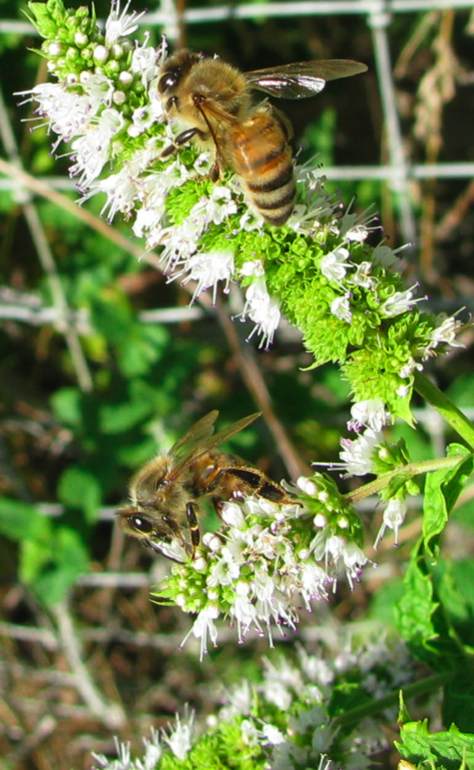
BeesOnMint1CR.jpg

The wire fence in the background encircles our vegetable garden; the mint just loves it in there, where there’s regular watering. If only the gophers would use the mint as a garnish for the vegetable plants they devour: every single sweet pepper plant (7 plants!) was sucked down into the ground by the gophers this year. It happens overnight as if the plants walked away, but dig and you will find remans. And the gophers tunnel around the roots of other plants which they don’t seem to eat, but the plants die anyway.

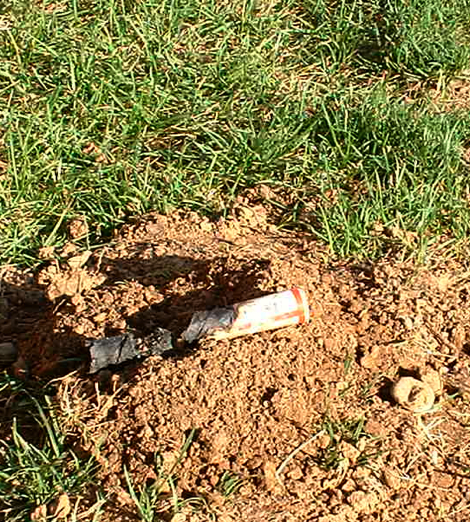
For ten years I waged war against the gophers until the futility of it sank in. I tried everything: a trap––lots of work to dig in the stony dry ground looking for a straight open run of tunnel, and the trap never caught one anyway; gassing them with exhaust via a pipe from the car to a tunnel opening (yes, there is a specialized flexible pipe sold just for this purpose, I’m not the only anti-gopher fanatic out here)––results apparently nil, though how can you tell?; curses and exhortations; and dozens and dozens of sulfurous poison gas bombs, like big firecrackers that you light and stick into a tunnel you’ve excavated, then cover it up so the smoke goes through the tunnel system. Or that is the theory. Within a few uses the gophers were changing their tunnels: adding right angles and frequent backfilled partitions. Even stranger, they often dug back to the site of a “Gopher Gasser”, then up to the surface, and left me a message:
BeesGopherEjecta.jpg

That’s the carefully ejected remnant of the “Gopher Gasser” placed right on top of the new pile of dirt! If you look closely you can imagine the little thought balloon above it…

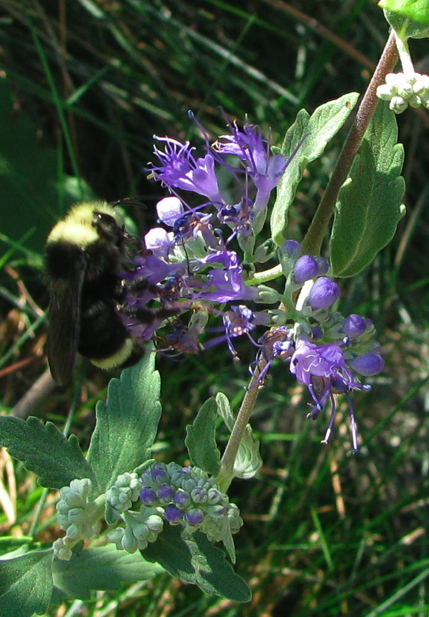
After seeing the bees busy in the mint I checked out their activity elsewhere. This is one of the big “bumblebees” or so we call them, on a Caryopteris plant (a hybrid cross between C. incana and C. mongholica ‘Bunge’, with cultivars such as “Bluebeard” or “Blue Mist Spiraea”).
BeesOnPurpleCR.jpg

There were honeybees on this plant too, but more of the big guys.

BeesCaryopteris2.jpg

One was clinging upside down, sheltering under a leaf because the sprinkler had been on this plant earlier.

BeesShelterBeneath.jpg

I like to watch the industrious behavior of the bees; if only I could feel that way about the gophers. Well, maybe a mint julep would help…
Visit to a California Eucalyptus grove

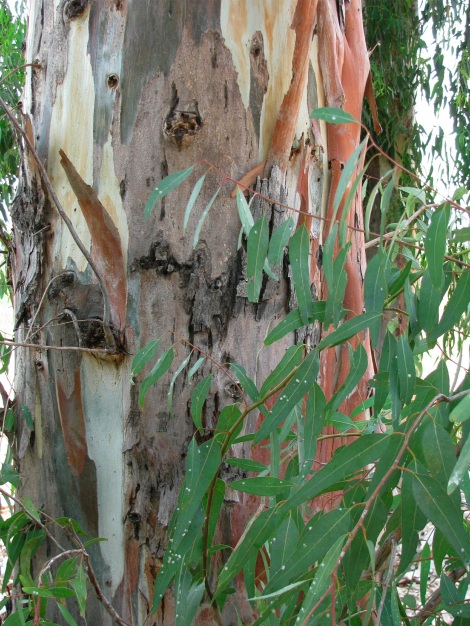
Growing up in Northern California, I always had a special fondness for the eucalyptus; various species have been planted there, mostly as windbreaks. They grow fast, are evergreen, and haqve fragrant leaves and varicolored bark that peels away in great strips.

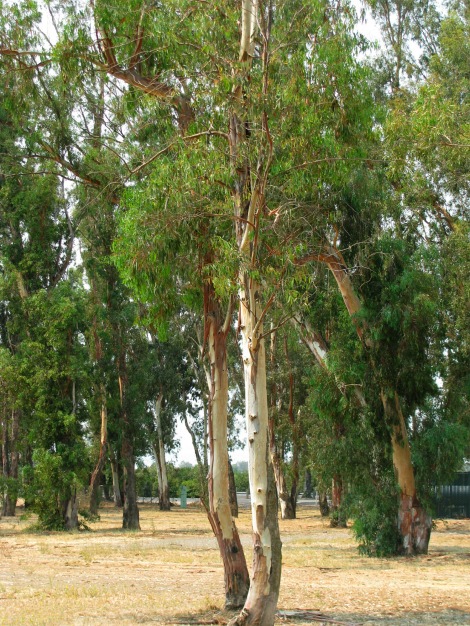
So last week as we headed home from Sacramento, up I-5 to Southern Oregon, I wanted to stop and get close to some eucalyptus again. We left it a little late, and settled for a planting at a rest stop, on the northern edge of where eucalyptus flourish. These were not as densely planted as many groves, but then you can appreciate the individual trees more.

EucalyptusGrove.jpg
EucalyptusMulti-trunk2.jpg

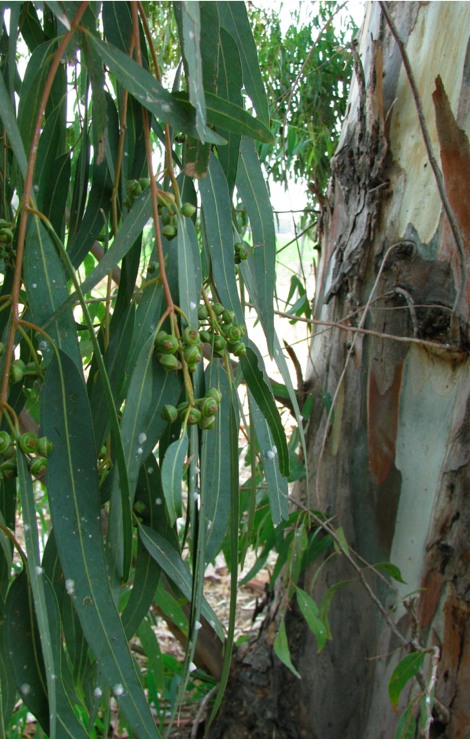
These trees were afflicted with scale, which you can see as small white spots on the narrow leaves.

EucalyptusBark&Scale.jpg

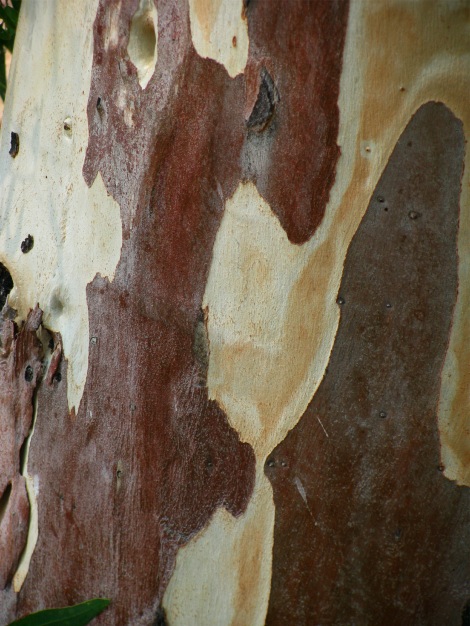
Bark patterns are always fascinating; like the madrones of Southern Oregon, eucalyptus trees present masterpieces of natural form wherever you look.

EucalyptusBarkLongTrunk.jpg

Wildlife

You can’t expect to see much in 20 minutes, during the hottest part of the day, among trees next to a freeway rest stop, but we found a bit.

In the picture below, a woodpecker’s work can be seen at the top.

EucalyptusBarkWoodpecker.jpg

We found traces of some sort of beetles under peeling areas of thick bark, and these are probably what the bird was hunting.

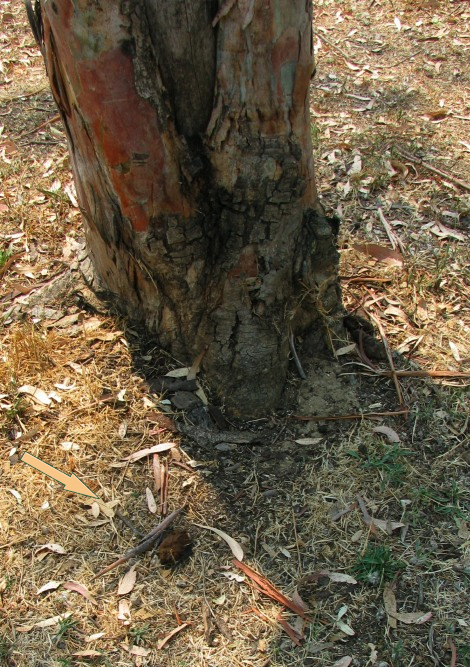
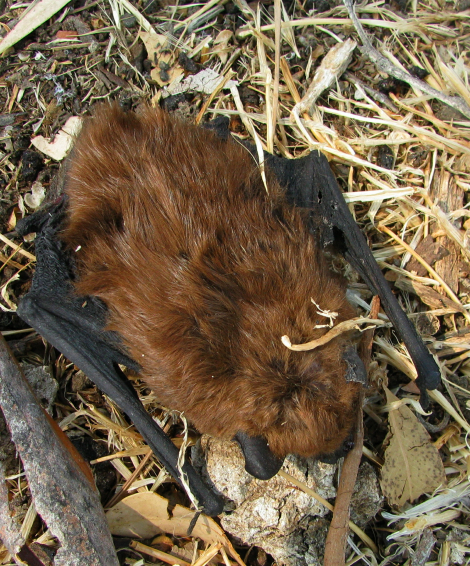
At night, other insect hunters emerge; at mid-day they were sleeping high in the trees invisible to us, but one who had died lay beneath a roost tree. (Traces of droppings, along twenty feet of the tree’s trunk, indicated the presence of multiple individuals.)

EucalyptusBat+TreeCR+ARROWY.jpg

We did not examine him or her, and I’m not sure what the species may be.

EucalyptusBatCR.jpg

A good guess would be the little brown bat, Myotis lucifugus: it’s very common, it is the right size and color, and has small dark ears as this one does. Or maybe California Myotis (or “California Bat”), Myotis californicus. I am really just guessing––one source says there are 24 species of bats in the state of California. The small ears and lack of a “leaf-nose” structure do rule out a few candidates.

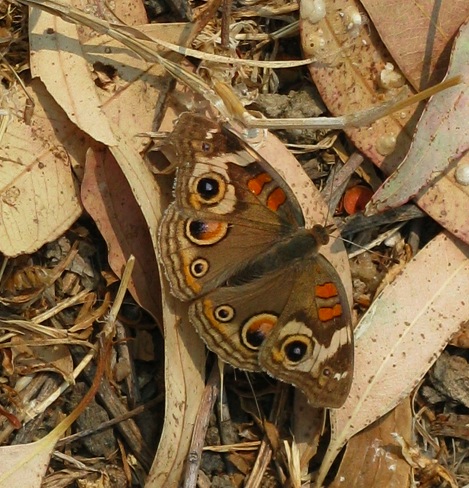
The butterfly we saw and photographed we do have an identification for, though: the Common Buckeye, Junonia coenia:

EucalyptusButterfly.jpg

I didn’t recognize it, and located a useful list of California butterflies with links to photos and information on each species. Then it turned out that Dan knew what it was all along, but it was fun to look through butterfly photos and have the Eureka! of seeing it. Maybe I will remember it better that way. The Common Buckeye probably isn’t resident where we saw it; the Butterfly Site says it lives along the coasts as far north as Central California in the West and North Carolina in the East and that:

Adults from the south’s first brood migrate north in late spring and summer to temporarily colonize most of the United States and parts of southern Canada.

That’s a lot of traveling for this tiny seemingly fragile creature.

Eucalyptus seedpods

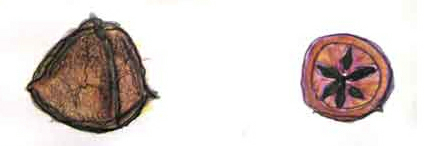
I wanted to collect some seeds to grow at home, and had in mind the seed pods that are up to an inch long and look like this (source of drawing), though the ones I wanted are silvery-grey in color.

eucalyptusSeedpodDrawing.jpg

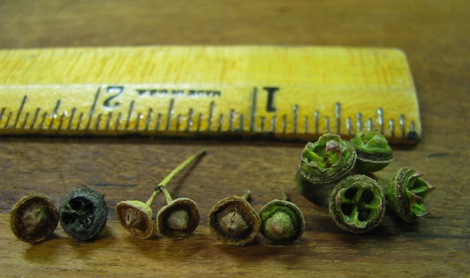
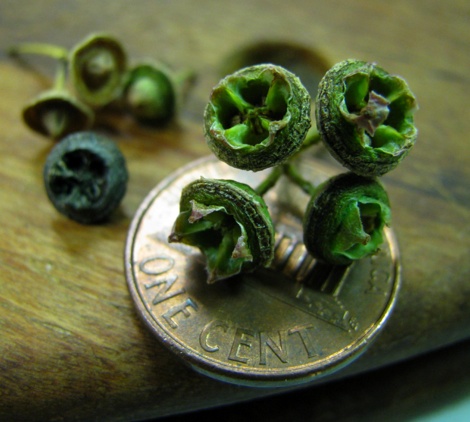
But the trees at the rest stop were a different species, with very different seed pods.

EucalyptusSeeds&Ruler.jpg
EucalyptusSeedsOnPenny.jpg

I’ll give them a try and maybe in ten years I’ll have my own eucalyptus grove.

EucalyptusSeedsScaleBark.jpg

Stooks and sheaves at an historic farm

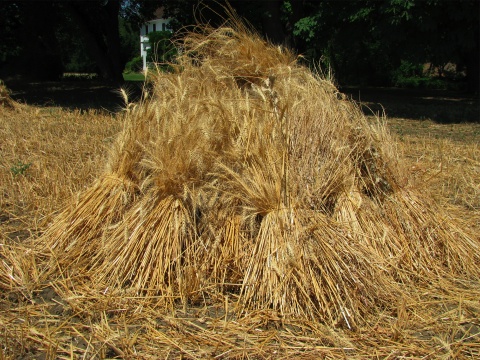
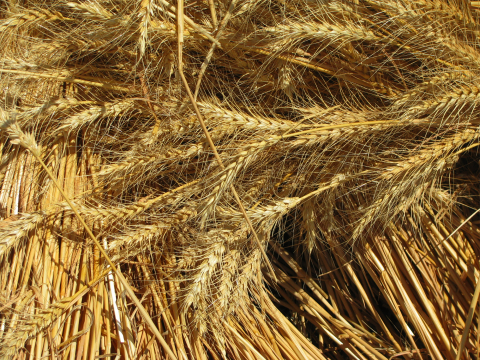
At Hanley Historic Farm near Jacksonville, Oregon, we came upon a wheatfield that had been cut and stacked, and it was a beautiful sight.

StooksField1.jpg

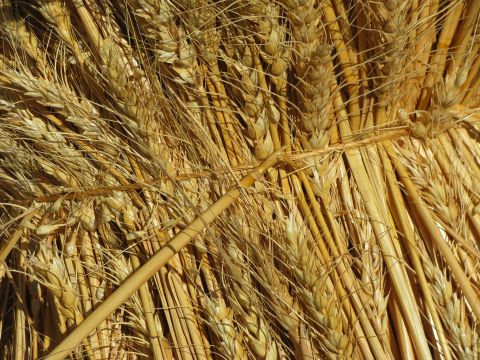
These aren’t just bunches of cut wheat tossed up into heaps like our idea of a haystack; they’re carefully constructed of sheaves, or bundles,

StookSingle.jpg

Stooks1V.jpg

and each sheaf is self-tied with wheatstraw.

SheafTied.jpg

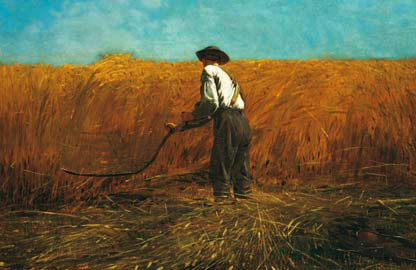
This takes us back a hundred and fifty years or so: before mechanical harvesters and threshers, grain was cut with scythes, made into stacks in the field to dry, heaved up onto wagons with pitchforks, and then threshed and winnowed to separate the wheat (or barley or oats or millet) from the chaff and straw. Hot, dusty, backbreaking work.

WinslowHomerThe_Veteran_in_a_New_Field1865.jpg

Winslow Homer (1836-1910), The Veteran in a New Field, 1865 (source)

ScythingPainting.jpg

(source; artist unknown.)

Think about cutting acres of wheat this way, stopping every 20 minutes or so to sharpen the scythe blade which had to be razor sharp so that the cut wheat would fall neatly.

Loading-The-Hay-Wagon-1.jpg

Heinrich Bürkel (1802-1869), Loading The Hay-Wagon [and hurrying to beat that rainstorm!] (cropped for this use; entire painting here)

StookCloseup1.jpg

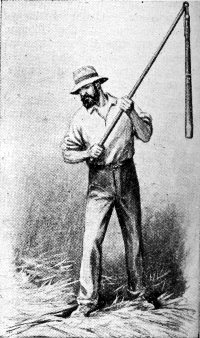
I’m curious how this wheat will be threshed and winnowed. Historic methods for threshing included having oxen walk round in circles stepping on the grain to break it (mentioned in the Bible: “You shall not muzzle an ox while it treads out the grain” Deuteronomy 25:4) and using a flail,

StookManWithFlail.jpg

Source

I’ll see what I can find out from the farm, which is run by the Southern Oregon Historical Society.

StooksFarmhouse.jpg

StooksHanleySign.jpg

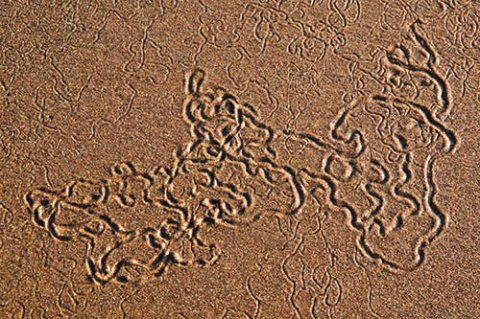
Sea Snail Trail in Sand

SnailTrackinSand480.jpg

Sea Snail Trail in Sand, Shi Shi Beach, Olympic National Park

A while back I posted some of our photos from a low-tide explore near Gold Beach, Oregon, and that got me interested in the marks and tracks left in the sand. I found this great photo on the flickr account livingwilderness. This photographer has an eye for patterns and forms in nature as well as spectacular scenes, in the American Southwest, Pacific Northwest, and New Zealand. Take a look!