
Exercise your ear for language. Of these quotations, which was not written or uttered by Thomas Jefferson? [some irregular spellings are contained, they aren’t typos but represent the flexibility of orthography in earlier centuries.]
“An honest heart being the first blessing, a knowing head is the second.” 1
“But though an old man, I am but a young gardener.” 2
“Do you want to know who you are? Don’t ask. Act! Action will delineate and define you.” 3
“A mind always employed is always happy…The idle are the only wretched. In a world which furnishes so many emploiments which are useful, and so many which are amusing, it is our own fault if we ever know what ennui is, or if we are ever drive to the miserable resource of gaming, which corrupts our disposition, and teaches us a habit of hostility against all mankind.” 4
Probably you had no difficulty in identifying #3 as the one that doesn’t fit. It seems to stick out like a wrong note in music: inappropriate to the man and his time, both in sentiment and expression. For me, being old enough to recall the human potential movement, it clearly has a connexion to that school of folly. Spontaneity, individualism, do whatever feels right to you (regardless of consequences to others, or even yourself), were exalted above all else. Impulse over reason. All self-expression is good. Learning, self-restraint, and practice are by implication unnecessary, and a cruel blow to one’s inner child.
“…you just get stoned, get the ideas in your head and then do ’em. And don’t bullshit. I mean that’s the thing about doin’ that guerrilla theatre. You be prepared to die to prove your point.”
Abbie Hoffman 5“I do my thing, and you do your thing. I am not in this world to live up to your expectations, and you are not in this world to live up to mine. You are you, and I am I, and if by chance we find each other, it’s beautiful.”
Frederick E. Perl 6
But all over the net, I found that laissez–faire quotation #3,
“Do you want to know who you are? Don’t ask. Act! Action will delineate and define you.”
attributed to our third president, author of the Declaration of Independence, a man of such parts that John F. Kennedy famously remarked, upon the occasion of a White House dinner honoring Nobel Prize Winners, “I think this is the most extraordinary collection of talent, of human knowledge, that has ever been gathered together at the White House, with the possible exception of when Thomas Jefferson dined alone. Someone once said that Thomas Jefferson was a gentleman of 32 who could calculate an eclipse, survey an estate, tie an artery, plan an edifice, try a cause, break a horse, and dance the minuet.” [Please indulge me while I point out the obvious, that Thomas Jefferson did not acquire any of these abilities by simply expressing himself and “doing his thing.”]
The mis-attributed quotation came to me a few weeks ago from some newsletter list I got on, and it seemed so anachronistic to me that I started looking for who really said it. Well, according to most websources, it was Thomas Jefferson. Google it and see. I did find another person credited with it, but the Jefferson attributions were far more numerous. But truth isn’t established by majority vote, so I kept looking.
Finally I discovered The Jefferson Encyclopedia which has a page of “Spurious Quotations” but I did not find “Don’t ask. Act!” there, so I wrote to them. This, now, is a reliable source, part of the foundation which protects and restores Jefferson’s estate at Monticello and sponsors educational and research programs. The encyclopedia site is described as “Trustworthy information on Thomas Jefferson and his world by Monticello researchers and respected Jefferson scholars.” I got a prompt reply; the experts there have had more than one inquiry on the subject, and mine must have been the last straw, as they decided to add a page concerning the “Do you want to know who you are?” quotation to their informational wiki-encyclopedia.
The true author of those words? Witold Gombrowicz, of course! He was (1904-1969 ) a Polish novelist and dramatist. As Anna Berkes, the Monticello researcher who kindly answered my email query, put it:
“Also, most people would much rather put “Thomas Jefferson” on their signature line or plaque or bumpersticker than, say,
Witold Gombrowicz; so it’s often an uphill battle to try to
dis-associate Jefferson from quotations like these.”
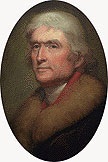
This painting is a copy of the second life portrait of Jefferson (1805) by Rembrandt Peale. Source.
The web is the best example to date of how something can get written once, and then copied by dozens of others who rely on the authority of the first.
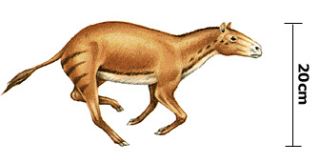
The late Stephen Jay Gould wrote an essay on the phenomenon, about how someone’s questionable comparison of the size of the earliest horses (Eohippus, when I was in school) to the size of a fox-terrier, was repeated by textbook publishers from 1904 to 1988 when Gould’s “The case for the creeping fox terrier clone” appeared in Natural History Magazine. (You can also find it in Bully for Brontosaurus, a collection of Gould’s essays, and in Google’s online digitization of same.) Gould’s point was the failure of textbook writers (compilers?) to consult original sources and use fresh material, instead of doing what, in a student, would be condemned as plagiarism. The only fox-terrier familiar to very many people is Asta in the Thin Man movies, but probably few people born after 1950 would know about William Powell’s debonair canine sidekick. Thus, as an aid to understanding, the metaphor has outlived its effectiveness.
And copying blindly leads also—as in the case of the Jefferson mis-attribution—to just plain wrong information. The Eohippus/fox-terrier comparison may be such a case. The AKC standard for the Wire(haired) Fox Terrier prescribes a height of 15.5 inches at the withers—roughly the shoulder—for the male. Wikipedia states that Hyracotherium (formerly Eohippus) “averaged 8 to 9 inches (20 cm) high at the shoulder.”
And why did I write this post? I admire Jefferson, and I wanted to help set the record straight. So, Google, find this: Thomas Jefferson did not say or write “Do you want to know who you are? Don’t ask. Act! Action will delineate and define you.” It was Witold Gombrowicz.



 nosleepingdogs