Children’s books online: social history, public-domain illustrations

PicturePuzzleABCtb.jpg

PicturePuzzleABC2tb.jpg

I’m fascinated by the wealth of vintage illustrations that have been scanned and made available on the web. The BibliOdyssey blog is all about this and a great place to browse. Lately I’ve been doing some ferreting about for myself too, and of course have to share my discoveries.

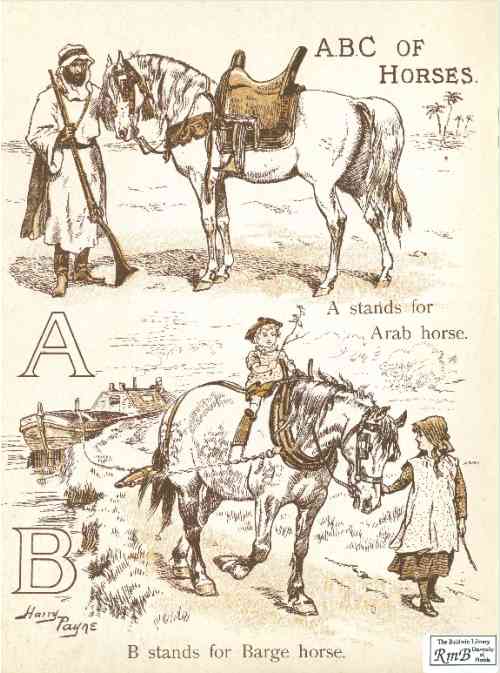
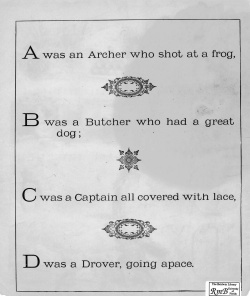
This time it’s old children’s books in two collections at the University of Florida: the Literature for Children Collection at the University of Florida Library (2455 titles), and the Baldwin Library of Historical Children’s Literature (4787 titles). Cruise the title lists (LCC, Baldwin) and find multiple versions of Robinson Crusoe, Aesop’s Fables, and other classics; various illustrated ABC’s, Annie and the elves, and other stories published in 1852 by the American Sunday-School Union, Around the World with Santa Claus (1891), At war with Pontiac, or, The totem of the bear : a tale of redcoat and redskin (1896)–––and we’re still in the “A” section. [Above are the first two pages from Aunt Louisa’s picture puzzle alphabet (1880).]

Below are a few illustrations from volumes in these collections, and I was assured when I enquired that “Nearly all of the books in this collection [LCC] are public domain. Those that are not are clearly labeled as such. You can use the images freely, although we always appreciate a statement attribution that they came from Literature for Children (palmm.fcla.edu/juv/).” I think the books from the Baldwin Collection would be public domain as well.

These are presented here considerably reduced in size and resolution, compared to the online originals, which are each over 1 MB when saved as pdfs.
PussInBoots.jpg

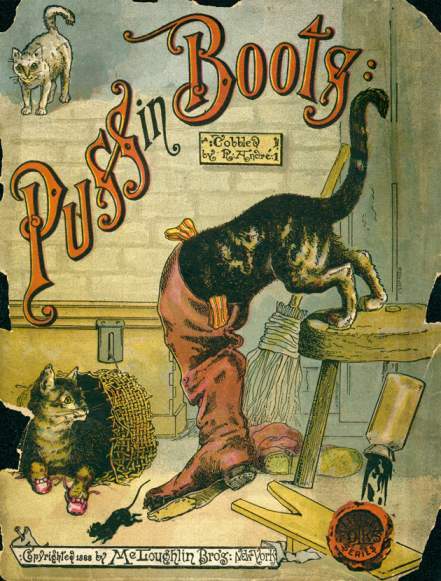
Above, the cover from Puss in Boots (c. 1888), illustrations by André, R ( Richard ), 1834-1907 [nom de plume of English artist William Roger Snow].

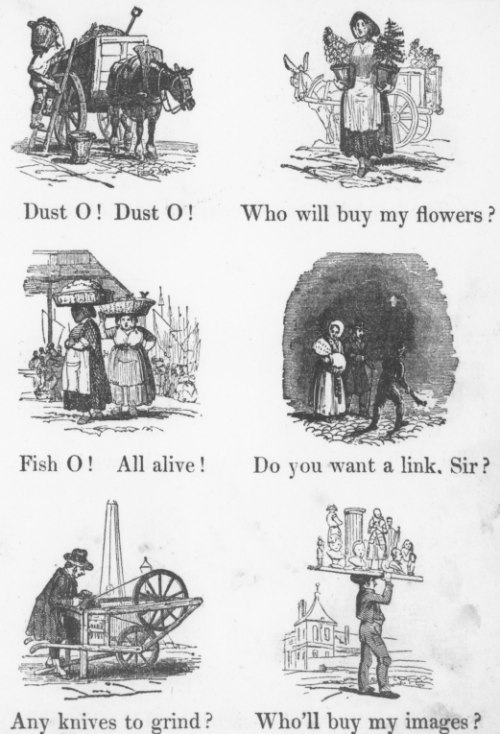
Below, the “London Cries” page from Aunt Mary’s primer: adorned with a hundred and twenty pretty pictures (1851) shows some of the street pedlars of the city along with their characteristic “cries” to hawk their wares, which gave us phrases such as “Cockles and mussels, alive alive-o!” Also shown are the dustman collecting who knows what (horse manure?) and a “link-boy,” selling his services to light the way of those travelling the unlit streets before gas lighting.
LondonCries1.jpg

Below, the cover and two pages from A museum of wonders and what the young folks saw there explained in many pictures (1884), text and illustrations by Frederick Burr Opper [Baldwin Library Digital Collection, also at the University of Florida].

MuseumOfWonders1.jpg
MuseumOfWonders2.jpg
MuseumOfWonders3.jpg

Below, the cover and two illustrations from the ABC of Horses (1880)

ABCHorsesCover.jpg
ABCHorses1.jpg
ABCHorses3.jpg

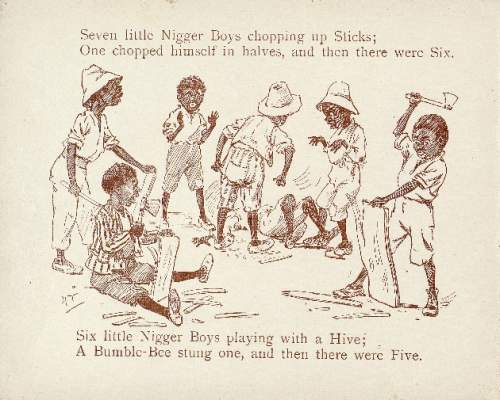
But there’s more here than quaintness, nostalgia, or public-domain illustrations. Children’s books are always in some way a part of society’s revelation of itself to children, and its effort to shape their attitudes. The very first entry in the alphabetical list of titles is 10 little nigger boys (1890), no author given. A rhyme recounts how a group of ten young black boys gradually becomes only one, as various accidents befall them on their journey. One oversleeps (the most benign incident); one chokes, one is hugged to death by a bear at the zoo, one “cuts himself in half”, you get the idea.
NiggerBoys1.jpg

This reminded me of the familiar title Ten Little Indians (Agatha Christie) and I wondered what the connexion was. Wikipedia was the first entry in a Google search and was very informative.

It is Christie’s best-selling novel with 100 million sales to date, making it the world’s best-selling mystery…The novel takes place on an island off the coast of Devon in late 1930s named Indian Island. Eight people of different social classes journey to the Soldier Island mansion are invited there by a Mr. and Mrs. U.N. Owen but the eight people don’t know them. Upon arriving, they are told by the butler and his wife, Thomas and Ethel Rogers, that their hosts are currently away. Each guest finds in his or her room a slightly odd bit of bric-a-brac and a framed copy of the nursery rhyme “Ten Little Soldier Boys” (“Ten Little Niggers” in the original 1939 UK publication and “Ten Little Indians” in the 1940 US publication) hanging on the wall:

Ten little Soldier boys went out to dine;
One choked his little self and then there were nine.
Nine little Soldier boys sat up very late;
One overslept himself and then there were eight.
Eight little Soldier boys traveling in Devon;
One said he’d stay there and then there were seven.
Seven little Soldier boys chopping up sticks;
One chopped himself in halves and then there were six.
Six little Soldier boys playing with a hive;
A bumblebee stung one and then there were five.
Five little Soldier boys going in for law;
One got into Chancery and then there were four.
Four little Soldier boys going out to sea;
A red herring swallowed one and then there were three.
Three little Soldier boys walking in the zoo;
A big bear hugged one and then there were two.
Two Little Soldier boys sitting in the sun;
One got frizzled up and then there was one.
One little Soldier boy left all alone;
He went out and hanged himself and then there were none.

Christie10Little.jpg

Cover of the first UK edition of this book (from Wikipedia).

Thus we learn, among other things, that in England in 1939 it was acceptable for Agatha Christie to publish her mystery novel under the title Ten Little Niggers in England, but not in the US, the title was changed to And Then There Were None. The book has been filmed a number of times under this latter title, and also as “Ten Little Indians.”

I wonder what black children were reading in 1890, when 10 little nigger boys was published. Books for children were a luxury, whether in white households or black. Was there a parallel endeavor to publish reading material for black kids? Maybe I’ll email the people at the University of Florida again and see what they can tell me.

Science fiction fan wins Nobel Prize

Hold up your heads, science fiction readers! Ansible, the sf news publication by Dave Langford, reports that

Paul Krugman, winner of this year’s Nobel Prize for Economics, is an unashamed sf fan who earlier in the year said of Isaac Asimov’s Foundation series: ‘It’s somewhat embarrassing, but that’s how I got into economics: I wanted to be a psychohistorian when I grew up, and economics was as close as I could get.’ (New York Times, 8 May)

Maybe someday “genre” won’t be a putdown when applied to fiction. Have some respect for sf: it is the literature of ideas.

Like Candide, go and tend your garden (but share the produce)

The popular press is seizing upon greed and stupidity as causes of the ongoing economic ripoff, and that’s true as far as it goes, but there’s a larger context. Here’s part of a European take on it:

The malady of infinite aspiration
In the first of two issues of Esprit devoted to the economic crisis, editor Olivier Mongin argues that market crashes are less the fault of ignorant or irrational traders and more the result of a broader historical trend in politics, philosophy, and aesthetics. Since the nineteenth century, value is no longer a property of each object or idea, but determined by the price it will fetch on the market.

Enter the herd mentality: traders who expect the market to move in a certain direction buy and sell accordingly, and so cause the change they have predicted. Politics and the media are plagued by the same self-destructive introspection. Without stable values, politicians and journalists try to anticipate what the public wants, and attempt to buy into a rising trend. As public discussion converges on these predicted beliefs, it propagates them through society – prophecies that self-fulfil.

One current consensus, notes André Orléan, is that the financial sector needs more regulation. Look deeper, though, and ideological differences remain. The dominant perspective sees markets as sound in principle, merely distorted by concealed risks. Regulate to increase transparency, and markets will get back on track. This view is opposed by those who note that bubbles and crashes appear in the most transparent markets. Markets are too volatile, this group holds, and would best be helped by keeping them connected to the economy of the real world. These fundamentally different approaches deserve to be publicly considered, argues Orléan, and not relegated to technical discussions between economists.

This is from the Eurozine Review, which presents summaries in English from European publications.

The analysis in the third paragraph echoes that of Nassim Nicholas Taleb in a book I’m reading, Fooled by Randomness: the hidden role of chance in the markets and in life. Taleb is a mathematically trained and philosophically inclined trader in the US markets; it seems as though his early life, as a Lebanese Christian whose family lost everything suddenly during the decades-long civil war there, helped him realize the power of chance events and the fragility of human fortunes. He emphasizes not only the role of chance but also the need to consider not just the odds of an investment, but its potential downside. Such consideration precludes participation in bubbles such as the sale of mortgages and credit debt, packaged and presented as safe investments.

Our American attitude has always been one of denying chance; we exalt the individual’s ability to prevail and the concepts of unlimited positive progress. We now find ourselves in a situation where many negative trends/possibilities are beginning to affect us–ones which we have denied, ignored, deferred action and study upon, for more decades than the Lebanese civil war lasted.

If the popular reports from neuroscience and behavioral studies are to be believed, humans have built-in tendencies that make us unfit for facing the complexities we now live with. We embrace short-term gains and ignore long-term risks, we do not judge the magnitude of risks accurately (e.g. we worry about dying on an airliner but drive with blithe blindness to the odds of injury or death on the road), we have short attention spans, and when something conflicts with our established ideas we ignore it or make up reasons why it doesn’t apply (cognitive dissonance behavior). And so on, the list is long.

At this point the rhythm of writing demands that I suggest some positive courses of action in mitigation of what I’ve described, but if you’ve read this far you probably know as well as I do the sort of changes, individual and systemic, that need to be made. When things get bad enough, perhaps some of them will happen in sufficient frequency to help. Until then, we must be frugal, provident, and compassionate in our own lives, and work at extending those principles more widely whenever there’s an opportunity.

The Pesthouse, by Jim Crace

Another post-apocalypse novel published (like Cormac McCarthy’s The Road) as mainstream fiction rather than science fiction. The Pesthouse (2007) won the National Book Critics Circle Award, and got good reviews, but I’m afraid it left me cold.

It’s a journey, the writing is “sensitive” and competent, the two protagonists suffer and change, the typical after-the-fall elements are present (religious nuts, violent raiders, superstitious greedy villagers)… Maybe if you don’t read sf this would all seem original and riveting, but I got bored and started skimming less than half-way through just to see if anything better came along and to find out how it would end. I think some sf writers have done much better on this theme, though as genre writers they never get much attention. Topics for another day: the genre label, and better stories on this theme.