
Wander through the history of world art

The Heilbrunn Timeline of World Art, on the Metropolitan Museum of Art site, is a garden of delights in which one can easily become lost. It now includes over 6000 items and more are being added. Covering the time period from 20,000 BCE to the present, the site allows exploration by keyword or subject, name of artist, time period, country or region, time period and region, medium, and more. You can even sort the alphabetical list of essays by region or time period, see a cultural time line (e.g. Central and North Asia, 8000–2000 B.C.), or search for something specific in both the Timeline and the Met’s overall collection database. I searched for “hat,” and found 2020 hits in The Costume Institute, and 75 in the Heilbrunn Timeline itself.

I arrived at this site while googling prehistoric Japanese sculpture (of the “Jomon” culture) and then somehow found myself looking at Moroccan embroidery and a 19th c. American quilt using squares with the signatures of notables of the time such as Ralph Waldo Emerson.

Each item has at least one photo that can be viewed in two sizes, a short description, and perhaps most enticing, links to other pieces related by time period, region, or material. Short essays are provided for many topics. Here’s one on the American Arts and Crafts movement; here’s one on a site in China, dated to 7000 BCE, with pictograms and bone flutes–”the earliest playable musical instruments” found (disputable, but let’s not carp).

Go to the list of artists and sort them according to medium or type of work: performance artist, calligrapher, painter, weapons maker, architect, metal worker, etc.

If this sounds wide rather than deep, who can complain? African Rock Art, Albrecht Dürer, Arms and Armor—Common Misconceptions and Frequently Asked Questions, Ancient Greek Dress, Botanical Imagery in European Painting, the Bikini, the Bronze Age, the Bauhaus…if I had to choose a few sites to be able to access on a desert island, this might make the list. (All of the foregoing are thematic essays on the A-B page.)

Embroidered panelMorocco.jpg

Above, embroidered panel, ca. 1800, Morocco.
Linen, silk; 9 ft. x 32 1/2 in. (274.3 x 82.5 cm)

Purchase, Everfast Fabrics Inc. Gift, 1970 (1970.272)
One of the rarest and finest examples of Moroccan embroidery, this wall hanging (arid) displays the most remarkable achievement of a Chechaouene needlewoman’s skills. The arids were used to cover the surrounding areas of interior arches in matching sets. Worked in plaited stitch, these panels contain geometric motifs based on tracery, arabesques, stars, rectangles, and diamonds, all closely associated with Andalusian elements. Said to have been used as an altar curtain in a Nestorian church in Jerusalem, this particular piece is certainly conversant with a variety of cultures and civilizations. The importance of embroidery in Moroccan life can be illustrated by the ceremony held for every infant girl at the age of four months, when the baby was placed in a chair and given a needle and thimble along with some silk thread to hold, in anticipation of a life blessed with the needle’s art.

[The images may be used for non-commercial purposes, with credit to the source, but the museum stipulates that the accompanying text must be used also.]
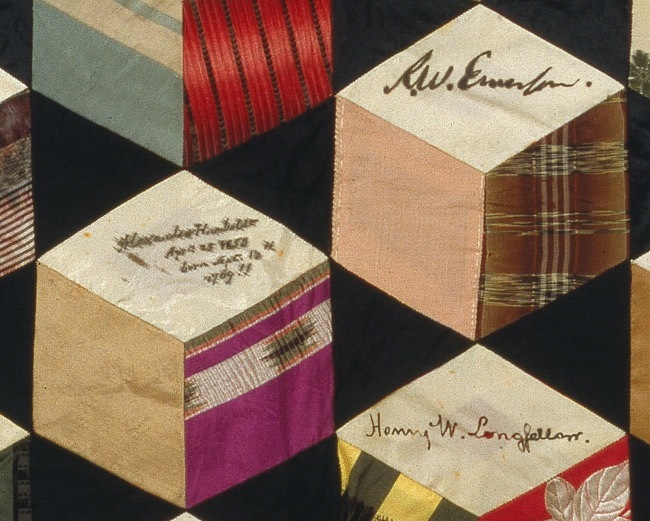
AutographQuilt2.jpg

Above, detail, Autograph quilt, ca. 1856–63, by Adeline Harris Sears (American, 1839–1931). Silk with inked signatures; 77 x 80 in. (195.6 x 203.2 cm).
Below, entire quilt.

Purchase, William Cullen Bryant Fellows Gifts, 1996 (1996.4)
In 1856, seventeen-year-old Adeline Harris, the daughter of a well-to-do Rhode Island mill owner, conceived of a unique quiltmaking project. She sent small diamond-shaped pieces of white silk worldwide to people she esteemed as the most important figures of her day, asking each to sign the silk and return it to her. By the time the signatures were all returned and ready to be stitched into a “tumbling-blocks” patterned quilt, Adeline had amassed an astonishing collection of autographs. Her quilt features the signatures of eight American presidents; luminaries from the worlds of science, religion, and education; heroes of the Civil War; such authors as Charles Dickens and Ralph Waldo Emerson; and an array of prominent artists. Today, the autographs displayed in this beautiful and immaculately constructed quilt provide an intriguing glimpse into the way an educated young woman of the mid-nineteenth century viewed her world.

AutographQuilt1.jpg

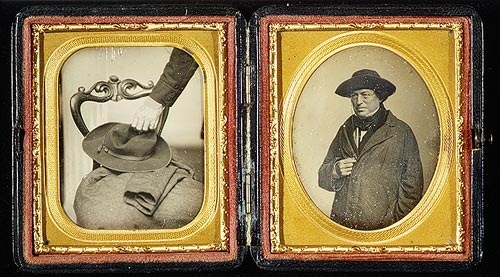
Below, one result of the “hat” search: [Cornelius Conway Felton with His Hat and Coat], early 1850s
John Adams Whipple (American, 1822–1891)
Daguerreotype; Each 3 1/4 x 2 3/4 in. (8.3 x 7 cm)

The Rubel Collection, Purchase, Lila Acheson Wallace, W. Bruce and Delaney H. Lundberg, and Ann Tenenbaum and Thomas H. Lee Gifts, 1997 (1997.382.41)
This rare daguerreotype diptych shows Cornelius Conway Felton (1807–1862), Eliot Professor of Greek Literature at Harvard University, reaching for his felt hat and duster. The first son of a poverty-stricken furniture maker, Felton became one of the most renowned classical scholars in the country and, in 1860, Harvard’s president. Although Felton donned academic robes, he never lost his connection to the everyday experiences of common folk. As opposed to the inflexible silk top hat worn by dandies and professors alike, the broad-brimmed felt duster that co-stars here was worn by outdoorsmen and was practical, casual, and fundamentally democratic.
Hat1.jpg

Iraqi journalist throws shoes at Bush

Our President flew in for a secret visit to Iraq, kind of a victory lap maybe, but all was not rose petals…

During a farewell visit to Baghdad on Sunday, President George W. Bush defended a war that has taken far more time, money and lives than anticipated, saying the conflict “has not been easy” but was necessary for US security, Iraqi stability and “world peace”.

But in a sign of lingering anger against the US military presence, an Iraqi journalist shouted: “This is a goodbye kiss from the Iraqi people, dog,” and hurled his shoes at the US president during a news conference with prime minister Nouri al-Maliki.

Throwing shoes at somebody is a supreme insult in the Middle East. One of the shoes sailed over the president’s head and slammed into the wall behind him and he had to duck to miss the other one. Mr Maliki tried to block the second shoe with his arm.

“It’s like going to a political rally and have people yell at you,” said Mr Bush. “I don’t know what the guy’s cause was. I didn’t feel the least bit threatened by it.”

By Sudarsan Raghavan, Dan Eggen and Reuters

Published: December 14 2008 18:47 | Last updated: December 14 2008 20:47

And we know that this is a true story, not just because it came from the Financial Times of London, but also because of Bush’s response: “I don’t know what the guy’s cause was…” Who could make that up?

“Sweat of the brow” copyright

As a person who enjoys the digitized reproductions, on the web, of old illustrations, I found this interesting reading:

Gutenberg: No Sweat of the Brow Copyright

From Project Gutenberg, the first producer of free electronic books (ebooks).

Work performed on a public domain item, known as sweat of the brow, does not result in a new copyright. This is the judgment of Project Gutenberg’s copyright lawyers, and is founded in a study of case law in the United States. This is founded in the notion of authorship, which is a prerequisite for a new copyright. Non-authorship activities do not create a new copyright.

Some organizations erroneously claim a new copyright when they add value to a public domain item, such as to an old printed book. But despite the difficulty of the work involved, none of these activities result in new copyright protection when performed on a public domain item:

▪ scanning and optical character recognition (OCR)

▪ proofreading and OCR error correction

▪ fixing spelling and typography, including substantial updates to spelling such as changing from American to British English

▪ adding markup (HTML, XML, TeX, etc.)

▪ digitizing, cropping, color-adjusting or other modifications to images

▪ addition of trivial new content, such as images to indicate page breaks in an HTML file, or pictures of gothic letters for the first letter in a chapter, or adding or removing a few words per chapter

▪ substantial reorganization, such as moving footnotes to end-notes, or changing the locations of pictures within the text

▪ recoding to new character sets, such as Unicode, or new formats, such as PDF

There is some value-added content that DOES get a new copyright, but only for the actual new work (that is, it may be possible to remove the new copyrighted content to go back to a public domain document):

▪ translation into another human language

▪ creating a new compilation of existing materials (though the individual items compiled retain their public domain status)

▪ creating new original art work

▪ creating an original derivative work, such as an audio performance, a new chapter, or a set of favorite quotations

▪ adding a new introduction or critical essay

Project Gutenberg is able to utilize any material which is judged to be public domain in the country of use (i.e., the United States). If it is determined that components of an item are public domain, but others are not, then the copyrighted components may be removed without the permission of whoever owns the copyright for the new content.
It is Project Gutenberg’s practice to seek permission of those who distribute materials, including copyright claimants, before harvesting their materials. This is done in order to be polite, and to allow the producer or distributor to request a particular credit be used. But if permission is not given, public domain items can still be used by Project Gutenberg, typically without any attribution. Because Project Gutenberg receives submissions from many different sources, it is not always clear where an item came from. Volunteers who submit content they did not themselves generate should be diligent about reporting sources, even if the source will not be credited in the item as distributed by Project Gutenberg.

Contagious happiness?

Are we so hungry for meaning in our chaotic world, that mere association is automatically assumed to be proof of a cause and effect relationship? Again and again, the media seizes upon research results (sometimes with the eager cooperation of the researchers) and touts them as proof that A causes B.

Latest in this parade of dubious connexions is the study which found that happy people tend to know a lot of other happy people, and the more happy people in your circles of acquaintance, the happier you are. Ergo, knowing happy people makes you happier!

An article about the study says:

The scientists found that a person’s happiness is most likely to boost the happiness levels in people closest to him — spouses, relatives, neighbors, and friends.

But, if one person is happy, that increases the chances of happiness in a friend living within a mile by 25 percent. The “cascade” effect, as the researchers put it, continues: a friend of the friend has almost a 10 percent higher likelihood of being happy, and a friend of that friend has a 5.6 percent increased chance.

In the other words, one person’s happiness can spread outward through three degrees of separation. Those at the center of such circles may be people that “you have never met. But their mood can have a profound effect on your own mood,” Fowler said.

HappinessGraphic2.jpg

Fig 1 Happiness clusters in the Framingham social network. Graphs show largest component of friends, spouses, and siblings at exam 6 (centred on year 1996, showing 1181 individuals) and exam 7 (year 2000, showing 1020 individuals). Each node represents one person (circles are female, squares are male). Lines between nodes indicate relationship (black for siblings, red for friends and spouses). Node colour denotes mean happiness of ego [individual being studied] and all directly connected (distance 1) alters [alters are persons connected to the ego, potentially influencing the behaviour of the ego], with blue shades indicating least happy and yellow shades indicating most happy (shades of green are intermediate).

Figure (reduced here) and caption are from the full article, in the British Medical Journal.

The original article’s abstract says in part,

Results Clusters of happy and unhappy people are visible in the network, and the relationship between people’s happiness extends up to three degrees of separation (for example, to the friends of one’s friends’ friends). People who are surrounded by many happy people and those who are central in the network are more likely to become happy in the future. Longitudinal statistical models suggest that clusters of happiness result from the spread of happiness and not just a tendency for people to associate with similar individuals. A friend who lives within a mile (about 1.6 km) and who becomes happy increases the probability that a person is happy by 25% (95% confidence interval 1% to 57%). Similar effects are seen in coresident spouses (8%, 0.2% to 16%), siblings who live within a mile (14%, 1% to 28%), and next door neighbours (34%, 7% to 70%). Effects are not seen between coworkers. The effect decays with time and with geographical separation.

Conclusions People’s happiness depends on the happiness of others with whom they are connected. This provides further justification for seeing happiness, like health, as a collective phenomenon.

So that’s clear: happiness is somehow “contagious”! By this line of reasoning, we could investigate the contagious effects of race, profession, sports fanaticism, and most anything else. I must have become white (and stayed that way) because nearly all my friends are white; a lawyer is a lawyer because he or she knows so many lawyers, and so on.

On a certain level, I have no argument with the direct “contagiousness” of positive emotion: it certainly cheers one up to be around smiling ebullient people. I still remember a dark rainy day, decades ago, when I was walking gloomily across my college campus and passed someone smiling and carrying a bright bouquet of flowers. It actually did change my mood, I smiled back and was bumped out of my self-absorbed thoughts. But then, the same effect might well have resulted from other stimuli that are enjoyable to me: seeing a horse running in a field, reading something that introduced a new idea, even coming in out of the rain into a warm inviting place. And if I do things often enough that elevate my mood, I will probably be in fact be happier than if I do the opposite: but these are choices, not influences beyond my control.

When it comes to a person’s close associates, surely Pollyanna chooses to hang around mostly with other cheerful folks, rather than letting Cassandra or Gloomy Gus bring her down. Perhaps really unhappy people are hard to be around and don’t share the interests and types of conversations that are common to happy people. Some people have truly terrible experiences dealt them by fate, and are unhappy; with others you feel like a good kick in the pants to get them out of being so self-centered would go along way toward changing their mood; either way, it seems entirely reasonable that the positive happy busy people tend to associate more with others of their own “type”. What was that result of an ancient sociological study? Oh yes: “Birds of a feather flock together”. The data has been lost but the conclusion has survived.

Some of the dots on the graph are family, who may be viewed as unchosen associates. Or are they? Do we know if the researchers counted that grumpy cousin I don’t like and never see (though she lives only five miles away)? And other studies have shown that there are genetic factors influencing traits such as agreeableness and extroversion which may be associated with degree of happiness. So, if happy people tend to have happy sibs and cousins, this could be caused more by shared genetically-influenced traits than by their “contagious” influence on one another.

And, in a long-term study of human behavior like this one (twenty years), some less happy people who are around happier people may indeed benefit from the activities, the “vibes”, may even learn better behavior or learn how to fake it…but those who don’t will tend to drop away from the setting where they feel out of place. Or won’t be invited so often because they “just don’t seem to enjoy our dinners or outings”. So over time people settle out into groups they feel comfortable with. This can’t be really big news. Animal-study researchers don’t count many fervid PETA members among their circles of friends and close acquaintances, and vice versa. There’s a cause and effect here all right but it may not be the one being alleged in this study.

I should admit the obvious, that I don’t understand regression analysis and the other statistical tools that are used to verify the significance of associations in studies like this one. However, I don’t think it matters. We’re not talking about whether the associations exist, but about what they mean.

This is, of course, the weakness with observational studies as opposed to experimental ones. All the observer can say is what was observed; cause and effect relationships are speculative in all but the simplest of situations (dropping things off a tower, for example: Yes! they fall because they were dropped!). In this case, an experimental study might try to find a way to cause happy and unhappy people to hang around together for months or years and see what the results are. But how can this be done without denying people freedom of association, which is a factor in happiness? We could pay them to gather together, but what about those for whom no money is enough to make tolerable the company of such damnably cheerful/such oppressively dismal folks? Individuals have even been known to change jobs because they couldn’t stand the people they worked with.

Figuring out complicated things just can’t be as easy as the media, and perhaps some scientists, would wish. And in this discussion, we haven’t even gotten to evaluating the definition of “happiness”!