Reading and the brain, and “brain scans”

There’s a new book out about what happens in our brains when we read, which may appeal to people interested in accessible accounts of neuroscience, as well as to those of us who are watching the shift from paper to electronic reading.

Reading in the brain : the science and evolution of a human invention
Stanislas Dehaene. (New York : Viking, 2009)
ISBN: 9780670021109 – Description: xi, 388 p. : ill., map ; 24 cm.

ReadingInTheBrainCover.jpg

I put a reserve on it at the library and am waiting for it to arrive. In the meantime, I found that the author has put all the color figures online along with short chapter summaries. The imbalance on the webpage between text, and the diagrams and brain maps, makes the book look more forbiddingly technical than it is, I hope. Unfortunately the book on Amazon doesn’t have the LookInside feature, so we can’t look at more of the text. Reviews have been mostly positive (links to several, on author’s page; Barnes and Noble review) though one was critical of the book’s accessibility for us “interested lay readers”:

Unfortunately, he needs to lay a lot of groundwork. This makes the first 100 pages of the book an excruciating slog. While it picks up after the first two chapters, the book still sometimes slips back into detailed explanations of neurophysiology. Dehaene is first and foremost an academic, and he seems to want to make his work defensible to his peers even as he tries to explain it to laymen. This is especially problematic in his diagrams. Rather than helping to clarify points, his visual presentations are almost always overly technical, presenting formulas and pictures of the brain that are difficult to decipher. Part of the problem is that images are all black-and-white. While he offers up full color versions on the book’s website, that’s only useful to readers who are also regularly consulting their computers. …The result is a work that requires focus to read, but rewards the effort.

It is disappointing that, according to this reviewer, the images in the book are not in color like those on the web. This reminds me of a book I looked at recently on the various branches of our early human-ish ancestors, in which maps to locate the various hominid species were poorly done or not there at all. Publishers try to cut corners and end up crippling the book. But I hope that won’t be the case here, and even if parts of it are over my head I look forward to the exploration.

I’m expecting a stimulating mix of actual established neuroscience, conclusions based on new research still open to interpretation, and informed speculation. After discussing how, he believes, reading (including our writing systems) developed in response to our neurological structures—“over time, scribes developed increasingly efficient notations that fitted the organization of our brains”, Dehaene applies the same theory to other areas of human culture: “Mathematics, art, and religion may also be construed as constrained devices, adjusted to our primate brains by millennia of cultural evolution.”

Cautions about fMRI (brain scan) studies: What a fish can tell us

I don’t know how much of Reading in the Brain relies on fMRI data, but many of the popularized “this-is-how-your-brain-works” revelations do rely heavily on brain scans, including fMRI, and we’re seeing some push-back from other scientists. A study at Dartmouth (reported by Wired, and Science News) found that a salmon’s brain had “a beautiful, red-hot area of activity that lit up during emotional scenes [photos put before the salmon’s eyes]”. Wow! Unfortunately for all but the spiritualists among us, the fish in question was dead. Apparently the neural activity that showed up was random, and more rigorous statistical analysis of the data revealed this. While many popularizers, especially in the general media, give the impression that brain scan interpretation is cut and dried, the truth is quite the opposite.

Less dramatic studies have also called attention to flawed statistical methods in fMRI studies. Some such methods, in fact, practically guarantee that researchers will seem to find exactly what they’re looking for in the tangle of fMRI data. Other new research raises questions about one of the most basic assumptions of fMRI — that blood flow is a sign of increased neural activity. At least in some situations, the link between blood flow and nerve action appears to be absent. Still other papers point out insufficient attention to insidious pitfalls in interpreting the complex enigmatic relationship between an active brain region and an emotion or task. (Science News)

Michael Shermer, founding Publisher of Skeptic magazine and columnist for Scientific American, gives an excellent presentation of how fMRI works and why “bright spots” in the brain don’t necessarily tell us much of anything. His article (pdf) , “Five Ways Brain Scans Mislead Us”, is as technical as it needs to be but won’t give you a headache. A more technical but still readable article by Edward Vul et al., “Puzzlingly High Correlations in fMRI Studies of Emotion, Personality, and Social Cognition” examines one major source of errors in brain scan analyses. [There’s a short summary here at mindhacks.com, if you want to skip the technical details, and an interview with Edward Vul at scientificamerican.com.]

So while the area known as “social cognitive neuroscience” is fascinating, and we all love quick and easy explanations, remember that much of what you read in this area is, like the lottery, best used “for entertainment purposes only”.

ReadingBrainDeadFish1.jpg

Ice structures on leaves

FrostyWalkJack.jpg

It’s been a bit colder here than usual the past few days, with night-time lows in the high teens and freezing fog some nights. Yesterday Jack the mastiff and I walked up Star Gulch Road, which goes along a stream with several private gold-panning claims on it. But it was way too cold for panning!

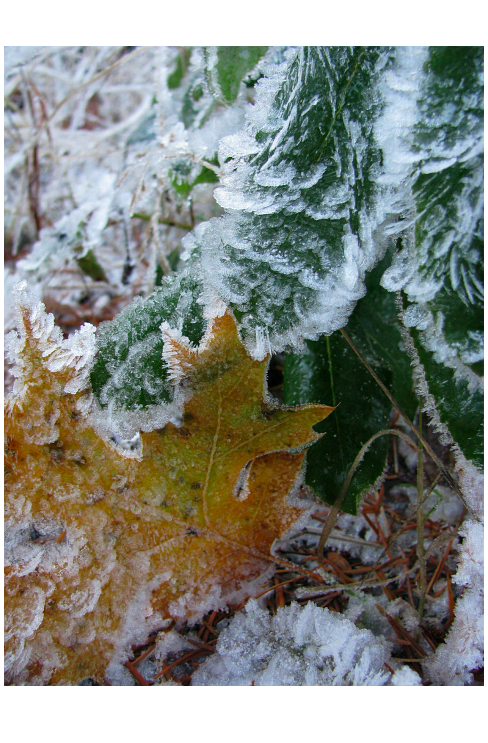
Nights of heavy frost had enrobed the vegetation in dense but delicate icy structures.

FrostyWalkIceLeaf1.jpg
FrostyWalkIceLeaf3a.jpg
FrostyWalkIceLeaf2a.jpg

Jack and I each pursued our personal obsessions. His are: following wherever I go but arriving there first, and of course sniffing around the woods to see what creatures have been there. Mine, that morning, were: walking fast enough to stay warm, interspersed with stopping and kneeling to take photos. Jack probably thinks the camera is some sort of mechanized human sniffer when I put it up close to things. Well, he’s right, in a way. I’m afraid I do see more when I take the camera, and certainly the camera remembers things better than I can.

Sometimes Jack responds oddly to objects; a statue of a horse or animal is approached cautiously and sniffed at full extension, ready to leap away. On this walk he saw a large wooden “Put out your campfire” sign, on 2 wooden posts, and reacted as if it were some strange beast. He barked at it until we got up to it then very carefully checked it out. Well, if it had been an animal it would have been quite a big one, easily six feet tall with legs made of four by fours, so I guess I understand his caution if not his failure to discern its true nature. Or, maybe it was really some entish thing just pretending to be a sign . . . you never know.

Acorn Woodpeckers and Steller’s Jays

We see Acorn Woodpeckers (Melanerpes formicivorus) only occasionally, so when two adults and a youngster showed up at the feeder the other morning we were delighted. These are showy birds, adding light yellow to the customary woodpecker color scheme of black/red/white. They came to the tube feeder with a spiral wire around the outside which is supposed to encourage woodpecker use, but our resident flickers (who nest inside the walls of the barn) rarely use it.

The third bird was smaller than the other two and took a while to figure out the feeder. He wanted to cling to the bark of the nearby tree and reach over to the seeds, but was finally doing it the easy way by using the wire.

I wish I could say I’d taken these photos, but without a long lens there was no point, and the birds were very wary of us even watching from the kitchen window. These are all from flickr, under Creative Commons licenses.

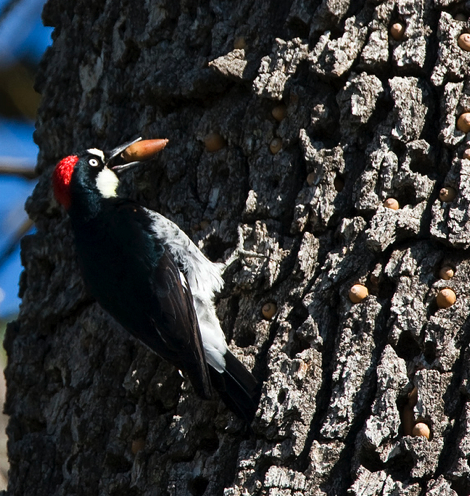
The picture below illustrates why they are called Acorn Woodpeckers. They drill holes to store the acorns. “As acorns dry out, they are moved to smaller holes and granary maintenance requires a significant amount of the bird’s time. The acorns are visible, and the group defends the tree against potential cache robbers like Steller’s Jays and Western Scrub Jays. Acorns are such an important resource to the California populations that Acorn Woodpeckers may nest in the fall to take advantage of the fall acorn crop, a rare behavior in birds.” [Wikipedia]. Their diet also includes insects caught in the air, fruit and seeds, and sap sipped from holes they drill.

Photo byKevin Cole, Creative Commons.

AcornWoodpecker&Acorns.jpg

The facial patches may be white or light yellow; our visitors had showy yellow faces. Very handsome birds!

AcornWoodpeckerYellow.jpg

Photo above by Len Blumin, Creative Commons.

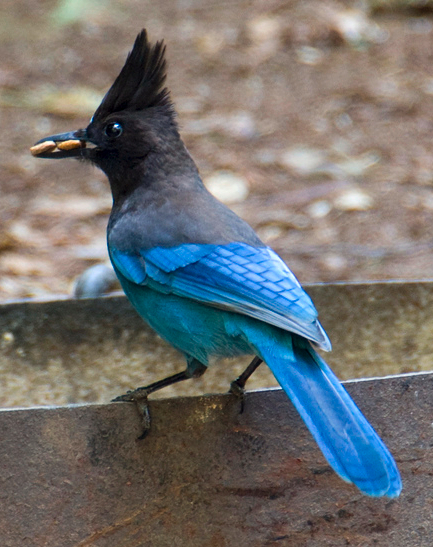
The Steller’s Jay (Cyanocitta stelleri) mentioned above as a stealer of acorns is another notable bird here in the Pacific Northwest, striking in appearance and a bit thuggish in behavior. They’re larger than the Acorn Woodpecker. Upper parts vary with latitude from nearly black to dark blue.

Steller'sJay1.jpg

Photo above by Vincent, Creative Commons.

Some have light blue markings on the forehead and/or above the eyes.

Steller's JayMarkings.jpg

Photo above by dotpolka, Creative Commons.

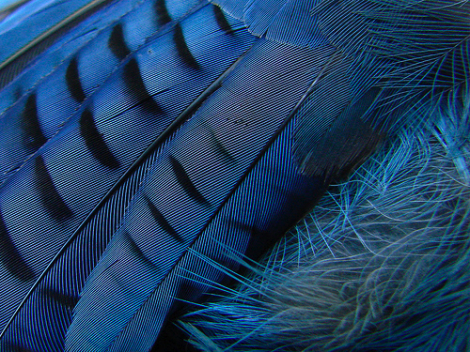
Steller'sJayFeathers.jpg

Photo above by randomtruth, Creative Commons.

Does fibromyalgia “get better” with age? (Alert: Whining ahead)

I’ve encountered this statement a few times since being diagnosed with fibromyalgia in 1992. Finally, at age 63, I think I’m qualified to offer an opinion upon it:

No, unlike a fine wine or a teething puppy, fibromyalgia does not get better with age.

It might seem that way, because some things that do change with age may lessen one’s concern about symptoms, or even ameliorate them.

As we grow older, we expect to have memory lapses, aches and pains, and reduced energy and strength. The person with fibromyalgia has a head start on all of these, believe me! But with advancing years, these symptoms seem a bit less unreasonable—or perhaps I should say unseasonable—even though I am still more tired, forgetful, etc., than an otherwise healthy person of my age ought to be.

Starting several years ago other people about my age began assuring me that my symptoms were “normal” for this stage of life, they had them too. Their intentions were benign, but I don’t like to hear this; not because I am clinging to the distinction of my disease, being “sick” but not “old”, but because I feel that the impairments of fm have been different. [It also echoes the remarks so familiar to people with fm or cfs or other chronic conditions, “Oh, you’re really tired/achy? Yes, I’ve had that too, just get some extra rest, you’ll feel better.”]

I was 35 when an injury caused the continuous pain and disturbed sleep that gradually turned into fibromyalgia by age 40 or so. During that time I went from having an unusually good memory, to the reverse. What did I do yesterday? Did I eat lunch today? What did I do this morning? Often I can’t answer such questions without some sort of reminder. Sometimes even with a reminder I have no recollection whatsoever of very recent events, and everything beyond a few days ago is gone or vague. Some days I grope for words—for a particular word, or to be able to put my thoughts into words at all. For a person who used to remember where on the page a certain passage of a book was to be found, or the details of bibliographic citations years after checking them, this sudden decline was, and remains, a severe assault upon my sense of who I am. And rightly or wrongly I think the daze that so frequently envelops me is not typical for a 63-year-old. Maybe at 85 I’ll feel it is age-appropriate. Until then, dammit, I’ll feel ticked off and robbed. Join the club, eh?

Still, inevitably over time one grows less sensitive to diminished abilities, and the limitations are less at odds with one’s lowered expectations.

As for symptoms seeming to decrease with age, I think this is a result of getting better at coping and self-pacing. I’ve learned to avoid things that aggravate the fm, such as late nights, loud or crowded places, being on my feet too long, and overexertion (whether it be in duration or in type of activity). I’m less of a perfectionist, I have a combination of medication and mental techniques to help me get to sleep most nights, and I feel okay about saying “I need to go lie down and rest for a while”. It’s following the naval maxim of “maintain a steady strain”.

The danger with all of this—lowered expectations, avoidance of stressors—is that it becomes a downward spiral. And age provides a reassuring excuse. Of course I’m doing less than I did last year, I’m getting older.

I keep pushing myself mentally, with challenging reading and dogged efforts to learn new things. Even though most of what I read today will be gone from my mind tomorrow, I tell myself that the effort may keep the neural connexions from deteriorating as we know they do with lack of use. Blogging has become a good motivator, encouraging me to do some writing, and follow research interests to produce and finish short pieces.

Physical exertion is harder because the pain and fatigue always increase, sometimes severely. When I was working a fairly physical job, I came up with this description for how I felt when I got up in the morning: “as if I’d been forced to run up a mountain, and then kicked and rolled all the way back down”. The chronic fatigue and pain in muscles and joints have been dialed back now that I’m not on my feet all day lifting, bending, carrying, etc., but they’re still there. I’m struggling to stay on a program of walking about 45 minutes every other day, motivated by a recent blood-test result that was in the pre-diabetic range. Some days I don’t want to expend a big part of the day’s energy for walking, or I feel worse than usual. There are no rewards of feeling noticeably better, but if I take the dog and my camera I will enjoy the walk itself.

Being off of methadone has made a big difference mentally and physically. It’s been two years last month, and I think I’m still improving. I couldn’t have walked for 45 minutes before that. Drugs that don’t help just weigh you down, and methadone does a lot more harm than most. (earlier post about getting off methadone)

So, in some ways I really am feeling better. But it’s not due to aging.

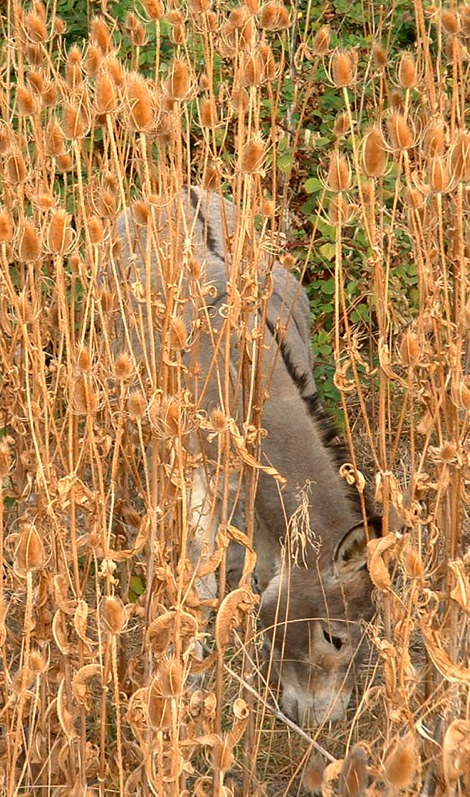
Thistles,GrazingAmong.jpg

Note for logophiliacs

After I put the word “whining” in the header, I encountered what would have been a good alternative if it weren’t quite so obscure. It has such appropriate associated meanings. I may whine and twine, but I’m trying not to dwine.

Twining
A minor lexicographical result of the devastating floods in Cumbria last week has been the appearance in at least two UK national newspapers of the dialect word twine, to complain or whine (“Cumbrians are a unique breed. They say what they see. They are hands-on people. They will twine and moan but then they will just get on with it.” — Metro, 23 November). It was at one time widely known throughout Scotland and the north of England. By way of another of its senses, to be fretful, ailing or sickly, it may be connected with dwine, another dialect word, to pine or waste away, which is from an ancient Scandinavian source. from Michael Quinion’s World Wide Words, # 667, 28 November 2009.

Photo by author.