
An early warning system for health threats: the invaluable work of ProMED

ProMED Mail is one of the most important information resources on the net, and most of us have never heard of it. It’s an email list which describes itself as a “global electronic reporting system for outbreaks of infectious diseases and acute exposures to toxins that affect human health, including those in animals and in plants grown for food or animal feed”.

Unlike the official clearinghouses run by WHO and CDC, ProMED is, in its own words, “open to all sources” and its reports are freely available to us all. ProMED was first to raise concern about the aggressive respiratory disease spreading in China in 2003, which became known as SARS. Before the Chinese authorities had permitted their officials to report the disease to WHO, Catherine Strommen, an elementary school teacher in Fremont, California, spotted a post in an international teachers’ chat room from a concerned teacher in China describing “an illness that started like a cold, but killed its victims in days”.

Alarmed, Strommen emailed an old neighbor and friend, Stephen Cunnion, M.D., a retired Navy physician and epidemiologist who now lived in Maryland. A practical, no-nonsense man, Cunnion started searching the web. With no success, he tried a new tack—sending an email to ProMED-mail, a global electronic reporting system for outbreaks of emerging infections and toxins. After quoting Strommen’s missive, he asked: “Does anyone know anything about this problem?”

The tiny ProMED staff conducted its own web search. It, too, came up empty-handed. On February 10, it sent out to tens of thousands of subscribers a posting headed: “PNEUMONIA – CHINA (GUANGDONG): RFI,” or Request for Information.

Thus did the world first learn of SARS, the new and deadly infection that would kill 774 people and infect 8,000 in 27 countries.

From an article by Madeline Drexler in The Journal of Life Sciences.

H1N1 Reports (Swine-avian-human Influenza A)

To keep up on H1N1 flu [I agree with the pig farmers, “swine flu” sounds like your big risk is getting it from pigs and pork, not human sneezes and handshakes] check the ProMED main page. While all the media is now frothing over with “news” about this disease, some of it sounds as reliable as alien abduction accounts. ProMED is timely and scientifically accurate but understandable by non-biologists. It includes valuable, and interesting, commentary on reports and questions: “this has been reported, but here’s what we don’t know, or here are local factors that must be considered in evaluating it”.

What ProMED does

ProMED is a program of the International Society for Infectious Diseases which began in 1994. It does not simply print whatever comes in—this is an extremely well-moderated list. A group of specialists checks and filters the reports, seeks more information from local sources and other experts, and provides judicious commentary. This group also “scans newspapers, the internet, health department and government alerts, and other information sources for inklings that an infectious disease, perhaps not yet reported widely, is threatening animal, plant and/or human health.”

I think I first signed up to receive the digests back when “mad cow disease” was emerging, and have since used ProMED to follow diseases such as anthrax and Ebola.
A topic of interest to me recently concerns outbreaks of measles and mumps in Western nations due to falling rates of vaccination. And as a former zookeeper I keep up on diseases of wildlife and zoo animals, including the fungal disease threatening whole populations of wild bats in the Eastern US. ProMED also covers plant diseases (mostly of crops).

All of this, infectious diseases of humans, wildlife, and crops, is of greatly increased urgency because climate change, global transport, and destruction of wild areas all lead to the spread of familiar diseases to new locales and the emergence of “new” diseases previously only found in remote wild areas. With regard to contaminants and toxins, governments are unable to deal with this effectively due to the political power of corporations and lack f oversight in producing countries. ProMED can’t make your food and furniture non-toxic, but it can sound alarms that might otherwise be silenced.References to a topic’s prior appearances on the list are attached to current reports, and archives are easy to access. Editions in French, Portuguese, Russian and Spanish are now available.

“Each posting is limited to 25 KB bandwidth—to ensure that it slips through an old-fashioned dial-up modem in the most remote areas of the world (where new infectious threats tend to smolder). ‘We use technology that was state-of-the-art in 1994. We use email—plain-text email at that. We don’t use fancy fonts,’ Madoff says. ‘The power of the Internet is its ubiquity and speed; it’s not necessarily in all the neat things you can do.’ [from Drexler’s article cited above]

You can subscribe here.

Toxins and contaminants

ProMED also collects, evaluates, and disseminates reports of health problems related to toxins and contamination of food and medicines. These can be quite unusual. For example, the case of the toxic leather sofas in Britain:
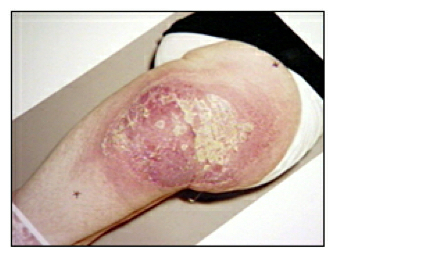
toxicsofaleg.jpg

Photo: Effect on leg of reaction to toxic chemical contained in sofas. From BBC.

A judge [in the UK] is expected to order several retailers to pay millions of
pounds to people who suffered burns and rashes from faulty leather
sofas….

More than 1600 people claim to have been affected by the problem. Tens
of thousands more people could have burns not yet traced to sofas.
The High Street stores, along with 11 others, may have to pay more
than 10 million pounds [USD 14.3 million] in compensation and legal
costs, the shoppers’ lawyers say. They claim that makes it “the
largest group compensation claim ever seen in British Courts.”

The sofas, which were manufactured in China, were packed with sachets
of an anti-mould chemical called dimethyl fumarate to stop them from
going moldy during storage in humid conditions.

Commonly known as DMF, the toxic, fine white powder has been used by
some manufacturers to protect leather goods like furniture and shoes
from mold. Even very small amounts can be harmful.

One sofa customer, who is well aware of the health problems caused by
her purchase, is a customer who bought a leather sofa suite from
Argos in April 2007. Almost a year later, she started to notice a
rash developing on her arms and legs. After a few weeks, her skin
started flaking off. She says the irritation was so bad, she was off
work for 2 months. This customer was seen by more than a dozen
doctors, who couldn’t work out what was causing the rash.

She said: “It was very, very painful; I couldn’t sleep at night; I
couldn’t walk about; I couldn’t drive; every time I did walk about,
the skin would fall off, and I would leave a trail of it, therefore,
I couldn’t go to work.”

Reliable histories of outbreaks/events

ProMED doesn’t just present breaking news and requests for additional reports; it frequently publishes very useful summaries of what’s been learned, and what action governmental agencies have taken. For example, “Melamine contaminated food products – Worldwide ex China” and “Prion disease Update 2009 (01)” (Mad Cow Disease and its human infectious disease, the fatal “variant Creutzfeldt-Jakob disease”.

Supporting ProMED

Believe it or not, ProMED is supported by individuals, with not a penny of funding from any government. That means they are independent (remember the movie Jaws, where the city council wants to suppress news of the shark attacks?) and fast to react. They sift a lot of news from all sorts of sources, put out calls for more information, and disseminate news in a responsible way.

If the work of this group seems like something you’d like to support, here’s your chance. They’re having a brief Spring fundraising campaign. To quote their email,

Your gift funds quick information every day – The economical, low-tech computer programs we use enable us to speed ProMED to your mailboxes, to post it online where anyone can find it, , and to provide the administrative services (accounting, office space, cell phone connections, etc.) required to support a small, agile worldwide enterprise.

ProMED-mail reaches over 50,000 public health officials, students, journalists, agricultural specialists, infectious disease professionals and others around the globe. Because it is free, subscribers in more than 187 countries have an equal opportunity to know when a disease outbreak occurs — and can spring into action when necessary to prevent or minimize its spread.

If the Spring campaign is past, here’s the main donations page.

Helping National Guard and Reservists “re-enter” after deployment

Sometimes local news should have a wider audience across the country.

Our US Senator Ron Wyden (D-OR) has earned great respect in this state for his humane principles and competence at building coalitions to get things done in DC. Here’s an example from the Oregonian newspaper on an issue that, typically for him, is not at all parochial but affects all of us deeply.

Sen. Wyden proposes extending Guard pay

The Oregon lawmaker wants to give soldiers returning from war 90 extra pay days

Wednesday, April 08, 2009

JULIE SULLIVAN, The Oregonian Staff

When Oregon Army National Guard soldiers returned from Iraq four years ago, fewer than half had a job waiting.

Employers wanted to help. Within a week, the Guard organized a reintegration fair that offered an estimated 500 jobs. But not a single soldier took one.

It was too soon.

“They are not ready to leave a combat zone and seven days later, go back to work,” Brig. Gen. Mike Caldwell said.

State and federal officials say they’ve learned how to do it right. U.S. Sen. Ron Wyden, D-Ore., wants to extend federal pay for National Guard and reservists for 90 days to ensure a “softer landing” when they return.

Oregon has posted some of the highest percentages of Guard members serving in Iraq and Afghanistan. Another 2,700 are training to deploy Iraq in July.

Unlike the regular Army, where soldiers return to their stateside military jobs and bases, the Oregon Guard and reservists scatter to hometowns. They lose their military salary, and more than $600 a month in other hazardous duty and separation pay.

When Oregon soldiers returned from Afghanistan two years ago, fewer than half of them younger than 35 had a job waiting. The younger the vet, the worse the outlook, with nearly 65 percent younger than 25 unemployed.

“About 79 percent returned to poverty,” said Sgt. First Class (Ret.) J.D. Baucom, a career assistance liaison for the Oregon Guard. He’s concerned in today’s economy those numbers are bound to get worse.

Wyden said paying the Guard for up to 90 days after they return would give them time to rebuild their lives before hitting a financial wall.

“We not willing to sit around and watch soldiers go from the front lines to unemployment lines,” he said.

Oregon has led in veterans’ advocacy. The Guard’s re-integration program — launched by wounded Alsea and Albany infantrymen in 2004 — is a national model. In 2007, the Legislature created a new veterans hiring preference for public employees. Now it is considering extending that preference from 15 years to a lifetime and granting 15 days unpaid leave to spouses of deploying soldiers.

Wyden’s bill covers returning soldiers so it would help only a fraction of the 350,000 Oregon veterans. He met former service members at the IBEW Local 48 in Northeast Portland on Tuesday morning in part to highlight job opportunities in the building trades. One federal program, Helmets to Hardhats, has put more than 1,757 veterans nationally into union apprentice programs. Across the hall, three young military veterans had found union jobs a good match on their own. They said that learning discipline, attention to detail and the ability to work in a team in the service has helped them apprentice as commercial electricians.

“I tried college, but I was working full time and going to school full time and that didn’t work,” said Craig Enneberg, 28, of Sherwood. “This works.”

Still, veterans advocates — and veterans themselves — told Wyden that a far more targeted approach is needed. Among the suggestions:

Reduce paperwork. “If we can’t get through the process, how we can we ask a 20-year-old from eastern Oregon who doesn’t know where to call?” said Sgt. 1st Class Phillip Maas, who manages career assistance for the reintegration team.

Connect veterans. Ret. Master Sgt. Mike Eschete, who recently graduated from Portland State University, proposed a mentoring program using military retirees. “They speak a different language and understand a dimension that is invisible to others,” he said.

Educate gatekeepers at agencies. “Put someone in that position who gives a damn,” said Erik Burris, a 12-year veteran of the Navy. Burris said one state employment specialist, Rene Garcia, helped him.

But little else has helped Burris in this economy.

The 41-year-old aviation structural mechanic and flight deck troubleshooter in the Navy has been laid off from four jobs in Portland since 2002. Wyden invited him to the Tuesday meeting. He arrived in a stylish blue shirt and tie, his carefully clipped hair and leather organizer in hand. He handed a reporter his resume.

After being laid off from jobs in quality control, sales, tech support and as a contractor at Intel he hasn’t worked since January 2008. He keeps applying, whittling his three-page resume into a one page “cram ad” and checking 12 job boards online a day. He does all the family cooking for his wife, Jeanmarie, and their daughter and keeps the kitchen immaculate in their “inexpensive” 900-square-foot Tigard apartment.

“Home is what you make it,” Jeanmarie says.

“You lose your pride and a little bit of yourself every time you get laid off,” he says. “And we have so much to give.”

juliesullivan@news.oregonian.com

2009 Oregonian

Why not let your senators and representatives know that you support this? The following pages help you get contact information and send emails:

for US representatives; need to know your ZIP code + the four digit addition to it

this one works for both representatives and senators (also yields info for state legislators); use the search box at the left to get names, click on name, click on “Contact” tab above the person’s photo.

Apple’s short video tutorials

Mac users know that OS X, and its included applications such as Mail and Preview, can do more than we realize. One place that provides an easy review and demo of new functions is the tutorial site, Apple Business Theater. Beneath the video viewing window are dozens of titles. Here are some examples:

AppleTutorials1.jpgAppleTutorials2.jpg

The video tutorials I sampled were only a couple of minutes long: tightly targeted to doing just the one action described. I was particularly interested in the new capabilities of Preview (Apple’s viewer for pdfs, images, and other things) to work with pdf files. In the past I have spent hours searching for and trying out various third-party apps to merge or edit a pdf, since we didn’t own Adobe’s expensive Acrobat editing program, only their free reader.

OS X enables “Print to pdf” from any app, and some apps such as Nisus Writer offer “Save as pdf” too. Either way, it is easy to create a pdf now without Acrobat. Now, using Preview, we can merge 2 pdfs, delete and re-arrange pages, add pages, and annotate pdfs.

Many other handy tips are demonstrated here; take a look!

Back to the past: Return of the percolator

Over three decades our household has averaged a new coffee-maker every three or four years. We’ve had Braun, Gevalia, Black and Decker, Krups, and other brands I’ve forgotten. A couple of times we got the $90 model but mostly they’ve been about half that price. Either way, eventually they quit working and this big non-repairable piece of plastic and electronics goes into the garbage.

As years have passed they’ve gotten more complicated, and that seemed to be the downfall of last week’s purchase. It was a Krups with an added water filter (good for us, with mineral-rich well water, but also one more thing to have to find, buy, and replace––profit’s big on consumables, like printer cartridges!). It also had an extra idiot light feature: a “low water” display and override which would keep it from running if it thought there was not enough water. This was not a feature we wanted, in fact we did not discover it until it malfunctioned on the third day of use. Push ON and all that happened was a cryptic pattern flashing on the display.

In the morning, when you want your coffee, reading a coffee-maker manual is not on your list of desired activities. Before consulting the manual we tried the chimpanzee approach, pushing the four control buttons in various combinations. Luckily we did not happen to activate any of the more arcane features, which can only be guessed at, nor (since we live in such a remote location) did the machine’s electronic calls for help manage to bring its plastic comrades jetting to its aid in time to defend it from our mishandling. Nor did we fix it, even after we deciphered the display message. We plugged and unplugged it, emptied and refilled it, all to no avail. Then we called the Customer Service number and listened to music for 20 minutes before a polite woman with a southern accent came on, heard our story, and informed us that by unplugging it and plugging it back in, we had “done all the troubleshooting” that we could do and our next step was to pack it up and ship it to their service center. Or, she said, we “might be able” to return it to the point of sale for a “straight-across trade”. Yes, I said, thinking “But not for another one of your brand!”

By then, we had made our morning’s coffee using a kettle and a flat-bottomed gold filter set in a sieve over a large pyrex measuring container. It was good. Caffeinated, we discussed our next step. Something simpler, not plastic and electronic, would be good; perhaps it would even have been Made NOT in China. We decided on a percolator, since Dan said he’d seen one on the shelf when he chose the Krups, and I remarked that when I was a kid people had the same percolator for 20 years, perking on and on. We marvelled that the coffee-makers of our childhood were still being sold. Maybe we weren’t the only people tired of having to read a manual for something that should be simple, and tired of the (planned or unplanned) short life-span of the new coffee-makers.

For $45 we got a shiny stainless steel West Bend percolator. It has no controls. Fill with water (there is a clear water gauge on the side, one new feature); insert the tube up which the hot water flows; put coffee in metal basket, put on lid, place basket on tube, put coffee-maker lid on, plug in. Less than a minute later hot water is flowing up into the clear knob on top and down onto the coffee basket. There is no possible programming, no clock, and only one “feature”, a plastic light on the base. I thought the thing was already broken, when the light did not come on after the percolator was plugged in. But no: the light comes on when the coffee is done. It keeps the coffee hot until unplugged, so you have to remember to do that to avoid cooked-all-day coffee remains. Unlike all the coffee-machine carafes we have ever had, the percolator does not drip when you pour too fast. Also, it takes up less space on the counter.

And the coffee? We like it better than what we were drinking before. The perking noise is pleasant, unlike the hissing and puffing of the previous type. Only one part didn’t turn out as we hoped: it was “Made in China”. But we hope it’s the last coffee-maker we buy for a long long time.