
I’m fascinated by the wealth of vintage illustrations that have been scanned and made available on the web. The BibliOdyssey blog is all about this and a great place to browse. Lately I’ve been doing some ferreting about for myself too, and of course have to share my discoveries.
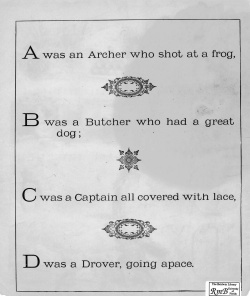
This time it’s old children’s books in two collections at the University of Florida: the Literature for Children Collection at the University of Florida Library (2455 titles), and the Baldwin Library of Historical Children’s Literature (4787 titles). Cruise the title lists (LCC, Baldwin) and find multiple versions of Robinson Crusoe, Aesop’s Fables, and other classics; various illustrated ABC’s, Annie and the elves, and other stories published in 1852 by the American Sunday-School Union, Around the World with Santa Claus (1891), At war with Pontiac, or, The totem of the bear : a tale of redcoat and redskin (1896)–––and we’re still in the “A” section. [Above are the first two pages from Aunt Louisa’s picture puzzle alphabet (1880).]
Below are a few illustrations from volumes in these collections, and I was assured when I enquired that “Nearly all of the books in this collection [LCC] are public domain. Those that are not are clearly labeled as such. You can use the images freely, although we always appreciate a statement attribution that they came from Literature for Children (palmm.fcla.edu/juv/).” I think the books from the Baldwin Collection would be public domain as well.
These are presented here considerably reduced in size and resolution, compared to the online originals, which are each over 1 MB when saved as pdfs.
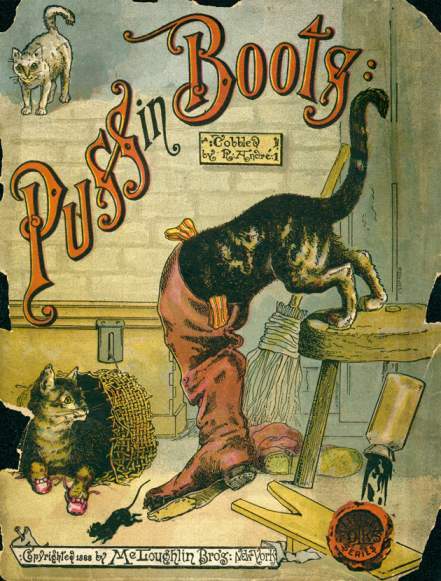
Above, the cover from Puss in Boots (c. 1888), illustrations by André, R ( Richard ), 1834-1907 [nom de plume of English artist William Roger Snow].
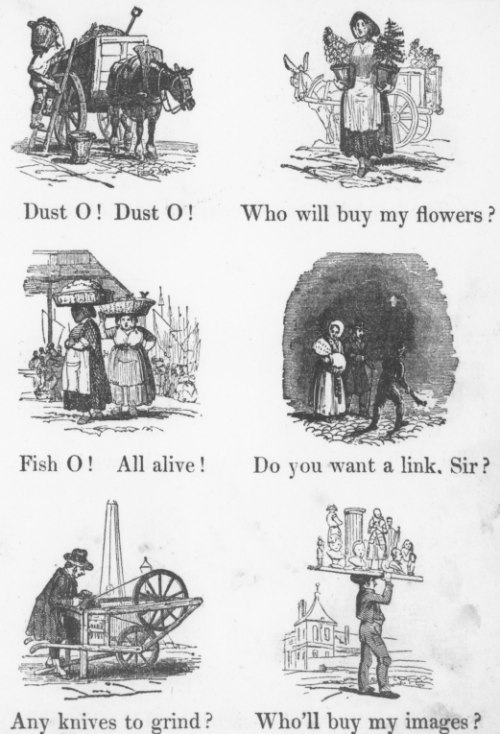
Below, the “London Cries” page from Aunt Mary’s primer: adorned with a hundred and twenty pretty pictures (1851) shows some of the street pedlars of the city along with their characteristic “cries” to hawk their wares, which gave us phrases such as “Cockles and mussels, alive alive-o!” Also shown are the dustman collecting who knows what (horse manure?) and a “link-boy,” selling his services to light the way of those travelling the unlit streets before gas lighting.
Below, the cover and two pages from A museum of wonders and what the young folks saw there explained in many pictures (1884), text and illustrations by Frederick Burr Opper [Baldwin Library Digital Collection, also at the University of Florida].
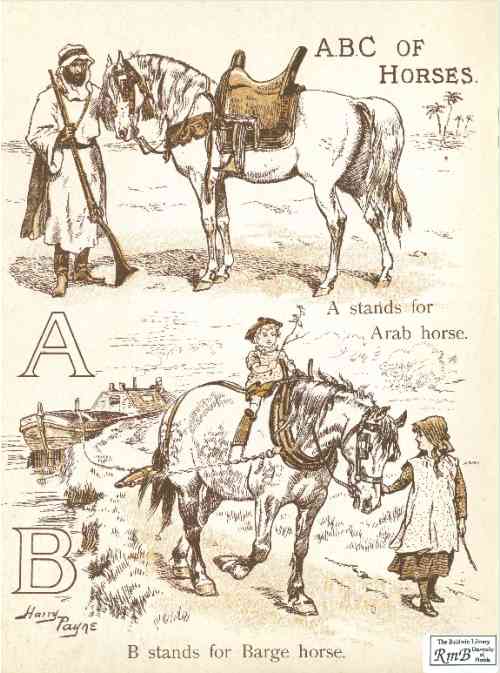
Below, the cover and two illustrations from the ABC of Horses (1880)
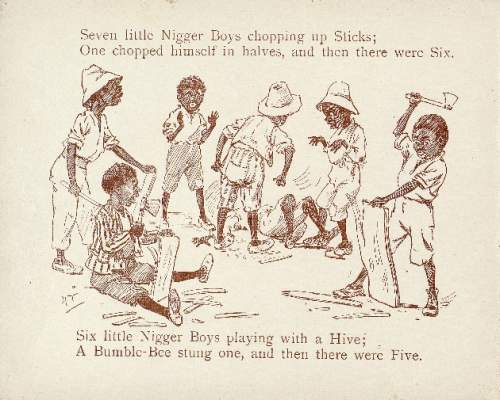
But there’s more here than quaintness, nostalgia, or public-domain illustrations. Children’s books are always in some way a part of society’s revelation of itself to children, and its effort to shape their attitudes. The very first entry in the alphabetical list of titles is 10 little nigger boys (1890), no author given. A rhyme recounts how a group of ten young black boys gradually becomes only one, as various accidents befall them on their journey. One oversleeps (the most benign incident); one chokes, one is hugged to death by a bear at the zoo, one “cuts himself in half”, you get the idea.
This reminded me of the familiar title Ten Little Indians (Agatha Christie) and I wondered what the connexion was. Wikipedia was the first entry in a Google search and was very informative.
It is Christie’s best-selling novel with 100 million sales to date, making it the world’s best-selling mystery…The novel takes place on an island off the coast of Devon in late 1930s named Indian Island. Eight people of different social classes journey to the Soldier Island mansion are invited there by a Mr. and Mrs. U.N. Owen but the eight people don’t know them. Upon arriving, they are told by the butler and his wife, Thomas and Ethel Rogers, that their hosts are currently away. Each guest finds in his or her room a slightly odd bit of bric-a-brac and a framed copy of the nursery rhyme “Ten Little Soldier Boys” (“Ten Little Niggers” in the original 1939 UK publication and “Ten Little Indians” in the 1940 US publication) hanging on the wall:
Ten little Soldier boys went out to dine;
One choked his little self and then there were nine.
Nine little Soldier boys sat up very late;
One overslept himself and then there were eight.
Eight little Soldier boys traveling in Devon;
One said he’d stay there and then there were seven.
Seven little Soldier boys chopping up sticks;
One chopped himself in halves and then there were six.
Six little Soldier boys playing with a hive;
A bumblebee stung one and then there were five.
Five little Soldier boys going in for law;
One got into Chancery and then there were four.
Four little Soldier boys going out to sea;
A red herring swallowed one and then there were three.
Three little Soldier boys walking in the zoo;
A big bear hugged one and then there were two.
Two Little Soldier boys sitting in the sun;
One got frizzled up and then there was one.
One little Soldier boy left all alone;
He went out and hanged himself and then there were none.

Cover of the first UK edition of this book (from Wikipedia).
Thus we learn, among other things, that in England in 1939 it was acceptable for Agatha Christie to publish her mystery novel under the title Ten Little Niggers in England, but not in the US, the title was changed to And Then There Were None. The book has been filmed a number of times under this latter title, and also as “Ten Little Indians.”
I wonder what black children were reading in 1890, when 10 little nigger boys was published. Books for children were a luxury, whether in white households or black. Was there a parallel endeavor to publish reading material for black kids? Maybe I’ll email the people at the University of Florida again and see what they can tell me.






 nosleepingdogs