Remedies for poison oak, poison ivy

I’m as allergic to poison oak as anyone I know; I’ve “gotten” it even from contact once removed, from the coat of a dog, someone else’s hand or jacket. The swelling and itching is very bad: eyes swell shut, skin won’t tolerate clothing. I’ve found two things that work better for me than anything else.

For the itching, take antihistamines. These work also for relieving the itching of mosquito bites.

For the swelling, and to make the poison oak lesions dry up and go away faster, try Neutrogena’s Body Clear Body Scrub. Put it on the affected areas generously and gently (do not scrub) and let it sit for 3 or 4 minutes before rinsing. One application usually is enough; if not repeat after a few hours. The active ingredient is salicylic acid, 2%, meant to dry up oily skin, but for me it has been extremely effective at reducing swelling and itching, stopping “weeping” from the lesions, and making them heal in perhaps half the usual time. I expect that other preparations with similar content of salicylic acid would work too, as long as no other ingredient irritates the poison oak blisters, but this is the only one I have tried. I keep a bottle just for poison oak season, year after year.

The active ingredient that causes the allergy is urushiol, and as far as I know it is the same in all three species of poison oak and ivy, so this remedy should help in all cases. The fact that the condition is an allergy, not a case of “poisoning,” explains why reactions vary among individuals and even in the same individual. A person previously non-reactive can develop the allergy after any number of exposures.

Disclaimer: I’m not a doctor, nor do I have any financial interest in Neutrogena.

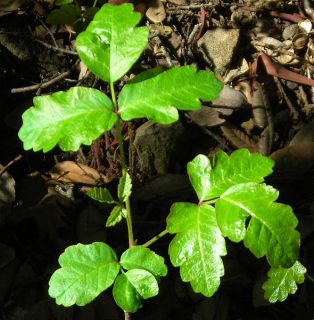
Images below from Wikipedia: left, glossy new spring growth of Western or Pacific poison oak (Toxicodendron diversilobum, also called Rhus diversiloba. Brand-new spring foliage is sometimes crimson.
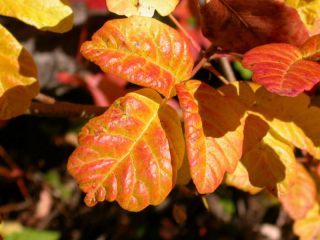
Right, the attractive fall colors.
poison_oak1.jpg

poison_oak2.jpg

Flowering birches

Springtime, and the birch tree at our back door is laden with blossoms.

DSCF0048-400w.jpg

This year I took a really close look at these, and then looked up more about them.

catkins -400h.jpg

Birches are pollinated by the wind, like corn, but a different design: the male pollen-bearing parts are the pendulous ones in this photo (right), while the much smaller female “catkins” appear from between a pair of leaves and curve upward. On our trees (Betula populifolia, I believe) the female catkins begin to droop downward with age, like all of us––the object intruding into the upper left of the picture is an older female catkin, nearly horizontal. In Britain the long male catkins are also called “lamb’s tails.” They bear a lot of pollen; a week ago when they were new my dark blue vest showed long golden streaks after brushing against them.

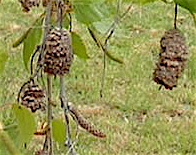
After pollination the female flowers will get larger, droop down, and gradually fall apart, loosing the scale-like seeds. Other species have winged seeds but not this one. Some of the male and female catkins survive into the next year. Below are some from last spring, still on the tree among the new ones. The old female catkins are shorter, thicker, & shaggy looking; rub one between your fingers and it easily comes apart into minuscule seeds and scales. The male catkins change with age too, becoming smaller, and hard to break up, almost feeling varnished on the outside.

Birches produce seeds abundantly and in our yard a couple of seedlings spring up each year in places that get water during the dry summers. It’s easy to see why they are known as early colonizers both after fires (secondary succession), and simply moving into wetlands or heath areas (primary succession).

DSCF0009.JPG

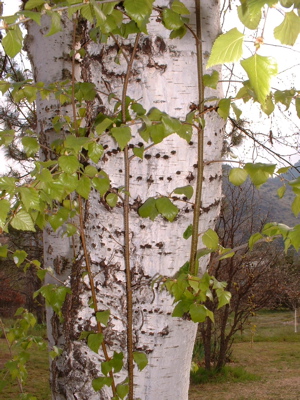
This tree also bears horizontal rows of holes, at which we have seen woodpeckers, either downy (Picoides pubescens) or hairy (Picoides villosus), probably drinking the birch’s sweet sap. The woodpeckers make the holes but others may come to them when they are exuding sap, and once I did see a hummingbird drinking there. Now that would be a great photo!

birchbark 300w.jpg