A little river walk in the Siskiyous

This morning before the day heated up too much we took the more spry of our two old dogs and headed out for a little walk. The border between Oregon and California is only about 15 miles from us by road; after crossing into California the roads are unpaved but not bad, and follow various river branches up in the Siskiyou Mountains.

The place where we parked was just before a bridge over a small river and then we hiked up along that river, crossing to the other side when our way was blocked. In August the water is low, but we saw plenty of winter driftwood lodged nearly ten feet above the current water level.

BridgeView.jpg

View upriver, from the bridge

It was mostly shady and cool and the rocks were great: huge outcroppings of basalt that may have continued down and under the river into the very roots of the earth, and smaller boulders of other types. We thought they were great; our dog Brook found them rough going at some points but did fine, finding her own route uphill from us at some points. Crossing a river, even such a small one, was new to her; I think she was a city dog before we got her as a rescue at age 5, and in the 6 years since we have seldom gone hiking with the dogs. Dan goes goldpanning, for fun, and has forded many a river in that pursuit, so he led the way and helped Brook out when she got too close to strong currents. She was nervous, though not too nervous to stop each time in midstream for a drink.

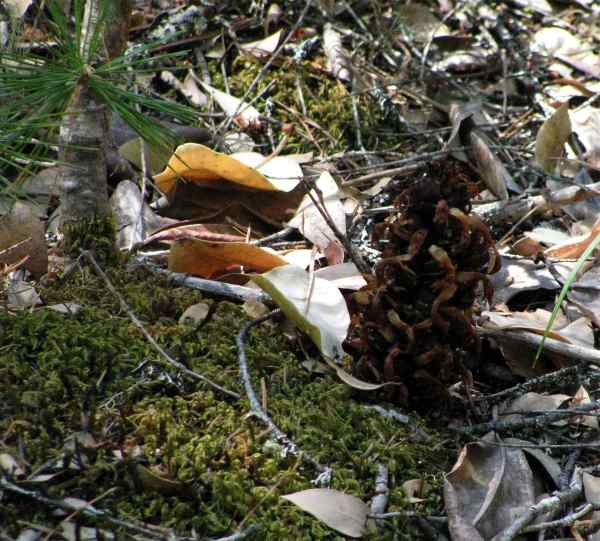
We saw an unusual plant in a flat dry area above the river: the “Ground cone” (Boschniakia species, perhaps hookeri or strobilacea). This is a parasitic plant that forms a tuberous growth upon roots of trees or shrubs, deep underground, then sends up a long flowerstalk with this pine-cone-like flower. Only the flower appears aboveground; there are no leaves.
IMG_0184_2.jpg

There was a group of perhaps ten such cones within a circle ten feet in diameter. I looked and photographed from a distance because there was poison oak around and I’m very sensitive to it. But I got one shot that shows the dry flower petals, and the seeds.

groundcone2.jpg

According to descriptions I found on the web, the petals are purple, and the plant is a prolific seed-producer–“a single plant may produce more than a third of a million seeds.” [from The Natural History of Puget Sound Country, by Arthur R. Kruckeberg, in Google Books] The ten or so cones we saw may all have been from the same plant. The flowers are said to be hermaphroditic, having both male and female parts, so they can self-fertilize.

Not far away was a very robust Douglas fir with a branch that was almost another trunk, in size. Below, within the reach of idiots with spray paint, “Felix” had immortalized his contempt for nature in bright red letters (hidden by shadow and rough bark, in the photo). If I had surprised him at his little task, could anyone blame me if I tied him to the trunk and carefully spraypainted him?
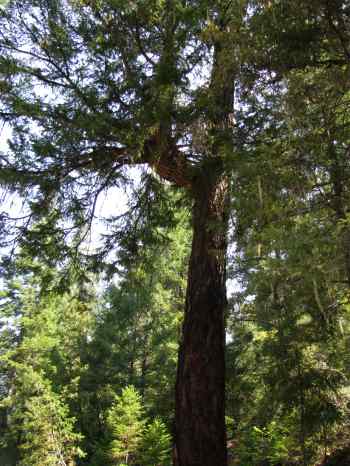
dougfir1.jpg

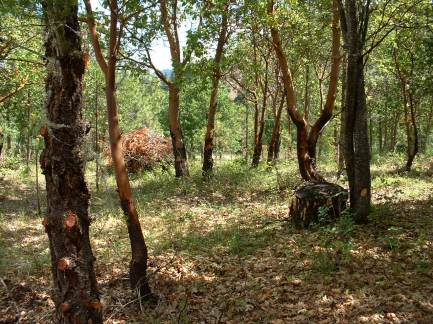
In open areas there were madrones, which have bark that peels in gorgeous patterns and colors.
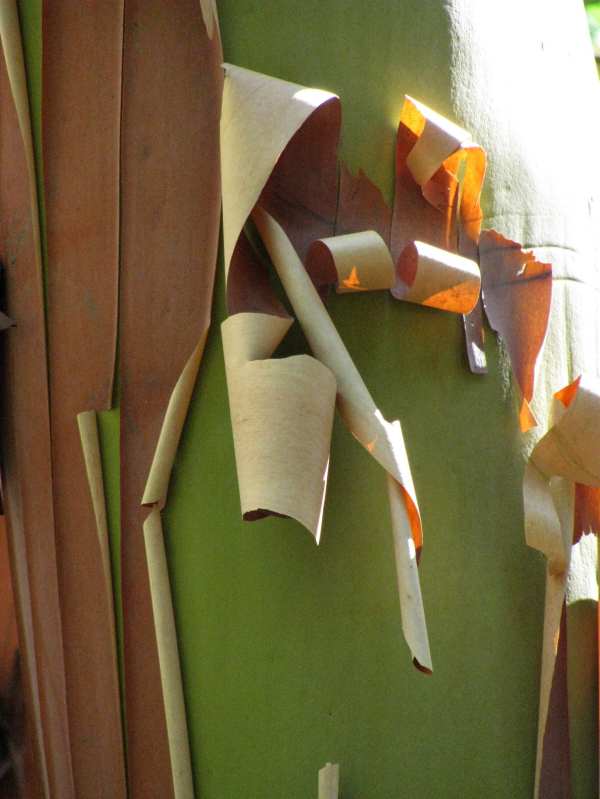
madronebark1.jpg
madronebark4.jpg

Back at the road, we went past the car to take a look each way from the bridge. In one direction, traces of old hydraulic mining could be seen.
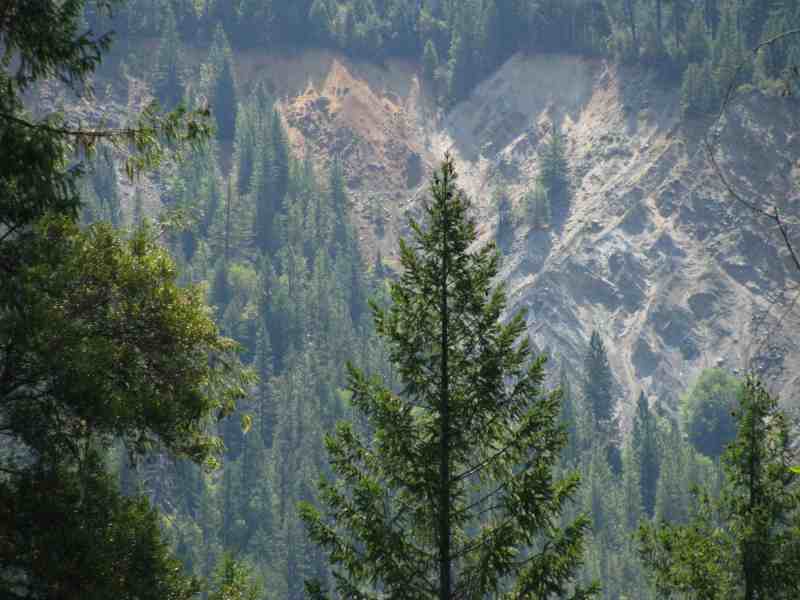
hydraulic_damage.jpg

In Gold Rush days, and again in the 1930’s, gold miners of all sorts were around here, from humble individual panners to gangs that tore aside mountain-sides with pumps and hoses to sort out gold from the dirt and rock. The damage to this hillside must have been done at least 70 years ago; a few trees have managed to take root but the slopes remain mostly bare and prone to further erosion or landslide. This is public land and I think hydraulic mining is restricted, but with the high price of gold we are seeing more dredgers in the rivers. They use a big suction hose to vacuum up sediment and small rocks for sorting; one person runs the hose while another often works underwater moving big rocks to get at what’s underneath. Dangerous and destructive, a double thrill.

But down below this little river carried on, looking just fine.
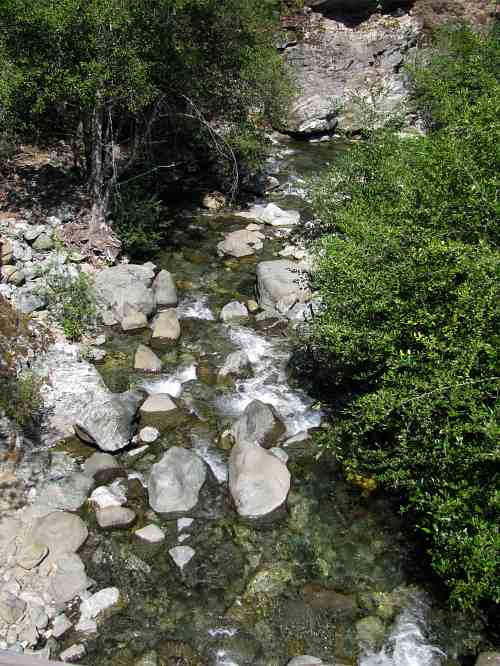
river2.jpg

It’s hypnotizing to watch the water go over the rocks. But our dog Brook felt she’d scrambled over enough rocks for one morning. As soon as she determined we were just loitering on the bridge, not continuing across it, she waited in the road between the bridge and the car, and we finally gave in and headed home.
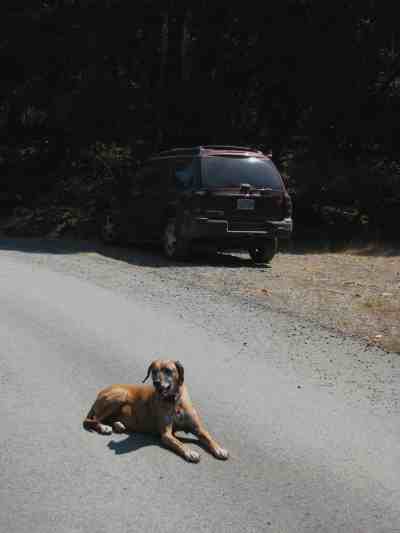
Brookinroad.jpg

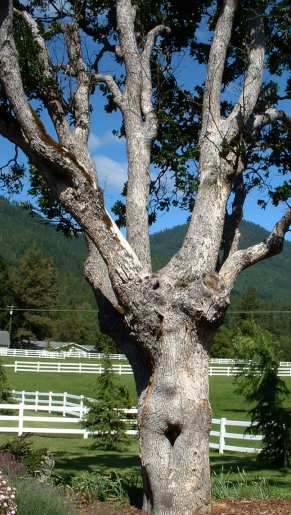
A local dryad

dryad.jpg

When I first saw this I understood better where the ancient Greeks got their vision of women turned into trees! Standing alone it is perhaps merely a curiosity, especially with the recently added white fencing, bark dust, and ornamentals (I’m sorry I never photographed it before those distractions/desecrations). But encountered suddenly in the forest, perhaps in dim light–that would be something quite different.

Keeping deer out of the garden

Deer love tender new leaves and can leap tall fences at a bound. We see them all the time, on our rural property outside the fenced area where the dogs have free range. But we’ve never had one get into our vegetable garden which is bordered on the back by that main fence, and on the other three sides by fences to keep our dogs out. The fences are well under five feet tall, nothing for a deer to jump. Our garden is in raised beds about three feet wide and varying in length; between the wooden sides of the beds, the walkways are about two and a half feet wide. My theory is, that deer (like other hoofed animals) are concerned about having good footing when they jump into a place, and the narrow spaces and mixture of heights doesn’t look safe or inviting.

Outside our fence I have been trying for over eight years to get trees and tall plants established in a bare spot to make a visual barrier between us and our neighbor’s two-story place. Poor soil and hot dry weather have been the major problem, but then the deer have chowed down on most everything that I have kept alive except some weeping willows I started by sticking branches in the ground. I’ve tried old remedies, new remedies, and wacky ideas: Mylar pinwheels, hanging scented soap, rotten egg spray, flapping hanging things tied to the trees, systemic bittering agents put in the soil, glittery hanging things like metallic beads, Mylar streamers, and aluminum pie plates (reputed to work to repel birds eating ripening fruit). Never did try hanging little bags of human hair trimmings, a method with a following. I bought dehydrated coyote urine but then on the drive home thought about how it must have been collected, and went back and returned it with an explanation to the wild bird store, and I believe they stopped carrying it. It might have worked, but the confinement needed to produce it was unacceptable.

I went so far as to lay down landscape cloth around the trees and then on top of that peg down that plastic-netting fencing used for temporary barriers. I put it down horizontally: it did a good job of tripping me up all the time but the deer did not seem to be affected. And soon falling leaves covered it, weeds rooted in the decomposed leaves, and it was buried.

Finally I decided to mimic what worked in the garden and I used wide plastic tape, like crime scene tape or the fiberglass tape used on drywall seams, to divide the tree area into many narrow portions. It worked! I put it at varying heights between 2 – 4 feet, going around a tree trunk or stake and then off at an angle to another point. I’ve now moved to using bright yellow polypropylene rope because the tapes didn’t hold up to uv exposure, and the stronger rope is easier for me to get over or under when working out there. Once the trees get tall enough, it can be removed; without some protection, nothing but the original willows will ever get that tall. It’s not too scenic, but I don’t care, and the neighbors–I think they probably prefer it to the flapping plastic trash bags!

Defensive chainsawing

Here in wildfire country, it’s all about “defensible space” around your house, created by “fuel reduction.” We’re in the foothills of southern Oregon’s Siskiyou Mountains at about 2300 ft.; it’s dry, and rocky, and wildfires are a fact of life.

Shortly after we moved here I overheard someone say, at the local grocery store, “Plans for summer trips? No, we never go anywhere in the summer in case of wildfire.” This sounded pretty paranoid but I understand it better now that we’ve been here 12 years and seen two fires come close enough to worry about.

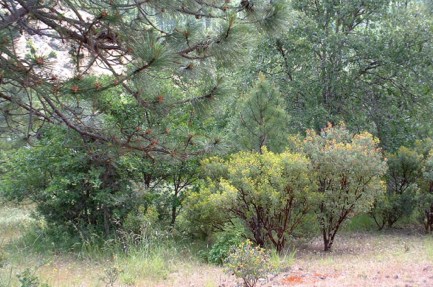
Pine-oak woodlands and mixed conifer stands seem to be the climax trees in our area, but 150 years of logging, farming, and road-building have caused a lot of disturbance. On our property, oaks, Douglas fir, and sun-loving Pacific madrones are the most common native trees. The madrones, which would be shaded out by dense mature forest, are often multi-trunked especially when resprouting after being cut; some of the oaks are the same. This results in brushy growths that can feed fire close to the ground. Shrubs like manzanita (Arctostaphylos sp.) and buckbrush (Ceanothus cuneatus) are very common and both are superb fuel for fires. We cleared one area ourselves, early on, of many pickup loads of buckbrush ranging to 5 feet tall. We burned them soon after cutting and even green they burned like gasoline.

Since that early effort of ours, the agencies concerned with fires and forests have gotten much more aggressive about fuel reduction on private as well as public lands. Small acreage homeowners like ourselves present a real problem to those fighting wildfires, since we expect our property, lives, and livestock to be protected and the fire-fighting resources–people, planes, equipment–are always stretched thin. Because we are part of the problem, we have been encouraged to be part of the solution as well by creating defensible zones around structures and along driveways, and having acreage “treated” to reduce fuel loads. In practice this means removing brush and dead trees, increasing distance between trees, and “limbing them up” by cutting branches that start below 6-10 feet.

The local fire district has a program to reimburse landowners for the costs of fuel reduction and we have participated in this twice. Someone comes out from the fire district to do a walk-around with you, discussing how fires travel and what changes you need to make, then you can either hire the work done or do it yourself, and upon a second inspection, be reimbursed on a per-acre basis for satisfactory completion. The amount is about $300/acre.

The financial aid means that it is possible for property owners to do fuel reduction even if they can’t do this strenuous job themselves. And when wildfires threaten private property, certified defensible properties will be given priority if there aren’t enough resources to protect everything.

Our first project was along the driveway and around the house. It included work we did ourselves (such as screening the open space between our large deck and the ground to prevent wind-blown sparks from igniting the dry wood from underneath) and work we paid for (the chain-saw removal of trees and brush and later burning of the brush piles).

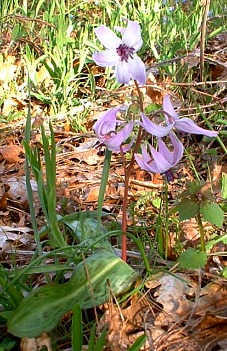
This spring we heard the grants were available again and decided to have fuel reduction done on most of the rest of our 5 acres. This was a decision that we made with regret; the cleaned-up look, which some call a “parklike setting” of spaced-out trees with little growing between them, is not pleasing to our eye, provides less cover and food for wildlife, and will change the mix of wildflowers we enjoy. Twelve years of benign neglect has allowed the land to recover from various affronts and we’ve seen a significant increase in our favorite wildflower, the ephemeral Erythronium hendersonii (Henderson’s Fawn Lily, but we call it Trout Lily–both terms refer to the mottled leaves), and others.

troutlily.jpg

However, thinking of our house becoming a pile of cinders was incentive enough. It is also true that big wildfires fed by abnormal accumulations of fuel are a long-term loss to wildlife here, where dry weather and poor soils make plant recovery slow; and both times we have chosen the more expensive method of selective hand-thinning by chainsaw over the cheaper way of clearing acres with whirling blades mounted on eco-buster caterpillar tractors. That method, as we saw when BLM used it next to (and actually on) our land, leaves a blasted wasteland that reminded me of photos of WWI France where months of artillery shelling turned forests into craters studded with splintered trunks rising at angles from the trampled mud.

The latest clearing work has been completed, although warm weather arrived too soon for the piles to be burned; they’ll have to wait until the rains start in the fall. I didn’t think to take any “before” pictures, but for comparison the photo below is of an area untreated since we cut buckbrush a decade ago. It’s less dense than the treated areas were, before clearing, and has little madrone, but the growth of manzanita and oak clumps is similar.

denser1.jpg

The next photo is of a just-cleared section; the whitish band near the center is the driveway which would not have been visible at all before the thinning and limbing-up. The indistinct brown blob just to the left of the driveway (but closer) is a pile of branches and brush to be burned. A few piles will be left for the small creatures to shelter in, and a few large dead trees were left standing. The man who did the work is well experienced and at our request left a little extra brush where he thought the fire district would approve it.

cleared1.jpg