The Button Jar

Perhaps button jars have gone the way of the darning egg (unlamented!) but I think most women used to keep one, full of the buttons removed from wornout clothing. The buttons were saved for replacing lost ones, or for sewing new garments—a pretty common thing up through the sixties. Then the clothing itself was recycled, as we would call it now, as rags for cleaning and household projects, or perhaps as quilt or blanket material.

I remember playing with my mom’s jar of buttons when I was very young; all the colors, textures, and sizes, made it fascinating. Probably she told me some of the stories about where particular buttons had come from, though I don’t remember that. I have my own small button jar, and if I’d had kids or grandkids, I would have gotten it out once in a while on a rainy day.

Mine doesn’t have such interesting buttons as my mother’s jar did; buttons are simpler and cheaper now, throwaway items, and I haven’t gone in much for fancy clothing, while my mom during her single days working in San Francisco used to save up for some special item at I. Magnin’s. Still, I’ve accumulated a good variety.

ButtonJar1.jpg

Somehow I ended up with one or two items from her collection, though: two big metal buttons with a Latin motto (“Our hope is God”, and I liked the Latin but did not absorb the sentiment) from a corduroy car coat I had in high school,

ButtonJarSpes.jpg

and (my favorite as a child) the metal wolf’s head.

ButtonJarWolf.jpg

I suppose this wolf was from a cub scout uniform, but there were no cub scouts in our extended family, so it remained mysterious in origin and attractive to the imagination.
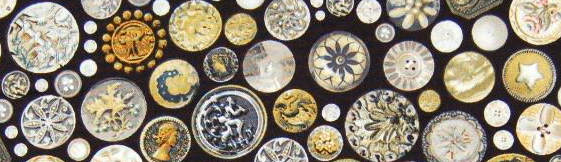
buttonJar40sButtons.jpg

Above, old buttons. Below, Watercolor “Out of the Jar V…..Antique Buttons” by Janet Mach Dutton.

ButtonJarWatercolor.jpg

If you were wondering about what a darning egg was, here’s a drawing of one so you can go to your wood-lathe and make your own [courtesy of http://www.sydneywoodturners.com.au].

Button JarDarningEgg.jpg

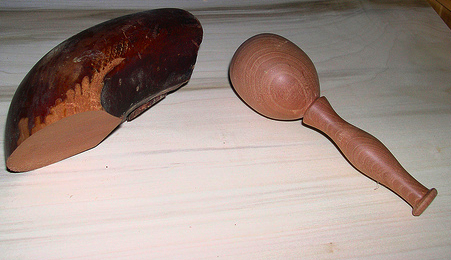
The result will be a device that goes into a sock, to provide shape and support while darning a hole. Below, one made from a piece of chestnut stair railing alongside a sample of the railing. My mother had one, lacquered black, but I don’t remember ever seeing it used.
ButtonJarDarningEgg2.jpg

Ground Cones and Witches’ Butter

The forest road we’ve been walking on has not provided much in the way of wildlife sightings—two flickers, and various mammalian scat—but here are two odd “plants” seen this week. One’s a fungus, the other a plant with no chlorophyll. Let’s look at that one first:

GroundCone1CR.jpg

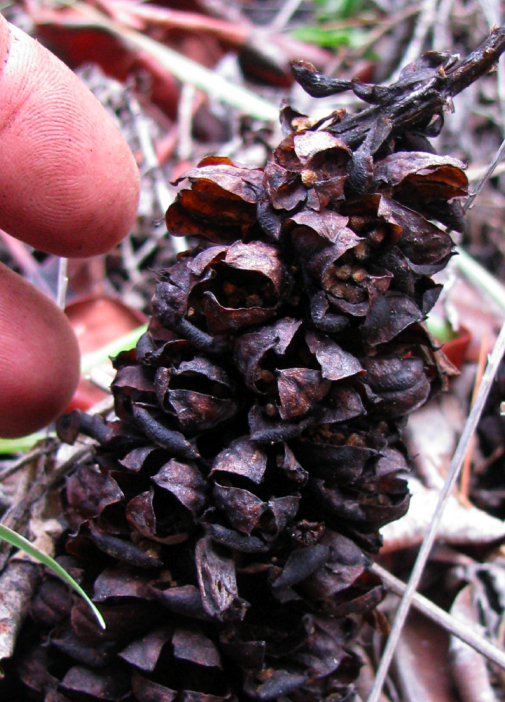
This is the ground cone (Boschniakia strobilacea), which we found pushed up through duff near maple and madrone trees.

GroundCone2CR.jpg

These belong to a group of organisms that are considered plants, although they have no chlorophyll and hence don’t make their living through photosynthesis. The larger group to which they belong is that of heterotrophic plants,

meaning “other-feeding”, since they must get their nutrition from other organisms.

Heterotrophic plants are divided into one of two groups, based upon how they obtain their food. The first of these two groups are parasitic plants. As parasites, they obtain their organic carbon from a host green plant directly through the use of structures called haustoria [rootlike outgrowths]. Wildflowers such as ground cone … are examples of root parasites. US Forest Service

Ground cones may not look like it but they are flowering plants; the ones we found today were from last spring, so they had flowered and gone to seed. Last spring they probably looked like this:

GroundConeFlowering.jpg

Photo by Russell Towle, taken in the Sierra Nevada (N. fork of the American River).

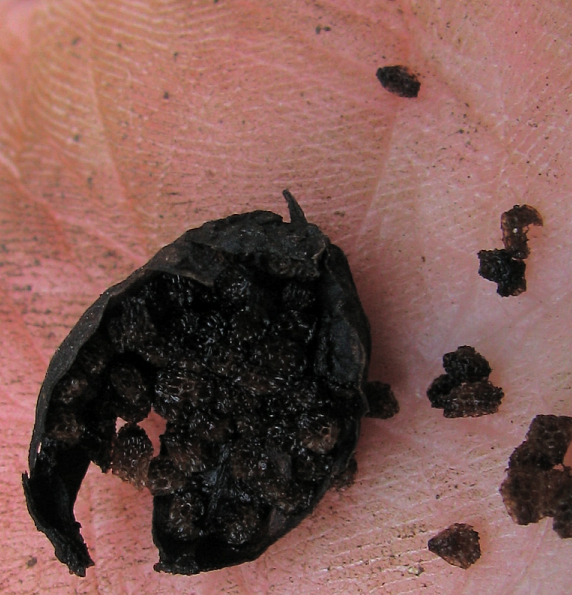
Here is one of the seed pods and contents.

GroundConeSeedsCR.jpg

The pod, though swollen with moisture, was still less than a quarter inch in diameter before I broke it open.

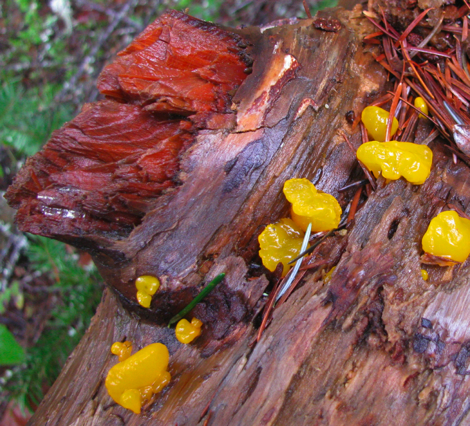
Our other find was a gelatinous fungus with the colorful and descriptive name of witches’ butter.

Witches' butter 1CR.jpg

I think this is Dacrymyces palmatus; similar-looking yellow-orange fungi, with the same common name, are found as parasites growing on other fungi, rather than directly on wood like this. And the witches have “butter” that is black in color too (Exidia recisa, see photo here).

Witches' butter 2CR.jpg

These are the fruiting bodies, like a conventional mushroom, though I could not find out in a brief search of the net exactly how the spores disperse.

Ice structures on leaves

FrostyWalkJack.jpg

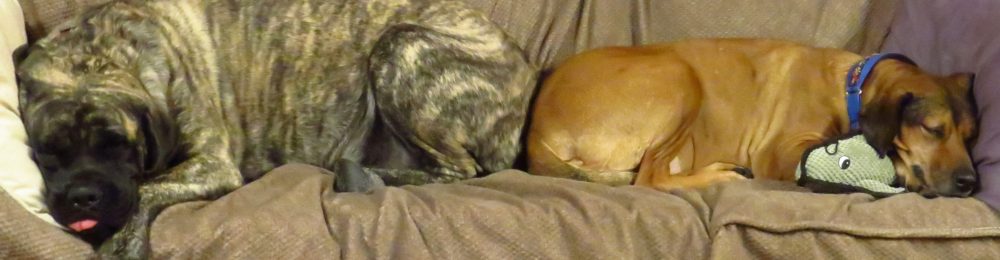
It’s been a bit colder here than usual the past few days, with night-time lows in the high teens and freezing fog some nights. Yesterday Jack the mastiff and I walked up Star Gulch Road, which goes along a stream with several private gold-panning claims on it. But it was way too cold for panning!

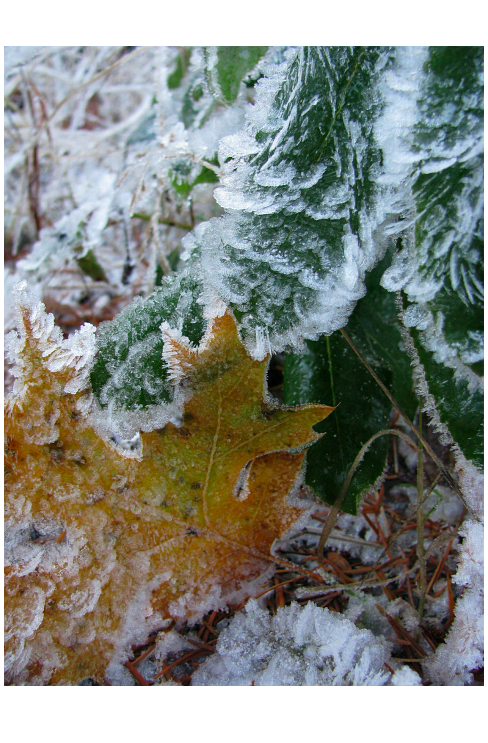
Nights of heavy frost had enrobed the vegetation in dense but delicate icy structures.

FrostyWalkIceLeaf1.jpg
FrostyWalkIceLeaf3a.jpg
FrostyWalkIceLeaf2a.jpg

Jack and I each pursued our personal obsessions. His are: following wherever I go but arriving there first, and of course sniffing around the woods to see what creatures have been there. Mine, that morning, were: walking fast enough to stay warm, interspersed with stopping and kneeling to take photos. Jack probably thinks the camera is some sort of mechanized human sniffer when I put it up close to things. Well, he’s right, in a way. I’m afraid I do see more when I take the camera, and certainly the camera remembers things better than I can.

Sometimes Jack responds oddly to objects; a statue of a horse or animal is approached cautiously and sniffed at full extension, ready to leap away. On this walk he saw a large wooden “Put out your campfire” sign, on 2 wooden posts, and reacted as if it were some strange beast. He barked at it until we got up to it then very carefully checked it out. Well, if it had been an animal it would have been quite a big one, easily six feet tall with legs made of four by fours, so I guess I understand his caution if not his failure to discern its true nature. Or, maybe it was really some entish thing just pretending to be a sign . . . you never know.

Acorn Woodpeckers and Steller’s Jays

We see Acorn Woodpeckers (Melanerpes formicivorus) only occasionally, so when two adults and a youngster showed up at the feeder the other morning we were delighted. These are showy birds, adding light yellow to the customary woodpecker color scheme of black/red/white. They came to the tube feeder with a spiral wire around the outside which is supposed to encourage woodpecker use, but our resident flickers (who nest inside the walls of the barn) rarely use it.

The third bird was smaller than the other two and took a while to figure out the feeder. He wanted to cling to the bark of the nearby tree and reach over to the seeds, but was finally doing it the easy way by using the wire.

I wish I could say I’d taken these photos, but without a long lens there was no point, and the birds were very wary of us even watching from the kitchen window. These are all from flickr, under Creative Commons licenses.

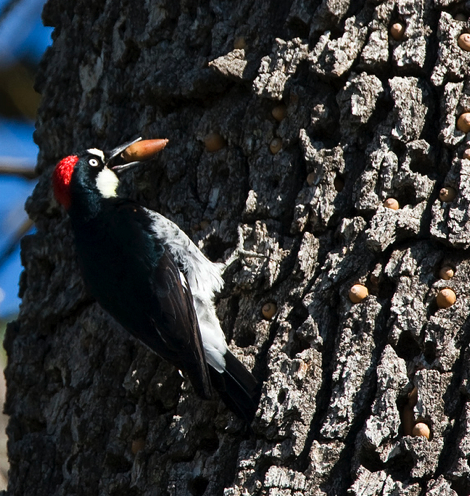
The picture below illustrates why they are called Acorn Woodpeckers. They drill holes to store the acorns. “As acorns dry out, they are moved to smaller holes and granary maintenance requires a significant amount of the bird’s time. The acorns are visible, and the group defends the tree against potential cache robbers like Steller’s Jays and Western Scrub Jays. Acorns are such an important resource to the California populations that Acorn Woodpeckers may nest in the fall to take advantage of the fall acorn crop, a rare behavior in birds.” [Wikipedia]. Their diet also includes insects caught in the air, fruit and seeds, and sap sipped from holes they drill.

Photo byKevin Cole, Creative Commons.

AcornWoodpecker&Acorns.jpg

The facial patches may be white or light yellow; our visitors had showy yellow faces. Very handsome birds!

AcornWoodpeckerYellow.jpg

Photo above by Len Blumin, Creative Commons.

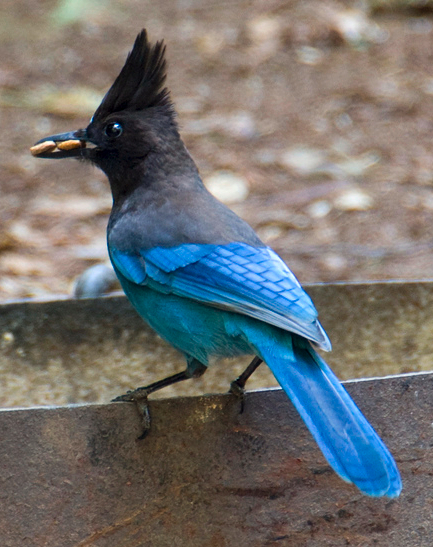
The Steller’s Jay (Cyanocitta stelleri) mentioned above as a stealer of acorns is another notable bird here in the Pacific Northwest, striking in appearance and a bit thuggish in behavior. They’re larger than the Acorn Woodpecker. Upper parts vary with latitude from nearly black to dark blue.

Steller'sJay1.jpg

Photo above by Vincent, Creative Commons.

Some have light blue markings on the forehead and/or above the eyes.

Steller's JayMarkings.jpg

Photo above by dotpolka, Creative Commons.

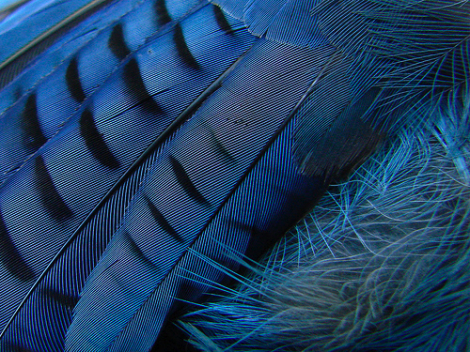
Steller'sJayFeathers.jpg

Photo above by randomtruth, Creative Commons.