That title sounds contradictory, doesn’t it? Butterflies are beautiful, innocuous, always to be protected. If only the world were as Walt Disney told us it was! [NOTE: I’ve learned from readers of this post that this caterpillar has a toxic substance in its hairs or spines that can cause a very painful reaction if you touch it, so be careful—indeed of any hairy or spiny caterpillar. See below, https://nosleepingdogs.wordpress.com/2010/06/01/attack-of-the-mourning-cloak-butterfly-larvae/#comment-40639 and https://nosleepingdogs.wordpress.com/2010/06/01/attack-of-the-mourning-cloak-butterfly-larvae/#comment-40872 ]
The first title of this post was “Attack of the tent caterpillars”, because of what I saw. First the caterpillars,
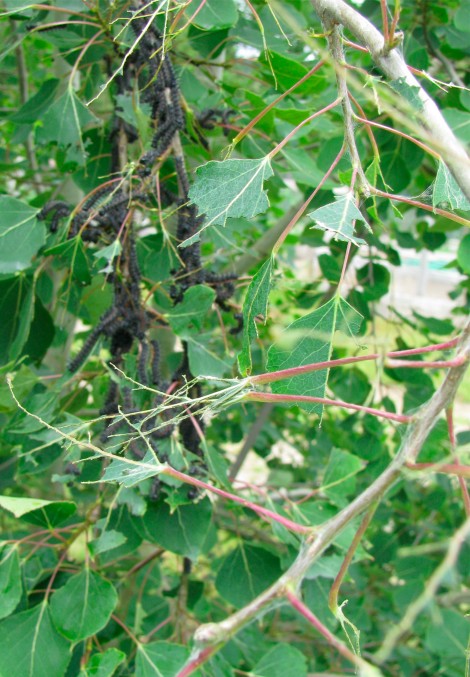
then their “tent”. The black balls visible are probably frass (caterpillar excrement). A few caterpillars are under the tent; some species retire periodically to their tent for protection from the elements and birds.

The closer I looked the uglier they were to me.

They were chowing down on the leaves of our little grove of aspens, planted a few years ago and much cherished.

Birds, including 6 pairs of nesting tree swallows (Tachycineta bicolor), usually keep insect pests under control around our house. But nobody showed any interest in this concentration of food on the aspens; too spiky, or maybe bad-tasting. Caterpillars eat so much so fast, they can defoliate trees. I went looking for something to spray them with and found we had no insect spray. Finally I used 409 cleaning spray, it certainly smells toxic. The next day most of the caterpillars were still alive and eating. Finally a better idea occurred: cut off the branches they were on and bag them up. Since the infestation had spread to just 3 branches, I was able to do that.
It was only afterwards that I succeeded in identifying the caterpillars. I had looked at all the so-called “tent caterpillars”, and others, without finding anything that matched. Then there they were: they would have grown up to be mourning cloak butterflies (Nymphalis antiopa).

Photo from milesizz on flickr.
You can imagine how bad I felt. I’ve since thought that maybe I could have cut the branches and then lodged them in among the branches of some other tree. Or kept some and fed them until they pupated. The favored food trees for the larvae are elm, willow, hackberry, and trees of the genus Populus: cottonwood, poplar, birch, and, yes, aspen. Except for occasional cottonwoods and shrubby willow along the river, none of these are native around here. But we do see the occasional mourning cloak, one of which must have laid the eggs earlier this spring—this species overwinters as adults, emerges to mate and lay eggs in spring, then after 10 days or so the caterpillars hatch out, eat, pupate and emerge as butterflies before fall. Given how much caterpillars eat, harvesting enough willow from the riverbanks to keep them fed doesn’t sound practical, at least not for very many individuals. But if there is a next time I think I will try it.
Here are a few closeups of the caterpillars. Identification was hard, maybe because they go through 5 “instars” or stages, shedding their skins each time and so perhaps different instars look a bit different. Some of the photos of this species showed much hairier-looking caterpillars, whereas the ones here were extremely spiny but with few hairs.
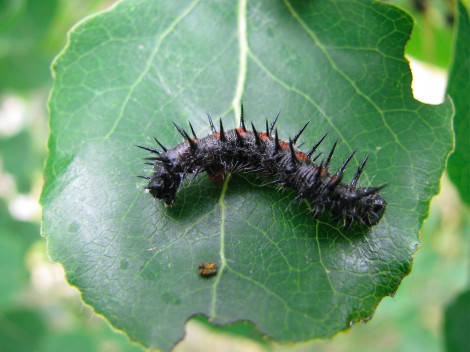

Note the red dots on the back, and the red legs (arrows).
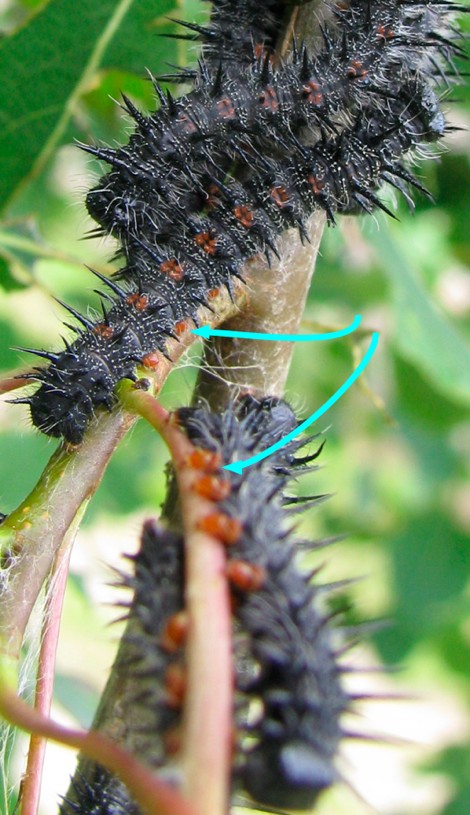
The eggs would have looked like this.

Photo from Canadian Biodiversity Information Facility. For an excellent series of photos showing a female laying eggs, changes in the eggs as they get close to hatching, and the tiny new caterpillars, see this backyardnature.com page by Bea Laporte.
And each spiky black voracious caterpillar, after eating its fill of the tender leaves of our aspens, would have toddled off to some sheltered place to pupate, making a chrysalis like this.
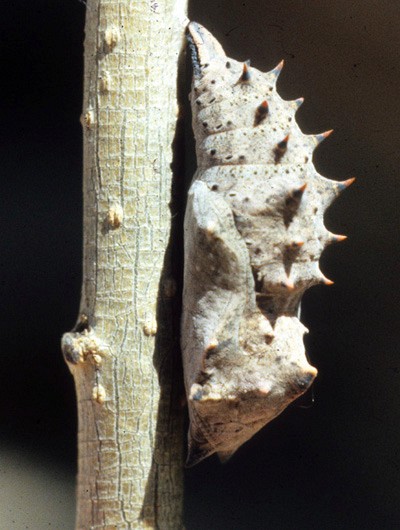
Photo from bugwood.org.
Since mourning cloak adults overwinter, they are one of the earliest butterflies to appear, and regarded as a sign of spring. The “mourning cloak” refers to their dominant wing color, dark rusty red bordered with black—though it’s lightened with blue jewels and cream-colored edges.
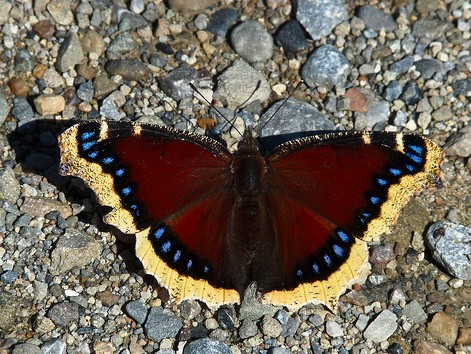
I’ll close this tale of butterflies-never-to-be, with a melancholy ballad in which the mourning cloak appears, perhaps in the role of one of the Greek Furies, haunting one who has done wrong. Usually such messengers of vengeance and doom have unpleasant appearances, as did the Furies, but to the guilty heart a bright butterfly might be even more menacing than a dark spiky caterpillar.
The Mourning Cloak
(Karah Stokes/Spruce and Maple Music 1)
One fair morning late in June
The sun shone on the daisies white
When a messenger of sorrow deep
Came into my garden bright
Wings of deepest velvet black
Bound with gold and sapphires rare
A butterfly, a Mourning Cloak,
Like one a wealthy widow’d wear
He promised me a golden ring
But he gave it to a rich man’s child
He craved the ease wealth would bring
Above a love both true and wild
So I called him to our trysting place
“Since there’s no help, let’s kiss and part”
He took me in a sweet embrace
And he felt a penknife in his heart
He looked at me with fading eyes
I left him there as he left me
The dawn next morning brought the news
That he’d been set upon by thieves
Oh, butterfly, why do you haunt?
Know you the secret in my breast?
I pierced his heart as he pierced mine
I slew the one I loved the best
One fair morning late in June
The sun shone on the daisies white
When a messenger of sorrow deep
Came into my garden bright







 nosleepingdogs