Autumn

This October afternoon the sun was mild enough that I could go out and soak it up, just lying on the deck, resting my head on the book I had brought along. Somewhere within earshot quail moved along in the golden-dry grasses, and I considered, in between dozing, whether their calls were more like “kee kee KEE” or “we’re here HERE”. When I looked up after an hour or so of moving crablike to keep in the light, I noticed how low the sun was already in the southern sky; it’s as if four months have skipped by me untasted, as I stayed in to avoid the heat, came out briefly to sit in the hot shade, ran in and out setting sprinklers to try to nurse the plants through the dry hot summer.

I was reminded of February in Portland (Oregon), where one can easily go a month in winter without seeing the sun through grey and misty skies. Portland is not all that rainy, measured in inches, but measured in sunny days from October to May it can feel like Scotland without the wind (though that’s a climate I’ve only read about). There are usually three or four days in early February when the sun appears, to encourage the world, and I remember going out then as I did today to turn my body to the sun, driven by hunger for its warmth, even though here it’s been blazing for months.

A flock of tiny birds–kinglets perhaps–swept through the trees and I heard their little sounds. When the late afternoon breeze came up and I roused myself to use eyes instead of only ears, it seemed the birds were moving from tree to tree to stay in the light and warmth. I filled up the mineral-encrusted pyrex pan that serves as a bird-waterer; there was some rain the past two days but the earth drank up the moisture, eager for it as I was for the sun. We all feel the dark coming on apace.

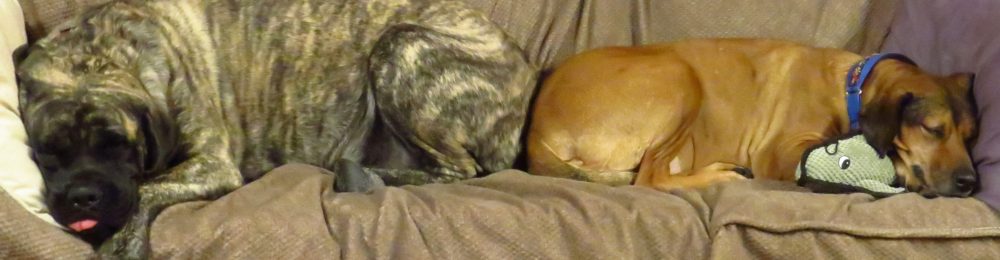
There is more sunlight in the back part of the yard and I follow it, wandering around. The dogs follow me, drawn in varying degrees by companionability, the responsibility of guarding me, and curiosity as to what the two-legged hunter may turn up. The back is dusty and rocky, spiky dry weeds divided by gopher-plowed patches. A pattern catches my eye; I stoop and find the carcass of a goldfinch as dry and fleshless as the weeds. He seems not the remains of a creature done with life, but a form ready to be filled: pour flesh and guts in through the gape in the breast where the sternum is revealed bare, perfect, curved; pop in that bit of a brain that sits behind the huge eyes–one can look through one side of the skull and see daylight out the other, so large are a bird’s eyes, far larger than the tiny part that shows–and then restore those marvelous eyes and nerves, preen the feathers straight, and off he might fly.

Can elephants really paint?

I found a link somewhere to a YouTube video of a young Asian elephant painting quite a good outline picture showing an elephant holding a flower in its trunk. It is impressive to see, but I found it hard to believe the implication: that this elephant was creating, rather than performing a learned task. As a former zookeeper and continuing student of animal intelligence I’m well aware of how various animal species can display amazing “intelligence” and problem-solving skills. And I’m equally aware of how we can misinterpret the actions of animals: we are blind to demonstrations of the real “intelligence” that animals use in their lives, but seize upon actions that remind us of ourselves.

We must keep in mind that we are the ones defining “intelligence”: it’s very specific to human concerns, sometimes even cultural distinctions and values. We don’t even count as intelligence the mental activity displayed, say, by a social hunter like a wolf or lioness who uses its knowledge of prey behavior, local topography, and the expected reactions of its hunting partners, to set up successful hunts of prey which may be much larger, faster, and part of a distracting herd. What we like to see, what we (naturally) respond to, are actions that mimic our own activities. To impress us, the mimicry must even be culturally appropriate. If I try to teach my dog to sing and he makes sounds like a Tuvan throat-singer I probably won’t think the venture a success, but if he sounds like Caruso or Elvis, that’s a different matter.

Also, animals can appear to perform complicated volitional acts which may be done simply by rote or mimicry. You may teach a dog to perform an operatic aria, or to mimic you when you dance, but the meaning invested in the act, and the amount of creativity or self-expression involved may not be at all what you (would like to) believe it is. A few animals have become famous for applying their acute powers of observation of human gesture, stance and expression; their masters guided them without being at all aware of having done so. Clever Hans, the horse who solved arithmetic problems and tapped out the answers with his hoof, is the pre-eminent example; when his guileless owner was blocked off from view of the horse, or did not know the answer himself, then Hans could hear the questions but was completely unable to tap out any correct responses. It appears that the horse read his owner’s body language, not that the man intentionally cued him. If the owner knew that 9 hoof-taps was the answer to “What is 3 times 3?” then his body relaxed after the ninth tap and the horse reacted to that.

So when we think we see an animal performing a complex activity (such as painting representational pictures), and one which has no apparent functional place in its normal life, we need to set aside our amazement and delight and look deeper.

It appears that the elephant video was made in an elephant camp in Thailand, perhaps at ChengMai where elephants have been trained in drawing and painting for over a decade, or at a newer camp called Mateman Elephant Camp. At Chengmai, the paintings are sold or exchanged for donations which help support the elephant center. The use of elephants in Asian logging is declining, and of course truly wild habitat where elephants won’t come into conflict with humans is scarce or nonexistent there. So the financial return from tourists is probably a positive thing, and painting may provide some stimulating activity for the elephants themselves although their greatest natural need is for more active pursuits such as walking many miles daily, uprooting bushes and trees, searching for water, learning and remembering their territory, and so on.

The photo below, from a 1995 issue of the Chengmai Mail, shows elephants in front of their largest painting to that time, a 12m mural made to raise money for a children’s fund.

elephantpaintingschool.jpg

But what is the elephant in the video actually doing? How much direction might the elephant be getting from his keeper or mahout? The video’s close focus on the animal did not offer any view of the mahout, who might have been giving verbal cues or making gestures.

Is the elephant painting a picture which it has composed and chosen or one which it is copying or has learned? A clue to this does appear in the video: near the end after the elephant has painted the red flower, the camera draws back and we can see an attendant removing a finished painting of very similar flowers from an easel near the elephant. To me, this indicates the likelihood of rote performance. The trainer has schooled the elephant: he hands the elephant a brush with red paint on it and says “Flower now,” while someone holds up a board with flower paintings on it, and the elephant responds. Even that act shows “intelligence,” and certainly trainability, but it would not demonstrate that the elephant is making the multiple choices, conscious and subconscious, made by a human artist.

There weren’t any videos I could find of elephants just learning to paint at ChengMai, but those in US zoos who’ve been given paintbrushes have consistently turned out paintings that can definitely be called “non-representational.”

The fullest account I found of the training of the elephants to paint was at the blog Stranger in a Strange Land in the March 14, 2008 post. It indicates pretty intensive training of the elephants.

“Teaching an elephant to paint is like teaching a young child,” says Tossapol Petcharattanakool, an art instructor at Maesa and professionally trained as an elementary school art teacher. “They have a sense of form and style and can learn positioning of lines. But while the elephant IS the painter, there is definitely communication, collaboration between mahout and elephant.”

In addition, at a site that sells the elephants’ paintings, I found indications that individual elephants repeat the same work.

There’s a photo of an “elephant with flowers” painting very much like the one made on the video, but with two flowers instead of one, and underneath,

Product Information

This is the last “Self Portrait” in stock – our allotment for May/June from Elephant Artist Hong.

Thanks to Anchalee Kalmapijit, director of the Mateman Elephant Camp and now director of an new Elephant Art enclave, we were able to obtain several of these Elephant Self Portraits made famous first by the documentary made by Blink TV with Vanda Harvey – an English Artist which was featured on the BBC and then the video posted on YouTube.

According to Anchalee, now is the rainy season in northern Thailand which makes it difficult for the Elephant Artists to paint in the open. Couple that with the decision by Anchalee and Hong’s handler Noi to “relax” and paint at a pace more set by Hong’s “mood”, and one can understand the scarcity of these paintings in the elephant art market. These paintings have sold as fast as we post them so order NOW! There is NO video with this painting.

PS Check out other sites that carry self portraits by Hong – they sell for a lot more than this!

That gives me enough evidence to conclude, until I learn differently, that the elephants are “merely” reproducing movements they have been taught. The degree of consistency is so great (in these few examples I’ve seen) that the trainers may even guide the animal’s trunk in the beginning, to teach it the desired lines and curves. Later the trainer gives verbal commands indicating which set of lines to draw. The elephants are not, say, looking over at another elephant and drawing lines with a brush to depict what they see.

The more we learn about natural animal behavior the richer and more complex we see that it is. If elephants or chimpanzees are unable to paint original representational pictures, that does not diminish them. The delight we feel when animals act like people is deeply selfish: “Look, it can hold a bat and hit a ball with it!” It’s imitating a human, that pinnacle of creation! Homage to humanity from the lesser beings.

Much more interesting are the things they can do that arise from their “essence,” their way of interacting with the world. But few of us ever get to observe at length any animals that are not living in a human-designed world; our pets, our livestock, our zoo animals, all act within the limits of a man-made environment. Even in that environment we can get glimpses of essence, of dog-ness or penguin-ness, if we pay attention and are resistant to self-serving interpretations.
Keeping deer out of the garden

Deer love tender new leaves and can leap tall fences at a bound. We see them all the time, on our rural property outside the fenced area where the dogs have free range. But we’ve never had one get into our vegetable garden which is bordered on the back by that main fence, and on the other three sides by fences to keep our dogs out. The fences are well under five feet tall, nothing for a deer to jump. Our garden is in raised beds about three feet wide and varying in length; between the wooden sides of the beds, the walkways are about two and a half feet wide. My theory is, that deer (like other hoofed animals) are concerned about having good footing when they jump into a place, and the narrow spaces and mixture of heights doesn’t look safe or inviting.

Outside our fence I have been trying for over eight years to get trees and tall plants established in a bare spot to make a visual barrier between us and our neighbor’s two-story place. Poor soil and hot dry weather have been the major problem, but then the deer have chowed down on most everything that I have kept alive except some weeping willows I started by sticking branches in the ground. I’ve tried old remedies, new remedies, and wacky ideas: Mylar pinwheels, hanging scented soap, rotten egg spray, flapping hanging things tied to the trees, systemic bittering agents put in the soil, glittery hanging things like metallic beads, Mylar streamers, and aluminum pie plates (reputed to work to repel birds eating ripening fruit). Never did try hanging little bags of human hair trimmings, a method with a following. I bought dehydrated coyote urine but then on the drive home thought about how it must have been collected, and went back and returned it with an explanation to the wild bird store, and I believe they stopped carrying it. It might have worked, but the confinement needed to produce it was unacceptable.

I went so far as to lay down landscape cloth around the trees and then on top of that peg down that plastic-netting fencing used for temporary barriers. I put it down horizontally: it did a good job of tripping me up all the time but the deer did not seem to be affected. And soon falling leaves covered it, weeds rooted in the decomposed leaves, and it was buried.

Finally I decided to mimic what worked in the garden and I used wide plastic tape, like crime scene tape or the fiberglass tape used on drywall seams, to divide the tree area into many narrow portions. It worked! I put it at varying heights between 2 – 4 feet, going around a tree trunk or stake and then off at an angle to another point. I’ve now moved to using bright yellow polypropylene rope because the tapes didn’t hold up to uv exposure, and the stronger rope is easier for me to get over or under when working out there. Once the trees get tall enough, it can be removed; without some protection, nothing but the original willows will ever get that tall. It’s not too scenic, but I don’t care, and the neighbors–I think they probably prefer it to the flapping plastic trash bags!

Defensive chainsawing

Here in wildfire country, it’s all about “defensible space” around your house, created by “fuel reduction.” We’re in the foothills of southern Oregon’s Siskiyou Mountains at about 2300 ft.; it’s dry, and rocky, and wildfires are a fact of life.

Shortly after we moved here I overheard someone say, at the local grocery store, “Plans for summer trips? No, we never go anywhere in the summer in case of wildfire.” This sounded pretty paranoid but I understand it better now that we’ve been here 12 years and seen two fires come close enough to worry about.

Pine-oak woodlands and mixed conifer stands seem to be the climax trees in our area, but 150 years of logging, farming, and road-building have caused a lot of disturbance. On our property, oaks, Douglas fir, and sun-loving Pacific madrones are the most common native trees. The madrones, which would be shaded out by dense mature forest, are often multi-trunked especially when resprouting after being cut; some of the oaks are the same. This results in brushy growths that can feed fire close to the ground. Shrubs like manzanita (Arctostaphylos sp.) and buckbrush (Ceanothus cuneatus) are very common and both are superb fuel for fires. We cleared one area ourselves, early on, of many pickup loads of buckbrush ranging to 5 feet tall. We burned them soon after cutting and even green they burned like gasoline.

Since that early effort of ours, the agencies concerned with fires and forests have gotten much more aggressive about fuel reduction on private as well as public lands. Small acreage homeowners like ourselves present a real problem to those fighting wildfires, since we expect our property, lives, and livestock to be protected and the fire-fighting resources–people, planes, equipment–are always stretched thin. Because we are part of the problem, we have been encouraged to be part of the solution as well by creating defensible zones around structures and along driveways, and having acreage “treated” to reduce fuel loads. In practice this means removing brush and dead trees, increasing distance between trees, and “limbing them up” by cutting branches that start below 6-10 feet.

The local fire district has a program to reimburse landowners for the costs of fuel reduction and we have participated in this twice. Someone comes out from the fire district to do a walk-around with you, discussing how fires travel and what changes you need to make, then you can either hire the work done or do it yourself, and upon a second inspection, be reimbursed on a per-acre basis for satisfactory completion. The amount is about $300/acre.

The financial aid means that it is possible for property owners to do fuel reduction even if they can’t do this strenuous job themselves. And when wildfires threaten private property, certified defensible properties will be given priority if there aren’t enough resources to protect everything.

Our first project was along the driveway and around the house. It included work we did ourselves (such as screening the open space between our large deck and the ground to prevent wind-blown sparks from igniting the dry wood from underneath) and work we paid for (the chain-saw removal of trees and brush and later burning of the brush piles).

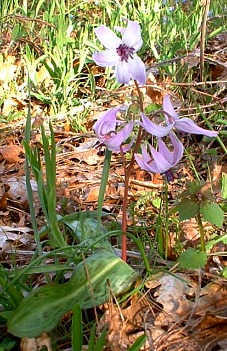
This spring we heard the grants were available again and decided to have fuel reduction done on most of the rest of our 5 acres. This was a decision that we made with regret; the cleaned-up look, which some call a “parklike setting” of spaced-out trees with little growing between them, is not pleasing to our eye, provides less cover and food for wildlife, and will change the mix of wildflowers we enjoy. Twelve years of benign neglect has allowed the land to recover from various affronts and we’ve seen a significant increase in our favorite wildflower, the ephemeral Erythronium hendersonii (Henderson’s Fawn Lily, but we call it Trout Lily–both terms refer to the mottled leaves), and others.

troutlily.jpg

However, thinking of our house becoming a pile of cinders was incentive enough. It is also true that big wildfires fed by abnormal accumulations of fuel are a long-term loss to wildlife here, where dry weather and poor soils make plant recovery slow; and both times we have chosen the more expensive method of selective hand-thinning by chainsaw over the cheaper way of clearing acres with whirling blades mounted on eco-buster caterpillar tractors. That method, as we saw when BLM used it next to (and actually on) our land, leaves a blasted wasteland that reminded me of photos of WWI France where months of artillery shelling turned forests into craters studded with splintered trunks rising at angles from the trampled mud.

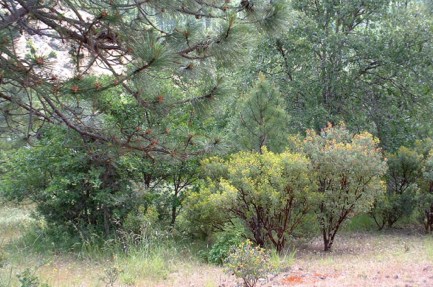
The latest clearing work has been completed, although warm weather arrived too soon for the piles to be burned; they’ll have to wait until the rains start in the fall. I didn’t think to take any “before” pictures, but for comparison the photo below is of an area untreated since we cut buckbrush a decade ago. It’s less dense than the treated areas were, before clearing, and has little madrone, but the growth of manzanita and oak clumps is similar.

denser1.jpg

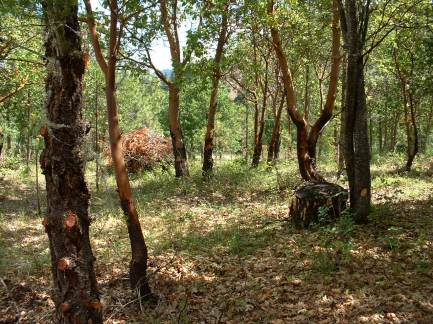
The next photo is of a just-cleared section; the whitish band near the center is the driveway which would not have been visible at all before the thinning and limbing-up. The indistinct brown blob just to the left of the driveway (but closer) is a pile of branches and brush to be burned. A few piles will be left for the small creatures to shelter in, and a few large dead trees were left standing. The man who did the work is well experienced and at our request left a little extra brush where he thought the fire district would approve it.

cleared1.jpg