Let’s be niggardly with the n-word, but…

but…sometimes it can and should be said.

niggardly
stingy, sparing, parsimonious, e.g. “serving out the rations with a niggardly hand”.

from niggard
mid-14c., nygart, of uncertain origin. The suffix suggests French origin (cf. -ard), but the root word is probably related to O.N. hnøggr “stingy,” from P.Gmc. *khnauwjaz (cf. Swed. njugg “close, careful,” Ger. genau “precise, exact”), and to O.E. hneaw “stingy, niggardly,” which did not survive in M.E. [etymonline.com]

nigger
1786, earlier neger (1568, Scottish and northern England dialect), from Fr. nègre, from Sp. negro (see Negro, from Latin nigrum (nominative form niger) “black,” of unknown origin (perhaps from Proto Indo European *nekw-t- “night,”). From the earliest usage it was “the term that carries with it all the obloquy and contempt and rejection which whites have inflicted on blacks” [cited in Gowers, 1965]. But as black inferiority was at one time a near universal assumption in English-speaking lands, the word in some cases could be used without deliberate insult. More sympathetic writers late 18c. and early 19c. seem to have used black (n.) and, after the American Civil War, colored person. Also applied by English settlers to dark-skinned native peoples in India, Australia, Polynesia. The reclamation of the word as a neutral or positive term in black culture (not universally regarded as a worthwhile enterprise), often with a suggestion of “soul” or “style,” is attested first in the Amer. South, later (1968) in the Northern, urban-based Black Power movement. [”You’re a fool nigger, and the worst day’s work Pa ever did was to buy you,” said Scarlett slowly. … There, she thought, I’ve said ‘nigger’ and Mother wouldn’t like that at all.” [Margaret Mitchell, “Gone With the Wind,” 1936] [etymonline.com]

Dr. Laura Schlessinger, radio dispenser of advice and moral judgments, is taking considerable heat for her response to a call involving the word nigger. I don’t even know if WordPress will allow me to spell that word out—and that is what I want to talk about. If you would like to see a transcript of the call and Dr. Laura’s remarks immediately after the call, it is here.

I will say that I think Dr. Laura should apologize, but not for saying a bad word on the radio. For whatever reason, she abandoned her professional role and lost the distance and composure essential to that role. Instead of asking elucidating questions and listening to the caller’s answers, she went off on a rant of her own. As Dear Abby and Ann Landers and others have often decreed, when a spouse hears relatives or friends insulting or taunting his or her spouse, spouse1 must let the relatives/friends know that this is not acceptable, that neither member of the couple will stay to hear such insults and taunts. There are good practical reasons for this, and there is even Biblical justification: “For this reason a man shall leave his father and his mother, and be joined to his wife; and they shall become one flesh.” Genesis 2:24. New American Standard Bible (©1995)

When a black woman married to a white man complained that the word nigger was being used, the therapist-of-the-air should have asked: “How is it being used? Give us an example.” Probably the example will not be a disquisition having to do with Mark Twain’s use of the word in Huckleberry Finn, or the word’s etymology, or a quotation from a black comic using the word. Most likely the remarks are of this nature: “You know niggers, they always/never…” or “Some nigger robbed the convenience store over by where I work…”

These uses are insulting, hostile, and demeaning, like all the other dehumanizing terms used to set some group apart from the rest of us. English has terms like that for Arabs, Baptists, Catholics, Jews, fat people, smart people, stupid people, white people, Hispanic people, gay people, men, women, and people whose ancestors were from Ireland, Italy, Poland, Scandinavia, and so on. Other languages have similar terms for the same list, subtracting the words for the speaker’s religion, gender, sexual preference, appearance, and ethnic origin, and adding ones for us Americans. Sometimes there’s intra-group use of such terms; Dr. Laura went off on that tangent but I will not, it’s irrelevant. When outsiders use the term it is almost exclusively insulting and demeaning. Worst of all, these dehumanizing terms are the mental preparation for pogroms, lynchings, beatings, bombings, murders, war, and ethnic cleansing (a shocking euphemism which deserves its own examination, but not here).

No question, nigger is not a word for everyday use by non-blacks, same as the other group-based terms alluded to above.

But when someone wants to excise words from our language, all of us should resist.

When we begin killing words, where will it end?

Some may say, Better words than people! My reply is that manipulating language is the same as manipulating thought, which in turn changes how we act. Dehumanizing the Other is a preparation for war, violence and mistreatment, whether organized or individual. What’s necessary and positive is to continue to educate people not to use these category-based insulting demeaning words to other people. If you want to call someone lazy then do that, but don’t couple it with an insult to the person’s innate or historic self. I can argue with you about whether I am lazy or not, and if convinced that I am, I can choose to change it, but I will always be a black Scandinavian Catholic gay smart woman, if that is what I am.

If we must substitute the ridiculous circumlocution “the N-word” for nigger, then how do we discuss historical documents that used it? How do we read literature that used it? How do we talk about the word itself and its history that renders it sharp as a sword, clanking with manacles, reeking of hatred and suffering?

James Baldwin used nigger, and not just in the vocative sense (e.g., my example, as some use “man”, “Man, you know I’m…”, “Nigger, you know I’m…”) In fact he and Dick Gregory made a serious movie by that title, and it’s the title of Dick Gregory’s 1990 autobiography. Baldwin and Gregory believed that the word and its various meanings needed to be thought about, talked about, by whites and blacks.

Apparently “the N-word” attained popularity during the OJ Simpson trial, in talking about recorded statements by Mark Fuhrman. Chris Darden, black prosecutor, tried to save Fuhrman’s credibility by letting everyone know how awful he, Darden, thought the word was: “The prosecutor [Christopher Darden], his voice trembling, added that the “N-word” was so vile that he would not utter it. “It’s the filthiest, dirtiest, nastiest word in the English language.”

But the Bowdlers who gave us first “the F-word” and then “the N-word” won’t stop there. Broadcasters aid and abet them, probably feeling a little frisson of guilty pleasure at being able to allude unmistakably to words the FCC won’t permit them to utter. And some people make up new “[letter] – words” to dramatize their remarks or because they feel victimized. So we have “the B-word”, and words for C, D, E, F, G, H, J, K and on through the alphabet. Some of the words so represented are offensive, others are as inoffensive as “green”.

Let’s let this “N-word” thing stop and fade away. Many times it will be sufficient to say that a person used a “racial slur referring to black people”. If not, then just say the word. “Candidate Joe Smith singled out a black man in the audience for insult, calling him a nigger and a ‘mono’, Spanish for monkey.” Let’s be grown-ups about language and about how we treat others. Hiding behind alphabetical euphemisms makes us sound like giggling 8 year olds, and prevents us from thinking and talking about the issues that euphemisms cover up.

Frog changes color with changed surroundings

I really wish I’d taken a photo of this frog when I found her this noon, sheltering on the porch next to the wall. There were some beer 6-pack carriers there waiting return to the store and when I picked one up there was this big dark frog clinging to the side. She (well, she just seems like a “she”) was a very dark brown tinged with green all over, with some darker mottling on her back, and sparkling gold stripes above her eyes. I caught her up and put her in our 100-gallon pond, on the lotus and water hyacinth leaves.

This afternoon, here she is, transformed in color.

FrogChangesColor.jpg

The dark splotches on her rear are about the color that her entire body was, about six hours ago.

It was only recently that I learned frogs could do this, so now having seen it in action I had to talk about it. Apparently it’s an ability found in many species, and the frogs can change as a result of light, humidity, surroundings, or “mood”. Whatever that means. The frog changed and the researcher cannot see any objective alteration in environment so it’s put down to “mood”.

Fear or excitement makes many frogs and toads turn pale, but others, like the African clawed frog, darken when disturbed. Another African frog is normally green, but turns white in the heat of the day to reflect heat and keep cool. The tiny African arum frog is ivory white and lives in the white blossoms of the arum swamp lily. When the blossoms die, the frogs turn brown to match. from exploratorium.edu.

We think she’s probably a Pacific Tree Frog (Pseudacris regilla).

[Etymological note: Pseudacris from the Greek pseudes (false) + akris (locust) — alluding to the frogs’ song?; regilla from the Latin regilla (regal, splendid) — probably referring to the markings.]

No glaciers on the news

Last night I wanted to see footage on television of the huge island of ice that has broken off of the Petermann glacier in Greenland. It’s the biggest such event in the Arctic for 50 years, launching a massive iceberg that has four times the area of Manhattan and is 600 feet thick. “The so-called “ice island” covers a hundred square miles (260 square kilometers) and holds enough water to keep U.S. public tap water flowing for 120 days.”

I thought that some enterprising Greenlander, perhaps from the Greenland Ice Patrol which monitors ice movement for shipping safety, would surely have gotten aloft and sent us all some live footage showing the area, but apparently not. Merging two clichés, one about cable tv and the other about big-box stores, I thought: “500 channels, but never what you want”.

Online, of course, there are photos like these from NASA.

NASArealcolor2.jpg

Real color photo from NASA. I added the orange line around the breakaway ice island. Source.

NASAfalsecolor.jpg

False color photo from NASA. Source.

And I did find about two seconds of overhead video on YouTube. It’s about 20 seconds into the video, and most of the rest is talking heads taking sides on whether the event is connected to global warming/climate change. Maybe yes, maybe no, does it really matter if each individual event can be connected? Good for politicians and talk-shows.

In the Antarctic, however, there seems to be quite a clear pattern. Nearly all of the world’s glacier ice, 91%, is located there. An international scientific partnership including the US Geological Survey (and the British Antarctic Survey, with the assistance of the Scott Polar Research Institute and Germany’s Bundesamt fűr Kartographie und Geodäsie) has found that

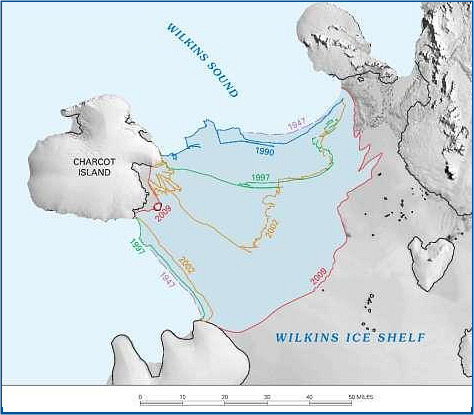
every ice front in the southern part of the Antarctic Peninsula has been retreating overall from 1947 to 2009, with the most dramatic changes occurring since 1990. The USGS previously documented that the majority of ice fronts on the entire Peninsula have also retreated during the late 20th century and into the early 21st century.

The ice shelves are attached to the continent and already floating, holding in place the Antarctic ice sheet that covers about 98 percent of the Antarctic continent. As the ice shelves break off, it is easier for outlet glaciers and ice streams from the ice sheet to flow into the sea. The transition of that ice from land to the ocean is what raises sea level. [report dated 2/22/10]

Since 1950, total Antarctic ice loss exceeds 9,652 square miles. Temperatures on the Antarctic Peninsula have risen faster than in any other area in the southern hemisphere – a rise that translates to more than five degrees Fahrenheit since the middle of the last century.

AntarcticPeninsulaIceLossMap.jpg

This image shows ice-front retreat in part of the southern Antarctic Peninsula from 1947 to 2009. Distance bar may be hard to read: it’s 50 miles in 10 miles increments. USGS scientists are studying coastal and glacier change along the entire Antarctic coastline. The southern portion of the Antarctic Peninsula is one area studied as part of this project, and is summarized in the USGS report, “Coastal-Change and Glaciological Map of the Palmer Land Area, Antarctica: 1947–2009” (map I–2600–C). (Credit: Image courtesy of U.S. Geological Survey). Source.

It is expected that loss of the floating ice shelves will allow the land-based ice to flow faster toward and into the ocean. If the Greenland Ice Sheet were to melt completely, it is estimated that it would add about 23 feet (7 meters) to current sea level. The West Antarctic Ice sheet is believed to be less stable than that covering East Antarctica, because the ice of East Antarctica lies on rock that is above sea level and is thought unlikely to collapse. But the West Antarctic Ice Sheet (WAIS) is on rock below sea level:

“Not just a bit below sea level, it’s 2,000 meters below sea level,” said David Vaughan, a principal investigator with the British Antarctic Survey. “If there was no ice sheet there, this would be deep ocean, deep like the middle of the Atlantic.”

Some scientists have theorized that this makes the WAIS inherently unstable. If the ice sheet retreats beyond a certain point, a positive feedback mechanism should, they say, lead to runaway retreat that would not stop until most of the ice sheet disappears. [Source.]

The Western Antarctic Ice Sheet contains 13% of all the ice on the Antarctic continent, enough to raise current sea levels around 11 feet (3.3 meters). And when the Intergovernmental Panel on Climate Change (IPCC) made its climate change predictions, including the “mid-range projection” (mid-range meaning, not the best-case nor the worst-case scenario) that seas will rise 17 inches (44 centimeters), they did not include what the effects would be, if polar ice sheets began to melt faster than in the decade of 1993-2003. This was done because there wasn’t enough known about ice sheet melting and its change over time. The Antarctic Ice Sheet is 6 miles thick in places, so it’s not easy to know what is going on under it and finding out has only recently seemed important to those who fund such expensive research.

Finally, the aspect that has seemed to many the most frightening about climate change predictions: the unknown potential for interactions between complex systems such as wind currents and ocean currents, which could conceivably multiply foreseen effects. (Or, if we were amazingly lucky, cause them to cancel one another out; but we won’t know until it’s too late to do anything about it.) For example, it’s believed that the melting of Antarctic ice shelves is caused by warmer water flowing up underneath the ice. But this water is not from melting ice; rather it comes from deep within the ocean, and climate change may be making it warmer by one of those unforeseen linkages:

Antarctica is encircled by atmospheric currents that largely insulate it from the rest of Earth’s climate and keep it colder than it otherwise would be. Jenkins’ model showed that these circumpolar currents, sometimes called “Westerlies,” “the Screaming 50s,” or “the Roaring 40s,” actually push surface waters out away from the continent. This results from the Coriolis Force, the byproduct of Earth’s rotation that causes cyclonic systems to turn counterclockwise in the northern hemisphere and clockwise in the southern hemisphere. As surface water is pushed away, warm deep water rises to replace it.

If the atmospheric currents speed up, more water is pulled up. Indeed, observations indicate these atmospheric currents have sped up in recent decades in response to global warming. So increased upwelling seems likely.

[Read more in this article which goes into deeper detail than many accounts of climate research for lay persons. It reports on the 2007 the West Antarctic Links to Sea-Level Estimation (WALSE) international workshop.]

It’s this sort of unforeseen multiplier-effect between two systems (each one of which,by itself, strains our capacity to make accurate mental and statistical models), that makes me think efforts to mitigate, and prepare for, climate change should be at the top of every developed nation’s agenda. Of course it’s not at the top of any nation’s agenda, and won’t be, until the effects are severe—not just “extreme weather” like last week’s flooding and unusual heat waves, but unmistakeable (and irreversible) such as significant rise in sea levels. By then secondary results, such as mass migration of tens of millions trying to flee drought and famine, will be well under way and our primate brains will be where they are most comfortable, dealing with what’s right in front of them. Near-term possibilities are construed concretely, long-term ones abstractly, and the consequences of that upon human action are pretty much as you’d expect. Psychologists even have a name for this, “temporal construal”.

We are told that Homo sapiens mostly evolves culturally now, rather than physically. Yet human cultures in industrial nations are mostly under the control of corporate interests which manufacture and sell us “culture” in a form that serves their ends. Government, also, serves them. If corporations were subject to natural selection we wouldn’t have seen no-strings bailouts for banks and financial institutions, instead there would have been widespread failures. If American culture is poorly adapted for survival in coming conditions, and if the few run it for their short-term gain, then chances for “our” success seem slim. Humans are slippery devils, though, enduring and resourceful. And there are still a few groups of hunter-gatherers and nomads left who may well prove far more resilient than any of our proud nations.

Siskiyou Wildflowers: Mt. Ashland in July, part 2

So many flowers!

We’ve made two trips to Mt. Ashland (Southern Oregon), on July 22 and 31, along a gravel/dirt forest road noted for wildflowers, and it was a new experience: instead of marvelling at a single flower or small patch of flowers, we saw slopes red with Indian Paintbrush or Scarlet Gilia, places with a dozen different flowers blooming in a 50 foot stretch. On gentle slopes where the snow has recently melted, plants grow so thickly it’s hard to see which leaves belong to which flowers. This is Forest Road 20, for those who might want to visit, and it’s the continuation of the main paved road that goes to the Mt. Ashland ski area. Just keep going, and the road soon turns to gravel and there are meadows of wildflowers on each side. A few miles later the road winds into a drier area with few but choice species, such as various penstemons as well as paintbrush, gilia, eriogonum, and many more. For us novices, identifying what we’ve seen and photographed has been a challenge.

Here are some of the plants we’ve seen on these two trips. Others were included in the earlier “Part 1” post. [Our identifications are the best we have been able to do, but shouldn’t be considered authoritative.]

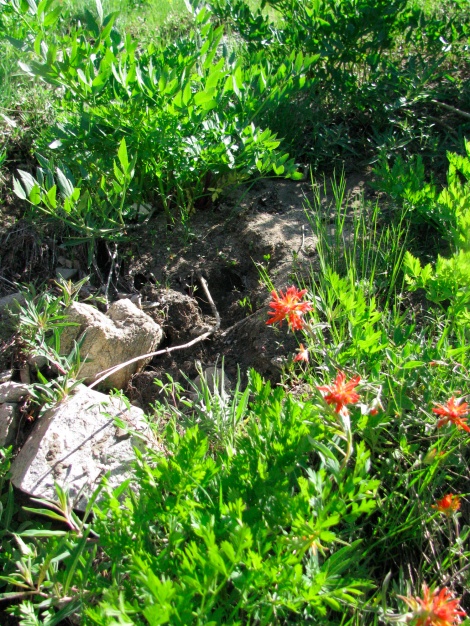
Castilleja species along a seep.jpg

Castilleja (Paintbrush) along a trickle of water. Not sure of the species, but it doesn’t have the wavy leaves of C. applegatei.

Tiny wildflowers like this one are easy to overlook, hard to identify. For scale, that large pink object on the left is part of my finger. The entire plant was only two or three inches tall, and was growing in a wet sandy area.

Mystery tiny pink flower.jpg

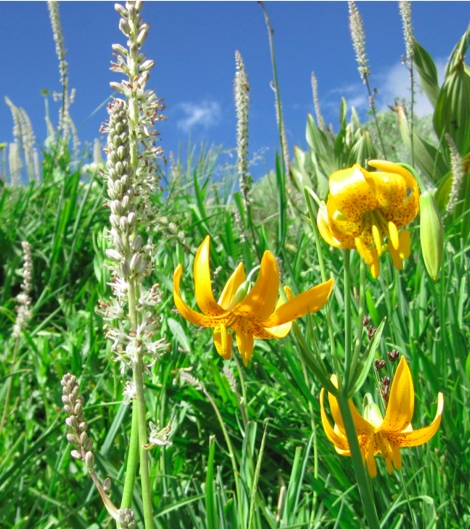
Lilium pardalinum, Veratrum californicum (foliage), .jpg

The striking yellow lilies above are Leopard Lilies (Lilium pardalinum), native to Oregon and California. The spires of white flowers are White Schoenolirion or White Rush-lily (Hastingsia alba; also called Schoenolirion album).

[Etymological note: pardalinum is an adjective from the Greek pardalis, female leopard (meaning spotted like a leopard); Hastingsia after Serranus Clinton Hastings (1814-1893), first Chief Justice of the Supreme Court of California, who helped publish The Botany of the Pacific Coast edited by Asa Gray, Sir Joseph Hooker and J. D. Whitney; album and alba are from the Latin albus (white); Schoenolirion from the Greek schoinos (a rush), + lirion (lily).]

Lilium pardalinum, Leopard Lily CLOSE.jpg

The White Rush-lily is in the lily family; it grows from a bulb, and has the flat strap-like leaves characteristic of many lilies. The mixed species of plants were so dense in some places on Mt. Ashland that it was hard even to find the foliage of a particular species, much less photograph it, but the picture below shows a big area where White Rush-lily alone grew.

Hastingsia alba, foliage.jpg

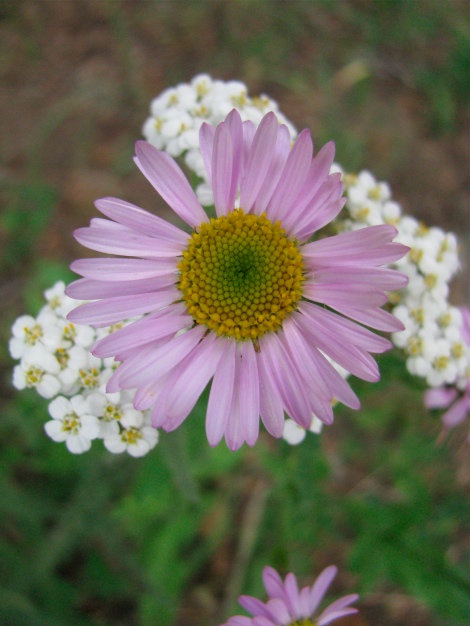
Aster family purple, and yarrow.jpg

A purple flower in the aster family, but which one? In the background is Achillea millefolium, Common Yarrow.

Out of the ordinary Owl’s Clover

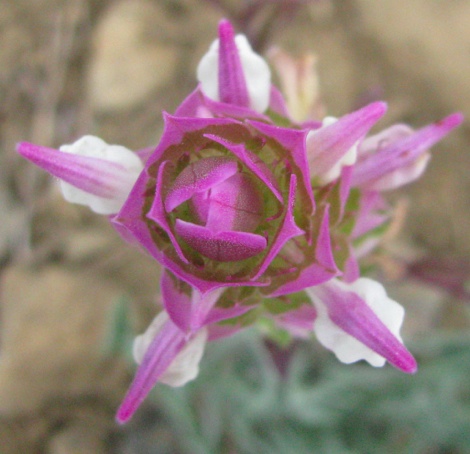
Next is an unusual flower, Toothed Owl’s Clover (Orthocarpus cuspidatus). Owl’s Clovers are in the Snapdragon family along with Paintbrushes (Castilleja genus), Foxgloves, and Penstemons (Beardtongues). Because it is so remarkable, I’m going to include pictures of it from several points of view. From above, looking down on the upright flower.

Owl'sCloverTopView1.jpg

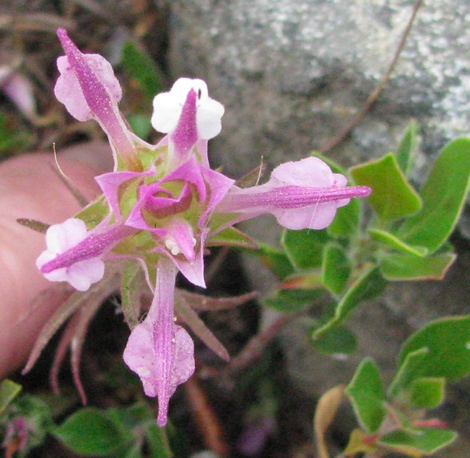
Below, another top view of a rather different-looking individual, missing some of its parts or having developed differently.

Owl'sCloverTopView2.jpg

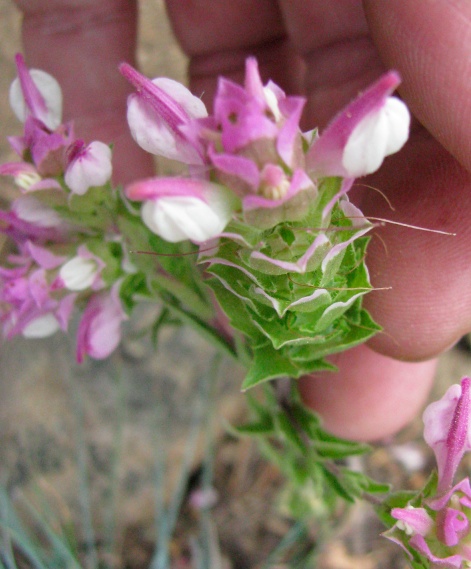
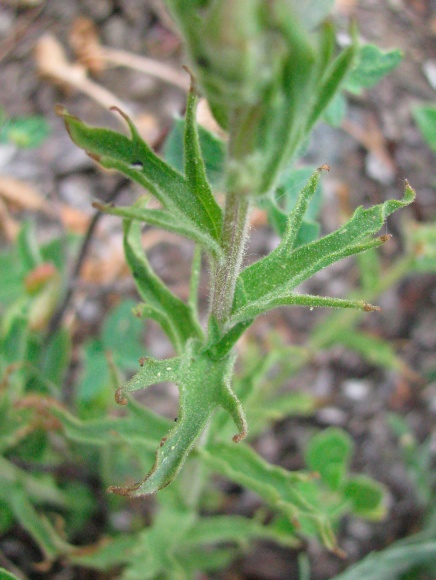
Two views from the side.

Owl'sClover.jpg

Owl'sClover2.jpg

Owl’s Clovers are not just unusual in appearance, but also in their natural history. They are annuals, and

if the first roots emerging from a germinating Owl Clover seed find themselves near the roots of a neighboring plant of a different species, such as prairie lupine, it will initiate structural connections called haustoria. These are modified roots capable of causing infection in the host plant.

The haustoria invade, literally grow into, the inner tissues of the host lupine’s roots. The Owl Clover haustoria are triggered into formation when the lupine itself exudes chemicals from its roots; that is, the lupine chemically signals its presence to the Owl Clover. The haustoria connections are all completed and in place within a few hours! With functional haustoria in place, Owl Clover’s growth is accelerated. The Owl Clover gains water, minerals and energy from the host plant. Being an annual, Owl Clover has a relatively small root system, so getting extra food really helps its growth rate. This host-parasite relationship is called heterotrophy, the opposite of autotrophy [self-sustaining by photosynthesis]. Being semi-parasitic [capable of both parasitism and if necessary autotrophy], Owl Clover may engage in both at the same time.

Owl Clover, when functioning as a parasite, also takes in toxic chemicals the host plant produces; lupines have alkaloids (remember, plants like lupines are poisonous to livestock). These toxic chemicals are distributed into the Owl Clover’s stem and leaf tissues. The consequences? The presence of the poisonous alkaloids, botanists have learned, reduces the level of feeding (herbivory) by butterfly and moth larvae that favor Owl Clover leaves for their growth and development. Larvae feeding is hindered by the presence of the poisons, and the Owl Clover retains more of its leaf tissue for photosynthesis, an obvious benefit. Butterfly and moth larvae need alternative leaves to eat, but that’s impossible since mature butterflies and moths lay their eggs on developing Owl Clover plants not knowing if the leaves are toxic or not. Larvae, it’s assumed, survive better, and develop to maturity by feeding on Owl Clovers that are not parasitizing a lupine or other toxic host plant.

There’s one remaining piece of this interesting relationship to be told: studies suggest that Owl Clover’s flower nectar is not contaminated by the toxic alkaloids. Perhaps the alkaloids are detoxified by some means before reaching the nectar glands. Why is this important? Visiting pollinators, such as hummingbirds or bumble bees, can harvest the Owl Clover’s nectar reward without suffering ill effects. [Source article by Jim Habeck, professor emeritus of botany at the University of Montana]

Representations of the seeds and seed-pods of wildflowers seem hard to find; after the colorful floral show is over, the photographers lose interest just as the pollinating bees and hawkmoths do. But in my Owl’s Clover wanderings I came across photos here of the seeds and pods of two species. Looking at the flowers, I wouldn’t have expected this:

Orthocarpus purpurascens SEED POD.jpg

Seeds and seedpod of Purple Owl’s Clover (Orthocarpus purpurascens, also called Castilleja exserta). Not the species we saw, but it has a similar flower so probably the seedpods are similar.

[Etymological note: Orthocarpus, from the Greek ortho (straight, upright) + carp- (fruit, seed); cuspidatus, from the Latin cuspis (lance, point); purpurescens, becoming purple, from the Latin purpura (purple); Castilleja, named for Domingo Castillejo (1744-1793), Spanish botanist and Professor of Botany in Cadiz, Spain; exserta, from the Latin exsertus, past participle of exserere (to thrust out, from ex- + serere to join).]

Wavy-leaf Paintbrush and hand signals

Castilleja applegatei, Wavy-leaf Paintbrush.jpg

This, I think, is Wavy-leaf Paintbrush (Castilleja applegatei)

Castilleja applegatei, Wavy-leaf PaintbrushLEAVES.jpg

Here are the wavy-edged 3-lobed leaves. Some leaves are single, not lobed.

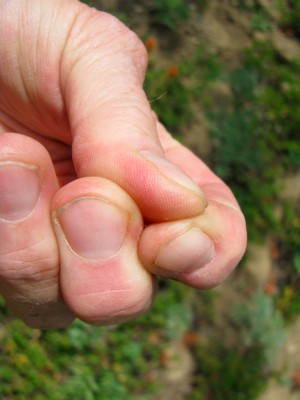
And this is my hand signal to tell myself that the flower felt “sticky”! I have found I have trouble remembering these things days later when I am looking over 300 photos, sometimes of more than one species of the same genus. Now which one had the sticky flowers? It’s characteristic of some Paintbrushes and not others, so knowing helps to identify these tricky guys.

Another difficulty was that if two similar species were photographed one after the other I couldn’t be sure where the first one ended, in the series of photos. Now when I finish photographing one species I take a “spacer” photo of my foot in its red sandal. Sounds odd but seems to be helping.

[Etymological note: Castilleja, named for Domingo Castillejo (1744-1793), Spanish botanist and Professor of Botany in Cadiz, Spain; applegatei, named after Elmer Applegate (1867-1949), a student of the flora of Oregon best known for his monograph of trout lilies (Erythronium).]

Thistle, Buckwheat, Roses and more

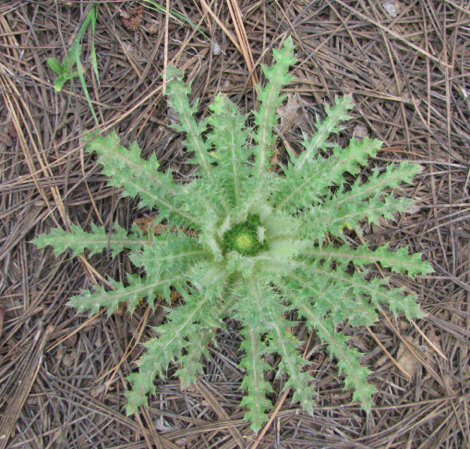
Cirsium scariosum, elk thistle CLOSE.jpg

Above is a close-up of the center of a flat-growing thistle, called Elk Thistle (Cirsium scariosum). All our other local thistles send up tall stems defended with spiky leaves and ending in one or more flowers, but this one grows and flowers at a height of just 2 or 3 inches. The plants we saw were up to a foot in diameter.

Cirsium scariosum, elk thistle.jpg

[Etymological note: Cirsium from the Greek kirsion (a kind of thistle) in turn from kirsos (a swollen vein or welt) because thistles were often used as a remedy against such things; scariosum from “New Latin” (=concocted by moderns) scariosus c. 1806, origin uncertain (dry and membranous in texture, chaffy, brown).]

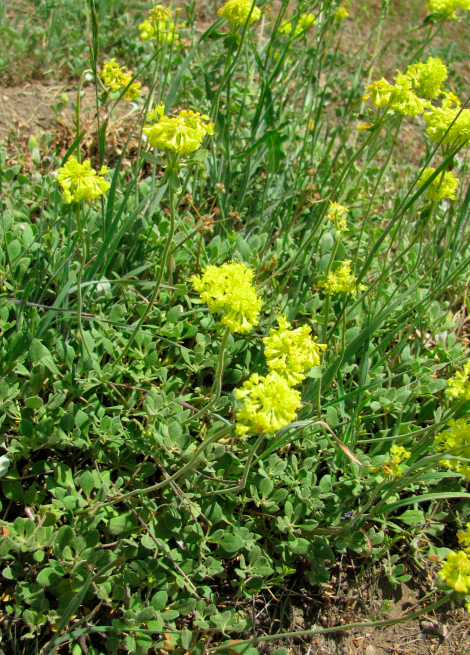
Eriogonum umbellatum, Sulphur-flower Buckwheat.jpg

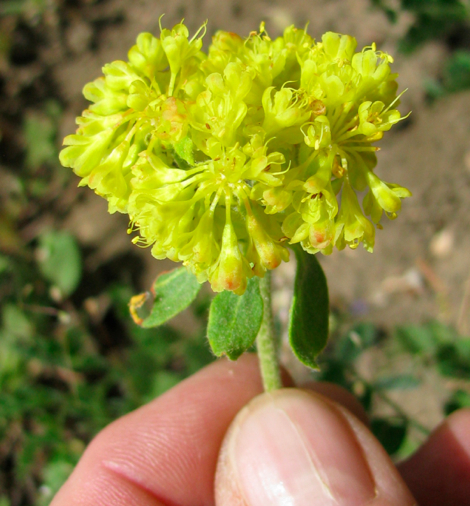
Sulphur-flower Buckwheat (Eriogonum umbellatum). The genus Eriogonum is in the same family (Polygonaceae) as the field crop buckwheat, and the seeds of some species are important for wildlife. The name ‘buckwheat’ or ‘beech wheat’ comes from its triangular seeds, which resemble the much larger seeds of the beech nut from the beech tree, and the fact that it is used like wheat [Wikipedia].

Eriogonum umbellatum, Sulphur-flower Buckwheat CLOSE.jpg

[Etymological note: Eriogonum, from the Greek erion (wool) and gony (knee or joint), so called because the jointed stems are covered with hair; umbellatum, from the Latin umbella (sunshade), diminutive of umbra (shadow), and refers to the arrangement of the flowers which arise in a head from a central point, i.e. bearing an umbel.] Now that I know this odd bit about the meaning of Eriogonum, I’ll be looking for those “hairy knees” on wild buckwheat plants in future.

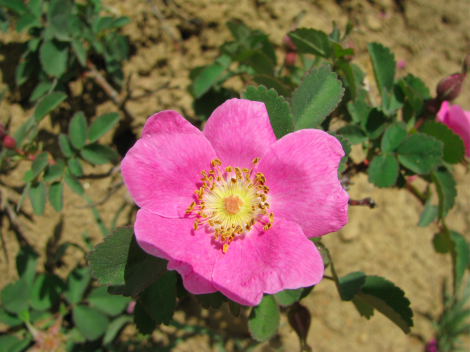
Rosa woodsii, Woods' rose.jpg

Small patches of these vivid pink roses were blooming in areas of loose dry soil, and the plants were only a few inches tall. I think it’s Wood’s Rose (Rosa woodsii).

[Etymological note: Rosa, from the Latin rosa (rose), in turn derived from the Greek rhodon (rose); woodsii, after American botanist Alphonso Wood (1810-1881).]

Penstemon azureus, azure penstemon.jpg

We think this Penstemon is Azure Penstemon (Penstemon azureus). At their peak the flowers must have been glorious.

Penstemon azureus, Azure penstemon, LEAF.jpg

The broadly oval leaves are distinctive, and seem to clasp the stem as described for this species.

[Etymological note: Penstemon from Greek penta- (five) + Greek stēmōn (thread, here meaning stamen); azureus (of a deep blue color) from Arabic via Old French azaward which developed from Arabic lāzaward, from Persian lāzhuward, of obscure origin—in Old French the initial ‘l’ was dropped from the word proper and turned into the definite article “le” as if it were French: l’azaward].]

Here is a beautiful penstemon we are not able to identify.

Penstemon, unknown species 1 FLOWERS.jpg

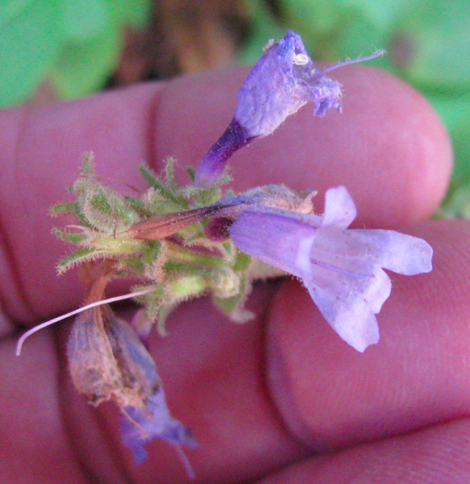
Penstemon, unknown species 1 CLOSE.jpg

The difference in flower color between these two pictures is due to light conditions; the one taken in full sunlight is actually a bit washed out compared to how the colors appeared to my eye, and the one taken in shade is more accurate.

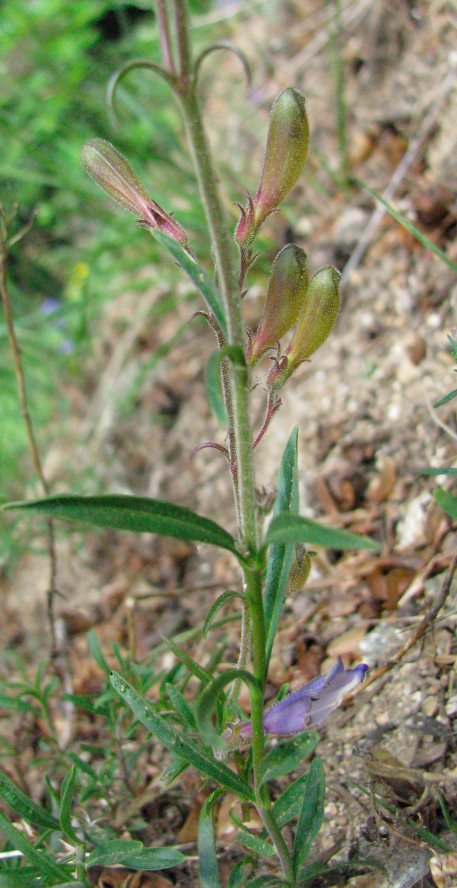
Penstemon, unknown species 1 LEAF.jpg

The buds and long narrow leaves of this penstemon.

A second unidentified penstemon.

Penstemon unknown species,#2 CLOSE .jpg

The leaves are quite different from the first unidentified one.
Penstemon unknown species,#2 .jpg

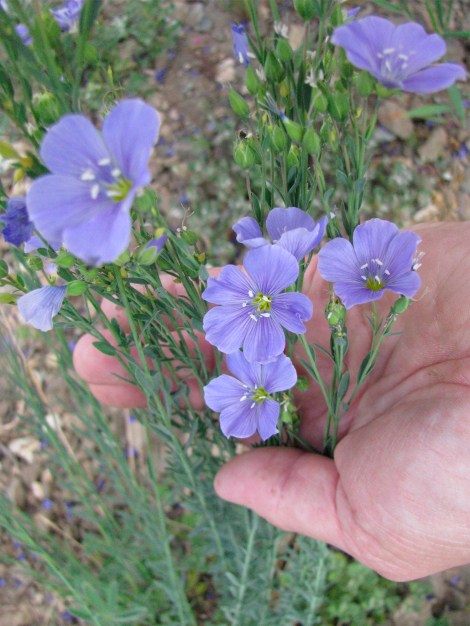
We saw many more flowers on these two trips, but I’ll stop with this one, Western Blue Flax or Prairie Flax (Linum lewisii, also called Linum perenne var. lewisii).

Linum lewisii (Linum perenne var. lewisii), Lewis flax, blue flax, prairie flax2.jpg

Western Blue Flax is very similar to the European Flax plant from which linen is made; indeed, some consider the two a single species, Linum perenne. Native American peoples used flax fiber for cordage and string, as well as for mats, snowshoes, fishing nets and baskets.

Linum lewisii (Linum perenne var. lewisii), Lewis flax, blue flax, prairie flax CLOSE.jpg

[Etymological note: Linum from Latin linum (flax, linen); lewisii, for Captain Meriwether Lewis (1774-1809) of the Lewis and Clark expedition of 1804-1806; perenne from Latin perennis (lasting through the year or years) from per- (through) + annus (year), botanical sense of “Remaining alive through a number of years”.]

Mt. Ashland flower scene.jpg

View of Mt. Shasta from Mt. Ashland, July.jpg

View of Mt. Shasta from Mt. Ashland.