Chronic pain—resources for patients

I haven’t written about chronic pain or fibromyalgia for many months, though I think about those subjects every day. A comment on one of my posts (Methadone and chronic pain: a personal account), raised the question of how a patient can help his family understand what he’s experiencing. Chronic pain can change a person in so many ways from facial expression to level of activity, interest in sex, mental acuity. For family, friends, and people at work, the changes can be frustrating, mysterious, threatening. What does this new behavior mean, who is this person, how long will it be like this? Why can’t s/he just live with that pain, why does it have to affect everything? Is s/he behaving like that because s/he doesn’t love me and the kids any more? Is it ever going to change back?

The person in pain is feeling a complex mix of emotions too, wanting to communicate and be close but embarrassed to admit how huge the effects of the pain really are, or to confess helplessness in the face of the pain. Will my spouse leave me, will my boss fire me, will I be thought crazy or weak, manipulative or a malingerer?

Patient
Can’t know how others feel about his or her pain and changes
Does know it has a negative effect, and may feel guilty about it
May feel helpless, resentful, guilty, frustrated, angry
Afraid to ask

Family and friends
Can’t know how patient feels physically or mentally
May feel helpless, resentful, guilty, frustrated, angry, abandoned
Afraid to ask

It’s the classic set-up for terrible misunderstandings and friction: intense emotions on each side, big stakes at risk (marriage, jobs, survival of relationships you’ve spent years building), and neither side knows what to say.

Then there’s dealing with the medical establishment, not easy for the person with chronic pain. Treating chronic pain is frustrating and unrewarding for physicians. The pain is invisible and resistant to treatment, progress is measured subjectively by the patient, misuse of pain medications is a serious risk, and perceived pain is affected by emotional and social factors outside a doctor’s comfort zone.

I’m choosing three parts of this huge subject to address now. First, ways to track your pain level and medications’ effects so that you can discuss them more clearly with others, including family and physician. Second, articles on families and chronic pain. Third, an annotated list of links to the major organizations concerned with pain, where more resources can be found.
My hope is that individuals can find tools here to help them get started with communicating better, understanding better. The tools are not the conversation, but they may be the foundation for it. To build on that foundation requires each of us to expose vulnerability, to admit how much other people mean to us, and to practice patience and compassion every day. And keep your sense of humor in good working order!

To that end, here’s an interruption, with a cartoon that nosleepingdogs has been saving for just the right occasion, and she hopes this is it. (Cartoon by Bizarro, reproduced without permission but with great appreciation.)

Bizarro,onNosleepingdogs.jpg

Making the invisible, visible

How can we pain patients help others understand what we’re feeling? Pain is invisible, it varies in type and intensity, and everyone has had some pain so they all think they know what chronic pain is like. Keeping a daily record, with numeric measurements, will give something concrete to point to, showing that you’ve had no pain-free days for the past month, or that your pain consistently increases under certain conditions. Such records are called pain diaries, journals, or logs, and they are a very useful aid in talking to doctors as well as to family members. They also give patients a way to know, and remember later, how this week’s pain compares to that of last week, or how this pain med compares to the one we used previously.

The heart of the pain log is a measurement scale for pain, like this one from the National Institutes of Health.

Numeric Rating Scale and use.jpg

At one end is “no pain”, at the other end “severe” pain, with the 10 at the end often described as the worst pain you can imagine. Record numeric pain ratings on your log form as often during the day as you think will be helpful. I’ve gathered several forms from various sites, which you can download or print directly. Because links change, I’m giving not only the original link to the site presenting the form, but also a link to a copy of the form hosted on my blog. The forms are free for personal use, I think none of these organizations will object, but not for any commercial purpose. Or, you can design your own form, and I include a sample that I made in a few minutes in a word processor.

Choose a form that lets you record the additional information that you think is important. Some include what meds you took and when, so you can compare that to changing pain level. Others have places to record levels of stress, quality of sleep, amount of exercise, and mood. I recommend photocopying or printing at least a month’s worth, and stapling them or putting them in a notebook. Be conscientious about this. It doesn’t take long to fill in the day’s information, and the value lies in writing it down at the time, and every day. Once a week won’t be much good, nor will it work to try and remember how you felt last week. Just do it, maybe when you brush your teeth at night, or after taking each medication, or after each meal.

Pain log templates

The thumbnails are just pictures, not links. View or download the forms with the links at the end of the description. All forms are in pdf format.

Here is the Daily Pain Diary Form from Partners Against Pain. It consists of 2 pages; one in graph format to record pain level and meds taken, the other with questions about breakthrough pain, sleep, side effects, other things you did to help relieve your pain, etc. Download or view this form from the original site, or from my blog files.

Daily_Pain_Diary.jpg

Next is the Pain Management Log, a simpler one-page form from Partners Against Pain. It records date, time, severity of pain, medicine or non-drug control method used, how severe the pain is one hour later, and activity at the time of pain. It can be used for a single day, or you can make entries for successive days on the same page. Download or view this form from the original site or from my blog files.

Pain Management Log from www.partnersagainstpain.com

The 8.5×11 Pain Log is a 2 page form, from the American Chronic Pain Society, unusual in that it uses cartoon-like symbols for levels of pain, exercise, stress, etc. Download or view this form from the original site or from my blog files.

8 5x11 Pain Log from the American Chronic Pain Society

The form pictured below is the one I made up quickly myself in a word processor, just as an example for those who want to design their own. One page. Download or view this form from my blog files.
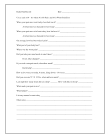
Original pain form made on a word processor.

Next are two forms that are not for daily use but would be good to fill out before a visit to your doctor, as a sort of summary or review of a period of time. First, a 6-page questionnaire called Keeping Track of Your Care, from Partners Against Pain. (It seems to have been designed for cancer patients, but will serve other pain patients just as well.) In addition to summing up pain, meds taken, and that sort of thing, it also has a list of questions about the effect of the pain upon your life over the time period, and the usual drawing of a body front and back on which to indicate location of pain. The list of questions would be good to review before going to see your pain doctor each time, to be sure you bring up all your concerns.

This questionnaire also asks “What is your goal for relief?”, a great question to consider, and let your physician know what your goal is. It’s a good question for two reasons: one, you need to realize that zero pain may not be an achievable goal, and if it is not, what is your secondary goal? To continue working, to enjoy better relationships with your loved ones, to be able to be active for 6 hours a day before you have to stop, to get your pain from an 8 to a 3? Important issues to think about. And, second, it gives both you and your physician something defined to strive toward. Download or view this form from the original site or from my blog files.

Keeping Track of Your Care from http://www.partnersagainstpain.com/printouts/A7012PD2.pdf

Second, the 2-page Patient Comfort Assessment Guide, another from the Partners Against Pain organization.
Like the preceding template, this is not a daily record but the sort of thing that your pain doctor might have you fill out regarding your pain, meds taken and how much relief each gives on a numeric scale, side effects, and how pain has interfered with different aspects of your life in the past week, including mood, sleep, ability to concentrate, normal work, etc. Download or view this form from the original site or from my blog files.
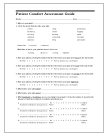
Patient Comfort-Assessment Guide, another from the Partners Against Pain organization

How pain records help you talk to your doctor

Pain doctors have to have a way to decide upon, and justify, the medications they give you (or prescriptions for physical therapy, TENS units, referrals to nerve specialists, etc.). They can feel much more confident if you bring in a photocopy of your pain journal for them to keep in the file, with times, dates, and numeric ratings, than if you just come in and say “Doc, I need something stronger, this prescription just isn’t helping me.” If you feel your journal shows something in particular, go over the entries with your physician. Maybe your journal will show that what you need is medication for “breakthrough pain”, to be used occasionally as needed to keep the pain from getting the upper hand. Or maybe there will be a pattern telling the doctor something you’re not even aware of.

It is absolutely in your best interest to keep a pain journal, and keep it accurately. Don’t inflate what you are feeling. But—and here is another way pain records can help— do use them to show the doctor exactly how the uncontrolled pain is affecting your life. Restoring you to your previous level of functioning is the pain doctor’s aim, not making you feel good. That, I’m afraid, is up to you, perhaps with some help from anti-depressants or the like. But your doctor knows that people don’t feel good when they can’t do the normal things in their life because of pain, so improving function does, indirectly, also improve mood and enjoyment of life.

When my pain was at its worst, I began to think of my life as a sinking ship, from which everything nonessential was being thrown overboard. Anything I did just for enjoyment, over it went. The “have-to’s” of course were kept: working, commuting, taking a shower, shopping for food, and so on. Your pain journal can be the evidence of how much of your life has been “thrown overboard”, or become very difficult, because of pain (and the fatigue that goes with it). Choose a journal template that will help you record this, as well as levels of pain and how well meds or other methods work.

How pain records can help you

They can help you measure progress, or lack of it, over time. When you feel rotten all the time, the days can all blend together. Then you look back at your records and see that 6 months ago you couldn’t walk a block, or sit in the car for more than 15 minutes. Now both of those things have improved. “Wow! I’m making progress!” Give yourself a pat on the back, figure out what made the difference, and work on it some more. Or, no progress? backward movement? Then you know what you are doing is not working, and you and your doctor need to talk about this. And you’ve got the evidence on paper to show her or him, rather than just walking in and saying that you feel worse than ever.

What’s on paper can also help your family understand your situation, what you are going through. They may not need to look at the pages, but just being able to say that for the last month your pain level hasn’t been below 6 on a scale of 1 to 10, is a concrete representation of something otherwise invisible and hard to think about. “Dad hurts all the time” doesn’t have the same impact.

Articles for chronic pain patients and their families

My search for reading material I can recommend has just begun, it seems, since so far I’ve found only one article, and no books. I’m hard to please, apparently. I have no use for material that doesn’t adequately distinguish between addictive behavior, and the behavior of a pain patient who’s become habituated to opioids (see earlier post, Dr. House’s writers betray pain patients), or for intimations that people with chronic pain just need to think positive thoughts and get some exercise. (Though I won’t deny, both of those are good things! Both can make you feel a little better, too, but they are not cures for pain, and many people are in such pain that the advice is a mockery.)

Surviving a Loved One’s Chronic Pain. This article was written by a pain doctor as a handout to patients.

This handout was inspired by a patient of mine who came into my office and inquired what resources were available for the family members of patients with pain to help them understand what their loved ones were going through. He discussed how his wife was frequently angry at him for not doing more physically at home while she was at work and how she often yelled at him. He felt guilty about it, but felt he did as much as he could tolerate. I was embarrassed to admit that I did not know of any handouts explicitly directed at spouses, family members, and other loved ones. After doing some research on the Internet, I discovered several very helpful publications, specifically Julie Silver’s 2004 book, Chronic Pain and the Family: A New Guide (Harvard University Press) and the American Chronic Pain Association family manual, ACPA Family Manual: A Manual for Families of Persons with Pain, written by Penny Cowen (ACPA, 1998). I also found some helpful articles by Mark Grant, a psychologist in Australia, especially his “Ten Tips for Communicating With a Person Suffering From Chronic Pain,” which is available on his website, http://www.overcomingpain.com. Mark was kind enough to allow us to summarize his suggestions here. As well, one of us (Whitman) has a website to help patients cope with chronic pain, and occasionally discusses family issues on it (www.howtocopewithpain.org). Much of what is in this handout is taken from these sources.

What was striking, however, is how little material there was oriented toward the family compared to the massive amount of self-help material oriented to the patient with pain. In view of the profound effect the patient’s pain has on the family and the equally profound effect the family’s (and friends’) responses have on the patient with pain, I found this troubling. I also felt that while Silver’s book and the ACPA manual were very helpful, few family members would get them and fewer read through them. What was needed, I felt, was something brief and to the point. This is the result of that determination.

Surviving a Loved One’s Chronic Pain, four pages, available as a pdf from the original source, pain-topics-org, or from my blog files.

This article recommends another that I agree on, “Ten Tips for Communicating With a Person Suffering From Chronic Pain” available at overcomingpain.com or from my blog files.

Organizations concerned with pain

American Pain Society
a professional medical organization with some education functions. They do research on sub-topics in pain and also some advocacy.

Publications include:
Guides for Persons with Pain
Patient Guide: Managing Osteoarthritis Pain
Consumer Guide: Managing Rheumatoid Arthritis
Parent Guide: Managing Pain from Juvenile Chronic Arthritis
Guide for Adults with Cancer Pain
Guide for Adults with Fibromyalgia Syndrome Pain
The above are short pamphlets, 12-16 pp and are offered for sale in sets of 25 of one title, for medical. There is no version that can be read online as far as I could find.

American Pain Association

They say, “Pain has been ignored as a problem by the medical science and society for a long time. The fact that America still doesn’t have a National Institute of Pain indicates this lack of attention towards pain. Surprisingly, America does have a National Institute for Addiction. The primary efforts of the American Pain Association are directed towards education and research. We are also working in the area of developing expert consensus statements regarding pain issues.”

Seems to be mostly a professional organization, offering certification courses in pain, and basic and advanced courses in pain management for all medical personnel including nurses, physicians, pharmacists.

American Pain Association page summarizing new methods of pain relief, will give you some ideas to research or ask about.

American Chronic Pain Association

A previous organization, the National Pain Foundation, is merging with the ACPA.

The ACPA has some very good informational resources, including their Chronicle (archives here). For example, the Summer 2006 issue was devoted to nerve pain.

Partners Against Pain, source of many of the forms I’ve described above. They describe themselves as “a resource that serves patients, caregivers, and healthcare professionals to help alleviate unnecessary suffering by advancing standards of pain care through education and advocacy.” Advocacy is a major element of their work, but other material is available too. They publish a Resource Guide for People in Pain which contains some of the forms above, and others including checklists for doctor visits or the ER, as well as sections on other aspects of health that are good to review, like nutrition, stress, and exercise; it also has lists of organizations concerned with certain diseases or conditions, or professional fields, or patient support. I recommend skimming through it for what you need at the moment. Read or download it here.

American Pain Foundation

APF is an education & advocacy group, which actively works with the news media on conveying pain issues, and publishes a semi-annual Pain Research and Practice Update. The Summer 2010 issue is here.

They have a library of online materials which I haven’t explored yet, but it looks worth checking out. Here’s the directory:

Information Library

• Audio/Video Replays
• Chat Transcripts
• Pain Conditions
• Pain Topics
• Publications
• Q&A About Pain
• Top Ten Tips for Coping
• Webinar/Teleconference Replays

Pain Resource Information
• Financial Information & Assistance
• Finding Care
• Journals
• Pain Law & Ethics
• Pain Links 
• Pain Resource Locator

Programs & Campaigns
• Acute Pain Spotlight
• Back Pain Spotlight
• Breakthrough Cancer Pain Online Guide
• Cancer Pain Spotlight
• CareCentral for Caregivers
• End of Life Care Spotlight
• Exit Wounds – Military/Veterans Pain Initiative
• Fibromyalgia Spotlight
• Health Decision Making Online Guide
• Let’s Talk Pain
• Shingles & Post-Herpetic Neuralgia Spotlight
• Yoga for Chronic Pain & Disability

The vocabulary of pain

Pain and its treatment have a specialized vocabulary. I found some online glossaries that may be of interest in understanding exactly what is being talked about.

Chronic Pain Glossary of Terms
Pain management: Glossary of terms

American Pain Society Glossary of Pain Terminology
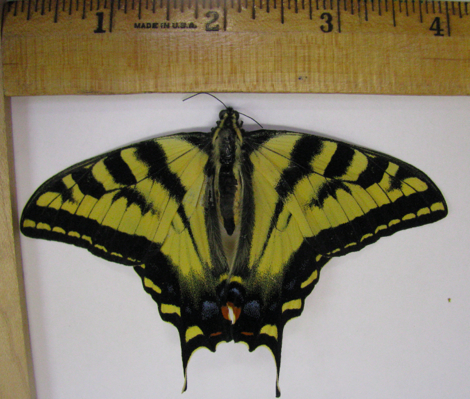
Western Tiger Swallowtail butterfly, and a very close look at butterfly wing-color

We’ve gotten a few terrific photos of butterflies this year—some posted here and here— but none of the swallowtails has cooperated by alighting within range. When I saw one that had died and fallen to the road I carefully carried it home for the chance to get a close look.

Papilio 02 Dorsal.jpg

There are at least three very similar species of swallowtail around here—the Anise, Western Tiger, and Oregon Swallowtails. Based on the red and blue markings I’m thinking this is the Western Tiger Swallowtail, Papilio rutulus.

Finer than “frog hair”—butterfly hair!

Enlarging the macro photos shows details such as hairs on the body and along the inner edges of the wings.

Papilio40 CLOSE 1.jpg

These hairs, called tactile setae, are attached to nerve cells, which relay information about the hairs’ movement to the butterfly. … Adults have tactile setae on almost all of their body parts. In both adults and larvae [caterpillars], the setae play an important role in helping the butterfly sense the relative position of many body parts (e.g., where is the second segment of the thorax in relation to the third segment). This is especially important for flight, and there are several collections of specialized setae and nerves that help the adult sense wind, gravity, and the position of head, body, wings, legs, antennae, and other body parts. In monarchs, setae on the adult’s antennae sense both touch and smell. (from monarchwatch.com).

In the photo below, a ventral view of the lower wings where they meet at their lowest point, there is also a delicate fringe visible along the edges. This could have aerodynamic as well as sensory functions.

papilio 46 CLOSE.jpg

From pointillism to nanostructures

Parts of the markings that appear as solid areas to our eye are revealed to be pointillist creations. I suspect we would need to know much more than we do about the vision of butterflies (and their predators?), in order to understand how these markings work for them.

Papilio42 CLOSE 1.jpg

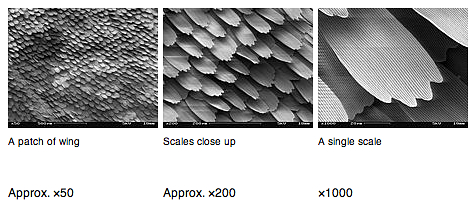
The odd squareness of the smallest dots of color is not some pixellation in the photo, but an accurate representation. It shows the shape of the overlapping scales which form the surface of butterfly wings. Here are some microphotographs of wing scales at various magnifications, from Wikipedia.

ButterflyWingScales.jpg

And here are color microphotographs showing the same squared-off dots along with the underlying scale pattern.

MicrophotographButterflyWingScales.jpg

Picture source.


It’s been known for some time that the colors of butterfly wings are partly from pigments but mostly from the microstructure of the scales, scattering light to produce the colors. Blues, greens, reds and iridescence are usually structural, while blacks and browns come from pigments. (Wikipedia).

But now we know more, and the more we know the more intricate and amazing it is. Research (published this past June) has been able to identify the light-scattering shapes from the wings of several butterfly species, and they are described as “ ’mind-bendingly weird’ three-dimensional curving structures… [resembling] a network of three-bladed boomerangs”. The name for these crystalline forms is gyroids, and they were first described

in 1970 by NASA physicist Alan Schoen in his theoretical search for ultra-light, ultra-strong materials for use in space. Gyroids have what’s known as an ‘infinitely connected triply periodic minimal surface’: for a given set of boundaries, they have the smallest possible surface area. The principle can be illustrated in soap film on a wireframe (see image below). Unlike soap film, however, the planes of a gyroid’s surface never intersect. As mathematicians showed in the decades following Schoen’s discovery, gyroids also contain no straight lines, and can never be divided into symmetrical parts. (source, text and soap-bubble photo: wiredscience.com)

Gyroid-like soap bubble.jpg

Gyroid-like soap bubble. Photo from wiredscience.com

So gyroids were introduced to humans as an imagined created form, something that is a mind-boggler for non-mathematicians to envision.

gyroid_hex.jpg

The image above is a mathematician’s representation of one of the simpler types of gyroid.

Materials scientists have learned how to make synthetic gyroids for photonic devices, such as solar cells and communication systems, that manipulate the flow of light.

gyroidProcess.jpg

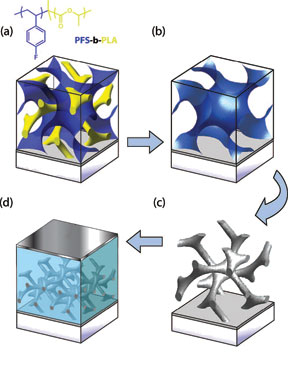
A self-assembled solar cell begins with one of two polymers forming a “gyroid” shape while the other fills in the space around it. The inner polymer is dissolved away to create a mold that is filled with a conductor of electrons. The outer polymer is then burned away, the conductor is coated with a photosensitive dye, and finally the surrounding space is filled with a conductor of positive “holes”. A solar reaction takes place at all the interfaces throughout the material, and the interlocking gyroid structure efficiently carries away the current. (Source for image and caption, Cornell Univ.)

And when Yale evolutionary ornithologist Richard Prum got curious about exactly how butterfly wing-scales twisted light, he found gyroids. His team had to use an advanced microscopy technique with nanoscale resolution, called synchrotron small angle X-ray scattering, in order to see them, but there they were. (See note at end for citation of article in PNAS.)

The butterfly’s gyroids are made of chitin, not exactly the flashy material I would associate with iridescent wings. It’s

the tough starchy material that forms the exterior of insects and crustaceans. Chitin is usually deposited on the outer membranes of cells. The Yale team wanted to know how a cell can sculpt itself into this extraordinary form, which resembles a network of three-bladed boomerangs. They found that, essentially, the outer membranes of the butterfly wing scale cells grow and fold into the interior of the cells. The membranes then form a double gyroid—or two, mirror-image networks shaped by the outer and inner cell membranes. Double gyroids are easier to self assemble but they are not as good at scattering light as a single gyroids. Chitin is then deposited in the outer gyroid to create a single solid crystal. The cell then dies, leaving behind the crystal nanostructures on the butterfly wing.

“Like engineers, butterflies grow their optically efficient single gyroids through a series of steps that make this complex shape easier to achieve. Photonic engineers are using gyroid shapes to try to create more efficient solar cells and, by mimicking nature, may be able to produce more efficient optical devices as well,” Prum said. (Source)

In an interview about the work, Richard Prum said “We’re still trying to wrap our brains around gyroids and what they are.” The shapes seem to have evolved separately in several lineages of butterflies.

”It’s a Swiss cheese,” he adds, “with spiraling channels of air traveling through it that intersect one another. But those channels actually travel in three different dimensions through the cheese, and what you end up with is this very complicated form left behind, and that form is a gyroid.”

And while the idea of butterflies with Swiss cheese wings is slightly strange, Prum says it’s a very useful one for scientist and engineers looking for the next leap forward in electronic technology.

For example, Prum says, take the fiber-optic cables that carry phone calls under the ocean. These cables carry signals in the form of colored light, but it’s very difficult to insulate them well enough to prevent light from leaking out. Current transoceanic cables have to have booster stations built along them to keep the signal strong. But a layer of gyroids around the fiber-optic cable “would act like a perfect insulation to that fiber,” Prum says. The same tiny structures that give the Emerald-patched Cattleheart its lovely green patches could also be used to keep green light from escaping a fiber-optic cable.

ButterflyScalesGreen.jpg

The vivid green color of the scales of this Papilionid butterfly are produced by optically efficient single gyroid photonic crystals. Caption and photo from www.physorg.com

Right now, it’s expensive and impractical to manufacture gyroids small enough to do that job. But butterflies hold the secret to growing them naturally. “If you could grow one, at exactly the right scale, as butterflies do,” says Prum, “you could make these things a lot easier.” (NPR interview, Jul 3, 2010)

This is a fine example of how curiosity can lead us to unexpected discoveries. The original question is one that could be used by certain Congressional anti-intellectuals in their periodic efforts to discredit basic research: “Imagine, all this work to find out what makes the color on butterfly wings! How ridiculous!” The research and technological developments that are thought “useful” by these folks had their origins in someone’s basic research, sparked by human curiosity. From butterfly wing-color to, perhaps, more efficient fiber-optic cables or solar energy collectors. It’s called bioengineering: investigating the functions and structures of nature, to derive principles and patterns for technological innovations. But for me it’s satisfying in itself, the revelation of these marvelous structures, underlying the evanescent beauty of a butterfly.

Papilio rutulus.jpg

Western Tiger Swallowtail butterfly on Buddleia bloom. Photo by terwilliger911, flickr.

Note: The article describing gyroids as the structure causing some colors in butterfly wings is:
Structure, function, and self-assembly of single network gyroid (I4132) photonic crystals in butterfly wing scales.
Vinodkumar Saranathan et al. Proceedings of the National Academy of Sciences. Published online before print June 14, 2010, doi: 10.1073/pnas.0909616107. The abstract is available free, but the article requires purchase or subscription to PNAS. There is a supplementary article here that contains some interesting images and very technical text. There’s even a movie you can watch showing a slice-by-slice trip through a certain sort of gyroid, or as the text says, though “the pentacontinuous volume of a level set core-shell double gyroid structure”.

The Armenian Cucumber Martini

What with too many gophers and not enough bees, our vegetable garden is not as abundant as we’d hoped. Even the several varieties of summer squash, which usually can be counted on to produce more than the most ardent squash lover can eat, aren’t setting much fruit.

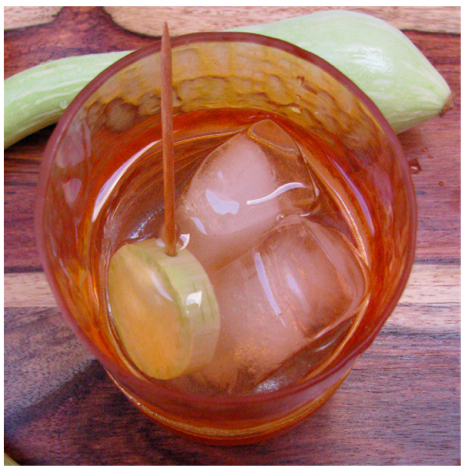
Deciding to drown our horticultural sorrows we needed a garnish for the martinis. Something different…there, on the counter! An Armenian cucumber. It’s in the same family as the squash but is setting fruit much better. They’re slender, pale green, and curl into a circle. Let’s give it a try.

ArmenianCucumberMartini1.jpg

Into the glass goes a slice.

ArmenianCucumberMartini3b.jpg

Verdict by the resident Martini expert? “Cool and refreshing. I think I like that better than olives!”

ArmenianCucumberMartini5.jpg

We’ve also enjoyed these cucumbers sliced up in soups. Turns out, though, that while they look and taste like cukes they’re technically melons, Cucumis melo var. flexuosus. True cucumbers are Cucumis sativus.

Finding good fiction—a new place to look

BookCovers2.jpg

What is the difference between a book that libraries and bookstores shelve as “Young Adult” fiction, and one that goes into regular fiction?

This is a question that has occurred to me before. In the process of giving away kids’ books at the food pantry (described in a previous post) I also end up reading my stock which includes picture books, board books for infants, “chapter books”, and “YA” books. Most are ex-library, so Young Adult (defined as ages 13 – 18) books come bearing yellow “YA” tape markers on the spine. Some are as absorbing and satisfying as I could wish, and a few seem to defy their labels. “Yes, it’s a great book for a teenager, but also for adults,” I find myself thinking.

The most recent such experience was from a science fiction YA book by an author whose adult science fiction book I had just read. Searching for more of his work in the library I found the YA novel and checked it out. The author is Paolo Bacigalupi, and the books were The Windup Girl (2009, adult sf) and Ship Breaker (2010, YA). Mr. Bacigalupi is very hot in sf (see note 1), more than I realized; I think I read a story of his in Analog or Asimov’s, and off I went looking for more. That’s one of the good reasons for subscribing to fiction magazines, having new authors (or unfamiliar established authors) brought right to your door. And supporting the incubators of new writers, that’s important too.

Anyway, while his adult book is very good, I have to say that I enjoyed the YA novel just as much, and the writing, characterization, and plot were not inferior to the adult book.

So what does make the difference, why does one get a yellow YA label and the other not? Certainly it is not quality of writing.

Of course such formal classifications are not rigid, there is some overlap. They’re largely conveniences for marketing, and for the convenience of library patrons. Adults and teens do have some differences in taste, though, and those who stick on the labels must have some criteria. I listed some differences that I could think of:

YA fiction often includes
• a youthful protagonist
• the protagonist’s age as a defining factor: things are possible or not possible, things happen or do not happen, because the main character lacks the status, experience, privileges, that go with adulthood
• a “coming of age” story, either via a single event or a a longer period of growth; protagonist learns things that move her or him toward adulthood which may result in expansion of what’s possible for the character
• discovery of lessons or truths (appropriate to the culture): the value of the individual even if different from peers or expectations is a common one in our culture, along with the importance of loyalty, bravery, kindness; need for the young protagonist to strike out on his or her own, make difficult choices and make mistakes; learn that appearances are deceiving; find that one can sometimes master the unfamiliar, the formidable, through courage, persistence, hard work.
• following from the last two elements, there is often a moral structure to the book, making it clear that some choices are better than others and that choices bring consequences. I’m referring to a moral structure organic to the plot and characterizations, not something overt. (Preachy-ness turns off kids just as it does most adults, so it’s not going to be tolerated by most editors.) For myself, this added depth is high on my criteria for judging fiction, and a lot of adult fiction fails to deliver it.
• a less complex, more linear, plot than much—but not by any means all—adult fiction
• shorter length than many adult novels, although the Harry Potter series showed how even younger kids will read 700-page books if the book is good enough. And the extraordinary buzz among peers helped keep the enthusiasm up.

YA fiction almost never includes
• explicit sex
• graphic violence, pleasure from violence
• insanity or “perversity”
• the protagonist’s entire life history, birth to old age. Generally the book ends with adulthood or before.
• lengthy passages of description
• complex narrative devices such as multiple points of view
• politics or religion (except in denominational literature for youth)

You see that I didn’t make any of these rules absolute, though the first three under each heading probably come close. (The absolutism of the negatives—sex, violence, insanity—would be mostly for marketing purposes, not because books with these aspects wouldn’t appeal to teenagers!) The entire body of fiction published in a year is best viewed as a spectrum, with outright children’s books at one end, shading into YA fiction, then a range of books that can be enjoyed by adult or YA readers, shading into more and more adult fare.

spectrum line.jpg

Unlike this graphic, the distribution isn’t uniform, but would follow a reverse bell curve with a dip in the middle representing a relatively small fraction of published books which would be enjoyed by both teens and adults.

What’s the point of all this?

Aside from my personal urge to define and clarify, there’s the significant news for serious adult readers that the YA shelves hold some books well worth reading. When YA recommendation lists include Treasure Island, To Kill a Mockingbird, Catch-22, Fahrenheit 451, and Lord of the Rings, it’s clear that the YA label can cover a lot of ground. All of these works were published before labelling came along, so we think of them as adult books. But now, a book like Ship Breaker may get a yellow tape label as a marketing decision because someone thinks it will sell more copies that way, not because it’s judged too simple or not interesting for older readers.

How do we find these books, other than by word of mouth and chance?

The Young Adult Library Services Association (YALSA) has a website with lists of its awardwinners and recommendations. Lists include an annual Teens’ Top Ten determined by teenagers’ votes, Great Graphic Novels for Teens, Outstanding Books for the College Bound, and Popular Paperbacks for Young Adults. (Since I am such a promoter or reading by kids, I have to mention another list, for adults concerned about a teen who doesn’t read, called Quick Picks for Reluctant Young Adult Readers.) On the lists of award-winning authors there appear some familiar names such as Ursula Le Guin and Orson Scott Card, but more to the point there are lots of authors I’ve never heard of, and the net makes it easy to find out more about their books, maybe read a few pages on Amazon, and see if they’re at my library.

Easier yet, stop by the teen section of your library and sample some new fiction right there.

Give it a try, and I predict you’ll be rewarded with good books you’d otherwise have missed. And you’ll have more to talk about with the teenagers in your life!

Note 1: In fact, I see that The Windup Girl has won the Nebula and the John W. Campbell Awards for best sf novel and is a 2010 Hugo Award nominee, in the same category. Winning all three is the Triple Crown of science fiction. Bacigalupi has also received one of the awards named for science fiction masters, the Theodore Sturgeon Award. It also won the 2010 Compton Crook Award for best first novel. If I were Paolo, I’d be hunching my head into my shoulders anticipating some blow from fate after all this acclaim.

SummerReadingLG.jpg

Joost Swarte’s Summer Reading issue cover for The Walrus, “Canada’s Best Magazine”.