In an earlier post, about a walk along the Gin LinTrail, an area still scarred by hydraulic mining, I made errors that have been pointed out to me by a commenter on that post. I’ve made brief corrections to parts of my text in the original post, but will sort things out at more length here. On a couple of points, one trivial and the other important, I do differ with the commenter.
One error arose from my ignorance of the geological nature of the area where the hydraulic mining was done and the source of the gold. The commenter’s reference to Tertiary gravel deposits being the location of the gold was new to me, so I looked it up and learned a lot about the Northern California (and, I assume, extreme southern Oregon) hydraulic gold-mining industry.
The gold mined by hydraulic mining in Northern California was found accumulated in ancient “riverbed deposits, now elevated above modern rivers”. These deposits are 40 million years old, or older. So the hydraulickers, as they were sometimes called, were following a very old plane of deposited material across a large area which has since been raised, and also cut into, by modern geological forces such as uplift and water flow. The map below, from the UCSB Dept. of Geography, shows the location of those ancient rivers and their modern counterparts in one region of Northern California.

”Pay streaks”, some ado about a phrase
With regard to the term “pay streaks”, of which the commenter said “A pay streak is a modern term used to describe a gold deposit that has formed in an existing waterway”, this term does in fact date back to the days of hydraulic mining and was used as I used it. For example, here is a passage from Hydraulic and placer mining by Eugene Benjamin Wilson (Wiley, 1918), page 8 (Google Books):
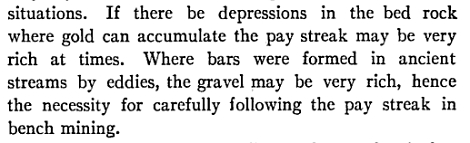
It is easy to see how confusion may have arisen about this term’s early use, because of the change in meaning of another word: “placer”. Like other writers of his time and before, Wilson’s definition of “placer” is much more inclusive than what seems to be common usage today. We think of placer as meaning something deposited recently (in geological terms)
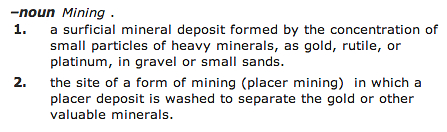
But Wilson and others of his era used it to refer not only to deposits in current rivers, but also to those made millions of years ago on riverbeds now under many feet of overburden.

(above, from Wilson page 11; below, from page 9) and
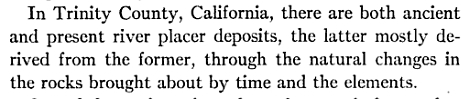
His use of the the term “pay streaks” is in the half of his book about placer mining. For him, hydraulic mining is a method and placer describes a type of gold deposit including both recent and ancient riverbeds.
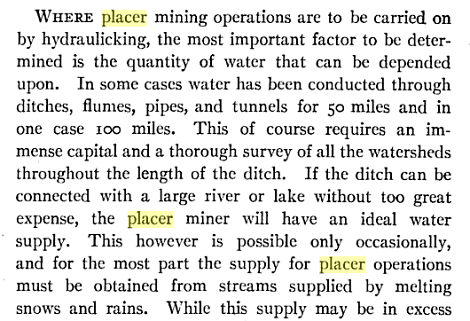
(Wilson, page 152)
Another authoritative writer, Waldemar Lindgren, used “placer” in the same way (and “pay streak” also). In 1911 the U.S. Geological Survey published his opus, The Tertiary Gravels of the Sierra Nevada of California, as no. 73 in its series of Professional Papers. He says,
The occurrence of gold in paying quantities in the Tertiary gravels of the Sierra Nevada is limited almost entirely to the gravels in which quartz and metamorphic rocks form the principal components. …
DISTRIBUTION OF THE GOLD IN THE GRAVELS
It has become almost an axiom among miners that the gold is concentrated on the bedrock and all efforts in placer mining are generally directed toward finding the bedrock in order to pursue mining operations there. It is well known to all drift miners, however, that the gold is not equally distributed on the bedrock in the channels. The richest part forms a streak of irregular width referred to in the English colonies as the “run of gold” and in the United States as the “pay streak” or “pay lead.”
(Lindgren, p. 65-66)
Environmental effects of hydraulic mining
I blamed hydraulic mining for the unvegetated areas we saw along the Gin Lin Trail. The commenter blamed it upon poor soil in the areas of these ancient rivers, which he said was typical and something he has often observed. He said, “the deeper they were worked, the better the vegetation has recovered”.
The best description I found, in researching the revegetation of hydraulic mining sites, was this by Randall Rohe:

(Source: Green versus gold: sources in California’s environmental history, by Carolyn Merchant. From the chapter by Randall Rohe, “Mining’s Impact on the land”, p. 128. Google books.)
So, all things being equal, the bottoms of hydraulic mining pits are most likely to revegetate quickly, while the slopes may remain bare for decades or centuries. However in some places the mining may result in contaminating the pit-bottom with minerals that are toxic to plants, such as seems to be the case here.

The photo above shows a pool of water devoid of any plants in or around it other than algae, in the area of the Malakoff Diggins—California’s largest hydraulic mine. (Source. Following photos are also of Malakoff Diggins.)

Source.
Minerals exposed by hydraulic mining can leach out and, if toxic, make plant growth impossible. Here is a view of what appears to be an exposed peak of some mineral:
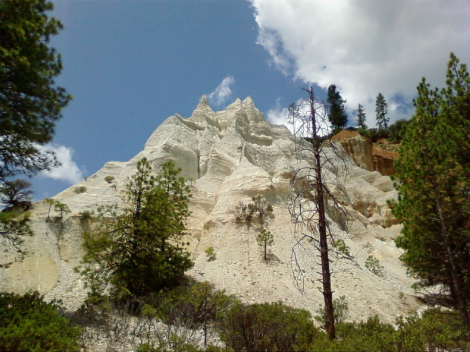
Source.
The steep slopes in themselves, of course, also resist plant growth.

Source.
As far as the differences in soil quality, comparing ground above the ancient riverbeds (which would probably be what’s on the top area of the cliffs shown) versus that exposed by water cannons like this
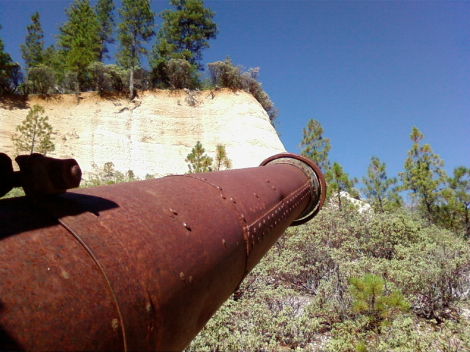
Source.
who can say? Are the bottoms of mining pits often more lushly vegetated because water collects there (as long as no toxic minerals accumulate)? Do different species, of different habits, grow in the pits as opposed to at the tops, and so growth appears different? My guess would be that it varies greatly according to specific location. Perhaps someone can point me to comparative photos or soil studies.
For the people downstream of these mines, the major consideration was what it did to their own locale. All the material washed away by the powerful streams of water—strong enough to hold a fifty-pound boulder in the air—went downstream sooner or later. Often the debris included boulders, cobbles, gravel, as well as finer material.
“The historian Hubert Howe Bancroft stated that an eight-inch Monitor [patented nozzle] could throw 185,000 cubic feet of water in an hour with a velocity of 150 feet per second.” (Source)
“A conservative estimate places the amount of debris dumped into tributaries of the Sacramento at 1.3 billion cubic yards.” (p. 132, article by Rohe in Green versus Gold previously cited). The total amount of material removed to build the Panama Canal (including both the French and the American work) was 268,000,000 cubic yards: only one-fifth the amount that was sent down the tributaries of the Sacramento.
The massive volume of debris that resulted from hydraulic mining clogged streams and rivers from the foothill outlets to the mouth of San Francisco Bay, obstructing navigable rivers and reducing their ability to carry flood waters. The lighter silt and sands, the “slickins”, spread over the river-side farms of the Sacramento Valley and ruined many farmers. These downstream impacts of the industry eventually brought on a series of local, then federal, lawsuits, and a series of debates in the California Legislature on how (or if) the problem would be solved. The end of debate came in 1884, when federal circuit judge Lorenzo Sawyer issued an injunction against the industry discharging its debris.
Source.
Many of the streams are turned out of their original channels, either directly for mining purposes, or in consequence of the great masses of soil and gravel that come down from the gold-washing above. Thousands of acres of fine land along their banks are ruined forever by the deposits of this character. A farmer may have his whole estate turned into a barren waste by a flood of sand and gravel from some hydraulic mining up stream; more, if a fine orchard or garden stands in the way of the working of a rich gulch or bank, orchard or garden must go. Then the tornout, dug- out, washed to pieces and then washed over side- hills, masses that have been or are being subjected to the hydraulics of the miners, are the very devil’s chaos indeed. The country is full of them among the mining districts of the Sierra Nevada, and they are truly a terrible blot upon the face of Nature. (Samuel Bowles, 1868.
It raised the level of rivers in some cases above the level of nearby towns, changed river-courses, silted up fish spawning gravels, reduced open water areas and increased tidal flats in San Francisco Bay and environs, and led to increasingly serious floods.
An invisible hazard accompanied the debris and silt-laden water: mercury. The gold-bearing material was sent down thousands of feet of sluices which were lined with mercury in order to snag particles of gold as they tumbled through. Mercury is very persistent in the environment. An estimated 2500 – 10,000 metric tons (2755 to 11,000 tons) entered the Bay. “Currently San Francisco Bay is listed under Clean Water Act Section 303(d) as impaired for mercury contamination, and many Bay-caught sport fish exceed the EPA human health criterion of 0.3 mg methylmercury/kg fish tissue” (Source). About 261 million cubic yards of sediment still remain in the northern part of San Francisco Bay.
When all is said and done
I went past the subject of the original commentator’s remarks (about seeing better vegetation in the bottoms of mining pits than on the presumably undisturbed top ground), to recapitulate some of the horrors of hydraulic mining, and that was not so I could bash him with matters not part of our differences, but because we must still fight against similarly great environmental damage from other mining practices. Strip mining, destruction of mountain tops, chemical “fracking” of strata to get at natural gas deposits, the list goes on and on.
Close to home, hydraulic mining’s little brother has come to visit. The recent moratorium on dredging in California has sent hundreds of miners with gas-powered dredges up to Southern Oregon, to suck up the banks and bottoms of streams in a small scale version of hydraulic mining. Small scale, but then our rivers and creeks are smaller too. The damage to the “stream banks and nursery gravels”, as one local gold panner wrote, is severe. “If you did a bio-survey of say, one cubic foot of stream gravel passed through a internal combustion driven pump, the numbers of ruptured organisms and caddis-fly eggs, water-beetle eggs, dragonfly larva, newt and salamander eggs would stagger one’s imagination. Just check a sluiced site for life forms sometime; see if you can find any. …The dredger’s assertion that their comparative damage is lesser than that of the major extractors doesn’t mitigate their injury.” (Pers. comm., Dan Barker, 2010).








 nosleepingdogs