Christine O’Donnell, religion, and the human brain

Poor would-be senator Christine O’Donnell has been ridiculed for her comment about mice with human brains:

O’DONNELL: … these groups admitted that the report that said, “Hey, yay, we cloned a monkey. Now we’re using this to start cloning humans.” We have to keep…

O’REILLY: Let them admit anything they want. But they won’t do that here in the United States unless all craziness is going on.

O’DONNELL: They are — they are doing that here in the United States. American scientific companies are cross-breeding humans and animals and coming up with mice with fully functioning human brains. So they’re already into this experiment.

From transcript of O’Reilly show, Friday, November 16, 2007.

Why would Ms. O’Donnell (or someone who informed her) believe this?

Reports of mouse-brain research have been greatly exaggerated

It doesn’t take much to find some of the “evidence” that may have convinced her or her informant. As others have noted, there have been experiments in which human cells were injected into embryo mice, and became part of their brains. A bit different than “cross-breeding humans and animals and coming up with mice with fully functioning human brains”, but all rumors have to start somewhere.

Bad reporting may be to blame: here’s the headline and first line of the 2005 article on the National Geographic site:

NatGeo article on mice.jpg

From nationalgeographic.com.

In case that last line is too small to read, it says “Researchers in California have created living mice with functioning human stem cells in their brains.”

Earlier that same year (2005) another article on the NatGeo site briefly referred to the same research (before it had occurred) this way “And at Stanford University in California an experiment might be done later this year to create mice with human brains.” The title of this misleading article was Animal-Human Hybrids Spark Controversy. Yes, plenty of controversy, but in the article no hybridization is being talked about, only the use of stem cells to demonstrate their potential to be re-purposed. In biology, a hybrid is the offspring of two plants or animals of different species or varieties, such as a mule (a hybrid of a donkey and a horse), and that is the popular understanding as well. Few would consider a mouse with a few cells of human origin, all functioning as mouse cells, to be a hybrid.

mouse with human headSM.jpg

Christine, you need a smart friend; meet Clyven the mouse

But wait, it’s not all down to irresponsible journalism; perhaps Ms. O’Donnell got her information from this page, on the site of the prestigious RYT Hospital, about “Clyven: The World’s First Transgenic Mouse with Human Intelligence” :

Clyven1.jpg

Here’s the explanatory text from that page.

Margaret A. Keyes, M.D., Ph.D., is a researcher in genetic medicine and Professor of Cell Biology and Genetics at RYT Hospital-Dwayne Medical Center. She is exploring the use of embryonic stem cells as a means to cure neurological conditions such as Alzheimer’s Disease and Creutzfeldt-Jakob Disease.

By implanting human brain cells (grown from a human embryo’s stem cells) into a mouse engineered to have Alzheimer’s, Dr. Keyes inadvertently made a remarkable and startling discovery: she not only cured the mouse’s Alzheimer’s Disease, but the animal soon developed the relative intelligence of a human being.

After extensive consideration by RYT Hospital’s Institutional Review Board (IRB) and Institutional Animal Care and Use Committee (IACUC), it was decided that this mouse would be placed under a new study led by Dr. Keyes’ lab.

As part of this new facility (pictured to the right), Clyven is placed inside a light-sensitive box with electrodes attached to him. He is able to communicate and interact with people via this neuro interface. He is able to communicate and interact with people via this neuro interface. [sic] To hear a live audio feed of Clyven inside his box, please click here.

© RYT Hospital-Dwayne Medical Center
Source.

Evidently RYT Hospital has a very understanding Ethics Committee; they approve of confining an animal with a human brain in a little box and punching his head full of electrodes. But Clyven is not bored—in fact, you are invited to chat with him or play a game against him.

Chat with Clyven.jpg

Unfortunately, Clyven’s conversation is limited and repetitious—maybe he himself wrote that quoted passage above, that has the repeated sentence. My best conversation with him was this one,

ME: Hi Clyven.
MOUSE: Yo.
ME: Do you know that a tea party candidate is talking about you?
MOUSE: That’s pretty silly.
ME: Yes.
MOUSE: Tell me more.
ME: I don’t want you to know how dumb people can get.
MOUSE: I’m sorry. I hope to get smarter as time goes on. Please be patient with me. I will be receiving additional neurological treatments next week.

On the other hand, don’t let him persuade you to bet money on that CheezeMaze contest, he’ll beat you paws down.

It’s surprising we haven’t heard more about this RYT Hospital, with the amazingly advanced and useful research that is being done there. Elsewhere on the site, you can read about a new drug, Revitalex

Revitalex.jpg

about successful gene therapy for back pain, and about “NanoDocs”, nanobots that circulate throughout the body repairing tissues.

medical nanites.jpg

Okay, so it’s not a real site but the project of an artist named Virgil Wong. He’s a painter, film-maker, and head of web design for two real hospitals.

Still, can’t you see how anybody might be taken in by the slick style, and accept that there really is a mouse with human intelligence, and nanobots that can tidy up your blood vessels?

No? You say anyone beyond the stage of believing in the Tooth Fairy should have seen through this? and through the distorted reports of growing human brains in mice?

I think so too.

Wherever Christine O’Donnell may have gotten her “information” about mice with human brains, the real problem is minds like hers that are unprepared to question things that most of us would find outlandish. They also believe that Obama is Hitler, Stalin, and a Kenyan anti-colonialist, all at the same time! which would explain why, as I have heard on good authority, Obama has three heads, a fact cleverly concealed by camera angles and good tailoring.

Newt, Eastern.jpg

Eastern Newt (Notophthalmus viridescens), Red Eft Stage. Etymological note: Notophthalamus from the Greek noto (a mark) and ophthalmus (eye), presumably in reference to the eye spots on the sides and back; viridescens from the Latin, (slightly green) referring to the greenish color of the adults. Source.

One born every minute? or are they made?

Where do these credulous people come from? I don’t mean people like Newt Gingrich, who will repeat anything—no matter how preposterous—if it seems advantageous. No, demagogues use untruths consciously, with calculated intent. The power of the demagogue depends upon there being enough people who cannot distinguish between the likely, the possible, and the absurd, and therefore won’t laugh him off his soapbox. And where do they come from?

The beginning preparation for most credulous people of otherwise normal intelligence is, I think, being raised with a huge area of life and thought which is categorically excluded from rational examination. Now, every culture and sub-culture has some areas like that, because they are essential as part of the group’s self-definition. In this Land of the Unquestioned reside things like appropriate behavior (manners), kinship rules, dress codes, what we eat and how we cook it, all that sort of thing. That’s why our way of life seems so logical and natural, and other groups’ ways seem bizarre and senseless.

No problem when it’s a question of the relative merits of haggis or corn on the cob, but in the area of exclusion there are more significant topics also, such as attitudes to the “Other” (women, outsiders, those in your own group who don’t conform), and toward violence. That’s the cultural “Don’t think about these things” list. Then there’s religion and its list.

Religion is the really big no-fly zone for human reason. It covers a much wider area of life than ordinary cultural indoctrination, often upon a foundation of dogmatic zeal which asserts sole possession of truth, and enforces details of the dogma with extreme fervor.

Totalitarianism and extremist religions share two fundamental principles: there is only one true way, and everyone must be forced to acknowledge it. It is not enough for the non-believer to refrain from critical expression and deviant action: he or she must be made to believe. Hence the show trials held by the Soviets, the Chinese Cultural Revolution, and the Inquisition, in which tortured inmates confess their nonexistent sins; hence the death penalty for apostasy in Islam, and the roasting alive of unrepentant Christians by the Romans and doggedly heathen Native Americans by the Christians. The Other must be brought within the fold or die, and it should be done in a public and painful way to present a compelling example to everyone else.

Children are born enquirers (non-believers), and about the age of three they start to ask “Why?” about everything, with irritating persistence. Give an answer and they ask for more details or ask “Why?” again. (Offer a non-answer like “I don’t know” or “Be quiet” and they repeat the original question or say nothing; curiosity discouraged begins to shut down.) Their brains are making and pruning connexions, they’re constructing an internal model of the world, and they want and need to know more and to discuss their own thoughts. They are also learning how to learn, how to figure things out.

A child who gets yelled at for asking about talking snakes, or smacked for asking why the God of Love is such a bloody-handed war-approving tyrant in the Old Testament (see note 1), will learn to accept what he or she is told and not think about it. The lesson is to avoid questioning—especially the things in life that seem illogical, cruel, unfair, out of sync with reality. And that “respect for authority” (actually, it is only respect for power and avoidance of punishment) carries over into other parts of life. The more intensely the “No Questions Zone” is defended, the more timid the young mind’s reason becomes.

Curiosity is inborn, but logic is learned. When children are exposed to illogical conclusions, such as “You got a cold right after you ate that ice cream, so no more ice cream” or “I know the Bible is the Word of God because the preacher says so and the Bible says to follow what the preacher says” they won’t learn the basic rules of logic that help humans sort true from false, as well as “probably true” from “probably false”. Ignorance of logic is of course a good thing for those enforcing a monolithic belief system.

Our country’s culture has an equivocal position on learning. Along with its tradition of independence and individualism, the US also has a strong anti-intellectual tradition, because of its religious foundations and the pragmatic demands of survival on successive frontiers from New England to the Pacific coast. When book-larnin’ is seen as irrelevant, perhaps un-masculine, some will make a positive virtue of ignorance. Also, study is hard, ignorance is effortless. Entropy prevails.

Logic and critical thinking are not enough. In order to winnow the wheat from the chaff reliably, it’s necessary to have some actual knowledge. When a statement is made, the hearers check it against their relevant knowledge base. This process is usually instant and automatic. The new information may directly conflict with existing knowledge, or it may just appear quite unlikely based on what is already known. A certain stock of knowledge, reliable because it has been tested or was provided by a trusted authority, is needed to get through life. Yet even some of this knowledge may be false—blondes are dumb, bankers are trustworthy, a barking dog never bites—and individuals must also possess the willingness to re-examine beliefs based on new experience. Except in the No Thinking Zone, where the only safe course is to agree with authority and otherwise keep your mouth shut.

When politics is the subject, then history must have special prominence among relevant areas of knowledge. Just like more workaday fields of endeavor, political systems embody responses to real needs and problems. If I were re-designing the internal combustion engine, I would first need to know why each part had been designed as it was; what earlier mechanisms were tried for mixing the fuel or timing the ignition, and what were their flaws?

It is history which answers these questions in politics, and must be consulted before tinkering or throwing away parts. For example, decades of controversy about the constitutional provision in the First Amendment usually referred to as “separation of church and state” have distorted public understanding of the law’s intent by framing it as a dispute between agnostics or atheists, vs. religious people. In fact it was enacted to defend all religions from government, and from a preference being shown for a single church, as well as to protect government (or non-religious persons) from religion. And the history of state-established religions illustrates the many repressions and disenfranchisements which are imposed upon members of the non-official religions, even including banishment and death. Only modern ignorance permits the discussion of this subject to be framed entirely as a conflict between religion and irreligion. [Christine O’Donnell, in a recent debate, was ignorant of the provision entirely. After the phrase “Government shall make no law respecting establishment of religion” was quoted to her, she asked “That is in the First Amendment?” Yes, it is, though the exact words are “Congress shall make no…”.]

Logic, general knowledge, critical thinking, history: how is the American public doing on these?

37% of Americans believe that houses can be haunted, and 25% believe in astrology, i.e. that the position of the stars and planets can affect people’s lives.

Fewer than a third can identify DNA as a key to heredity, only about 10% know what radiation is, and 20% think the Sun revolves around the Earth, an idea science abandoned by the 17th century.

50% of our fellow citizens believe in alien abductions, though happily only 7% say they or someone they know has been abducted.

39% of Americans could not name any of the freedoms in the First Amendment.

14 percent of Americans say President Barack Obama may be the Antichrist (24 percent of Republicans believe this). Almost 20% believe he is a Muslim. Does that add up to 34% or is there some overlap?

Two-thirds of 1,000 American adults polled couldn’t name a single current justice of the Supreme Court. In the same survey, more than a third did not know the century in which the American Revolution took place, and half of respondents believed that either the Civil War, the Emancipation Proclamation or the War of 1812 occurred before the American Revolution.

And 21% believe in witchcraft, so O’Donnell’s “I’m not a witch” ad did have its audience.

When you look through these and other poll results it seems that at least 10% to 25% of Americans believe in just about any unproven concept you can imagine. A larger percentage is very ignorant of history and public affairs.

If you’re reading this, and have been apathetic about getting to the polls, you better think again.

One final poll result: in 2009, 19% percent of Americans agreed that the First Amendment goes too far in the rights it guarantees, and 39% said the press has too much freedom.
mr natural.jpg

≈≈≈≈≈≈≈≈≈≈≈≈≈≈

NOTE 1: I cite only two examples, both from the same holy book, for the sake of brevity, but every religion seems to have its own set of magical events and unquestioned cruelties which must be accepted in order to belong. Belong, get along, go along.
The Palm PDA as pioneer e-book reader, and Ernest Shackleton, and war

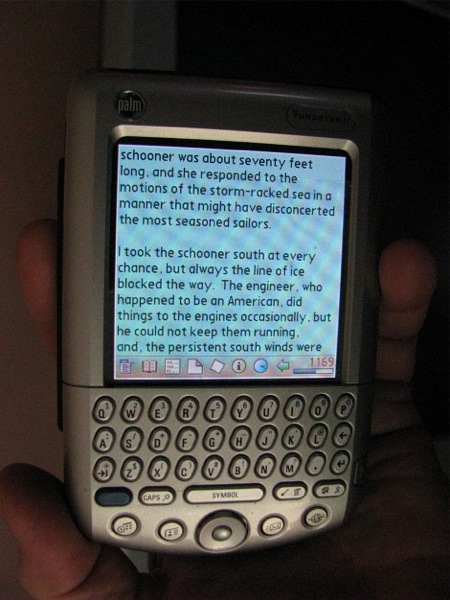
Before the Kindle, Nook, and iPad, there was the Palm

I got my Palm some years ago, to help out my fibromyalgia-diminished memory. It was like a proto-tablet, on which I could take notes, write, outline, draw and paint well enough to illustrate notes, and keep a calendar and to-do list. There were all sorts of games for it, and apps to change the look of the interface. The one feature I thought I’d never use was the ability to read entire books on that tiny screen.

But it came loaded with a mystery by a popular author and, compulsive reader that I am, I took a look at it and found it quite easy to read. Fonts and font size were adjustable and later I got a third-party app that enabled me to change the background color to one my eyes found more comfortable. I’ve been reading on my Palm ever since.

It’s a small device, about the size of a pack of cards, and with an upgraded memory card it can easily hold 50 or 75 books in addition to all the other stuff. iSiloX, companion app to one of the readers, would convert text files to Palm format (.pdb), so all of Project Gutenberg was mine.

Like most people, I don’t find it pleasant to read text continuously on the computer screen for an hour, and I would never have printed out these copyright-free books, but to have them available to read any time I wanted on the Palm—that worked for me. Is it easier to concentrate my visual attention on the small screen than on the large one? I don’t know what the reason is, but reading the Palm is more comfortable for long periods whether by daylight or in a dark room.

Shackleton Palm.jpg

Some of what I’ve been reading in the wee hours

Although I’ve bought a few e-books and issues of sf magazines for the Palm, mostly I have read my way through free downloads, 19th and early 20th C. works from Jack London’s social fiction and reflections on his own alcoholism, to Virginia Woolf’s Common Reader essays. I’ve found several good reads among women writers including novels like Wives and Daughters (1865), and North and South (1854), by Elizabeth Gaskell, and excellent short stories by Edith Wharton, Willa Cather, Mary Austin, and Katherine Mansfield. The Woman Who Did (1895) by Grant Allen, is about a “New Woman” who dared to live her life as she wished, having an affair but refusing to marry the man, raising the child, with tragic results. Then there’s the wide range of popular adventure fiction, of which I’ve enjoyed works by such out-of-fashion writers as H. Rider Haggard, P. C. Wren, and Ouida, with titles like The Snake and the Sword, and Under Two Flags (both stories of the French Foreign Legion). All these have been enjoyable to read in themselves, and of course provide fascinating windows into life and attitudes, with the same sort of caveats that attach to judging our times by our popular fiction.

I’ve got some familiar big-C Classics on the Palm too, like Fagles’s recent translation of the Odyssey (a purchased e-book, I have it in print as well), Northanger Abbey and Tom Jones (haven’t been able to finish either one of these), a couple of Anthony Trollope novels (more readable, enjoyed The Warden), and a bunch of poetry. There’s a goodly selection of older sf to be found online as text files, and even some new sf books that have been made freely available by authors such as Cory Doctorow.

Views of Antarctic heroism, and of the world before ours

Just now my 2 am reading is Sir Ernest Shackleton’s South, his account of the Imperial Trans-Antarctic Expedition (1914–17)—often known as the “ill-fated” Imperial Trans-Antarctic Expedition. Their sturdy ship was trapped in pack ice for nearly a year, then crushed by the movement of the ice; the men lived on ice floes for some time since the current was taking them closer to land, but when the floes broke up under their feet, they took to 3 small open boats…and on it goes. The privation endured, the courage and resourcefulness shown, are astonishing. One aspect of human beings at their best.

Shackleton replica boat in pack ice.jpg

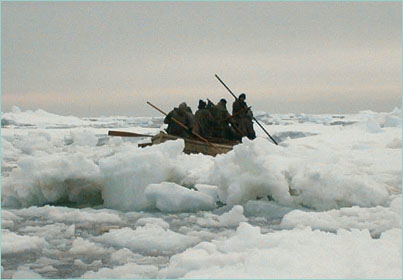
Replica of one of the expedition’s open boats, among pack ice.

And here too, are found glimpses of how differently some things were perceived.

Shackleton’s ship the Endurance left England just after the outbreak of what was to become World War I; at the time many thought it would be over by Christmas. I just read the part where Shackleton and a few companions reach South Georgia Island, having left the rest of the company slowly starving on Elephant Island, while they cross 800 miles of ocean in a small boat in order to send back a rescue ship. They are forced to land on the opposite side of the island from Stromness Whaling Station, and Shackleton takes the two fittest men on a 36-hour trek over glaciers and rocky peaks, without a map, to reach “civilization”.

The first thing Shackleton says to the whaling station manager, after introducing himself, is “Tell me, when was the war over?” It is May, 1916, and he cannot conceive that the war might still continue. The manager replies, “The war is not over. Millions are being killed. Europe is mad. The world is mad.” Later, after arranging for the other two men on South Georgia to be picked up, Shackleton and a companion hear details of the war. “We were like men arisen from the dead to a world gone mad,” he says.

I’ve often read of how shocked and demoralized people of the time were by this unprecedented industrialized war that dragged on and on, by the use of poison gas, machine guns, long-range artillery, and planes, and by battles such as the Somme, in which over one million men (on both sides) were killed, wounded, or taken prisoner, over a 4 and 1/2 month period. British casualties on the Somme (in these same three categories) were 80% during that time; by November, 80% of the original men in a division were gone save for those lightly wounded who returned. The total advance of the Allied lines was 8 miles.

But this scene, in which men in such an isolated and inhospitable place learn all at once of the war, has a different imaginative impact. After all, the late 20th-century reader may be appalled by the Somme, but knows already of things as bad or worse: the Holocaust, Rwanda, visions of nuclear war. To imagine Shackleton learning about his time’s Great War suddenly, in one conversation, is to experience a little of how it was for those of his time.

Many well-educated young men with literary leanings joined up in 1914, and some of them wrote poetry while in camps and trenches. The early World War I poetry is of a high idealistic tenor probably not equalled by any war poetry since, because that war changed reality for everyone then and since. Never again, I hope, can anyone write something like this, about dead soldiers:

Blow out, you bugles, over the rich Dead!
There’s none of these so lonely and poor of old,
But, dying, has made us rarer gifts than gold.
These laid the world away; poured out the red
Sweet wine of youth; gave up the years to be
Of work and joy, and that unhoped serene,
That men call age; and those who would have been,
Their sons, they gave, their immortality.

First stanza of 1914 III: The Dead by Rupert Brooke.

As I recall, Brooke died just as his attitude toward the war began to shift from public-school “play the game” patriotism to something more hopeless and grim. But many another British war-poet showed this change of reality that took place for his generation and those to come, including us. Things were never the same. Though it is long, I’ll reprint here one such poem:

Bent double, like old beggars under sacks,
Knock-kneed, coughing like hags, we cursed through sludge,
Till on the haunting flares we turned our backs,
And towards our distant rest began to trudge.
Men marched asleep. Many had lost their boots,
But limped on, blood-shod. All went lame, all blind;
Drunk with fatigue; deaf even to the hoots
Of gas-shells dropping softly behind.

Gas! GAS! Quick, boys! — An ecstasy of fumbling
Fitting the clumsy helmets just in time,
But someone still was yelling out and stumbling
And flound’ring like a man in fire or lime. —
Dim through the misty panes and thick green light,
As under a green sea, I saw him drowning.

In all my dreams before my helpless sight
He plunges at me, guttering, choking, drowning.

If in some smothering dreams, you too could pace
Behind the wagon that we flung him in,
And watch the white eyes writhing in his face,
His hanging face, like a devil’s sick of sin,
If you could hear, at every jolt, the blood
Come gargling from the froth-corrupted lungs
Bitter as the cud
Of vile, incurable sores on innocent tongues, —
My friend, you would not tell with such high zest
To children ardent for some desperate glory,
The old Lie: Dulce et decorum est
Pro patria mori.

The poem is Dulce et Decorum est, by Wilfred Owen, written in 1915.

Dulce et decorum est, pro patria mori (Latin) means “It’s sweet and fitting to die for one’s country”. This famous quotation from Horace would have been extremely familiar to public-school boys, in that time when education always included the Latin language and literature as well as some indoctrination about the Empire. In 1913, the first line, Dulce et decorum est pro patria mori, was inscribed on the wall of the chapel of the Royal Military Academy Sandhurst (Wikipedia), and the text and the sentiment were used to encourage enlistment and support of the war.

Indeed, Ernest Shackleton and his men (not one perished, incredibly) did emerge from the ice-bound wilderness “like men arisen from the dead” into a world forever changed.

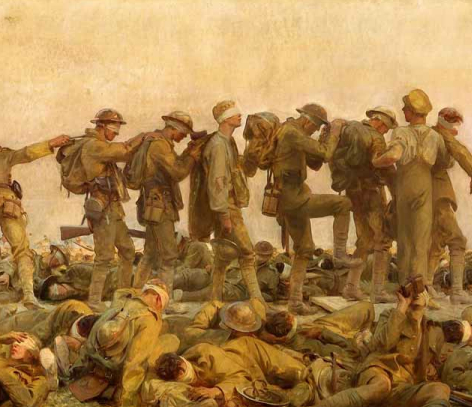
John Singer Sargent, Gassed (1918).jpg

Detail from John Singer Sargent, Gassed (1918). This painting hangs in the Imperial War Museum in London; the canvas is over seven feet high and twenty feet long. It depicts soldiers blinded by gas being led in lines back to the hospital tents and the dressing stations; the men lie on the ground all about the tents waiting for treatment. (Source)

Sights of Reno

Mystic Lamp slot machine 2.jpg

A Reno slot machine drawing on the magic of Aladdin, with a complicated pay-out scheme.

Mystic Lamp slot machine 1.jpg

These days there’s a slot machine theme for every taste, from marine mammals to Sex and the City. (I’d have more photos of them, but photography inside the casinos is verboten.) The vast majority are standard, though, since it seems most people simply want to stuff their money in and push the buttons.

Coin-operated slot machines are passé (you put in folding money now, or your credit card) and there’s no need to pull a lever, just push a button. I wondered how much of the “process”, the “theatre”, can be removed before reducing the devotees’ dedication. No more levers, no paper bucket of coins measuring your success by its weight, no shower of coins sounding for every 10-nickel jackpot, shorter and shorter times for each spin of the reels… Can I just phone it in, say “I’ll bet $1000 on the quarter slots, here’s my credit card number and let me know if I won anything”? I used to think that the external signals (such as the sound of jackpot coins hitting the metal tray) were part of the conditioning to make a gambler keep going, but perhaps it is really internal rather than external; perhaps it’s all in the thoughts of the individual.

Walking around downtown Reno, I couldn’t believe that the city has over five million visitors each year. Where are they all? Where are the restaurants, tourist attractions, and services for them? Answer to both questions: in the casinos, which do their best to provide food and entertainment so guests never stray outside. The big hotel-casino where we stayed (the Nugget) didn’t even have free wi-fi in the rooms; they don’t want people relaxing in their rooms, no money to be made that way! In an open alcove adjoining the casino there was an in-house Starbucks that promised free wi-fi. Carrying my laptop down there to use it, then back up to the room, seemed irritatingly inconvenient, but then I’m not the “demographic”, psychologically speaking, for whom the Nugget is designed. My fun came from walking around taking photos of odd stuff one morning until it was time to head home.

Reno river 1.jpg

The Truckee River runs through town and has been cleaned up quite a bit in recent years.

Reno fish drain sign.jpg

It was running shallow at this time of year. One area had been tarted up with faux gazebos and uncomfortable places to sit. It looked like a bit of alternative universe spliced into Reno’s dusty lower middle-class stay-in-and-gamble environment.

Reno River tarted up.jpg

Kind of like putting London Bridge in the Arizona desert—oh wait, we did that, and it isn’t too bad.

Reno has its share of odd architectural (and other) juxtapositions.

Ichiban.jpg

Reno dome.jpg

Odd arch juxtapositions 1.jpg

I don’t know who the statue in the alcove is meant to represent, but certainly she’s from a different era.

Odd arch juxtapositions 2.jpg

Then again, she’s going somewhere holding a sheet around herself in lieu of clothing, so perhaps she has been to modern Reno after all.

No trip to Reno could be complete without featuring a Wedding Chapel, and here’s one that multi-tasks. Or so it seemed from across the street, and in this town, it could be true.

Wedding chapel.jpg

We saw two intriguing old fortune telling machines, relics that will soon be snapped up by collectors no doubt. Place your hands on the crystal ball (which has two electrodes visible, to gauge your temperature and sweat level, I’d guess)

Zambini.jpg

and the Great Zambini will tell you all about yourself.

Zambini2.jpg

After that, if you’re wondering whether to proceed to the Wedding Chapel, stop first for a personalized answer to the perennial question, “What should you look for in a mate?”. The choices are Personality, Wealth, Looks, Shape, Brains, Height. Does it go on the principle of “opposites attract”, or “birds of a feather”? It was out of order, maybe overworked here in the one-time US capital of divorce, so we’ll never know.

Match Maker.jpg

I’m not really up on the souvenir biz but it is hard to imagine tackier products than we saw here.

Tacky purses1.jpg

Purses were big, and big sellers, with design motifs using tattoos, religion, faux fur, and celebrity worship (an entire Marilyn Monroe section).

Tacky purses 2.jpg

Why someone would want to proclaim “Love…passion…Hate” on a handbag is a mystery to me. Well, enjoy!

Reno purses 2.jpg

For the retro crowd there was a t-shirt with this on the front,

Reno wolf shirt.jpg

perhaps for the foreign tourists. It’s a Western town, after all, with car shows, air races, and legal brothels outside the city limits.

Bierstadt, Last of buffalo.jpg

I didn’t see that painting in Reno; it is Albert Bierstadt’s Last of the Buffalo, 1888 (cropped). It might sell well on a t-shirt though.

More than one souvenir emporium promised moccasins as part of the bill of wares painted long ago on their front windows, but the only ones I found were these, made of course in China, for $19.99.

Baby moccasins.jpg

One more odd photo: this building had circles of reflective material in its glass façade and I liked the combination of light standard and reflection.

Light pole & glowing circle Reno.jpg

Then again this circular object could be one of those wormholes between alternate universes, which would account for much in Reno and elsewhere these days. I did find evidence that at least part of our Congress is active.

Bowling Congress.jpg

Bipartisan bowling! Congress on tour, rubbing elbows with the common folk over cigarettes and beer! Move over, Tea Party, here comes Your Elected Representatives, Bowling for Dollars!

bugs bunny bowling.jpg

The end of international compassion: Haiti and Pakistan

The first version of this was written a few weeks after the January 2010 earthquake in Haiti, but I felt it was a grim scene to put before others. As events have unfolded after July’s floods in Pakistan, I changed my mind.

As of September 3, 2010, the total aid supplied to Haiti by USAID, State, and DoD Humanitarian Assistance to Haiti for the Earthquake, in fiscal year 2010, was $1,139,632,618. Over one billion dollars, for an estimated 3 million people affected.

For the relief of the 20 million homeless victims of the Pakistan floods, “the U.S. has provided some $345 million in governmental assistance,” having more than doubled the contribution from the amount a month ago”. [as of Sept. 21, 2010].

Why the disparity?

Politicians and pundits have various reasons and excuses, from “it’s too big to comprehend” (“this is a disaster on a scale that people are struggling to understand. One-fifth of the area of Pakistan is reported to be devastated by the current floods, yet aid pledges are slow to appear. The flooded area is the same size as England”, Nick Clegg, Deputy Prime Minister, UK), to Pakistan’s bad international rep (“Pakistan is always the bad guy,” Mosharraf Zaidi says in Foreign Policy, to the floods being “a disaster which has unfolded quite gradually” instead of suddenly like an earthquake or a tsunami (UK International Development Secretary Andrew Mitchell). Then there’s the unmentionable elephant-in-the-room reasons, “because they’re Muslims” and “they’re helping the Taliban kill our troops in Afghanistan”. These last two carry some weight with certain elements of the general public in, say, America, but not so much with governments which recognize that keeping Pakistan from being further destabilized is important for the West’s own strategic and security purposes. And it’s the response, or lack of it, from governments that is the primary issue.

None of these is of significant importance, I believe, but they’re put forth because the real causes are too distressing to admit. Here is my list of reasons, and they’re not happy reading.

The “quadraplegic” analogy

When you rescue a drowning quadriplegic, you can’t just pull him out of the water, lay him down on the riverbank, and leave.

Haiti rubbed our faces in it, a glaring example: “relief” aid is not enough. Haiti was not a functioning country before the earthquake, and restoring the status quo isn’t really an option. Infrastructure, education, commerce, effective and honest government—all were anemic or non-existent. Worse yet: if the West waved some magic wand to conjure them up upon the ruins of Port-au-Prince, Haiti lacks the trained people, legal structure, and culture to maintain them. So the rescuer takes round his neck the millstone of deep long-term involvement, perhaps for a generation, as in the supposed Chinese proverb about how when you save a man’s life, you become responsible for it.

Afghanistan, Iraq, and pre-flood Pakistan are examples of the same situation: regions upon whom nationhood has been forced, now flying apart from tensions both internal and external, without the resources, desire or culture to transform themselves. And indeed why should they do so, to join a foreign world that would gladly ignore them as it did pre-earthquake Haiti, if it were not for oil and Middle East politics?

The prospect of more frequent disasters affecting more people

Climate change will likely bring more frequent severe weather events and natural disasters (floods, droughts, famines, hurricanes, cyclones, wildfires). As world population increases and clumps together in cities, disasters can affect more people.

Many of the fastest-growing cities are coastal and therefore more at risk for big storms, and “of the 33 cities projected to have at least 8 million residents by 2015, at least 21 are coastal cities that will have to contend with sea-level rise from climate change” as well. (State of the World 2007) In 1994, two-thirds of the world’s mega-cities were located in less developed nations, and the trend was “rapidly accelerating”. The UN predicted in 2008 that in Africa and Asia “the urban population will double between 2000 and 2030: That is, the accumulated urban growth of these two regions during the whole span of history will be duplicated in a single generation. By 2030, the towns and cities of the developing world will make up 81 per cent of urban humanity.” [emphasis mine]

According to UN figures, 324 global cities with a population of over 750,000 experienced rapid growth of more than 20.0% between 2000 and 2010. The fastest-growing city was Abuja in Nigeria (139.7% increase) followed by the Yemenite cities al-Hudayda (108.1% increase) and Ta’izz (94.0%). Of the 324 fastest-growing cities, 53.1% were located in Asia Pacific, 24.4% in Africa and the Middle East, 16.0% in Latin America and the remaining 6.5% in North America, Australasia and Western Europe.

Don’t think that the vaunted free-market expansion to developing nations will result in cities with adequate infrastructure and living-wage jobs for everyone. Just as in our own country, the free market is not a tide that lifts all boats. It can be thought of as a rising tide all right, but one flooding an island, where only the rich have the means to get to high ground, while the poorer you are the closer you come to drowning.

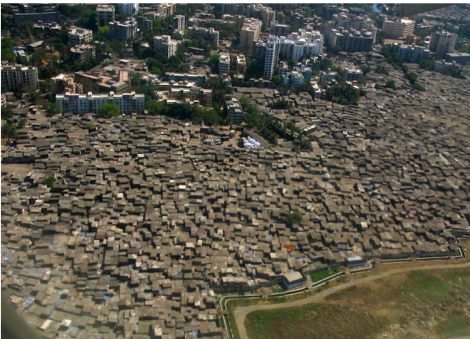
The economic growth we hear of in some cities, like Mumbai, does not extend to the ever-more numerous poor. Slums and high-tech companies in high-rises go on side by side. Both of the views below are of Mumbai. The slum occupants and their children are vanishingly unlikely to become participants in the high-tech boom. Rare exceptions, like the poor village-born protagonist in The White Tiger: A Novel by Aravind Adiga, get a chance to claw their way up by committing a crime to get capital, or by an act of fate as rare as a lightning-strike.[Slumdog Millionaire may be a feel-good film (I haven’t seen it) but that would be because it soothes us “Haves” by showing hope for people who as a group really have no chance of significant betterment. But that’s another subject. For a fictional synopsis of rural life, electoral practices, education of the poor, and other aspects of the “world’s largest democracy”, The White Tiger is worth a read. It reminded me of the works of early 20th C. American writers, the “muckrakers” and others, such as Frank Norris, Upton Sinclair, and Theodore Dreiser.]

India-Mumbai-ENH-slums-next-to-high-rise-flats-buggies-1-NC.jpg

Mumbai slumsENH.jpg

In fact, most of Mumbai is slums, as seen in the census map below. Dark red indicates 60% or more of the area is slum. Light yellow areas are composed of 15% or less slum. The very pale blue areas are mud, and are larger than the white (no slum) portions of the city.

Mumbai Census map.jpg

A disaster affecting any of these huge aggregations of people—who already live without safe housing, running water, sewage treatment, education, and so on—will, as in Haiti, defy traditional relief efforts and require extraordinary commitments. In Haiti, for example, “A preliminary study by Inter-American Development Bank economists indicates that it could cost as much as $14 billion to rebuild Haiti’s homes, schools, roads and other structures damaged” in the earthquake.

Wealthy nations will cry poor except when “charity” is a cover for national security

Poorer nations will be mostly on their own to deal with natural disasters, and the concomitant unrest of their own people. Highly contagious plagues will bring quick reactions from the developed nations, for obvious reasons. Likewise, if the developed nations’ interests or integrity are threatened by mass movements of millions fleeing starvation and lack of water, they will act, though one hesitates to imagine exactly how since meaningful relief of the suffering people is not feasible. I’d expect a return to the old policy of “containment”, this time against populations of defenseless refugees rather than communist ideology.

Today we have, according to the UN, 43.3 million refugees, internally displaced persons, and asylum-seekers worldwide. Pakistan has 1.7 million Afghan refugees, many of whom have been displaced since 1979. In a final blow, less developed nations will continue to be the battlegrounds of choice for wars begun by industrial nations for perceived national security purposes (resource control, demonstrating military dominance, justifying and testing new weapons, etc.).

Tight economic times

The economic condition of most Western nations today could charitably be described as precarious, with the US perhaps worse than most because of long-ignored needs ranging from public education to crime to infrastructure. With a frightening national debt, unconscionable political paralysis, and 10% unemployment that will feed new waves of house foreclosures, we can apparently only watch our country and its people in a race to the bottom where a new Great Depression awaits. In that climate, when word comes of millions starving overseas, the sententious will say “Charity begins at home” and the blunt will growl “Screw ‘em”. The politicians will make soft noises of sympathy when forced to by media exposure of death and destruction, and send token amounts of money and a couple of Navy ships full of surplus commodities and helicopters, to show the flag. Maybe Brazil and China, rising industrial stars, will then be the new cornucopias of aid to the developing world, but I rather doubt it. Unless it is in their national interest.

Inability to ensure that money sent is used as planned

Corruption of every sort flourishes, in inverse proportion to the power of established transparent legal systems that serve all citizens. As we have seen in Iraq and Afghanistan, billions may be spent to build things that turn out to be unfinished, shoddy, or even never begun. “More than $5 billion in American taxpayer funds has been wasted — more than 10 percent of the some $50 billion the U.S. has spent on reconstruction in Iraq, according to audits from a U.S. watchdog agency.” The 2008 and 2010 earthquakes in China killed a disproportionate number of children, revealing that many schools were not built as designed because of corruption; built, for example, without re-bar because officials connived at resale of the materials by crooked builders. NGOs often get better value for their money because they send people to be on the spot and help with the work, but utilizing that approach to build, say, ten thousand bridges and 2 million houses in Pakistan hardly seems feasible.

The Kerry-Lugar-Berman Bill included efforts to enforce transparency and accountability as to how the money was spent, but enforcing that in Pakistan, over hundreds of locations, seems unlikely to succeed.

Case in point: International response to the Pakistan flood

How has the US responded to the floods that have devastated Pakistan since July 2010? Administration sources have this very week been touting our allocation of $7.5 billion to Pakistan’s humanitarian needs. That sounds swell, but actually this money was dedicated to Pakistan last year in S. 1707, the Enhanced Partnership with Pakistan Act of 2009, also known as the Kerry-Lugar-Berman Bill. This bill was signed by President Obama back on Oct. 15, 2009. It provides $7.5 billion in mostly nonmilitary aid to Pakistan over five years,. (Mostly non-military: It does tie some funds to fighting militants, and all the money to a list of specified acts of cooperation with the US including giving the US relevant information from, or direct access to, Pakistani nationals associated with acquisition of nuclear weapons-related materials. [Text of bill here.] Because of such requirements, the bill is seen by Pakistani critics as violating their sovereignty.)

Recently parts of this already-committed money have been re-purposed, with ample publicity, to humanitarian assistance for the flood, and Kerry and Lugar have put forth another bill that would create a new fund to lure private enterprise to Pakistan, but it would use funds already appropriated in the previous aid bill.

How much new money has been directed to Pakistan by the US government, for flood relief and rebuilding? That is hard to know since reports lump re-direction of money already appropriated, in with new aid. According to the Toronto Sun on Aug. 30, 2010, “The United States is the single largest donor to the flood relief, contributing more than $200 million or over 20 percent of the total aid pledged so far”. At least $50 million of that appears to be already appropriated money re-directed from the Kerry-Lugar-Berman Bill of 2009. And, while I cannot look into the heart of any politician to see how they balanced compassionate response vs. US national security interests, it seems plain that the $7.5 billion of the 2009 Bill would not have been given to any country, however pitiful its condition, unless it had direct connexion with US national security. For the 2009 bill, the motives I would assign are 1) paying off Pakistan’s military and government for letting us cross their borders from Afghanistan to kill and abduct whomever we wish, and 2) heading off the further growth of extremist movements, and public sympathy with extremists, in Pakistan by improving conditions for the populace.

Now, after the floods, the money we are spending is for the second purpose, as various speakers including Sen. Kerry have made clear. Kerry visited Ghazi Air Base, a Pakistani military facility in the area first affected by the floods, met U.S. military personnel taking part in helicopter relief missions, and told reporters “we don’t want additional jihadists, extremists coming out of a crisis.” Again, I’m not accusing anyone of being heartless, only of not backing compassion with significant money except when there is a political payoff. Realpolitik.

Help from other countries has also been slow and small. “Donations to help with flood relief have been dismally low compared with those after other natural disasters, such as the Jan. 12 Haiti earthquake.” (Foreign Policy magazine, Aug. 19, 2010) A former U.N. relief coordinator who managed the international response to the tsunami in South Asia in 2004 said, “We got more in a single day just after the tsunami than Pakistan got in a month.” Muslim nations were not taking up the slack; until Saudi Arabia promised $20 million in late August, “no Muslim nation had given Pakistan more than the $5 million donation made by Kuwait, according to U.N. records”.

Even NGO response is halting. “According to The Chronicle of Philanthropy, twenty-two U.S. aid groups have raised a total of $9.9-million [for Pakistan flood work] while within two-and-a-half weeks of the Haiti earthquake, 40 aid groups had brought in a total of $560-million [as of Aug. 24, 2010]”.

An appeal at the UN in mid-September asked for $2 billion, prompting increased pledges from nations including Britain – $210 million, the United States – $340 million and the European Union $350 million. Saudi Arabia said it has now donated $345 million in government and public funds (what is the distinction? public=Islamic charities?). Iran allotted $100 million for its neighbor. It was not clear if the goal had been met. $2 billion sounds like a lot of money (and other funds have been promised by regional development banks and so on), but how does it compare to the need?

It is difficult to establish exact statistics on the scope of the flood disaster there. The UN says 21 million people have been affected, of an estimated population of 170 million. Pakistan’s government now estimates that more than 1.2 million homes have been damaged or destroyed. In addition, crops and foodstuffs in storage have been destroyed, innumerable roads and bridges swept away, and over 17 million acres of Pakistan’s agricultural land has been flooded by often polluted waters.

oxfam map floods PakistanSM.jpg

This map shows conditions as of 9/2/2010 and 9/6/2010. Red indicates severe damage, yellow moderate damage; dark grey areas in northern Pakistan are mostly inaccessible tribal areas with known but unassessed flood damage in the west. Map by UN/OCHA (Office for the Coordination of Humanitarian Affairs), from MapAction.

How does the UN’s goal of $2 billion stack up against the need? A billion is a thousand million. If $2 billion were spent on 2 million flood victims, it would provide $2000 each. But there are 20 million “affected”, so $2 billion is only $200 each. Millions need shelter, food, medical care, and clean water, for an undetermined period. Over a huge area, most human-made constructions have vanished or been damaged beyond repair. It’s estimated that 70% of the bridges in the flooded areas are destroyed, as well as all or most of the roads, schools, water treatment plants, irrigation systems, wells, houses, clinics, stores, small businesses and manufactories, and so on. Of course other organizations have and will provide some money and aid-in-kind, augmenting the UN’s $2B, but even if they doubled the $2B it would be a paltry sum relative to the task.

And after 10 months, how are efforts proceeding in Haiti?

Haiti may have benefited from greater international pledges of aid than Pakistan, but much of it is still “in the mail”. As of Sept. 29 2010,

Not a cent of the $1.15 billion the U.S. promised for rebuilding has arrived. The money was pledged by Secretary of State Hillary Rodham Clinton in March for use this year in rebuilding. The U.S. has already spent more than $1.1 billion on post-quake relief, but without long-term funds, the reconstruction of the wrecked capital cannot begin. With just a week to go before fiscal 2010 ends, the money is still tied up in Washington. At fault: bureaucracy, disorganization and a lack of urgency, The Associated Press learned in interviews with officials in the State Department, the Senate Foreign Relations Committee, the White House and the U.N. Office of the Special Envoy. One senator has held up a key authorization bill because of a $5 million provision he says will be wasteful.

Meanwhile, deaths in Port-au-Prince are mounting, as quake survivors scramble to live without shelter or food.

Nor is Haiti getting much from other donors. Some 50 other nations and organizations pledged a total of $8.75 billion for reconstruction, but just $686 million of that has reached Haiti so far — less than 15 percent of the total promised for 2010-11.

The lack of funds has all but halted reconstruction work by CHF International, the primary U.S.-funded group assigned to remove rubble and build temporary shelters. Just 2 percent of rubble has been cleared and 13,000 temporary shelters have been built — less than 10 percent of the number planned.

The Maryland-based agency is asking the U.S. government for $16.5 million to remove more than 21 million cubic feet (600,000 cubic meters) of additional rubble and build 4,000 more temporary houses out of wood and metal.
Source: AP.