
Jared Lee Loughner has mental health care now, the best that federal custody and lawyers can provide.

Is this really how we want to ration heath care?
bowdlerize
to expurgate (as a book) by omitting or modifying parts considered vulgar; to modify by abridging, simplifying, or distorting in style or content. An eponymous word referring to Thomas Bowdler, publisher in 1818 of
The Family Shakespeare, in Ten Volumes; in which nothing is added to the original text; but those words and expressions are omitted which cannot with propriety be read aloud in a family. [More on this helpful fellow in the notes at the end of the post.]
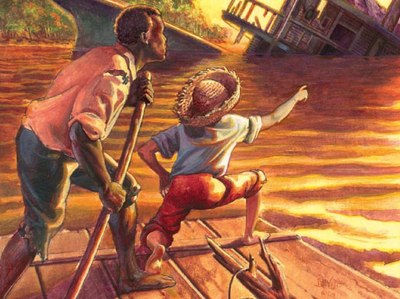
[Cover painting from the HarperFestival 2005 edition of Huckleberry Finn.]
There has been a great deal of commentary this past week about NewSouth Books‘ plan to publish an edition of Tom Sawyer and Huckleberry Finn in which all the instances of nigger are replaced with slave (and Injun with Indian). It’s the work of Professor Alan Gribben at Auburn University, who says that “After a number of talks, I was sought out by local teachers, and to a person they said we would love to teach [Tom Sawyer] and Huckleberry Finn, but we feel we can’t do it anymore. In the new classroom, it’s really not acceptable.” It’s not just some public school teachers motivating Gribben; he too shies at the word in the classroom: ”I found myself right out of graduate school at Berkeley not wanting to pronounce that word when I was teaching either Huckleberry Finn or Tom Sawyer,” he said. ”And I don’t think I’m alone… I just had the idea to get us away from obsessing about this one word, and just let the stories stand alone.”
What betrayal of a writer can be worse, than to change his words? And not just any words, but one particular word that occurs 219 times in Huckleberry Finn and is central to the book’s meaning. Twain shows Huckleberry Finn as an ignorant boy, a product of his time and place without pretense. He, and the other characters, speak as people of their age and place in life would have spoken; in fact, the second of Twain’s two short prefatory admonitions deals with speech quite firmly:
EXPLANATORY
IN this book a number of dialects are used, to wit: the Missouri negro
dialect; the extremest form of the backwoods Southwestern dialect; the
ordinary “Pike County” dialect; and four modified varieties of this last.
The shadings have not been done in a haphazard fashion, or by guesswork;
but painstakingly, and with the trustworthy guidance and support of
personal familiarity with these several forms of speech.I make this explanation for the reason that without it many readers would
suppose that all these characters were trying to talk alike and not
succeeding.THE AUTHOR.
The words used are carefully chosen to be authentic, and to show us the attitudes of the characters. When Jim first appears, Huck describes him as “Miss Watson’s big nigger, named Jim”. As the story goes along, with Jim a runaway slave rafting down the river with Huck Finn, the boy’s sense of Jim changes. This is plainly expressed in chapter 31, when Jim’s been caught; Huck is tempted to save him though he knows he’ll certainly go to hell for helping a runaway to escape his lawful master.
…I’d got to decide, forever, betwixt two things, and
I knowed it. I studied a minute, sort of holding my breath, and then
says to myself:“All right, then, I’ll GO to hell”…
It’s a change of heart, not of mind; Huck doesn’t decide that slavery is wrong but that Jim is his friend. Jim’s still a slave but no longer a nigger, no longer some inferior being beyond the pale of friendship.
Professor Gribben has chosen to replace nigger with slave, but the two words aren’t at all equivalent. Slave is a legal term describing a human being who is legally deemed to be property of another. It might apply to a person of any race, and certainly has, historically. It is a condition, not an immutable element of identity. A slave can be freed, as some occasionally were by their masters, and the children born to freed slaves are free themselves. All slaves in the US were freed in 1865 by the Thirteenth Amendment to the Constitution. But to most whites in the 19th C. South, a nigger was a nigger, whether he was a slave or free. If some French white man who’d been captured and enslaved by the Turks (like Candide) had visited, he might have been described as a slave or ex-slave but never as a nigger.
Huck Finn’s evil father holds violent views on this very subject, and goes into them in detail when we first meet him.
“Oh, yes, this is a wonderful govment, wonderful. Why, looky here. There was a free nigger there from Ohio–a mulatter, most as white as a white man. … And what do you think? They said he was a p’fessor in a college, and could talk all kinds of languages, and knowed everything. And that ain’t the wust. They said he could VOTE when he was at home. Well, that let me out. Thinks I, what is the country a-coming to? It was ‘lection day, and I was just about to go and vote myself if I warn’t too drunk to get there; but when they told me there was a State in this country where they’d let that nigger vote, I drawed out. I says I’ll never vote agin. Them’s the very words I said; they all heard me; and the country may rot for all me–I’ll never vote agin as long as I live. And to see the cool way of that nigger–why, he wouldn’t a give me the road if I hadn’t shoved him out o’ the way. I says to the people, why ain’t this nigger put up at auction and sold?–that’s what I want to know. And what do you reckon they said? Why, they said he couldn’t be sold till he’d been in the State six months, and he hadn’t been there that long yet. There, now–that’s a specimen. They call that a govment that can’t sell a free nigger till he’s been in the State six months. Here’s a govment that calls itself a govment, and lets on to be a govment, and thinks it is a govment, and yet’s got to set stock-still for six whole months before it can take a hold of a prowling, thieving, infernal, white-shirted free nigger, and–“
How will this “free nigger” be described in the new version of Huck Finn? As a “freed slave”, I suppose. Try making that substitution in this passage and see how much difference it makes. “Freed slave” is a neutral phrase compared to the repetitive angry utterance of nigger.
We must presume that Professor Gribben does understand the difference between race— defined by unchangeable color, and legal condition—alterable by legal action. But he thinks that current unease over the word nigger justifies removing this word which is in fact the center of the book. Huck Finn is about nigger, it’s about deciding a person’s worth and status based on his color.
Twain was no fan of the farrago of falsehoods, taboos, and blind spots that make up much of “civilization”. He chooses as his protagonist a shiftless superstitious barely educated boy, who hates the prospect of being “sivilized” and having to wear shoes and not curse, the son of a violent drunk (“He used to lay drunk with the hogs in the tanyard, but he hain’t been seen in these parts for a year or more,” says another boy about Huck’s father)—and then he shows us this boy weighing the evidence of his eyes and heart vs. what he’s been taught about niggers, and choosing to honor the former. Even if it means he’ll burn in Hell, even if he has to take serious personal risk to get Jim away from those who’ve captured him. They have the law, and local “civilization” on their side. Twain doesn’t exactly say what Huck has on his side, that’s for the reader to figure out.
Huck’s final words to us, with which the book ends, are “I reckon I got to light out for the
Territory ahead of the rest, because Aunt Sally she’s going to adopt me and sivilize me, and I can’t stand it. I been there before.“ I can imagine the bitter smile of Huck’s creator hearing that, 126 years after he was brave enough to publish a book about nigger, we aren’t brave enough to figure out how to teach something that contains that word. So we’re going to sivilize it to suit us.

[Undated photo of Samuel Clemens]
NOTES
According to some estimates, Huckleberry Finn is the fourth most banned book in the US. Mark Twain really had us pegged.
From the pen of Thomas Bowdler ((1754–1825):
“I acknowledge Shakespeare to be the world’s greatest dramatic poet, but regret that no parent could place the uncorrected book in the hands of his daughter, and therefore I have prepared the Family Shakespeare”
“Many words and expressions occur which are of so indecent a nature as to render it highly desirable that they should be erased.”
‘”If any word or expression is of such a nature that the first impression it excites is an impression of obscenity, that word ought not to be spoken nor written or printed ; and, if printed, it ought to be erased.”
Sample “bowdlerizations” of the texts:
Ophelia’s death in Hamlet is referred to as an accidental drowning, not a possible suicide.
Lady Macbeth’s “Out, Damned spot.” is changed to “Out, Crimson spot.”
The prostitute Doll Tearsheet is completely written out of Henry IV, Part 1.
Mercutio’s “the bawdy hand of the dial is now upon the prick of noon” is changed to “the hand of the dial is now upon the point of noon”
Juliet’s “Spread thy close curtain, love performing night” is changed to “. . . and come civil night”.
And so on…
It is not commonly known that Bowdler also prepared “family” editions of parts of the Old Testament and of Gibbons’ Decline and Fall of the Roman Empire, completing this edition just before his death in 1825. [this, quotations from Bowdler, and examples, from source]
Twain would have found confirmation for the hypocrisy of “civilization” in the fact that “[t]he editions were actually edited by Bowdler’s sister, Harriet, rather than by Thomas. However, they were published under Thomas Bowdler’s name, because a woman could not publicly admit that she understood Shakespeare’s racy passages.” [Wikipedia]
If you live in a state with hotly contested elections, your mail was full of wretchedly negative and misleading flyers last month. But, around here at least, we rarely see political billboards. When I did see one, it was this:

and it made me wonder why the Democrats hadn’t used billboards to get out simple positive messages about issues where there was great potential public support.
Here are some I made up, just quick mock-ups of a campaign for single-payer health care, but they give you the idea. If Obama had gotten people thinking along these lines, instead of ceding the issue to the Republicans, we might have a true universal health care system by now.

“The United States provides health care to all senior citizens although children are the least expensive and most cost-effective group to cover.”

“Half of all respondents (49%) indicated that their foreclosure was caused in part by a medical problem, including illness or injuries (32%), unmanageable medical bills (23%), lost work due to a medical problem (27%), or caring for sick family members (14%). We also examined objective indicia of medical disruptions in the previous two years, including those respondents paying more than $2,000 of medical bills out of pocket (37%), those losing two or more weeks of work because of injury or illness (30%), those currently disabled and unable to work (8%), and those who used their home equity to pay medical bills (13%).
Altogether, seven in ten respondents (69%) reported at least one of these factors.” [from abstract of Christopher T. Robertson, Richard Egelhof, & Michael Hoke, “Get Sick, Get Out: The Medical Causes of Home Foreclosures” Health Matrix 18 (2008): 65-105.]

”Growing numbers of uninsured children have made it harder for educators to focus on classroom achievement without first addressing the medical needs of their students who lack health insurance or dental coverage. Instead of notifying parents when their children are ill, school officials increasingly must help find health care, arrange transportation for sick children and often advise beleaguered parents about the health consequences of their inaction. Schools that don’t accept the extra responsibility can lose those students to prolonged absences that jeopardize their academic advancement.“
And children who lack health insurance are unlikely to get help for conditions that interfere with learning, such as learning disabilities or vision and hearing problems.

An article about how people get happier as they get older, says it’s partly due to “resources that contribute to happiness, such as access to health care, Medicare and Medicaid”.
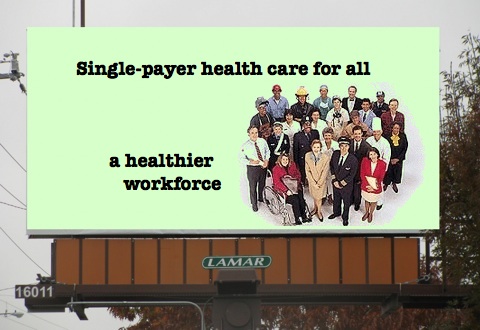
Inadequately treated health problems result in lower productivity, greater absenteeism and turnover, and become more severe over time. Concern about losing job-related health insurance causes individuals to stay in jobs for which they are unsuited when they could be more productive and successful at other work (a situation called “job lock”).
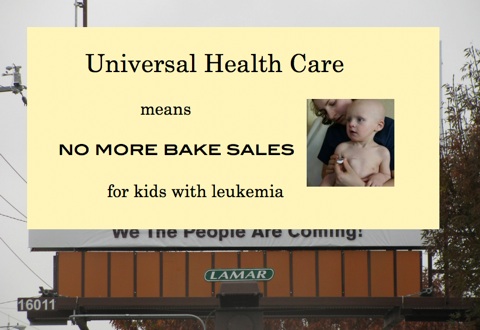
It’s shameful to see contribution jars and raffles in local stores collecting for sick people who would otherwise be untreated. Mostly these are for kids, since we are all more sympathetic toward sick children, but there are also spaghetti feeds and various benefits put on for adults who have brain tumors or other acute and potentially fatal illnesses. And every year at this time brings those holiday campaigns in the newspaper, raising money for individuals or families, and often there’s a medical need there. One of the ones I remember was a local young man who’d lost a leg to bone cancer when he was 11; now he was working full time at a job (with no insurance) that was mostly standing, and since he was off his mother’s insurance he could not get a replacement for his outgrown prosthetic leg.
“It’s estimated that 9 million children are completely uninsured. But the new study says 11.5 million more kids end up without medical care for part of the year. And another 3 million can’t get a ride to the doctor. That’s more than 23 million children.” (2008 figures)
And finally,

I don’t have a picture for this one. What I’d like it to be is not yet invented, some visual-mental device that reflects back to the viewer’s brain an image of him/herself, struck by a wasting disease well before the age of 65 when Medicare begins.
I do have a few more bits of information about the effects of not being insured. “Two large national studies of hospital admissions found that when the uninsured are admitted to a hospital, it is for a more serious mix of diseases and conditions, based on expected mortality, than the privately insured.…A study in California found that uninsured newborns with medical problems had significantly shorter stays (by 1.8-5.9 days) and received significantly less care (measured by total hospital charges) than privately insured newborns for several specific medical diagnoses. Another study found that the uninsured are at much greater risk of substandard hospital care due to negligence or poor quality: 40.3 percent of adverse events among the uninsured were due to negligence, compared to 20.3 percent for the privately insured who experienced adverse events.“ [source]
So the uninsured person, who is likely to be sicker when arriving at the hospital, is twice as likely to be the victim of negligent care during the stay. (Maybe it’s a mercy that the stay itself will be shorter than for the insured patient.) And the uninsured receive less treatment, whether for injury in a car accident, heart attack, or being born prematurely. More of them die, than insured people with the same conditions.
It’s a national disgrace and a drag on the economy; it’s contrary to our ideals and a terrible waste of the possibilities of human lives; it condemns many, from birth or before, to short and painful lives. It’s not open to compromise, Mr. President. You should have stood up for it and the issue should have been fully discussed before the people. If you think our attention spans are too short for extended discourse, you’re welcome to my billboard ideas.
Each year friends give us a subscription to Funny Times for Christmas, and we get 12 months of laughs from it. And also sanity, I have to say, because when I read it I often think: only here (never in the newspaper) do I regularly find people puncturing the jumbo-sized blimps of jargon and pretense that take up so much space in news and politics. Reading the newspaper, I want to say “Are you all crazy?” Reading the cartoons and columns in Funny Times, I know someone else agrees with that.
But don’t think the humor is all political; the latest issue has a column about the new combo camera/Barbie Doll, by Lenore Skenazy; Dave Barry on severance gifts from Wal-Mart, Garrison Keillor on Christmas; and cartoons that skewer pretensions, make visual puns, and are just plain silly. Sylvia always makes an appearance, so do Tom the Dancing Bug, the always-askew Piraro, Shannon Wheeler (Too Much Coffee Man), the K Chronicles, Lynda Barry, and about 50 others .
As if all that—24 tabloid-size pages full—weren’t enough, there’s a whole page of what we all really want from our newspapers: News of the Weird. You know, the reports of actual events, too stupid or bizarre to believe, in categories such as “Bright Ideas” and “Least Competent Criminals”. If you hold your brain just right while you read these they can make you feel better about the level of idiocy in your own locale, a real morale-builder!
But wait, there’s more! Harper’s Index! Winokur’s Curmudgeon! And if you call now, well, then you won’t procrastinate, what else can I say.
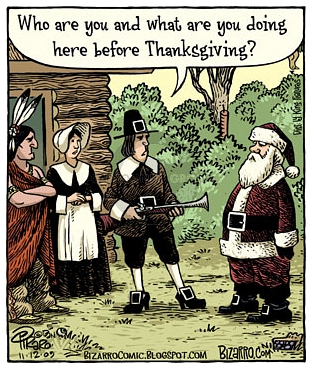
I wanted to include a sample of cartoons but I’m too lazy to scan them from our issue so here are some by the same great cartoonists, that I just got off that internet thing. In Funny Times they are mostly in black and white but just as funny.
Oh, and a full year’s subscription is only $25 at http://www.funnytimes.com/ or 1-888-386-6984.
It’s the perfect gift for friends and family, anyone with a sense of humor. So I guess you just have to shop for your relatives now. Because why would you have friends who don’t have a sense of humor?

I like this one because whenever I see that a movie contains “adult themes” my mind always has a flicker of literalism, “Oh, a discussion of the limits of rationality, or what it means to lead a good life, or…”.
Dan Piraro, Bizarro.


 nosleepingdogs