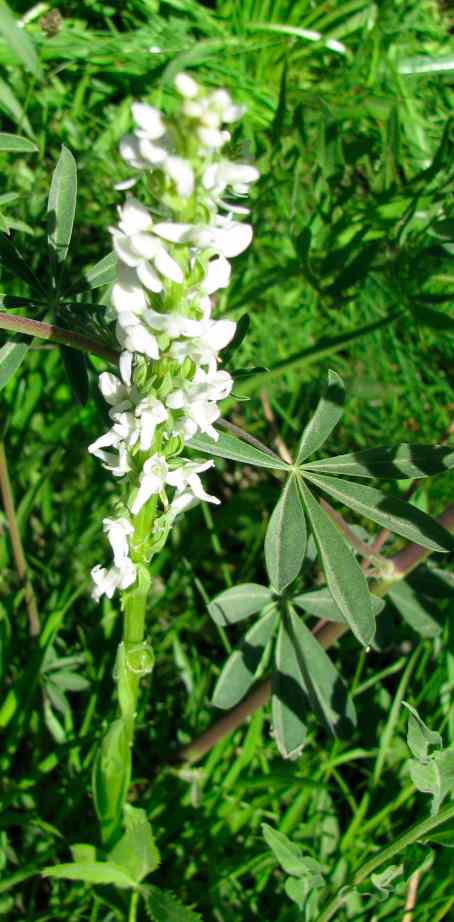
Algae poses threat to humans as well as animals

Health departments have been trying to inform swimmers and pet owners that they should avoid water with visible algae, since ingesting it can cause severe and sudden illness including convulsions or even death. In our state, three dogs died last year after swimming at a reservoir. One died before his owner could even get him to the car, another died on the way to the vet.

Now, a recent report in the ProMED health tracking network calls our attention to human risks that don’t involved either entering or drinking the algae-contaminated water.

One man, whose dog died after a swim in the lake, was hospitalized last week [week of 19 Jul 2010] after he gave the dog a bath. Within days, the 43-year-old man began having trouble walking and lost
feeling in his arms and feet.

“We weren’t swimming in the lake because it’s disgusting,” said the
victim’s wife, whose husband, is still having trouble with memory loss and fatigue. “Our dog was just covered in that sludge, and my husband washed him.” Washington Examiner, July 30, 2010.

According to one doctor treating the Ohio man, his neurological problems may be permanent. But he’s better off than his dog, who died despite having the algae washed off.

The algae are in the “blue-green algae” family, and are actually not algae but photosynthesizing bacteria, called cyanobacteria. Blooms, or overgrowths, in bodies of water (fresh or saltwater) are encouraged by temperature change and increases in nutrients, often from agricultural runoff into the water. The cyanobacteria, like some algae, make toxins harmful to fish and mammals. Humans have been aware of this mostly through being poisoned by eating shellfish, which concentrate the toxins. The familiar warnings about “red tides” and issuance of “shellfish advisories” result from these conditions.

While it has been known that skin contact with toxic algae could produce illness in humans, the severe results from relatively small exposure—simply washing an algae-slimed dog—seem to be worse than expected.

The lake in Ohio is Grand Lake St. Marys; it’s the largest inland lake in the state by area, but is extremely shallow, with an average depth of only 5 to 7 feet. This shallow lake warms up more, and doesn’t dilute the runoff of agricultural fertilizer and livestock waste as much as if it held more water. Recent algae blooms have killed so many catfish that crews were shovelling up the dead fish. With the lake surrounded by warning signs, the area’s $160 million tourism industry has declined, and a boat race that draws about 30,000 people in late August each year has been cancelled.

Some algae are harmless, but there are many different algae or bacteria that can produce dangerous levels of toxins when they bloom. Some are more harmful than others but it’s foolish to take chances: keep yourself, and children and pets, well away from any water that has a visible algae presence. This can be greenish, reddish, or other colors. Or it can appear as just cloudiness or discoloration in the water, as foam or scum floating on top, as mats on the bottom, or actual filaments or pellets. And don’t let kids or pets wander to areas of a river, stream, or lake that you have not closely checked.

Algae by rocks.jpg

Source.

An Ohio factsheet sums up the methods of exposure, and known symptoms:

Skin contact: Contact with the skin may cause rashes, hives, or skin blisters (especially on the lips and under swimsuits).

Breathing of water droplets: Breathing aerosolizing (suspended water droplets-mist) from the lake water-related recreational activities and/or lawn irrigation can cause runny eyes and noses, a sore throat, asthma-like symptoms, or allergic reactions.

Swallowing water: Swallowing HAB-contaminated water can cause:
◦ Acute (immediate), severe diarrhea and vomiting
◦ Liver toxicity (abnormal liver function, abdominal pain, diarrhea and vomiting)
◦ Kidney toxicity
◦ Neurotoxicity (weakness, salivation, tingly fingers, numbness, dizziness, difficulties breathing, death)   Source.

Splashing of water in eyes, or inhaling droplets of contaminated water, can get the toxin into your system. One of the toxins from cyanobacteria, Saxitoxin is “reportedly one of the most toxic, non-protein substances known. It is known that the LD50 (median lethal dose) in mice is 8 micrograms/kilogram. Based on
a human weighing approx. 70 kg (154 lb), a lethal dose would be a
single dose of 0.2 mg.” [Source, ProMED report.]

How much is two-tenths of a milligram? There are a thousand milligrams in a gram, and a dime or a paper clip each weigh about 1 gram. So an amount of toxin weighing the same as two ten-thousandths of a paper clip may be lethal.

Algae,feet in water.jpg

Source.

These “Harmful Algal Blooms” can occur in large or small bodies of water; often, but not always, they are in areas where the waterflow is slow (near shore) or nonexistent (stagnant). Small pools or puddles separate from the main body of water can contain algal growth. Even in tiny amounts the toxins can have devastating and sudden effects of humans or animals.

Eating fish or shellfish from contaminated waters is dangerous too. Cooking does NOT render toxins safe.

Algal blooms can be very transient, appearing and disappearing in a matter of days to weeks. If you spot a possible instance and there are no warning signs, it may not have been found yet. Stay away from the water and call your local or state health department so they can track outbreaks, and put up signs.

For the state of Oregon, current advisories can be found online here. The HAB team can be reached by email at Hab.health@state.or.us, by phone: 971-673-0440; Toll Free: 877-290-6767; or by fax: 971-673-0457. Other states should have similar programs; your city or county health department ought to be able to tell you more.

Why are these toxic algae blooms becoming more common?

The short answer is, better growing conditions for algae. They thrive in warm water, and temperatures are going up. Nutrients (nitrogen and phosphorus) from human activities pour into streams, lakes, rivers, and the ocean, and act like Miracle-Gro for the algae. Sources include runoff from fields treated with fertilizer or manure, spraying partially treated sewage sludge, sewage overflows, and runoff from pastures.

What can be done?

Rising temperatures, that’s a big one. Let’s just look at eutrophication or over-nutrification of water, since that’s something where local efforts can have relatively immediate local effects. Obviously, better treatment of sewage (including livestock waste) and reduced use of fertilizers (in agriculture, on golf courses, in parks, and in our own personal yards) are important steps to work on. On July 1st, 16 states will begin enforcing laws that require dishwasher detergents to be almost phosphate-free. That’s a small but significant improvement; the legislator who introduced the bill into the Pennsylvania legislature estimated that 7% to 12% of the phosphorus entering sewage plants came from automatic dishwashing detergents. New guidelines from the federal Clean Water Act to reduce nitrogen and phosphorus have provided more impetus to these particular efforts.

Not so obvious steps:

At least one study found that use of organic fertilizers led to less nitrogen runoff than use of chemical fertilizers.

Remediation of areas where nitrogen is stored in soil, from decades of deposition by one means or another, is possible but expensive and slow.

And years of research is showing us, surprise surprise, that intact aquatic communities slow the trickle-down of nutrient pollution (from, say, creeks to streams to rivers to a lake) and seem to enable a body of water to better resist eutrophication. Dr. David Schindler (Professor of Biological Sciences, University of Alberta) has studied the problem for decades including 37 years of work on Lake 227, a small pristine lake in the Experimental Lakes region of northern Ontario. He says, for example, that overexploitation of piscivorous (fish-eating) fish seems to increase the effects of eutrophication. (His earlier work energized the campaign to reduce phosphorus pollution.)

A study along the Georgia coast suggests that tidal marsh soils protect aquatic ecosystems from eutrophication, caused by the accumulation of nutrients. And they sequester large amounts of carbon, helping us slow down climate change. I would expect similar results with regard to freshwater wetlands and marshes. When I was a zookeeper I worked with mechanical incubators for bird eggs, none of which was as reliable as one of those “bird-brained” hens of whatever species. We are told that the appropriate native herbivores—bison, wildebeest, and so on—produce more meat per acre and do less damage than introduced species like cattle. And now we’re coming around to seeing that oldmothernature is better at water purification than we are, if we leave existing systems intact (but we never do).
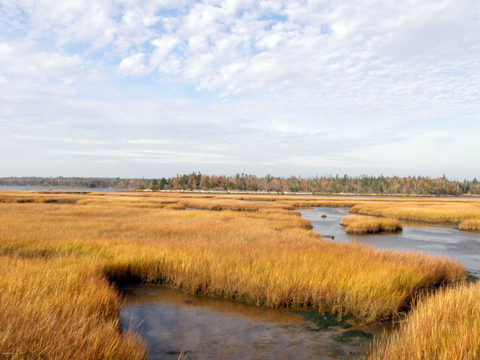
Salt Marsh.jpg

Salt Marsh near Dartmouth, Nova Scotia; more good photos of this marsh here.

Electronic IRS filing: endless loop of nothingness

The small nonprofit which I started 20 years ago for conservation-related publishing hasn’t had any inflow of money for years, but I maintain it in case I want to do such work again. Each year I file forms with the IRS saying “no income” and every so often they tell me not to bother filing, then they tell me to start filing again.

Now filing is via “E-postcard” and like many other nonprofits I got a mailing giving me directions, which I followed, last April. And I just got my third notice of failure to file, this one threatening penalties for unpaid tax.

The only proof I have of the e-postcard is a copy of the receipt they sent—via email of course. As I recall, the form was a series of fill-ins with no final complete page that I could have saved. So, unlike a paper form, the E-postcard leaves no tangible proof in the hands of the taxpayer.

The first two “You failed to file your e-postcard” letters asked me for proof that I filed, so I sent them a copy of the email receipt and a letter. This third notice is from the “enforcement division”, includes threats of property seizure and requests a phone number so they can call me.

Like many small nonprofits I have no paid employee who sits in an office waiting to answer the phone, so I have decided to try calling them. Right now I am on hold with the IRS, and have been for 30 minutes, waiting to talk to a trained employee who, if memory serves, cannot be cited as having told me anything. That is, if the advice I get is wrong, or the person fails to record her conversation with me correctly, it will not avail me to say “But Jane Smith of your office told me on July 30 at 8:42 am that she had found my e-postcard and everything was fine.” No, the IRS is not responsible for whatever its agents tell you. Maybe I should just send them a check for some random amount of money and see what happens. Oops, don’t do that: 20 years ago I saw another small nonprofit threatened with a fine for overpayment of taxes.

After 40 minutes a very nice woman has informed me that I called the wrong number; I looked at my printed-out receipt and called the assistance number on that, rather than the number on the forms just received from the IRS. We had a short but cordial conversation and now I am on hold again. The music is the same as on the previous call: loops of a lilting cheery tune of the sort that could be used to extract information from hardened terrorists, if it were played continuously, so I don’t know how long I can hold out before I decide to let them call me.

IRS,OnHold.jpg

Cartoon © The New Yorker, Gahan Wilson, used with appreciation but no permission.

I did it! (Maybe) Another polite person (think of the abuse they must endure!) finally came on, and—speaking of the IRS as if he were not part of it, and maybe he isn’t, maybe he’s part of some outsourcing—after checking my information, told me that “This electronic filing is a new requirement that the IRS has instituted for some non-profits, and the IRS has told us that if people call in and tell us that their receipts for the year were less than $25,000 we should just cancel out their case, and tell them that they may file in the future but they don’t need to.” [His words but condensed a little]

We concluded our conversation on a cordial note, but having been through something like this before, I will not rely on his assurance that I need not file in the future. I will file any forms they tell me to file. And probably go through this whole thing again.

Then of course I may get another even more threatening notice next month, as if all this telephone time never happened.

Would it have been any better if I’d had a physical copy of a paper form, instead of an ethereal email receipt for an e-postcard? I can’t say, but at least I would have felt more secure. There’s a disconnect when you don’t know what the person on the other end is looking at, because it is not the original of the paper you hold, but some electronic compilation.

Wait until all our medical records have been digitized by low-wage workers in Nigerian cybercafes recruited by Chinese low-bid companies, that’s really going to be fun! “But our records show that you are dead/a drug abuser/not allergic to anything…”

Siskiyou Wildflowers: Mt. Ashland in July, part 1

On July 22nd we left our usual nearby wildflower haunts and headed to Mt. Ashland, drawn by a brochure given us by the local ranger station. It’s called Wildflowers of Mount Ashland and the Siskiyou Crest from Mount Ashland to Cow Creek Glade, and shows small photos of 82 different flowers that may be found along Forest Road 20. There’s also concise information about each one as to wet/dry/shade habitat, location on the road, and height. The Siskiyou Chapter of the Native Plant Society of Oregon produced this, and did a great job. We’ll be joining, to support such efforts.

The day on the mountain was perfect: we left behind the valley where the temperature was headed for 100°, for an airy sunny breezy place from which Mt. Shasta was visible.

Mt. Shasta.jpg

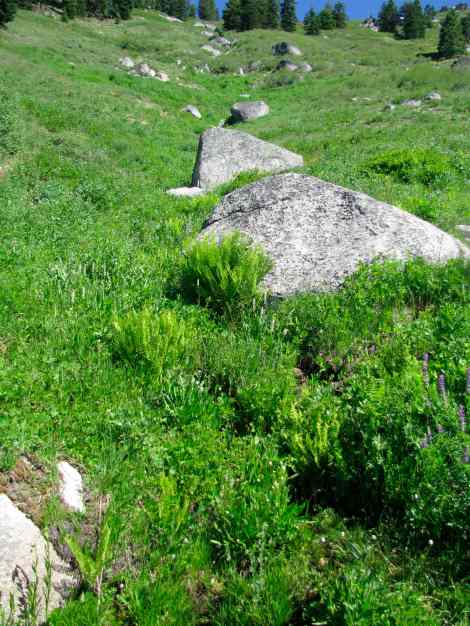
There were still a few areas of snow, and meadows moist from springs and snowmelt.

A small seep of water flows down this crease in the land, with plants most dense where the ground levels out a bit.

Water seep line.jpg

Habitats vary from dry and rocky to wet at this time of year. Peak flowering time is July and August. We saw many wildflowers—not all 82, but we’ll go back in a couple of weeks and see what else has appeared. Here’s a first installment of what we saw.

Ipomopsis aggregata, Scarlet Gilia #  - 06.jpg

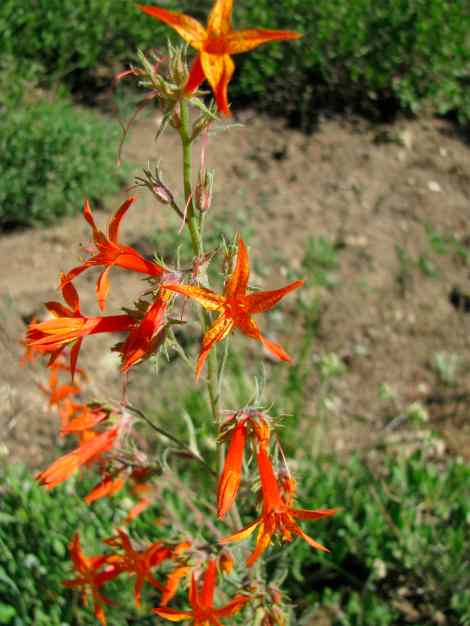
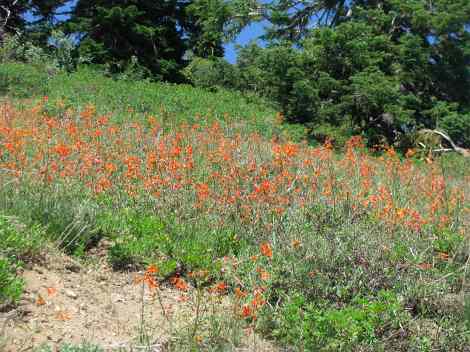
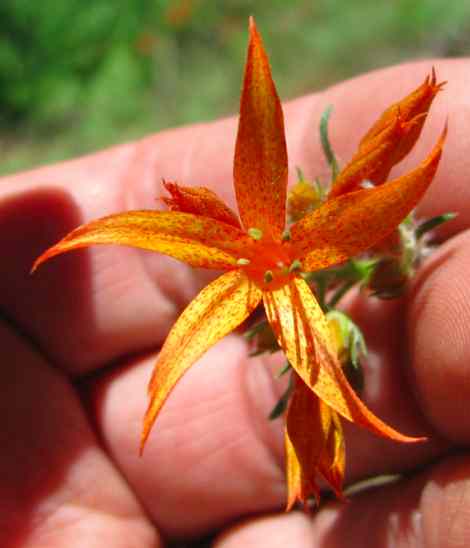
The most numerous species we saw was Scarlet Gilia (Ipomopsis aggregata). There were isolated plants, there were swathes of red. It was hard to believe something so bright and beautiful could be so abundant. [Etymological note: Ipomopsis is said to be from a Greek root meaning “striking in appearance,” but no one seems to be able to substantiate it; the species name means “flocking together,” or growing in groups, clustered, from Latin gregis (a flock) and the suffix -gate from agere (to set in motion, to drive, to lead).

Ipomopsis aggregata, Scarlet Gilia en masse.jpg

Ipomopsis aggregata, Scarlet Gilia CLOSE.jpg

Below is a yellow paintbrush, called Cobwebby Paintbrush, (Castilleja arachnoidea). Its leaves are narrow—the wide tapering hairy leaves belong to another plant that grew close in among the Castilleja. [Etymological note: named for Professor Domingo Castillejo (1744-1793), a Spanish botanist and instructor of botany at Cadiz, Spain; from Greek arachnes (spider), arachnion (spider web), like a spider’s web.]

Castilleja arachnoidea.jpg

Another Castilleja sp., but which one? Wavy-leaf Paintbrush (C. applegatei) was pictured in our guide to Mt. Ashland, but this plant did not have the distinctive wavy leaves.

Castilleja Sp. A.jpg

The next two photos show a small plant called Pussy Paws, for the soft fuzzy flowerheads(Calyptridium umbellatum). The second one pictured is the pink variety. [Etymological note: from the Greek kaluptra (a cap or covering) because of the way the petals close over the fruit; umbellatum meaning “having an umbel”, botanical term for a cluster of flowers with stalks of nearly equal length which spring from about the same point, like the ribs of an umbrella, and derived from Latin diminutive of umbra (shadow).]

Calyptridium umbellatum, Pussy Paws .jpg

Calyptridium umbellatum, Pussy PawsPINK.jpg

Two orchids were prize finds, in shady spots. Both are Uncommon, according to Turner. First the oddly named Short-spurred Rein Orchid (Piperia unalascensis). Living in the Pacific Northwest, even in a dry part of it, one wants to call this a “Rain” orchid, but all sources agree it is “Rein”. One writer alleges that it’s so named for the strap-like lower lip on each tiny flower, but I don’t really see it. [Etymological note: named after Charles Vancouver Piper (1867-1926), an agronomist with the US Department of Agriculture and an expert on Pacific Northwest flora; species name refers to Aleutian Islands (Unalaska) where species was first found. The Unangan people, who were the first to inhabit the island of Unalaska, named it “Ounalashka” meaning ‘Near the Peninsula’, according to Wikipedia. ]

Piperia unalascensis, Short-spurred Rein Orchid CLOSE.jpg

Below, not in very good focus, is the entire plant next to an Indian Paintbrush (Castilleja), species unknown.

Piperia unalascensis, Short-spurred Rein Orchid .jpg

The White Bog Orchid (Platanthera leucostachys) below It’s also called the Sierra Bog Orchid. The palmate leaf and thick stalk on the right belong to a lupine. [Etymological note: from the Greek “platanos” (broad or flat), and Greek anther (from Greek anthera, feminine of antheros (flowery) from anthos (flower), here anther is the botanical term, referring to the upper part of the stamen, containing pollen; species name from the Greek leukos (white) and Greek stachus (ear of grain or a spike) in reference to the spike-like form of the flowers.]

White bog orchid, Platanthera leucostachys   - 1.jpg

White bog orchid, Platanthera leucostachys CLOSE.jpg

Orange Agoseris (Agoseris aurantiaca), bright as the sun. [Etymological note: Agoseris was the Greek name for a related plant “goat chicory” and the word is usually seen as deriving from derived from Greek aix (goat) and seris (chicory). Some members of the Agoseris genus have woolly stems or leaves, possibly relating to the “goat” connexion. Species name aurantiaca from the Latin (orange, orange-yellow or orange-red), ultimately from aurum (gold, the metal).]

Agoseris aurantiaca, Orange AgoserisCLOSE.jpg

Several delphiniums were spotted, but not yet identified. Here’s one.

Delphinium A- 2.jpg

Its leaf is small and three-lobed.

Delphinium A- 2LEAF.jpg

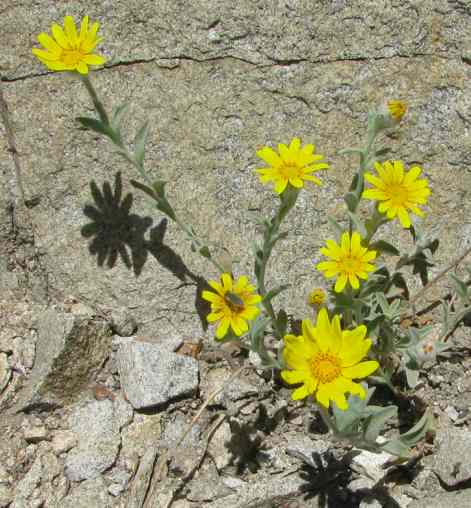
There are lots of yellow daisy-like flowers in the world, but not all have the tenacity of this one which seems to spring from the dry rock. It is Oregon Sunshine (Eriophyllum lanatum). [Etymological note: from the Greek erion (wool), phyllum (leaves); species name from the Latin lanatus, (woolly). Very very woolly!]

Eriophyllum lanatum, Oregon Sunshine  - 1.jpg

Western Wallflower (Erysimum capitatum) is another bright-flowered plant that does well in dry and disturbed soils. That trait may account for the common English name, supposedly derived from growing at the foot of walls in Europe. I suppose they’re rather like the hollyhocks you see springing up in the hard dry soil in front of abandoned sheds or at the edges of alleys. [Etymological note: from the Greek eryomai (to help or save) because some of the species supposedly had a medicinal value ; species name from Latin capitātus (having a head) from capit-, (head), refers to the way the flowers form in a head-like cluster.]

Erysimum capitatum, Western Wallflower # 2.jpg

It’s in the Mustard Family, a group called Cruciferae meaning “cross-shaped”, referring to the arrangement of the flower petals.

Erysimum capitatum, Western Wallflower.jpg

More soon!

Back to the Fair

I posted photos earlier from our visit to the Jackson County Fair, and here’s a series that I took with the title “Back to the Fair” in mind. This isn’t a cross-section of folks at the fair by any means; for one thing, it was clear that America does have an obesity problem. But photographing people who are 100+ pounds overweight felt bad, insulting, so they’re not here.

Mothr,Child&Balloons.jpg

Boy&Goats.jpg

CoupleWithDinosaur.jpg

ManWithTattoos.jpg

MotherBabyFoodStand.jpg

Ram'sHead.jpg

FatherWithChildren.jpg

YoungWomanPink&Black.jpg

TieDye&GirlInBubble.jpg

Trailblazers 4-H2.jpg

BabyInHatOnHip.jpg

OlderMan.jpg

LittleGirlWithStripes.jpg

ManWithMilitaryBearing.jpg