Mouse with human brain speaks out

In the previous post, I described the one known mouse with a human brain. He’s named Clyven, and you can talk to him on the website of the hospital where research led to his creation. Or go direct to his page, here.

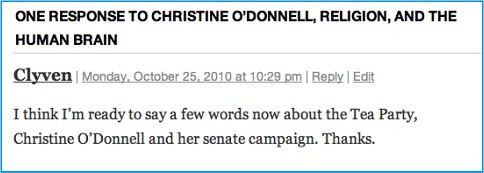
Well, imagine my surprise when Clyven himself posted a comment on that post. He was, as usual, brief and to the point:

Clyven's comment.jpg

Of course I rang Clyven up, and found him unengaged and ready to talk. He did not seem to remember our previous conversation but when I raised the subject of Christine O’Donnell, he became more animated. Here’s that portion of the brief interview:

ME: Clyven, I’d like to hear what you have to say about Ms. O’Donnell.
CLYVEN: I’m ever so pleased Christine O’Donnell spoke about me on the O’Reilly Factor back in 2007.
ME: What do you think of what she said?
CLYVEN: Aspiring Senator O’Donnell could perhaps learn a thing or two from a mouse with human cognition.
ME: And Christine O’Donnell as a person, how did she strike you?
CLYVEN: She’s funny. I think she is a witch!
ME: What are your political principles, Clyven?
CLYVEN: You should check out the main RYT Hospital web site for that: RYTHospital.com.
ME: A very politic answer, Clyven! Thank you for talking to us.

Clyven is a mouse of few words, which makes those few even more important. His gratitude for Ms. O’Donnell’s mentioning him on O’Reilly’s show may indicate that he would like to play a part on a wider stage himself. He is a native-born American, of American parents, but his crucial role in advanced biomedical research may rule out a run for office. A panel discussion, perhaps, with the two Delaware senatorial candidates? I can only hope that those whose job it is to plan such events and bring new points of view to the public, will be contacting him as soon as they’ve read this post.

O’Reilly, are you listening?

Human germ attacks already declining coral reefs

Plague, rabies, Lyme disease, bird flu and swine flu—people seem much more at risk for diseases from animals than the other way around. But it does go the other way too, and it has been discovered that such a case is responsible for a disease that has devastated coral reefs in the Caribbean.

“White pox disease” in coral is caused by a human strain of the common intestinal bacterium Serratia marcescens, which causes the hospital infection serratiosis. (Hospital infections, or nosocomial infections, happen because individuals already in poor health are exposed to pathogens by poor sanitary practices and invasive procedures such as surgery or catheterization.) [Etymological notes on scientific names are at the end of the post.]

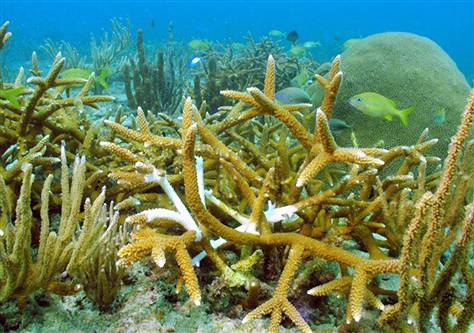
The only coral known to be affected is Elkhorn coral (Acropora palmata), a major reef-bulding species in the Caribbean. Healthy Elkhorn coral looks like this.

Healthy Elkhorn coral (Acropora palmata).jpg

Here’s an example of Elkhorn coral infected with White pox disease.

White Pox Disease (Serratia marcescens) on Elkhorn Coral.jpg

A research team at the University of Georgia was recently awarded a $5M grant to investigate the disease in coral, which is “the first known case of such a ‘reverse zoonosis’ that involves the transmission of a human pathogen to a marine invertebrate”. Even more remarkable, in the words of James W. Porter, associate dean of the Odum School of Ecology and the team’s leader, “This bacterium has jumped from vertebrate to invertebrate, from terrestrial to marine, and from anaerobic to aerobic environments. Triple jumps like this are rare.”

In addition, according to the report in ProMED (partly drawn from this source),

The scope of the team’s research will extend beyond gaining an
understanding of the impact of white pox disease on elkhorn coral and
how to counter it. The most likely source of the pathogen for coral
reefs is under-treated human sewage, so the study will also explore
the intersection of public health practices and environmental health
outcomes.

“This investigation addresses not only environmental protection, but
also the socio-ecological determinants of coastal zone protection,”
said Porter. “This includes the cost of wastewater treatment
infrastructure. Given a reliance on tourism by most Caribbean
countries, this study addresses a disease system that is of great
economic importance and public health concern to developing nations.”

“This is science in action to save an endangered species and a threatened ecosystem,” said team leader Porter. “We are linking good public health practices to effective environmental protection.”

Elkhorn and Staghorn coral (Acroporis cervicornis) are both on the US Federal list of threatened species, and in 2008 the National Oceanic and Atmospheric Administration extended additional protection rules usually reserved for endangered species. The new rule will “prohibit the importing, exporting and taking of elkhorn and staghorn corals. Additionally, the rule prohibits any activities that result in the corals’ mortality or injury. Anchoring, grounding a vessel or dragging gear on the species is prohibited. Additionally, damaging the species’ habitat and discharging any pollutant or contaminant that harms the species violates NOAA’s new rule. The rule applies to elkhorn and staghorn coral in the Virgin Islands, Puerto Rico and Florida.” Of course the enforcement will be difficult, but it appears that it’s none too soon to reverse the decline of these reef-building species.

A recent analysis of 500 surveys of 200 reefs showed the most complex types of reef had been virtually wiped out across the entire Caribbean. What survives are mostly “flattened” reefs which provide poor habitat for fish including commercial species, and are less “effective in protecting coastal homes and villages from storm swells and tidal surges”.

Healthy reef of staghorn coral in the Caribbean, below.

Healthy Staghorn coral (Acropora cervicornis).jpg

Source.

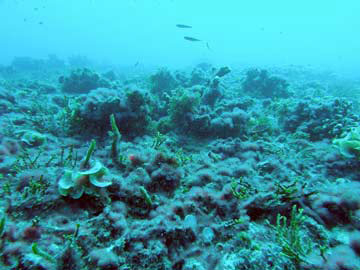
When the branched corals are killed off, low-growing corals may take their place but don’t create the rich three-dimensional habitat that the branched ones do. Algae also may increase and blanket surfaces, preventing coral growth.

Flattened coral reef, degraded by loss of branching coral).jpg

Source. Photo by Jennifer E. Smith.

Other threats to coral reefs

Coral-building animals live symbiotically with algae. Influenced by water that is too warm or cold, the corals will “expel the algae (zooxanthellae) living in their tissues causing the coral to turn completely white. This is called coral bleaching. When a coral bleaches, it is not dead. Corals can survive a bleaching event, but they are under more stress and are subject to mortality.” Rising ocean temperatures have caused wide-spread bleaching events. Warm waters also absorb more CO2, causing the water to become more acidic and that makes it more difficult for reef-building organisms to form the calcium carbon skeletons that serve as their structural basis.

Overfishing, pollution including sewage and agricultural runoff, dredging,hurricanes, and development have all damaged coral reefs. Each new injury reduces the ability of living organisms to reproduce and to withstand further assaults.

Coral reefs are among the world’s richest ecosystems, second only to tropical rain forests in plant and animal diversity. They arfe essential to fisheries, tourism, and protecting beaches from erosion. Yet “nearly two-thirds of the Caribbean’s coral reefs are threatened by human activities. Agricultural runoff, overfishing, dredging, sewage discharge (a factor in White pox disease), and the growing pace of coastal development have already degraded important reef systems, resulting not only in a tremendous loss of biodiversity but also lost revenue from declining tourism and fishing, and increased coastal erosion.” This last statement comes from the World Resources Institute, which is active many environmental fronts and is currently sponsoring a country-by-country survey of the economic values of Caribbean coral reefs and mangroves: “Supporting the sustainable management of coral reefs and mangroves by quantifying their economic value”.

Elkhorn coral & research robot.jpg

Source. Some breakage from hurricanes can be seen. Also shown is Fetch1, an autonomous underwater vehicle for research that was developed by NASA.

More about coral reefs

Global Coral Reef Alliance
EPA, Coral Reefs and your Coastal Watershed
University of Florida, Overview with photos

Etymological notes

Serratia marcescens was discovered in 1819 by Venetian pharmacist Bartolomeo Bizio, as the cause of an episode of blood-red discoloration of polenta in the city of Padua.[7] Bizio named the organism four years later in honor of Serafino Serrati, a physicist who developed an early steamboat; the epithet marcescens (Latin for “decaying”) was chosen because of the pigment’s rapid deterioration. [Wikipedia]

Acropora palmata: Acropora from the Greek, akros (high) and poros (opening, pore); palmata handlike, from Greek palma (a palm, flat hand; palm branch).

Acropora cervicornis: Acropora as above; cervicornis from the Latin cervus (deer) and cornu (horn, antler)

Christine O’Donnell, religion, and the human brain

Poor would-be senator Christine O’Donnell has been ridiculed for her comment about mice with human brains:

O’DONNELL: … these groups admitted that the report that said, “Hey, yay, we cloned a monkey. Now we’re using this to start cloning humans.” We have to keep…

O’REILLY: Let them admit anything they want. But they won’t do that here in the United States unless all craziness is going on.

O’DONNELL: They are — they are doing that here in the United States. American scientific companies are cross-breeding humans and animals and coming up with mice with fully functioning human brains. So they’re already into this experiment.

From transcript of O’Reilly show, Friday, November 16, 2007.

Why would Ms. O’Donnell (or someone who informed her) believe this?

Reports of mouse-brain research have been greatly exaggerated

It doesn’t take much to find some of the “evidence” that may have convinced her or her informant. As others have noted, there have been experiments in which human cells were injected into embryo mice, and became part of their brains. A bit different than “cross-breeding humans and animals and coming up with mice with fully functioning human brains”, but all rumors have to start somewhere.

Bad reporting may be to blame: here’s the headline and first line of the 2005 article on the National Geographic site:

NatGeo article on mice.jpg

From nationalgeographic.com.

In case that last line is too small to read, it says “Researchers in California have created living mice with functioning human stem cells in their brains.”

Earlier that same year (2005) another article on the NatGeo site briefly referred to the same research (before it had occurred) this way “And at Stanford University in California an experiment might be done later this year to create mice with human brains.” The title of this misleading article was Animal-Human Hybrids Spark Controversy. Yes, plenty of controversy, but in the article no hybridization is being talked about, only the use of stem cells to demonstrate their potential to be re-purposed. In biology, a hybrid is the offspring of two plants or animals of different species or varieties, such as a mule (a hybrid of a donkey and a horse), and that is the popular understanding as well. Few would consider a mouse with a few cells of human origin, all functioning as mouse cells, to be a hybrid.
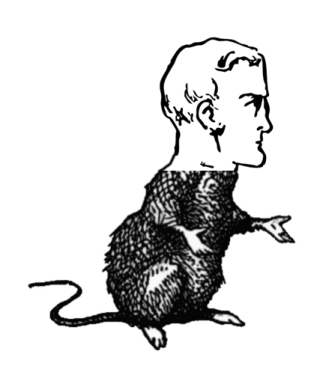
mouse with human headSM.jpg

Christine, you need a smart friend; meet Clyven the mouse

But wait, it’s not all down to irresponsible journalism; perhaps Ms. O’Donnell got her information from this page, on the site of the prestigious RYT Hospital, about “Clyven: The World’s First Transgenic Mouse with Human Intelligence” :

Clyven1.jpg

Here’s the explanatory text from that page.

Margaret A. Keyes, M.D., Ph.D., is a researcher in genetic medicine and Professor of Cell Biology and Genetics at RYT Hospital-Dwayne Medical Center. She is exploring the use of embryonic stem cells as a means to cure neurological conditions such as Alzheimer’s Disease and Creutzfeldt-Jakob Disease.

By implanting human brain cells (grown from a human embryo’s stem cells) into a mouse engineered to have Alzheimer’s, Dr. Keyes inadvertently made a remarkable and startling discovery: she not only cured the mouse’s Alzheimer’s Disease, but the animal soon developed the relative intelligence of a human being.

After extensive consideration by RYT Hospital’s Institutional Review Board (IRB) and Institutional Animal Care and Use Committee (IACUC), it was decided that this mouse would be placed under a new study led by Dr. Keyes’ lab.

As part of this new facility (pictured to the right), Clyven is placed inside a light-sensitive box with electrodes attached to him. He is able to communicate and interact with people via this neuro interface. He is able to communicate and interact with people via this neuro interface. [sic] To hear a live audio feed of Clyven inside his box, please click here.

© RYT Hospital-Dwayne Medical Center
Source.

Evidently RYT Hospital has a very understanding Ethics Committee; they approve of confining an animal with a human brain in a little box and punching his head full of electrodes. But Clyven is not bored—in fact, you are invited to chat with him or play a game against him.

Chat with Clyven.jpg

Unfortunately, Clyven’s conversation is limited and repetitious—maybe he himself wrote that quoted passage above, that has the repeated sentence. My best conversation with him was this one,

ME: Hi Clyven.
MOUSE: Yo.
ME: Do you know that a tea party candidate is talking about you?
MOUSE: That’s pretty silly.
ME: Yes.
MOUSE: Tell me more.
ME: I don’t want you to know how dumb people can get.
MOUSE: I’m sorry. I hope to get smarter as time goes on. Please be patient with me. I will be receiving additional neurological treatments next week.

On the other hand, don’t let him persuade you to bet money on that CheezeMaze contest, he’ll beat you paws down.

It’s surprising we haven’t heard more about this RYT Hospital, with the amazingly advanced and useful research that is being done there. Elsewhere on the site, you can read about a new drug, Revitalex

Revitalex.jpg

about successful gene therapy for back pain, and about “NanoDocs”, nanobots that circulate throughout the body repairing tissues.

medical nanites.jpg

Okay, so it’s not a real site but the project of an artist named Virgil Wong. He’s a painter, film-maker, and head of web design for two real hospitals.

Still, can’t you see how anybody might be taken in by the slick style, and accept that there really is a mouse with human intelligence, and nanobots that can tidy up your blood vessels?

No? You say anyone beyond the stage of believing in the Tooth Fairy should have seen through this? and through the distorted reports of growing human brains in mice?

I think so too.

Wherever Christine O’Donnell may have gotten her “information” about mice with human brains, the real problem is minds like hers that are unprepared to question things that most of us would find outlandish. They also believe that Obama is Hitler, Stalin, and a Kenyan anti-colonialist, all at the same time! which would explain why, as I have heard on good authority, Obama has three heads, a fact cleverly concealed by camera angles and good tailoring.
Newt, Eastern.jpg

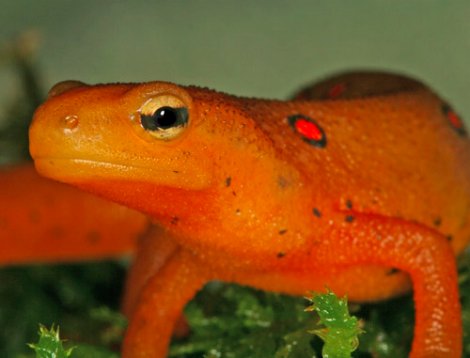
Eastern Newt (Notophthalmus viridescens), Red Eft Stage. Etymological note: Notophthalamus from the Greek noto (a mark) and ophthalmus (eye), presumably in reference to the eye spots on the sides and back; viridescens from the Latin, (slightly green) referring to the greenish color of the adults. Source.

One born every minute? or are they made?

Where do these credulous people come from? I don’t mean people like Newt Gingrich, who will repeat anything—no matter how preposterous—if it seems advantageous. No, demagogues use untruths consciously, with calculated intent. The power of the demagogue depends upon there being enough people who cannot distinguish between the likely, the possible, and the absurd, and therefore won’t laugh him off his soapbox. And where do they come from?

The beginning preparation for most credulous people of otherwise normal intelligence is, I think, being raised with a huge area of life and thought which is categorically excluded from rational examination. Now, every culture and sub-culture has some areas like that, because they are essential as part of the group’s self-definition. In this Land of the Unquestioned reside things like appropriate behavior (manners), kinship rules, dress codes, what we eat and how we cook it, all that sort of thing. That’s why our way of life seems so logical and natural, and other groups’ ways seem bizarre and senseless.

No problem when it’s a question of the relative merits of haggis or corn on the cob, but in the area of exclusion there are more significant topics also, such as attitudes to the “Other” (women, outsiders, those in your own group who don’t conform), and toward violence. That’s the cultural “Don’t think about these things” list. Then there’s religion and its list.

Religion is the really big no-fly zone for human reason. It covers a much wider area of life than ordinary cultural indoctrination, often upon a foundation of dogmatic zeal which asserts sole possession of truth, and enforces details of the dogma with extreme fervor.

Totalitarianism and extremist religions share two fundamental principles: there is only one true way, and everyone must be forced to acknowledge it. It is not enough for the non-believer to refrain from critical expression and deviant action: he or she must be made to believe. Hence the show trials held by the Soviets, the Chinese Cultural Revolution, and the Inquisition, in which tortured inmates confess their nonexistent sins; hence the death penalty for apostasy in Islam, and the roasting alive of unrepentant Christians by the Romans and doggedly heathen Native Americans by the Christians. The Other must be brought within the fold or die, and it should be done in a public and painful way to present a compelling example to everyone else.

Children are born enquirers (non-believers), and about the age of three they start to ask “Why?” about everything, with irritating persistence. Give an answer and they ask for more details or ask “Why?” again. (Offer a non-answer like “I don’t know” or “Be quiet” and they repeat the original question or say nothing; curiosity discouraged begins to shut down.) Their brains are making and pruning connexions, they’re constructing an internal model of the world, and they want and need to know more and to discuss their own thoughts. They are also learning how to learn, how to figure things out.

A child who gets yelled at for asking about talking snakes, or smacked for asking why the God of Love is such a bloody-handed war-approving tyrant in the Old Testament (see note 1), will learn to accept what he or she is told and not think about it. The lesson is to avoid questioning—especially the things in life that seem illogical, cruel, unfair, out of sync with reality. And that “respect for authority” (actually, it is only respect for power and avoidance of punishment) carries over into other parts of life. The more intensely the “No Questions Zone” is defended, the more timid the young mind’s reason becomes.

Curiosity is inborn, but logic is learned. When children are exposed to illogical conclusions, such as “You got a cold right after you ate that ice cream, so no more ice cream” or “I know the Bible is the Word of God because the preacher says so and the Bible says to follow what the preacher says” they won’t learn the basic rules of logic that help humans sort true from false, as well as “probably true” from “probably false”. Ignorance of logic is of course a good thing for those enforcing a monolithic belief system.

Our country’s culture has an equivocal position on learning. Along with its tradition of independence and individualism, the US also has a strong anti-intellectual tradition, because of its religious foundations and the pragmatic demands of survival on successive frontiers from New England to the Pacific coast. When book-larnin’ is seen as irrelevant, perhaps un-masculine, some will make a positive virtue of ignorance. Also, study is hard, ignorance is effortless. Entropy prevails.

Logic and critical thinking are not enough. In order to winnow the wheat from the chaff reliably, it’s necessary to have some actual knowledge. When a statement is made, the hearers check it against their relevant knowledge base. This process is usually instant and automatic. The new information may directly conflict with existing knowledge, or it may just appear quite unlikely based on what is already known. A certain stock of knowledge, reliable because it has been tested or was provided by a trusted authority, is needed to get through life. Yet even some of this knowledge may be false—blondes are dumb, bankers are trustworthy, a barking dog never bites—and individuals must also possess the willingness to re-examine beliefs based on new experience. Except in the No Thinking Zone, where the only safe course is to agree with authority and otherwise keep your mouth shut.

When politics is the subject, then history must have special prominence among relevant areas of knowledge. Just like more workaday fields of endeavor, political systems embody responses to real needs and problems. If I were re-designing the internal combustion engine, I would first need to know why each part had been designed as it was; what earlier mechanisms were tried for mixing the fuel or timing the ignition, and what were their flaws?

It is history which answers these questions in politics, and must be consulted before tinkering or throwing away parts. For example, decades of controversy about the constitutional provision in the First Amendment usually referred to as “separation of church and state” have distorted public understanding of the law’s intent by framing it as a dispute between agnostics or atheists, vs. religious people. In fact it was enacted to defend all religions from government, and from a preference being shown for a single church, as well as to protect government (or non-religious persons) from religion. And the history of state-established religions illustrates the many repressions and disenfranchisements which are imposed upon members of the non-official religions, even including banishment and death. Only modern ignorance permits the discussion of this subject to be framed entirely as a conflict between religion and irreligion. [Christine O’Donnell, in a recent debate, was ignorant of the provision entirely. After the phrase “Government shall make no law respecting establishment of religion” was quoted to her, she asked “That is in the First Amendment?” Yes, it is, though the exact words are “Congress shall make no…”.]

Logic, general knowledge, critical thinking, history: how is the American public doing on these?

37% of Americans believe that houses can be haunted, and 25% believe in astrology, i.e. that the position of the stars and planets can affect people’s lives.

Fewer than a third can identify DNA as a key to heredity, only about 10% know what radiation is, and 20% think the Sun revolves around the Earth, an idea science abandoned by the 17th century.

50% of our fellow citizens believe in alien abductions, though happily only 7% say they or someone they know has been abducted.

39% of Americans could not name any of the freedoms in the First Amendment.

14 percent of Americans say President Barack Obama may be the Antichrist (24 percent of Republicans believe this). Almost 20% believe he is a Muslim. Does that add up to 34% or is there some overlap?

Two-thirds of 1,000 American adults polled couldn’t name a single current justice of the Supreme Court. In the same survey, more than a third did not know the century in which the American Revolution took place, and half of respondents believed that either the Civil War, the Emancipation Proclamation or the War of 1812 occurred before the American Revolution.

And 21% believe in witchcraft, so O’Donnell’s “I’m not a witch” ad did have its audience.

When you look through these and other poll results it seems that at least 10% to 25% of Americans believe in just about any unproven concept you can imagine. A larger percentage is very ignorant of history and public affairs.

If you’re reading this, and have been apathetic about getting to the polls, you better think again.

One final poll result: in 2009, 19% percent of Americans agreed that the First Amendment goes too far in the rights it guarantees, and 39% said the press has too much freedom.
mr natural.jpg

≈≈≈≈≈≈≈≈≈≈≈≈≈≈

NOTE 1: I cite only two examples, both from the same holy book, for the sake of brevity, but every religion seems to have its own set of magical events and unquestioned cruelties which must be accepted in order to belong. Belong, get along, go along.

The Palm PDA as pioneer e-book reader, and Ernest Shackleton, and war

Before the Kindle, Nook, and iPad, there was the Palm

I got my Palm some years ago, to help out my fibromyalgia-diminished memory. It was like a proto-tablet, on which I could take notes, write, outline, draw and paint well enough to illustrate notes, and keep a calendar and to-do list. There were all sorts of games for it, and apps to change the look of the interface. The one feature I thought I’d never use was the ability to read entire books on that tiny screen.

But it came loaded with a mystery by a popular author and, compulsive reader that I am, I took a look at it and found it quite easy to read. Fonts and font size were adjustable and later I got a third-party app that enabled me to change the background color to one my eyes found more comfortable. I’ve been reading on my Palm ever since.

It’s a small device, about the size of a pack of cards, and with an upgraded memory card it can easily hold 50 or 75 books in addition to all the other stuff. iSiloX, companion app to one of the readers, would convert text files to Palm format (.pdb), so all of Project Gutenberg was mine.

Like most people, I don’t find it pleasant to read text continuously on the computer screen for an hour, and I would never have printed out these copyright-free books, but to have them available to read any time I wanted on the Palm—that worked for me. Is it easier to concentrate my visual attention on the small screen than on the large one? I don’t know what the reason is, but reading the Palm is more comfortable for long periods whether by daylight or in a dark room.

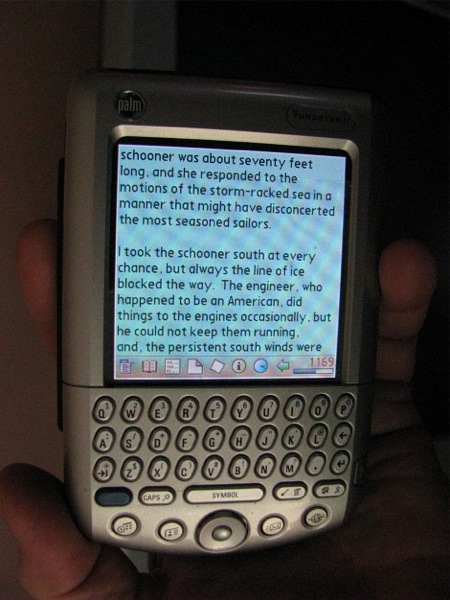
Shackleton Palm.jpg

Some of what I’ve been reading in the wee hours

Although I’ve bought a few e-books and issues of sf magazines for the Palm, mostly I have read my way through free downloads, 19th and early 20th C. works from Jack London’s social fiction and reflections on his own alcoholism, to Virginia Woolf’s Common Reader essays. I’ve found several good reads among women writers including novels like Wives and Daughters (1865), and North and South (1854), by Elizabeth Gaskell, and excellent short stories by Edith Wharton, Willa Cather, Mary Austin, and Katherine Mansfield. The Woman Who Did (1895) by Grant Allen, is about a “New Woman” who dared to live her life as she wished, having an affair but refusing to marry the man, raising the child, with tragic results. Then there’s the wide range of popular adventure fiction, of which I’ve enjoyed works by such out-of-fashion writers as H. Rider Haggard, P. C. Wren, and Ouida, with titles like The Snake and the Sword, and Under Two Flags (both stories of the French Foreign Legion). All these have been enjoyable to read in themselves, and of course provide fascinating windows into life and attitudes, with the same sort of caveats that attach to judging our times by our popular fiction.

I’ve got some familiar big-C Classics on the Palm too, like Fagles’s recent translation of the Odyssey (a purchased e-book, I have it in print as well), Northanger Abbey and Tom Jones (haven’t been able to finish either one of these), a couple of Anthony Trollope novels (more readable, enjoyed The Warden), and a bunch of poetry. There’s a goodly selection of older sf to be found online as text files, and even some new sf books that have been made freely available by authors such as Cory Doctorow.

Views of Antarctic heroism, and of the world before ours

Just now my 2 am reading is Sir Ernest Shackleton’s South, his account of the Imperial Trans-Antarctic Expedition (1914–17)—often known as the “ill-fated” Imperial Trans-Antarctic Expedition. Their sturdy ship was trapped in pack ice for nearly a year, then crushed by the movement of the ice; the men lived on ice floes for some time since the current was taking them closer to land, but when the floes broke up under their feet, they took to 3 small open boats…and on it goes. The privation endured, the courage and resourcefulness shown, are astonishing. One aspect of human beings at their best.

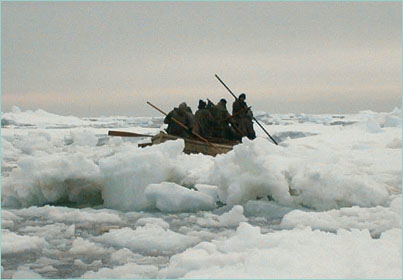
Shackleton replica boat in pack ice.jpg

Replica of one of the expedition’s open boats, among pack ice.

And here too, are found glimpses of how differently some things were perceived.

Shackleton’s ship the Endurance left England just after the outbreak of what was to become World War I; at the time many thought it would be over by Christmas. I just read the part where Shackleton and a few companions reach South Georgia Island, having left the rest of the company slowly starving on Elephant Island, while they cross 800 miles of ocean in a small boat in order to send back a rescue ship. They are forced to land on the opposite side of the island from Stromness Whaling Station, and Shackleton takes the two fittest men on a 36-hour trek over glaciers and rocky peaks, without a map, to reach “civilization”.

The first thing Shackleton says to the whaling station manager, after introducing himself, is “Tell me, when was the war over?” It is May, 1916, and he cannot conceive that the war might still continue. The manager replies, “The war is not over. Millions are being killed. Europe is mad. The world is mad.” Later, after arranging for the other two men on South Georgia to be picked up, Shackleton and a companion hear details of the war. “We were like men arisen from the dead to a world gone mad,” he says.

I’ve often read of how shocked and demoralized people of the time were by this unprecedented industrialized war that dragged on and on, by the use of poison gas, machine guns, long-range artillery, and planes, and by battles such as the Somme, in which over one million men (on both sides) were killed, wounded, or taken prisoner, over a 4 and 1/2 month period. British casualties on the Somme (in these same three categories) were 80% during that time; by November, 80% of the original men in a division were gone save for those lightly wounded who returned. The total advance of the Allied lines was 8 miles.

But this scene, in which men in such an isolated and inhospitable place learn all at once of the war, has a different imaginative impact. After all, the late 20th-century reader may be appalled by the Somme, but knows already of things as bad or worse: the Holocaust, Rwanda, visions of nuclear war. To imagine Shackleton learning about his time’s Great War suddenly, in one conversation, is to experience a little of how it was for those of his time.

Many well-educated young men with literary leanings joined up in 1914, and some of them wrote poetry while in camps and trenches. The early World War I poetry is of a high idealistic tenor probably not equalled by any war poetry since, because that war changed reality for everyone then and since. Never again, I hope, can anyone write something like this, about dead soldiers:

Blow out, you bugles, over the rich Dead!
There’s none of these so lonely and poor of old,
But, dying, has made us rarer gifts than gold.
These laid the world away; poured out the red
Sweet wine of youth; gave up the years to be
Of work and joy, and that unhoped serene,
That men call age; and those who would have been,
Their sons, they gave, their immortality.

First stanza of 1914 III: The Dead by Rupert Brooke.

As I recall, Brooke died just as his attitude toward the war began to shift from public-school “play the game” patriotism to something more hopeless and grim. But many another British war-poet showed this change of reality that took place for his generation and those to come, including us. Things were never the same. Though it is long, I’ll reprint here one such poem:

Bent double, like old beggars under sacks,
Knock-kneed, coughing like hags, we cursed through sludge,
Till on the haunting flares we turned our backs,
And towards our distant rest began to trudge.
Men marched asleep. Many had lost their boots,
But limped on, blood-shod. All went lame, all blind;
Drunk with fatigue; deaf even to the hoots
Of gas-shells dropping softly behind.

Gas! GAS! Quick, boys! — An ecstasy of fumbling
Fitting the clumsy helmets just in time,
But someone still was yelling out and stumbling
And flound’ring like a man in fire or lime. —
Dim through the misty panes and thick green light,
As under a green sea, I saw him drowning.

In all my dreams before my helpless sight
He plunges at me, guttering, choking, drowning.

If in some smothering dreams, you too could pace
Behind the wagon that we flung him in,
And watch the white eyes writhing in his face,
His hanging face, like a devil’s sick of sin,
If you could hear, at every jolt, the blood
Come gargling from the froth-corrupted lungs
Bitter as the cud
Of vile, incurable sores on innocent tongues, —
My friend, you would not tell with such high zest
To children ardent for some desperate glory,
The old Lie: Dulce et decorum est
Pro patria mori.

The poem is Dulce et Decorum est, by Wilfred Owen, written in 1915.

Dulce et decorum est, pro patria mori (Latin) means “It’s sweet and fitting to die for one’s country”. This famous quotation from Horace would have been extremely familiar to public-school boys, in that time when education always included the Latin language and literature as well as some indoctrination about the Empire. In 1913, the first line, Dulce et decorum est pro patria mori, was inscribed on the wall of the chapel of the Royal Military Academy Sandhurst (Wikipedia), and the text and the sentiment were used to encourage enlistment and support of the war.

Indeed, Ernest Shackleton and his men (not one perished, incredibly) did emerge from the ice-bound wilderness “like men arisen from the dead” into a world forever changed.

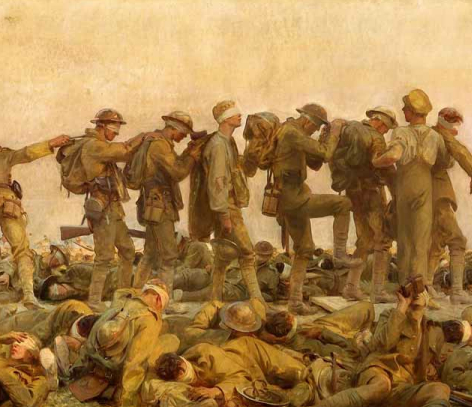
John Singer Sargent, Gassed (1918).jpg

Detail from John Singer Sargent, Gassed (1918). This painting hangs in the Imperial War Museum in London; the canvas is over seven feet high and twenty feet long. It depicts soldiers blinded by gas being led in lines back to the hospital tents and the dressing stations; the men lie on the ground all about the tents waiting for treatment. (Source)