Botanical prints of threatened flora

For those of us who find beauty in plant forms, the botanical illustrations available online are an always-blooming visual pleasure. Here are two that came my way via a mention in today’s Botany Photo of the Day.

First, a gallery of members’ works on the site of the The American Society of Botanical Artists, well worth a visit. There are only a couple of examples for each artist, but you can follow links to websites for many of those represented.

Ceanothus_spinosus.jpg
Detail, Mountain lilac or Greenbark ceanothus (Ceanothus spinosus), watercolor © Chris Chapman. Source [this is a frames page, click on artist’s name in list at side].

Also, the ASBA has made available online nearly all of a touring exhibition called Losing Paradise? Endangered Plants Here and Around the World.The exhibit is at The New York Botanical Garden through July 25 2010, and at the Smithsonian’s National Museum of Natural History in DC, August 14th through December 10th.

This ASBA blog has about thirty of the 44 artworks featured in the exhibition (another is added every few days), and each is accompanied by the text from the exhibit catalog: a description of the plant and its situation, and commentary from the artist. (Elsewhere, the ASBA also plans to post all 125 pieces that were submitted for the exhibit, with shorter text; only about a dozen are up now.)

Here are a few samples from the blog. The images on the page are thumbnails, be sure to look at the much larger versions.

PaintedTrillium.jpg

Detail of Painted trillium (Trillium undulatum), mixed media, © Anne Marie Carney, US.
Silene_regia.jpg

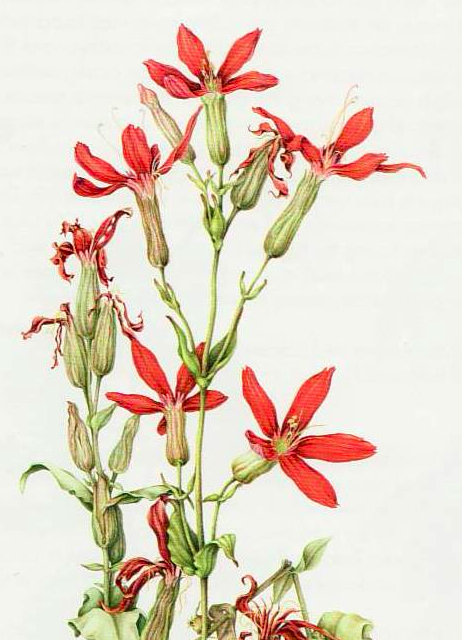
Detail of Royal catchfly (Silene regia), watercolor © Heeyoung Kim, US.

A perennial wildflower of the US Midwest; its bright red flowers are pollinated by butterflies and hummingbirds.
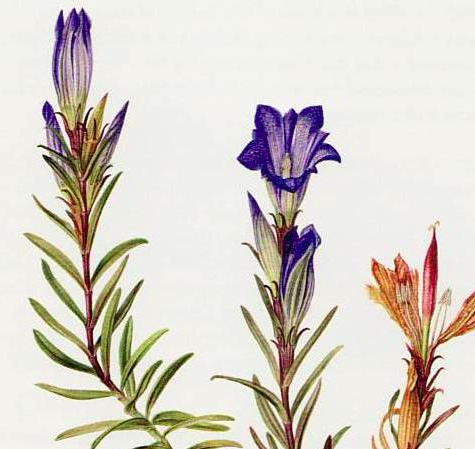
Marsh_gentian.jpg

Detail, Marsh gentian (Gentiana pneumonanthe), watercolor © Gillian Barlow, UK.

Marsh gentian is being studied all over northern Europe, mainly because of its fascinating relationship with the rare Alcon blue butterfly (Phengaris alcon). Adult Alcon blues lay their eggs on the outside of marsh gentian flowers, and when the larvae hatch, they emerge inside, where they begin to feed on the flower. After molting 3 times, these caterpillars chew through to the outside of the flower, then lower themselves to the ground on a “silken thread”. The caterpillar awaits the arrival of a Myrmica ant, which adopts it and carries it back to the ant’s nest. There it is fed by the ant colony through the fall and winter, growing quite large. In spring it forms a chrysalis, then emerges and exits the colony as quickly as it can to avoid being killed by the ants.

Actually, it’s even odder than that…

The larvae emit surface chemicals (allomones) that closely match those of ant larvae, causing the ants to carry the Alcon larvae into their nests and place them in their brood chambers, where they are fed by worker ants and where they devour ant larvae.

When the Alcon larva is fully developed it pupates. Once the adult hatches it must run the gauntlet of escaping. The ants recognise the butterfly to be an intruder, but when they go to attack it with their jaws they can’t grab anything substantial as the newly emerged adult butterfly is thickly clothed in loosely attached scales.

Over time, some ant colonies that are parasitized in this manner will slightly change their larva chemicals as a defense, leading to an evolutionary “arms race” between the two species.

The Phengaris alcon larvae are sought underground by the Ichneumon eumerus wasp. On detecting a P. alcon larva the wasp enters the nest and sprays a pheromone that causes the ants to attack each other. In the resulting confusion the wasp locates the butterfly larva and injects it with its eggs. On pupation, the wasp eggs hatch and consume the chrysalis from the inside. [Wikipedia]

Phengaris_alcon.jpg

Alcon blue butterfly (Phengaris alcon). Source.

Since the butterfly lays its eggs right on the flower, it may be serving the gentian as a pollinator, if it visits more than one plant.

Below, the Santa Cruz Cypress.

Santa_Cruz_Cypress.jpg

The endangered Santa Cruz Cypress, Cupressus abramsiana, is found only in the coastal Santa Cruz Mountains of central California, where it grows in gravelly, sandy soils above the fog belt, with chaparral and other evergreen species. This tree, once abundant, succumbed over the years to vineyard and home development, and road building. Only five populations totaling a few thousand individuals remain, all within a 15-mile stretch of the coast. It was Federally listed in 1987. It is still threatened by competition with non-native plants such as pampas grass and French broom, insect infestation and hybridization with other cypress species.

Visit the ASBA blogspot to see the rest of 30 or so. The catalog of the exhibit, from which these texts are excerpted, is on sale for $29.95 + s & h.
Siskiyou wildflowers and butterflies

Our roadside botanizing was especially exciting today. First perhaps I should explain why we walk along forest service roads instead of hiking along trails. It has a lot to do with a single plant, although not one I would describe as a widlflower.

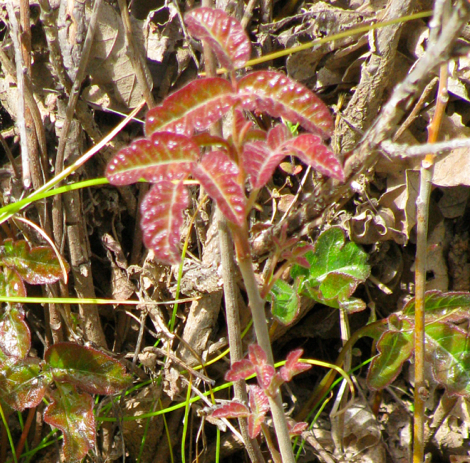
PoisonOak.jpg

Yes, it’s poison oak (Toxicodendron diversilobum), seen above early in the spring before it has reached its full diabolical potential of thickets six feet tall, stretching branches out onto trails in search of sunshine in order to grow even more monstrously large. Poison oak could be an interesting plant: it occurs in various forms from semi-vines threading up tree trunks, to a low-growing ankle-ambusher, as well as the aforementioned woody thickets. But all parts contain a chemical that is—not poisonous—but an extremely powerful allergen, an oil called urushiol. Most people are allergic to it, and I am very very allergic, so once we get off of bare ground I spend most of my time looking down and around before every step in order to find it before it finds me. (Be warned: allergies can come and go, so a history of immunity doesn’t mean you’ll always be immune.)

Happily, there’s an abundance of things to see by walking along the road and making a few careful excursions. Today was a bonanza.

LewWelch3.gif

There’s an audio recording of Lew Welch reading this, here.

I don’t think we saw anything that “nobody’s ever really seen”, although one must pay careful attention to Lew Welch’s language, that “really seen” part. But what we saw was marvelous. Here’s one sight:

ButterfliesOnScat2.jpg

ButterfliesOnScat1.jpg

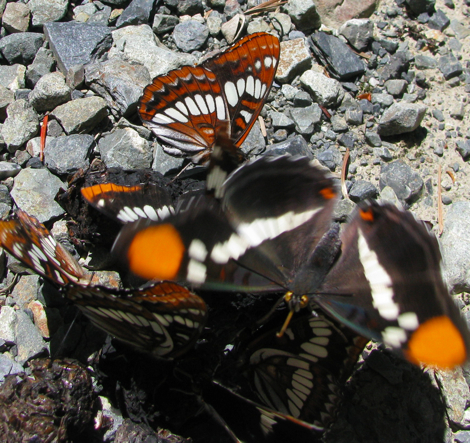
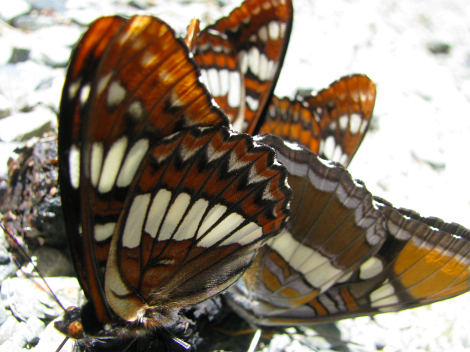
From a distance I thought the butterflies were gathered upon a damp patch improbably located in the middle of the hot dusty gravel road. In other such situations, I haven’t been able to approach very closely without scaring them off. I took some pictures, then moved a bit closer, closer still, and in the end I was kneeling right beside them without really disturbing them at all. And then I could see what it was that they were so attracted to.

ButterfliesOnScat3.jpg

They were on the scat of some animal, not an uncommon territorial marker to find in the middle of these forest roads. Could be fox, raccoon, coyote. Undigested material including seeds and some woody bits (pine needles?) can be seen, and the scat is pretty dry. Unlikely to be a source of moisture. However, butterflies require minerals not found in nectar, and often get these by drinking from damp soil or applying their tongues to scat. I am curious how they get nutrients from dry materials, because their tongues are hollow tubes designed for drinking liquids.

I poured some water on a nearby area before we left in search of lilies. When we came back, all the butterflies were still on the scat.

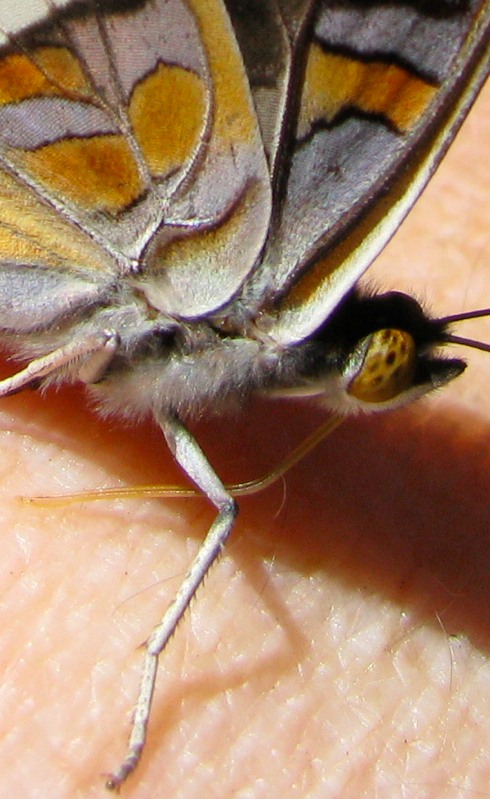
There were two species there. One was Adelpha bredowii, California sister, shown here exploring my arm. Some photos (here, for example) show this species with blue rather than grey markings, but that may be local variation.

Adelpha bredowii, California sister.jpg

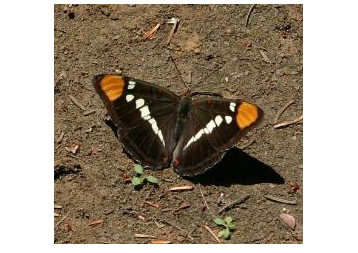
What’s the “sister” about? It’s said to refer to the black and white markings (like a nun’s habit) on the other side of the wings, the dorsal side (looking down on the outspread wings and the insect’s back, from above).

Adelpha bredowii, dorsal view.jpg

Photo source.

The other is Limenitis lorquinii, Lorquin’s admiral. There are several different butterfly species with “admiral” in their names, and the reference is not clear. Some say the names were originally “admirable” but I can find no support, just speculation. Lorquin was a Frenchman in California during the Gold Rush of 1850, who sent butterfly specimens back to France where they were described for the first time by eminent lepidopterist Jean Baptiste Alphonse Dechauffour de Boisduval.

Limenitis lorquinii, Lorquin's admiral.jpg

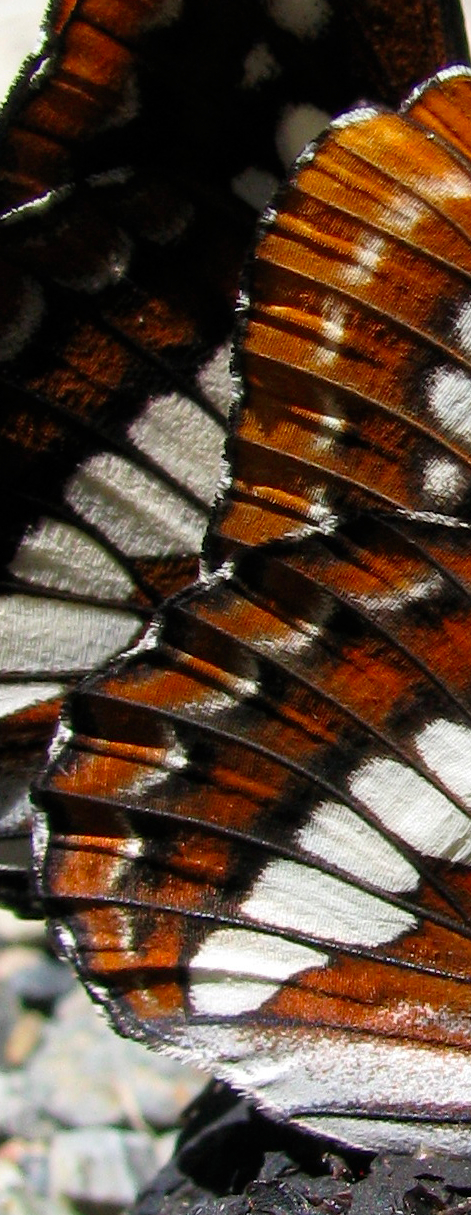
It is unbelievable to see these creatures in such detail. First, Limenitis lorquini.

Limenitis lorquini close-up.jpg

It is possible to see the wing-veins as the three-dimensional structures that they are. When we read that a new butterfly emerging from the chrysalis has to “pump up” its folded wrinkled wings, before they are strong enough to fly, these veins are the means. “The butterfly has to expand and dry [its wings] as soon as it emerges from the chrysalis. To do this, it uses its body as a pump and forces fluid through a series of tube-like veins. It’s a little like inflating a balloon — as the veins fill with fluid, they slowly stretch the surface of the wings.” Source.

Adelpha bredowii, closeup.jpg

Adelpha bredowii, trailing its long tongue over my skin.

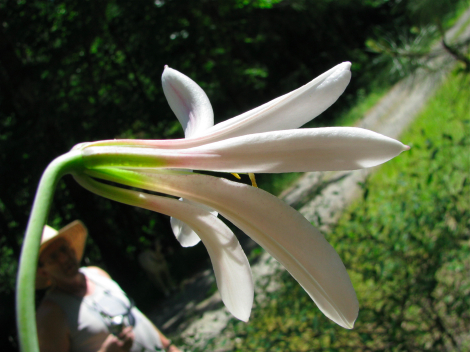
We went on to look at the Washington lilies described in my previous post. The blooms that were white and pink on June 24th,

Washington lily 3.jpg

today were nearly bright pink and drooping.

WashingtonLiliesOld.jpg

But another plant was in spectacular bloom.

Philadelphus lewisii-1.jpg

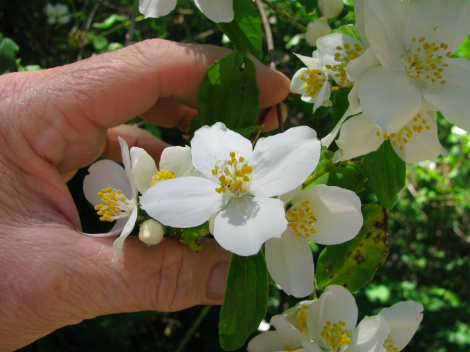
This is Philadelphus lewisii, commonly called mock orange for its fragrance. To me there was nothing citrus-y about the fragrance, but I’ve never smelled orange trees in bloom. (There are perhaps a dozen other plants also called mock orange, illustrating how treacherous common names can be.) Philadelphus lewisii is one of nearly 200 plants new to science which Lewis and Clark described. Indians used its straight stems in making arrows.

Philadelphus lewisii-2.jpg

On the drive back to the main road we saw many more, all in synchrony of bloom. It’s a shrub that can reach 12 feet, so it offers a lot of flowers! We had remarked earlier on how many butterflies were about, in the air: monarchs, tiger swallowtails, and others. Surely the Philadelphus extravaganza had something to do with the sudden abundance of butterflies, and we speculated on how insects and plants keep in step when the music of the dance—the temperature, rainfall, sunny or cloudy skies—can vary so drastically year to year. This long rainy spring was very atypical, yet after three sunny days here are the partners right in step.

Another unusual find will have to wait for my next post. It has something to do with this wild rose…

WildRose1.jpg

Siskiyou wildflowers: Washington Lily

Washington lilies buds.jpg

For two months we have been watching these lily plants, waiting for them to bloom. It took several days of sun and 80 degrees or so to coax them into revealing their flowers.

Washington Lily 5Dan.jpg

These are Washington lilies, Lilium washingtonium. The flowers are white, sometimes pinkish, with tiny pink or purple dots inside.

Washington lily 3.jpg

Despite the name, these are not found in Washington state, but only in Oregon and California. The plant was first described in 1859 by Albert Kellogg, who went against the usual practice of botanists and used the local settlers’ name, Lady Washington Lily, as basis for the scientific name. Presumably the settlers were referring to Martha Washington.

Turner calls them “uncommon”, and these are the only ones we have seen in our area. There are four plants within a six foot radius. One has had its top foot or so nipped off by some browsing animal, and one has not formed buds—too young perhaps.

Washington lily 2.jpg

Uncommonly beautiful they certainly are. And they bear a sweet fragrance.

Washington lily 4.jpg