
There was an unusually low tide last week, minus 2 to 2.5 feet, and we went over June 22nd to go tidepooling. Our destination was Gold Beach, on the rocky southern coast of Oregon, and our tidepooling was at Myers Rocks about 7 miles south of Gold Beach. We hoped to see nudibranchs, commonly called sea slugs––a canard, since many are so elegant and beautiful. [See Oregon nudibranch photos by others: 1, 2, 3, 4, several species, video.] But those are mostly found further north. We did see lots of sea stars, anemones, and smaller creatures, as well as a dead sea lion that had been washed up.

I posted a set of about 50 photos to a gallery on mobileme.com but was frustrated in being unable to add long enough captions, so I am using some of the photos, in smaller form, here with comments, our best efforts at identification, and a few photos found online. On mobileme I recommend using the “mosaic” viewing option from among those at the bottom of the screen; this will show thumbnails at the right, and you can click on any one to see it full-size, then either return to the mosaic view or continue in slideshow form.
Traces in the sand
The receding tide left most stretches of sand flat and smooth as can be; other places, where the water swirled out past rocks, had wonderful ripple patterns. And then there was this odd thing sticking up like a soft-serve “ice cream” serving.
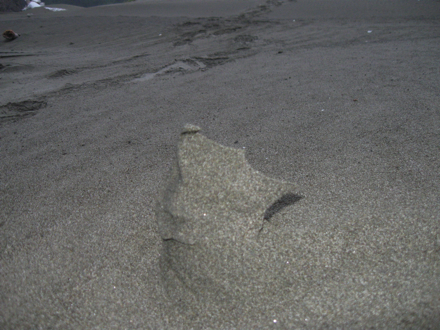
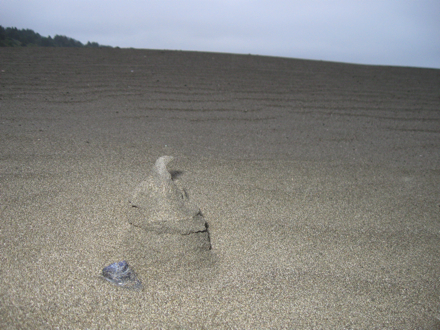
It was about about 10 inches tall, surrounded only by flat sand. Must have been an alien sand castle, and the builders left no tracks.
Other tracks were seen.

A few of the barnacle-covered rocks bore odd sandy structures, sometimes in a ring shape.

Something held this together, but what?
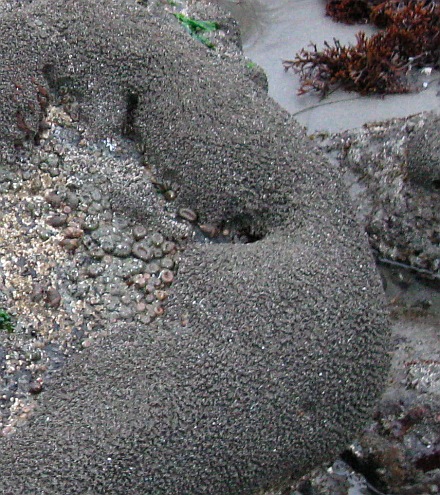
I did come across (but took no photos of) one that had crumbled a bit and when I examined a chunk it was still puzzling; mostly sand, with occasional fragile vertical rootlike things, connected to one another minimally if at all. Drawn away by things my naked eye could better appreciate, I didn’t examine this more closely but I hope someone may tell me more. There are some questions google can’t answer: googling “odd clumps of sand with rootlike things” doesn’t get much result. But of course a marine biologist, hearing that vague description, could immediately give me some likely candidates, and by asking a few more questions, probably identify it decisively. Score one for the human brain.
Sea Roaches, Barnacles, and Sea Stars
On another barnacled rock we found a scuttling little creature that made me think of a cockroach, and indeed turns out to be a Sea Roach or Rock Louse (perhaps the species Western Sea Roach, Ligia occidentalis). [Our identifications are the best we could do in a couple of hours at home, comparing our memories and photos with our field guides, including Ricketts & Hedgepeth, and also searching online, but they are open to revision. Leave a comment if you have suggestions or more information, please.]

There were Acorn Barnacles (a large group of species, barnacles without stalks)

and Gooseneck Barnacles, among Blue Mussels

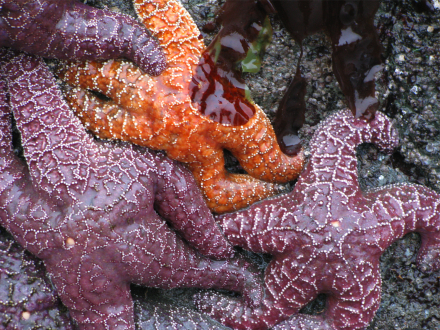
The most numerous creatures were Sea Stars, Pisaster ochraceus, generally known as the purple ochre star or ochre star (comes in brown, orange, and purple) and anemones, mostly Giant Green Anemones, Anthopleura xanthogrammica, which get their bright coloration from symbiotic, single-celled algae living within them.

Sea Stars get stiff and hard when the tide goes out, but their flexibility is evident from how they shape themselves to the rock.
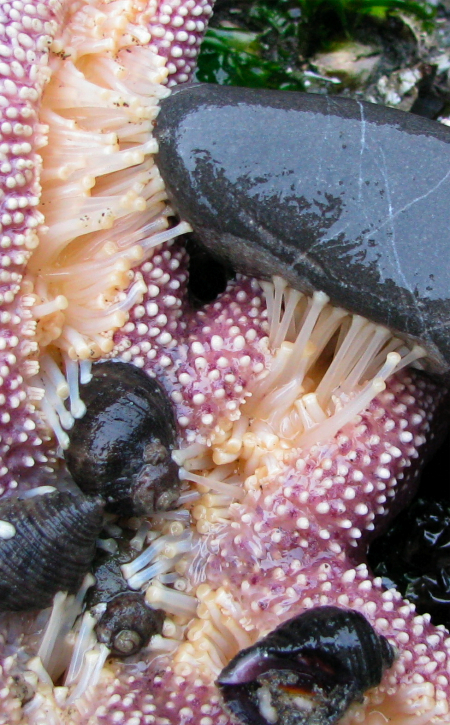
The mouth of the Sea Star is in the center, on the underside (oral side); it eats by everting its stomach through the mouth, enveloping and digesting its prey; it can pry open shellfish like clams with the hydraulically powered “suckers” or tube feet on its strong arms. The creatures inside the whelk shells being held next to the mouth, below, may be today’s lunch. Sea Stars themselves are a preferred food for sea otters.

Closer view of the tube feet.
Below, a closeup of the top side of a Sea Star; this is the aboral side, “away from the mouth”. (Not a typo for “arboreal”!) The white things are the so-called spines though they are just little nubbins really. More about Sea Stars, 1, 2.

Mollusks and others
Here’s a chiton, perhaps Katharina tunicata (Black leather chiton), about 1.5 inches long. Its familiars, whoever they may be, have nicknamed it “Black Katy”; knowing this, you too can be on casual terms with a mollusk!

These are primitive creatures, protected by overlapping segments of shell that flex enough so that they can move over uneven rocks and even curl up into a ball. Most eat algae that they scrape off the rocks beneath them using a radula, a hard sawtoothed band also found in predatory marine snails and squid. The Pacific Northwest is home to the world’s largest chiton, the Gumboot Chiton, up to 13 inches long and red as a brick. Wikipedia tells us that chitons were eaten by Native Americans, prepared like abalone: beat the large “foot” part until it is somewhat tenderized.
The wormlike thing (above and to the left of the chiton) is unidentified; our research turned up lots of possibilities, including some types that run 90 feet in length and maybe twice that (thus perhaps being longer than a blue whale!), but no way to tell for sure.
Another more familiar mollusk is the whelk. When you find whelk shells not firmly attached to rocks, they usually are empty ones that have been taken over by hermit crabs, but we found this one that had come loose but still had its original inhabitant. The visible part is the foot that mollusks use to attach themselves.

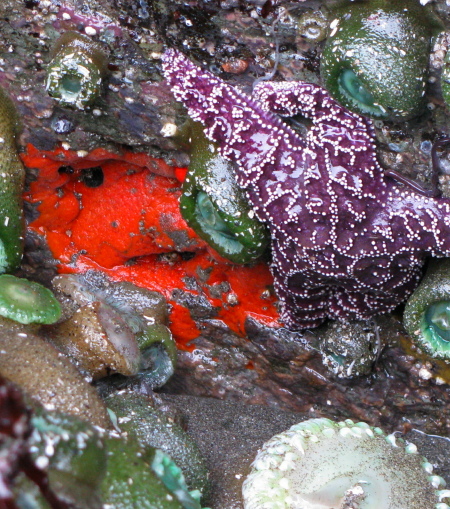
The bright red-orange creature below (we saw only one) is, we think, Ophlitaspongia pennata (Red encrusting sponge). Sometimes found with it is “a well-camouflaged little red nudibranch (Rostangea pulchra) on it or Rostangea’s red spiral eggcase”. But we didn’t see those.
Plant life revealed by the low tide
Sea Grass,

Kelp (actually not plants but algae, see below)

an unidentified vining sand plant,

and Sea Palms (Potelsia palmaeformis).

These Sea Palms, enlarged here, actually looked like silhouetted seabirds when I took the picture. Only when I enlarged it on the computer did I see what they really were. Wikipedia tells more: “Potelsia is a genus of kelp. There is only one species, P. palmaeformis. It is found along the western coast of North America, on rocky shores with constant waves. It is one of the few algae that can survive and remain erect out of the water; in fact it spends most of its life cycle exposed to the air. It is an annual, and edible, though harvesting of the alga is discouraged.” This made me look further, since if I ever knew that seaweeds were algae, I had forgotten. On algae, the Big W says “Algae, singular alga, (Latin for “seaweeds”), are a large and diverse group of simple, typically autotrophic organisms, ranging from unicellular to multicellular forms. The largest and most complex marine forms are called seaweeds. They are photosynthetic, like plants, and “simple” because they lack the many distinct organs found in land plants. For that reason they are currently excluded from being considered plants.” So, all that explains why these seaweedy things were up so high––the tide was low, but not so low that these seapalms would have been normally submerged, and I wondered about that. And now you know that if you want to call somebody really simple, you’d better liken him to an alga rather than a potato.
Birds and mammals
The bigger offshore rocks are nesting grounds for various sea birds, but none came near us. We were passed by a group of enthusiastic sea bird researchers in chest-high waders and rubber boots, off to climb one of the rocks and poke into nest burrows,
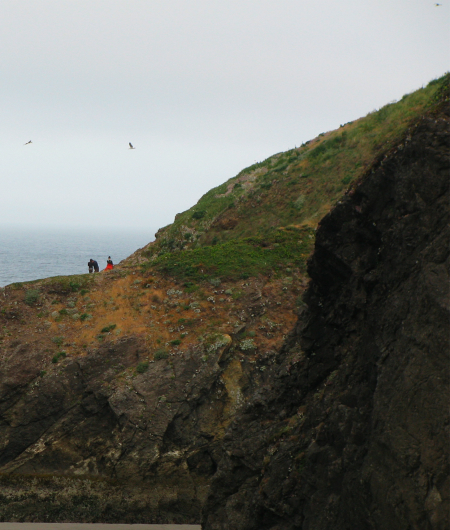
and later that afternoon we saw many Brown Pelicans, either on their way along the shoreline, or actually circling and diving for fish. Cormorants came for the fish too, riding the swells farther out than the diving pelicans, until they saw what they wanted. Also in the afternoon, as we walked and looked for agates (pretty rocks collected, many; agates, 3), we watched two seals close inshore, looked like a mother and youngster. All of these were beyond range of our cameras, but wonderful to see. It was sunny, hardly windy at all, and pleasurable to alternate between having warm bare feet above the surf line, and then chasing the churn of retreating sea-polished rocks and getting caught by knee-high icy waves.
WARNING: Next are several scenic photos, then a section of pictures I took of the dead sea lion we found on the beach as we left. If you do not want to see these, stop at the picture of the sunset.
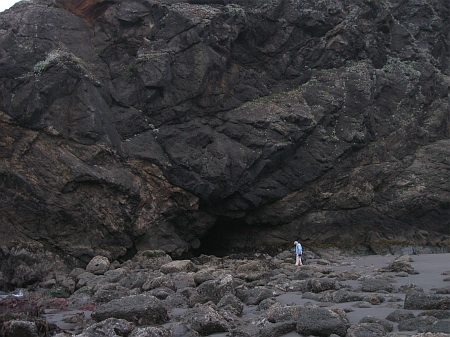
Gravity has its way with an anemone, when the water is not there to support it.

Another thing I learned while writing this, and as a logophile I found my ignorance embarrassing, is that there is no such word as anenome. I thought maybe anenomes were the flowers and anemones were the sea animals with toxic stingers, but anenome is as non-existent a word as George W.’s “nucular”. These,
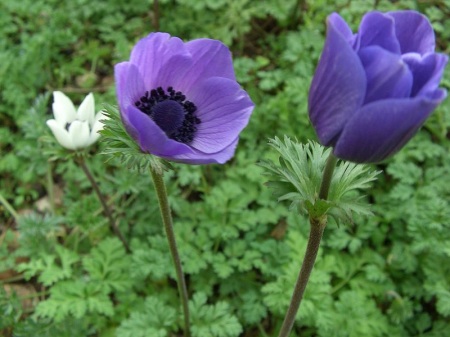
and these,

are anemones too, land plants rather than marine animals: Anemone coronaria (top) and Anemone narcissiflora (bottom) Photos from Wikimedia Commons.
Steller Sea Lion, Eumetopias jubatus, dead on the beach
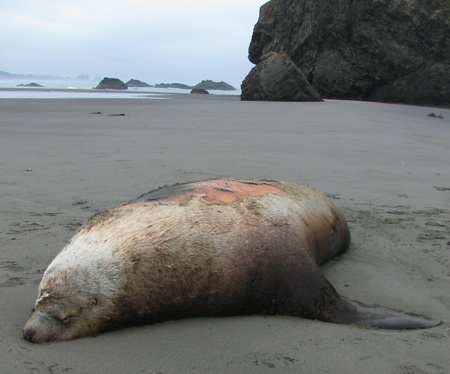
This sea lion bore several wounds that could have been the result of shotgun slugs––ocean fishermen resent the voracious consumption of salmon and other species by sea lions. In recent years, both this species and the California sea lion (Zalophus californianus) have gotten lots of bad ink and acrimony for their opportunistic predation on salmon when the fish bunch up at the dams on the Columbia River, on their way to reproduce and die. Of course the losses to sea lions are miniscule compared to the damage caused over the past century by overfishing, dams blocking rivers, and habitat destruction from logging (which damages fish breeding habitat in various ways including erosion that silts up rivers and streams).
We also thought these might be wounds made by sea gulls pecking their way in to eat what is, for a bird, a huge miraculous mountain of meat. But a fish and wildlife guy that we talked to later said the carcasses must be “pretty ripe” and rotten before a gull can pierce the thick skin. We wanted the f & w people to know, partly in case these were bullet wounds, and the man we talked to said they would send someone down with a metal detector. Both species of sea lion are protected by law.
This was a sad thing to see, especially if the death was caused by humans. If the animal had been alive we would of course have gotten it whatever help and protection we could. But it was too late for that, and what we were left with was an unusual opportunity for a close look. So what follows is not ghoulish or callous, though it may be unpleasant viewing for some.
The Steller Sea Lion is quite different in appearance from the California Sea Lion. The former has a blocky head and thick neck. The latter is sleeker, more gracile, with a slender muzzle, and is the model of what we think of when we hear the phrase “trained seal” although of course “true” seals––such as harbor seals––don’t have the ability to rotate their hind legs forward and “walk on all fours” that a “trained seal” demonstrates. True seals have to lunge and wriggle, on land; sea lions actually walk. Steller Sea Lion males may reach lengths of 11 feet and weigh 600-1100 kg (1300-2500 lbs). This specimen (sex unknown) was only about 6 feet long. The photo below shows the small external ear which is a distinguishing feature of the group of species known variously as eared seals, fur seals, or sea lions (Otariidae).

The closed eye, the lid of which appears swollen and damaged, is at left; the little comma-shaped ear is in the upper right.

Above, a view from the back shows one of the large holes. There were 5 holes visible. It seemed to us that none were close enough together to be wounds from the teeth of some big sea-lion-eating predator, such as an orca. Large areas of orange-ish skin are visible where the fur is gone, perhaps worn off by rubbing against the sandy bottom. The animal’s tiny tail can be seen between the two rear flippers. I took some close-ups of the claws visible on these flippers:
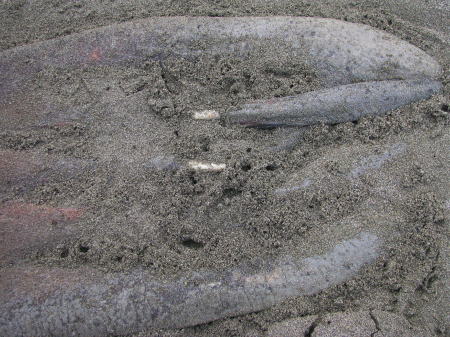
and here, on the other rear flipper, which was more damaged .

I found it hard to appreciate what they might have looked like in life, but was able to find a great photo online taken through the glass at the Sea Life Center in Seward, Alaska.
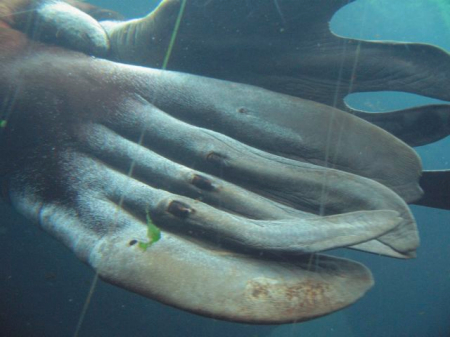
It was still hard for me to visualize the use of these claws, since they do not stick out past the end of the flippers, nowhere near. But here’s another great photo of an aquarium sea lion scratching, from flickr, and you can see how the flexible flipper can fold to allow the claws to stick out and scratch that itch. I cropped the photo to zoom in on the flipper. I think this is a California Sea Lion, based on the narrower snout.

Finally, the front flipper of the Steller Sea Lion found dead near Myers Rocks.

To end on a less somber note, there is a protected set of offshore rocks, called Rogue Reef Rocky Shore Area, about ten miles north of where we were: “More than 1,800 threatened Steller sea lions (45% of Oregon state total) use this reef, forming the largest pupping site for this species in the U.S., south of Alaska. Over 300 harbor seals are also found here. Approximately 4,000 common murres and more than 500 Brandt’s cormorants nest here” too.
In fact,
These rocks are part of the Oregon Islands National Wildlife Refuge which includes all of the state’s coastal rocks, reefs and islands (a total of 1,853) and two headland areas and spans 320 miles of the Oregon coast. All of the island acreage is designated National Wilderness, with the exception of 1-acre Tillamook Rock and Lighthouse, and public access is closed, to protect the birds and marine mammals.
Thirteen species of seabirds nest on this refuge [along the length of the state], including Common Murres, Tufted Puffins, Leach’s and Fork-tailed Storm-petrels, Rhinoceros Auklets, Brandt’s, Pelagic and Double-crested cormorants, and Pigeon guillemots. Harbor seals, California sea lions, Steller sea lions and Northern elephant seals use refuge lands for breeding and haulout areas. [Source]


 nosleepingdogs