
The first version of this was written a few weeks after the January 2010 earthquake in Haiti, but I felt it was a grim scene to put before others. As events have unfolded after July’s floods in Pakistan, I changed my mind.
As of September 3, 2010, the total aid supplied to Haiti by USAID, State, and DoD Humanitarian Assistance to Haiti for the Earthquake, in fiscal year 2010, was $1,139,632,618. Over one billion dollars, for an estimated 3 million people affected.
For the relief of the 20 million homeless victims of the Pakistan floods, “the U.S. has provided some $345 million in governmental assistance,” having more than doubled the contribution from the amount a month ago”. [as of Sept. 21, 2010].
Why the disparity?
Politicians and pundits have various reasons and excuses, from “it’s too big to comprehend” (“this is a disaster on a scale that people are struggling to understand. One-fifth of the area of Pakistan is reported to be devastated by the current floods, yet aid pledges are slow to appear. The flooded area is the same size as England”, Nick Clegg, Deputy Prime Minister, UK), to Pakistan’s bad international rep (“Pakistan is always the bad guy,” Mosharraf Zaidi says in Foreign Policy, to the floods being “a disaster which has unfolded quite gradually” instead of suddenly like an earthquake or a tsunami (UK International Development Secretary Andrew Mitchell). Then there’s the unmentionable elephant-in-the-room reasons, “because they’re Muslims” and “they’re helping the Taliban kill our troops in Afghanistan”. These last two carry some weight with certain elements of the general public in, say, America, but not so much with governments which recognize that keeping Pakistan from being further destabilized is important for the West’s own strategic and security purposes. And it’s the response, or lack of it, from governments that is the primary issue.
None of these is of significant importance, I believe, but they’re put forth because the real causes are too distressing to admit. Here is my list of reasons, and they’re not happy reading.
The “quadraplegic” analogy
When you rescue a drowning quadriplegic, you can’t just pull him out of the water, lay him down on the riverbank, and leave.
Haiti rubbed our faces in it, a glaring example: “relief” aid is not enough. Haiti was not a functioning country before the earthquake, and restoring the status quo isn’t really an option. Infrastructure, education, commerce, effective and honest government—all were anemic or non-existent. Worse yet: if the West waved some magic wand to conjure them up upon the ruins of Port-au-Prince, Haiti lacks the trained people, legal structure, and culture to maintain them. So the rescuer takes round his neck the millstone of deep long-term involvement, perhaps for a generation, as in the supposed Chinese proverb about how when you save a man’s life, you become responsible for it.
Afghanistan, Iraq, and pre-flood Pakistan are examples of the same situation: regions upon whom nationhood has been forced, now flying apart from tensions both internal and external, without the resources, desire or culture to transform themselves. And indeed why should they do so, to join a foreign world that would gladly ignore them as it did pre-earthquake Haiti, if it were not for oil and Middle East politics?
The prospect of more frequent disasters affecting more people
Climate change will likely bring more frequent severe weather events and natural disasters (floods, droughts, famines, hurricanes, cyclones, wildfires). As world population increases and clumps together in cities, disasters can affect more people.
Many of the fastest-growing cities are coastal and therefore more at risk for big storms, and “of the 33 cities projected to have at least 8 million residents by 2015, at least 21 are coastal cities that will have to contend with sea-level rise from climate change” as well. (State of the World 2007) In 1994, two-thirds of the world’s mega-cities were located in less developed nations, and the trend was “rapidly accelerating”. The UN predicted in 2008 that in Africa and Asia “the urban population will double between 2000 and 2030: That is, the accumulated urban growth of these two regions during the whole span of history will be duplicated in a single generation. By 2030, the towns and cities of the developing world will make up 81 per cent of urban humanity.” [emphasis mine]
According to UN figures, 324 global cities with a population of over 750,000 experienced rapid growth of more than 20.0% between 2000 and 2010. The fastest-growing city was Abuja in Nigeria (139.7% increase) followed by the Yemenite cities al-Hudayda (108.1% increase) and Ta’izz (94.0%). Of the 324 fastest-growing cities, 53.1% were located in Asia Pacific, 24.4% in Africa and the Middle East, 16.0% in Latin America and the remaining 6.5% in North America, Australasia and Western Europe.
Don’t think that the vaunted free-market expansion to developing nations will result in cities with adequate infrastructure and living-wage jobs for everyone. Just as in our own country, the free market is not a tide that lifts all boats. It can be thought of as a rising tide all right, but one flooding an island, where only the rich have the means to get to high ground, while the poorer you are the closer you come to drowning.
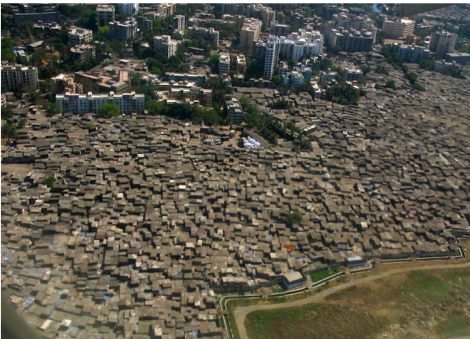
The economic growth we hear of in some cities, like Mumbai, does not extend to the ever-more numerous poor. Slums and high-tech companies in high-rises go on side by side. Both of the views below are of Mumbai. The slum occupants and their children are vanishingly unlikely to become participants in the high-tech boom. Rare exceptions, like the poor village-born protagonist in The White Tiger: A Novel by Aravind Adiga, get a chance to claw their way up by committing a crime to get capital, or by an act of fate as rare as a lightning-strike.[Slumdog Millionaire may be a feel-good film (I haven’t seen it) but that would be because it soothes us “Haves” by showing hope for people who as a group really have no chance of significant betterment. But that’s another subject. For a fictional synopsis of rural life, electoral practices, education of the poor, and other aspects of the “world’s largest democracy”, The White Tiger is worth a read. It reminded me of the works of early 20th C. American writers, the “muckrakers” and others, such as Frank Norris, Upton Sinclair, and Theodore Dreiser.]

In fact, most of Mumbai is slums, as seen in the census map below. Dark red indicates 60% or more of the area is slum. Light yellow areas are composed of 15% or less slum. The very pale blue areas are mud, and are larger than the white (no slum) portions of the city.

A disaster affecting any of these huge aggregations of people—who already live without safe housing, running water, sewage treatment, education, and so on—will, as in Haiti, defy traditional relief efforts and require extraordinary commitments. In Haiti, for example, “A preliminary study by Inter-American Development Bank economists indicates that it could cost as much as $14 billion to rebuild Haiti’s homes, schools, roads and other structures damaged” in the earthquake.
Wealthy nations will cry poor except when “charity” is a cover for national security
Poorer nations will be mostly on their own to deal with natural disasters, and the concomitant unrest of their own people. Highly contagious plagues will bring quick reactions from the developed nations, for obvious reasons. Likewise, if the developed nations’ interests or integrity are threatened by mass movements of millions fleeing starvation and lack of water, they will act, though one hesitates to imagine exactly how since meaningful relief of the suffering people is not feasible. I’d expect a return to the old policy of “containment”, this time against populations of defenseless refugees rather than communist ideology.
Today we have, according to the UN, 43.3 million refugees, internally displaced persons, and asylum-seekers worldwide. Pakistan has 1.7 million Afghan refugees, many of whom have been displaced since 1979. In a final blow, less developed nations will continue to be the battlegrounds of choice for wars begun by industrial nations for perceived national security purposes (resource control, demonstrating military dominance, justifying and testing new weapons, etc.).
Tight economic times
The economic condition of most Western nations today could charitably be described as precarious, with the US perhaps worse than most because of long-ignored needs ranging from public education to crime to infrastructure. With a frightening national debt, unconscionable political paralysis, and 10% unemployment that will feed new waves of house foreclosures, we can apparently only watch our country and its people in a race to the bottom where a new Great Depression awaits. In that climate, when word comes of millions starving overseas, the sententious will say “Charity begins at home” and the blunt will growl “Screw ‘em”. The politicians will make soft noises of sympathy when forced to by media exposure of death and destruction, and send token amounts of money and a couple of Navy ships full of surplus commodities and helicopters, to show the flag. Maybe Brazil and China, rising industrial stars, will then be the new cornucopias of aid to the developing world, but I rather doubt it. Unless it is in their national interest.
Inability to ensure that money sent is used as planned
Corruption of every sort flourishes, in inverse proportion to the power of established transparent legal systems that serve all citizens. As we have seen in Iraq and Afghanistan, billions may be spent to build things that turn out to be unfinished, shoddy, or even never begun. “More than $5 billion in American taxpayer funds has been wasted — more than 10 percent of the some $50 billion the U.S. has spent on reconstruction in Iraq, according to audits from a U.S. watchdog agency.” The 2008 and 2010 earthquakes in China killed a disproportionate number of children, revealing that many schools were not built as designed because of corruption; built, for example, without re-bar because officials connived at resale of the materials by crooked builders. NGOs often get better value for their money because they send people to be on the spot and help with the work, but utilizing that approach to build, say, ten thousand bridges and 2 million houses in Pakistan hardly seems feasible.
The Kerry-Lugar-Berman Bill included efforts to enforce transparency and accountability as to how the money was spent, but enforcing that in Pakistan, over hundreds of locations, seems unlikely to succeed.
Case in point: International response to the Pakistan flood
How has the US responded to the floods that have devastated Pakistan since July 2010? Administration sources have this very week been touting our allocation of $7.5 billion to Pakistan’s humanitarian needs. That sounds swell, but actually this money was dedicated to Pakistan last year in S. 1707, the Enhanced Partnership with Pakistan Act of 2009, also known as the Kerry-Lugar-Berman Bill. This bill was signed by President Obama back on Oct. 15, 2009. It provides $7.5 billion in mostly nonmilitary aid to Pakistan over five years,. (Mostly non-military: It does tie some funds to fighting militants, and all the money to a list of specified acts of cooperation with the US including giving the US relevant information from, or direct access to, Pakistani nationals associated with acquisition of nuclear weapons-related materials. [Text of bill here.] Because of such requirements, the bill is seen by Pakistani critics as violating their sovereignty.)
Recently parts of this already-committed money have been re-purposed, with ample publicity, to humanitarian assistance for the flood, and Kerry and Lugar have put forth another bill that would create a new fund to lure private enterprise to Pakistan, but it would use funds already appropriated in the previous aid bill.
How much new money has been directed to Pakistan by the US government, for flood relief and rebuilding? That is hard to know since reports lump re-direction of money already appropriated, in with new aid. According to the Toronto Sun on Aug. 30, 2010, “The United States is the single largest donor to the flood relief, contributing more than $200 million or over 20 percent of the total aid pledged so far”. At least $50 million of that appears to be already appropriated money re-directed from the Kerry-Lugar-Berman Bill of 2009. And, while I cannot look into the heart of any politician to see how they balanced compassionate response vs. US national security interests, it seems plain that the $7.5 billion of the 2009 Bill would not have been given to any country, however pitiful its condition, unless it had direct connexion with US national security. For the 2009 bill, the motives I would assign are 1) paying off Pakistan’s military and government for letting us cross their borders from Afghanistan to kill and abduct whomever we wish, and 2) heading off the further growth of extremist movements, and public sympathy with extremists, in Pakistan by improving conditions for the populace.
Now, after the floods, the money we are spending is for the second purpose, as various speakers including Sen. Kerry have made clear. Kerry visited Ghazi Air Base, a Pakistani military facility in the area first affected by the floods, met U.S. military personnel taking part in helicopter relief missions, and told reporters “we don’t want additional jihadists, extremists coming out of a crisis.” Again, I’m not accusing anyone of being heartless, only of not backing compassion with significant money except when there is a political payoff. Realpolitik.
Help from other countries has also been slow and small. “Donations to help with flood relief have been dismally low compared with those after other natural disasters, such as the Jan. 12 Haiti earthquake.” (Foreign Policy magazine, Aug. 19, 2010) A former U.N. relief coordinator who managed the international response to the tsunami in South Asia in 2004 said, “We got more in a single day just after the tsunami than Pakistan got in a month.” Muslim nations were not taking up the slack; until Saudi Arabia promised $20 million in late August, “no Muslim nation had given Pakistan more than the $5 million donation made by Kuwait, according to U.N. records”.
Even NGO response is halting. “According to The Chronicle of Philanthropy, twenty-two U.S. aid groups have raised a total of $9.9-million [for Pakistan flood work] while within two-and-a-half weeks of the Haiti earthquake, 40 aid groups had brought in a total of $560-million [as of Aug. 24, 2010]”.
An appeal at the UN in mid-September asked for $2 billion, prompting increased pledges from nations including Britain – $210 million, the United States – $340 million and the European Union $350 million. Saudi Arabia said it has now donated $345 million in government and public funds (what is the distinction? public=Islamic charities?). Iran allotted $100 million for its neighbor. It was not clear if the goal had been met. $2 billion sounds like a lot of money (and other funds have been promised by regional development banks and so on), but how does it compare to the need?
It is difficult to establish exact statistics on the scope of the flood disaster there. The UN says 21 million people have been affected, of an estimated population of 170 million. Pakistan’s government now estimates that more than 1.2 million homes have been damaged or destroyed. In addition, crops and foodstuffs in storage have been destroyed, innumerable roads and bridges swept away, and over 17 million acres of Pakistan’s agricultural land has been flooded by often polluted waters.

This map shows conditions as of 9/2/2010 and 9/6/2010. Red indicates severe damage, yellow moderate damage; dark grey areas in northern Pakistan are mostly inaccessible tribal areas with known but unassessed flood damage in the west. Map by UN/OCHA (Office for the Coordination of Humanitarian Affairs), from MapAction.
How does the UN’s goal of $2 billion stack up against the need? A billion is a thousand million. If $2 billion were spent on 2 million flood victims, it would provide $2000 each. But there are 20 million “affected”, so $2 billion is only $200 each. Millions need shelter, food, medical care, and clean water, for an undetermined period. Over a huge area, most human-made constructions have vanished or been damaged beyond repair. It’s estimated that 70% of the bridges in the flooded areas are destroyed, as well as all or most of the roads, schools, water treatment plants, irrigation systems, wells, houses, clinics, stores, small businesses and manufactories, and so on. Of course other organizations have and will provide some money and aid-in-kind, augmenting the UN’s $2B, but even if they doubled the $2B it would be a paltry sum relative to the task.
And after 10 months, how are efforts proceeding in Haiti?
Haiti may have benefited from greater international pledges of aid than Pakistan, but much of it is still “in the mail”. As of Sept. 29 2010,
Not a cent of the $1.15 billion the U.S. promised for rebuilding has arrived. The money was pledged by Secretary of State Hillary Rodham Clinton in March for use this year in rebuilding. The U.S. has already spent more than $1.1 billion on post-quake relief, but without long-term funds, the reconstruction of the wrecked capital cannot begin. With just a week to go before fiscal 2010 ends, the money is still tied up in Washington. At fault: bureaucracy, disorganization and a lack of urgency, The Associated Press learned in interviews with officials in the State Department, the Senate Foreign Relations Committee, the White House and the U.N. Office of the Special Envoy. One senator has held up a key authorization bill because of a $5 million provision he says will be wasteful.
Meanwhile, deaths in Port-au-Prince are mounting, as quake survivors scramble to live without shelter or food.
Nor is Haiti getting much from other donors. Some 50 other nations and organizations pledged a total of $8.75 billion for reconstruction, but just $686 million of that has reached Haiti so far — less than 15 percent of the total promised for 2010-11.
The lack of funds has all but halted reconstruction work by CHF International, the primary U.S.-funded group assigned to remove rubble and build temporary shelters. Just 2 percent of rubble has been cleared and 13,000 temporary shelters have been built — less than 10 percent of the number planned.
The Maryland-based agency is asking the U.S. government for $16.5 million to remove more than 21 million cubic feet (600,000 cubic meters) of additional rubble and build 4,000 more temporary houses out of wood and metal.
Source: AP.


 nosleepingdogs