Western Tiger Swallowtail butterfly, and a very close look at butterfly wing-color

We’ve gotten a few terrific photos of butterflies this year—some posted here and here— but none of the swallowtails has cooperated by alighting within range. When I saw one that had died and fallen to the road I carefully carried it home for the chance to get a close look.
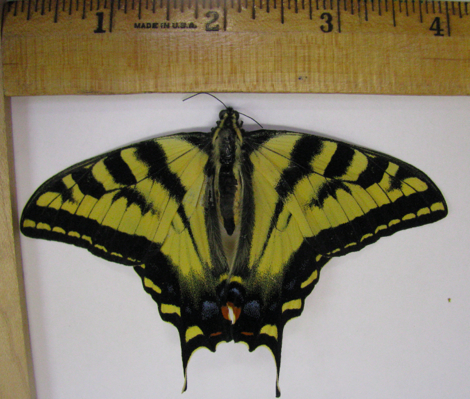
Papilio 02 Dorsal.jpg

There are at least three very similar species of swallowtail around here—the Anise, Western Tiger, and Oregon Swallowtails. Based on the red and blue markings I’m thinking this is the Western Tiger Swallowtail, Papilio rutulus.

Finer than “frog hair”—butterfly hair!

Enlarging the macro photos shows details such as hairs on the body and along the inner edges of the wings.

Papilio40 CLOSE 1.jpg

These hairs, called tactile setae, are attached to nerve cells, which relay information about the hairs’ movement to the butterfly. … Adults have tactile setae on almost all of their body parts. In both adults and larvae [caterpillars], the setae play an important role in helping the butterfly sense the relative position of many body parts (e.g., where is the second segment of the thorax in relation to the third segment). This is especially important for flight, and there are several collections of specialized setae and nerves that help the adult sense wind, gravity, and the position of head, body, wings, legs, antennae, and other body parts. In monarchs, setae on the adult’s antennae sense both touch and smell. (from monarchwatch.com).

In the photo below, a ventral view of the lower wings where they meet at their lowest point, there is also a delicate fringe visible along the edges. This could have aerodynamic as well as sensory functions.

papilio 46 CLOSE.jpg

From pointillism to nanostructures

Parts of the markings that appear as solid areas to our eye are revealed to be pointillist creations. I suspect we would need to know much more than we do about the vision of butterflies (and their predators?), in order to understand how these markings work for them.

Papilio42 CLOSE 1.jpg

The odd squareness of the smallest dots of color is not some pixellation in the photo, but an accurate representation. It shows the shape of the overlapping scales which form the surface of butterfly wings. Here are some microphotographs of wing scales at various magnifications, from Wikipedia.
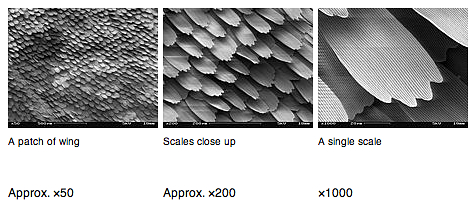
ButterflyWingScales.jpg

And here are color microphotographs showing the same squared-off dots along with the underlying scale pattern.

MicrophotographButterflyWingScales.jpg

Picture source.


It’s been known for some time that the colors of butterfly wings are partly from pigments but mostly from the microstructure of the scales, scattering light to produce the colors. Blues, greens, reds and iridescence are usually structural, while blacks and browns come from pigments. (Wikipedia).

But now we know more, and the more we know the more intricate and amazing it is. Research (published this past June) has been able to identify the light-scattering shapes from the wings of several butterfly species, and they are described as “ ’mind-bendingly weird’ three-dimensional curving structures… [resembling] a network of three-bladed boomerangs”. The name for these crystalline forms is gyroids, and they were first described

in 1970 by NASA physicist Alan Schoen in his theoretical search for ultra-light, ultra-strong materials for use in space. Gyroids have what’s known as an ‘infinitely connected triply periodic minimal surface’: for a given set of boundaries, they have the smallest possible surface area. The principle can be illustrated in soap film on a wireframe (see image below). Unlike soap film, however, the planes of a gyroid’s surface never intersect. As mathematicians showed in the decades following Schoen’s discovery, gyroids also contain no straight lines, and can never be divided into symmetrical parts. (source, text and soap-bubble photo: wiredscience.com)

Gyroid-like soap bubble.jpg

Gyroid-like soap bubble. Photo from wiredscience.com

So gyroids were introduced to humans as an imagined created form, something that is a mind-boggler for non-mathematicians to envision.

gyroid_hex.jpg

The image above is a mathematician’s representation of one of the simpler types of gyroid.

Materials scientists have learned how to make synthetic gyroids for photonic devices, such as solar cells and communication systems, that manipulate the flow of light.

gyroidProcess.jpg

A self-assembled solar cell begins with one of two polymers forming a “gyroid” shape while the other fills in the space around it. The inner polymer is dissolved away to create a mold that is filled with a conductor of electrons. The outer polymer is then burned away, the conductor is coated with a photosensitive dye, and finally the surrounding space is filled with a conductor of positive “holes”. A solar reaction takes place at all the interfaces throughout the material, and the interlocking gyroid structure efficiently carries away the current. (Source for image and caption, Cornell Univ.)

And when Yale evolutionary ornithologist Richard Prum got curious about exactly how butterfly wing-scales twisted light, he found gyroids. His team had to use an advanced microscopy technique with nanoscale resolution, called synchrotron small angle X-ray scattering, in order to see them, but there they were. (See note at end for citation of article in PNAS.)

The butterfly’s gyroids are made of chitin, not exactly the flashy material I would associate with iridescent wings. It’s

the tough starchy material that forms the exterior of insects and crustaceans. Chitin is usually deposited on the outer membranes of cells. The Yale team wanted to know how a cell can sculpt itself into this extraordinary form, which resembles a network of three-bladed boomerangs. They found that, essentially, the outer membranes of the butterfly wing scale cells grow and fold into the interior of the cells. The membranes then form a double gyroid—or two, mirror-image networks shaped by the outer and inner cell membranes. Double gyroids are easier to self assemble but they are not as good at scattering light as a single gyroids. Chitin is then deposited in the outer gyroid to create a single solid crystal. The cell then dies, leaving behind the crystal nanostructures on the butterfly wing.

“Like engineers, butterflies grow their optically efficient single gyroids through a series of steps that make this complex shape easier to achieve. Photonic engineers are using gyroid shapes to try to create more efficient solar cells and, by mimicking nature, may be able to produce more efficient optical devices as well,” Prum said. (Source)

In an interview about the work, Richard Prum said “We’re still trying to wrap our brains around gyroids and what they are.” The shapes seem to have evolved separately in several lineages of butterflies.

”It’s a Swiss cheese,” he adds, “with spiraling channels of air traveling through it that intersect one another. But those channels actually travel in three different dimensions through the cheese, and what you end up with is this very complicated form left behind, and that form is a gyroid.”

And while the idea of butterflies with Swiss cheese wings is slightly strange, Prum says it’s a very useful one for scientist and engineers looking for the next leap forward in electronic technology.

For example, Prum says, take the fiber-optic cables that carry phone calls under the ocean. These cables carry signals in the form of colored light, but it’s very difficult to insulate them well enough to prevent light from leaking out. Current transoceanic cables have to have booster stations built along them to keep the signal strong. But a layer of gyroids around the fiber-optic cable “would act like a perfect insulation to that fiber,” Prum says. The same tiny structures that give the Emerald-patched Cattleheart its lovely green patches could also be used to keep green light from escaping a fiber-optic cable.

ButterflyScalesGreen.jpg

The vivid green color of the scales of this Papilionid butterfly are produced by optically efficient single gyroid photonic crystals. Caption and photo from www.physorg.com

Right now, it’s expensive and impractical to manufacture gyroids small enough to do that job. But butterflies hold the secret to growing them naturally. “If you could grow one, at exactly the right scale, as butterflies do,” says Prum, “you could make these things a lot easier.” (NPR interview, Jul 3, 2010)

This is a fine example of how curiosity can lead us to unexpected discoveries. The original question is one that could be used by certain Congressional anti-intellectuals in their periodic efforts to discredit basic research: “Imagine, all this work to find out what makes the color on butterfly wings! How ridiculous!” The research and technological developments that are thought “useful” by these folks had their origins in someone’s basic research, sparked by human curiosity. From butterfly wing-color to, perhaps, more efficient fiber-optic cables or solar energy collectors. It’s called bioengineering: investigating the functions and structures of nature, to derive principles and patterns for technological innovations. But for me it’s satisfying in itself, the revelation of these marvelous structures, underlying the evanescent beauty of a butterfly.
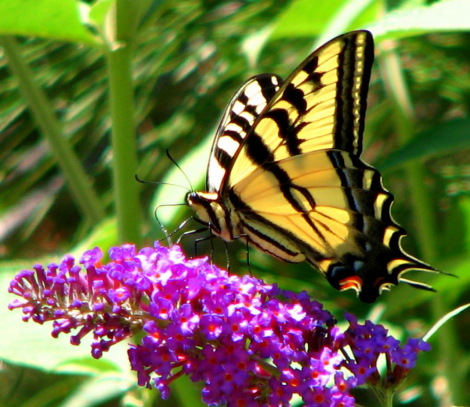
Papilio rutulus.jpg

Western Tiger Swallowtail butterfly on Buddleia bloom. Photo by terwilliger911, flickr.

Note: The article describing gyroids as the structure causing some colors in butterfly wings is:
Structure, function, and self-assembly of single network gyroid (I4132) photonic crystals in butterfly wing scales.
Vinodkumar Saranathan et al. Proceedings of the National Academy of Sciences. Published online before print June 14, 2010, doi: 10.1073/pnas.0909616107. The abstract is available free, but the article requires purchase or subscription to PNAS. There is a supplementary article here that contains some interesting images and very technical text. There’s even a movie you can watch showing a slice-by-slice trip through a certain sort of gyroid, or as the text says, though “the pentacontinuous volume of a level set core-shell double gyroid structure”.

Frog changes color with changed surroundings

I really wish I’d taken a photo of this frog when I found her this noon, sheltering on the porch next to the wall. There were some beer 6-pack carriers there waiting return to the store and when I picked one up there was this big dark frog clinging to the side. She (well, she just seems like a “she”) was a very dark brown tinged with green all over, with some darker mottling on her back, and sparkling gold stripes above her eyes. I caught her up and put her in our 100-gallon pond, on the lotus and water hyacinth leaves.

This afternoon, here she is, transformed in color.

FrogChangesColor.jpg

The dark splotches on her rear are about the color that her entire body was, about six hours ago.

It was only recently that I learned frogs could do this, so now having seen it in action I had to talk about it. Apparently it’s an ability found in many species, and the frogs can change as a result of light, humidity, surroundings, or “mood”. Whatever that means. The frog changed and the researcher cannot see any objective alteration in environment so it’s put down to “mood”.

Fear or excitement makes many frogs and toads turn pale, but others, like the African clawed frog, darken when disturbed. Another African frog is normally green, but turns white in the heat of the day to reflect heat and keep cool. The tiny African arum frog is ivory white and lives in the white blossoms of the arum swamp lily. When the blossoms die, the frogs turn brown to match. from exploratorium.edu.

We think she’s probably a Pacific Tree Frog (Pseudacris regilla).

[Etymological note: Pseudacris from the Greek pseudes (false) + akris (locust) — alluding to the frogs’ song?; regilla from the Latin regilla (regal, splendid) — probably referring to the markings.]

Siskiyou Wildflowers: Mt. Ashland in July, part 2

So many flowers!

We’ve made two trips to Mt. Ashland (Southern Oregon), on July 22 and 31, along a gravel/dirt forest road noted for wildflowers, and it was a new experience: instead of marvelling at a single flower or small patch of flowers, we saw slopes red with Indian Paintbrush or Scarlet Gilia, places with a dozen different flowers blooming in a 50 foot stretch. On gentle slopes where the snow has recently melted, plants grow so thickly it’s hard to see which leaves belong to which flowers. This is Forest Road 20, for those who might want to visit, and it’s the continuation of the main paved road that goes to the Mt. Ashland ski area. Just keep going, and the road soon turns to gravel and there are meadows of wildflowers on each side. A few miles later the road winds into a drier area with few but choice species, such as various penstemons as well as paintbrush, gilia, eriogonum, and many more. For us novices, identifying what we’ve seen and photographed has been a challenge.

Here are some of the plants we’ve seen on these two trips. Others were included in the earlier “Part 1” post. [Our identifications are the best we have been able to do, but shouldn’t be considered authoritative.]

Castilleja species along a seep.jpg

Castilleja (Paintbrush) along a trickle of water. Not sure of the species, but it doesn’t have the wavy leaves of C. applegatei.

Tiny wildflowers like this one are easy to overlook, hard to identify. For scale, that large pink object on the left is part of my finger. The entire plant was only two or three inches tall, and was growing in a wet sandy area.

Mystery tiny pink flower.jpg

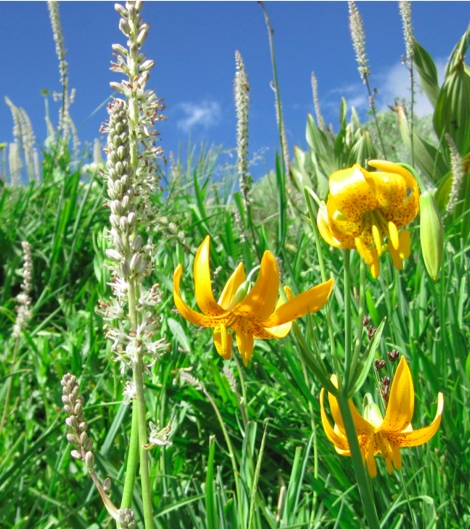
Lilium pardalinum, Veratrum californicum (foliage), .jpg

The striking yellow lilies above are Leopard Lilies (Lilium pardalinum), native to Oregon and California. The spires of white flowers are White Schoenolirion or White Rush-lily (Hastingsia alba; also called Schoenolirion album).

[Etymological note: pardalinum is an adjective from the Greek pardalis, female leopard (meaning spotted like a leopard); Hastingsia after Serranus Clinton Hastings (1814-1893), first Chief Justice of the Supreme Court of California, who helped publish The Botany of the Pacific Coast edited by Asa Gray, Sir Joseph Hooker and J. D. Whitney; album and alba are from the Latin albus (white); Schoenolirion from the Greek schoinos (a rush), + lirion (lily).]

Lilium pardalinum, Leopard Lily CLOSE.jpg

The White Rush-lily is in the lily family; it grows from a bulb, and has the flat strap-like leaves characteristic of many lilies. The mixed species of plants were so dense in some places on Mt. Ashland that it was hard even to find the foliage of a particular species, much less photograph it, but the picture below shows a big area where White Rush-lily alone grew.

Hastingsia alba, foliage.jpg

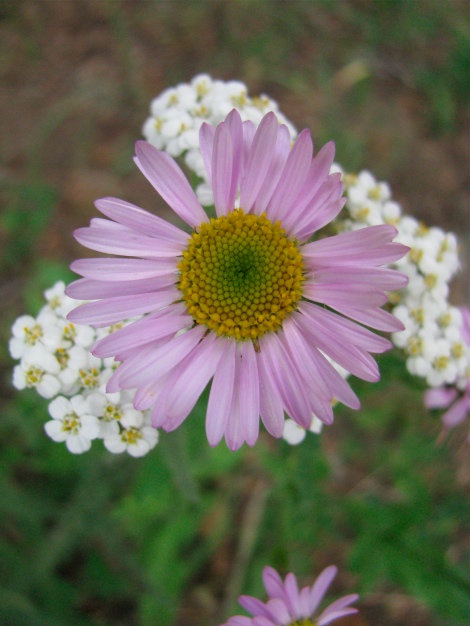
Aster family purple, and yarrow.jpg

A purple flower in the aster family, but which one? In the background is Achillea millefolium, Common Yarrow.

Out of the ordinary Owl’s Clover

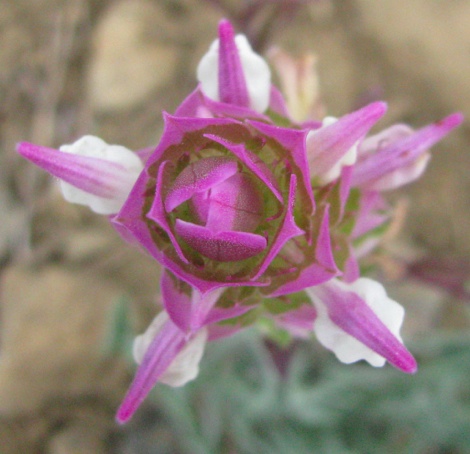
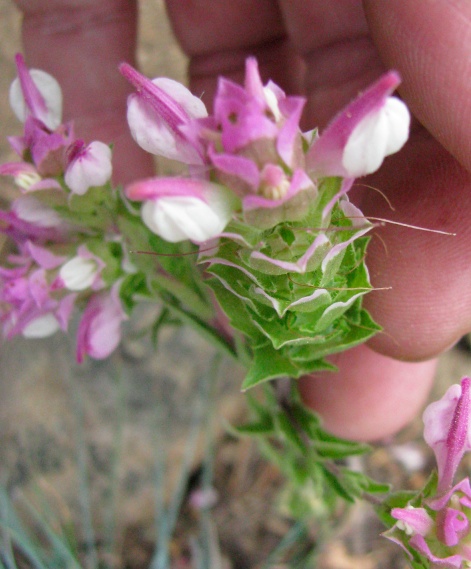
Next is an unusual flower, Toothed Owl’s Clover (Orthocarpus cuspidatus). Owl’s Clovers are in the Snapdragon family along with Paintbrushes (Castilleja genus), Foxgloves, and Penstemons (Beardtongues). Because it is so remarkable, I’m going to include pictures of it from several points of view. From above, looking down on the upright flower.

Owl'sCloverTopView1.jpg

Below, another top view of a rather different-looking individual, missing some of its parts or having developed differently.

Owl'sCloverTopView2.jpg

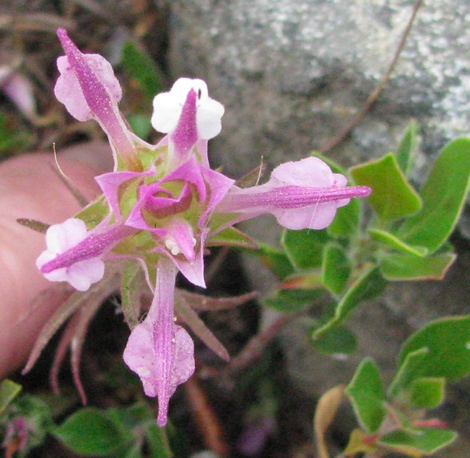
Two views from the side.

Owl'sClover.jpg

Owl'sClover2.jpg

Owl’s Clovers are not just unusual in appearance, but also in their natural history. They are annuals, and

if the first roots emerging from a germinating Owl Clover seed find themselves near the roots of a neighboring plant of a different species, such as prairie lupine, it will initiate structural connections called haustoria. These are modified roots capable of causing infection in the host plant.

The haustoria invade, literally grow into, the inner tissues of the host lupine’s roots. The Owl Clover haustoria are triggered into formation when the lupine itself exudes chemicals from its roots; that is, the lupine chemically signals its presence to the Owl Clover. The haustoria connections are all completed and in place within a few hours! With functional haustoria in place, Owl Clover’s growth is accelerated. The Owl Clover gains water, minerals and energy from the host plant. Being an annual, Owl Clover has a relatively small root system, so getting extra food really helps its growth rate. This host-parasite relationship is called heterotrophy, the opposite of autotrophy [self-sustaining by photosynthesis]. Being semi-parasitic [capable of both parasitism and if necessary autotrophy], Owl Clover may engage in both at the same time.

Owl Clover, when functioning as a parasite, also takes in toxic chemicals the host plant produces; lupines have alkaloids (remember, plants like lupines are poisonous to livestock). These toxic chemicals are distributed into the Owl Clover’s stem and leaf tissues. The consequences? The presence of the poisonous alkaloids, botanists have learned, reduces the level of feeding (herbivory) by butterfly and moth larvae that favor Owl Clover leaves for their growth and development. Larvae feeding is hindered by the presence of the poisons, and the Owl Clover retains more of its leaf tissue for photosynthesis, an obvious benefit. Butterfly and moth larvae need alternative leaves to eat, but that’s impossible since mature butterflies and moths lay their eggs on developing Owl Clover plants not knowing if the leaves are toxic or not. Larvae, it’s assumed, survive better, and develop to maturity by feeding on Owl Clovers that are not parasitizing a lupine or other toxic host plant.

There’s one remaining piece of this interesting relationship to be told: studies suggest that Owl Clover’s flower nectar is not contaminated by the toxic alkaloids. Perhaps the alkaloids are detoxified by some means before reaching the nectar glands. Why is this important? Visiting pollinators, such as hummingbirds or bumble bees, can harvest the Owl Clover’s nectar reward without suffering ill effects. [Source article by Jim Habeck, professor emeritus of botany at the University of Montana]

Representations of the seeds and seed-pods of wildflowers seem hard to find; after the colorful floral show is over, the photographers lose interest just as the pollinating bees and hawkmoths do. But in my Owl’s Clover wanderings I came across photos here of the seeds and pods of two species. Looking at the flowers, I wouldn’t have expected this:

Orthocarpus purpurascens SEED POD.jpg

Seeds and seedpod of Purple Owl’s Clover (Orthocarpus purpurascens, also called Castilleja exserta). Not the species we saw, but it has a similar flower so probably the seedpods are similar.

[Etymological note: Orthocarpus, from the Greek ortho (straight, upright) + carp- (fruit, seed); cuspidatus, from the Latin cuspis (lance, point); purpurescens, becoming purple, from the Latin purpura (purple); Castilleja, named for Domingo Castillejo (1744-1793), Spanish botanist and Professor of Botany in Cadiz, Spain; exserta, from the Latin exsertus, past participle of exserere (to thrust out, from ex- + serere to join).]

Wavy-leaf Paintbrush and hand signals

Castilleja applegatei, Wavy-leaf Paintbrush.jpg

This, I think, is Wavy-leaf Paintbrush (Castilleja applegatei)

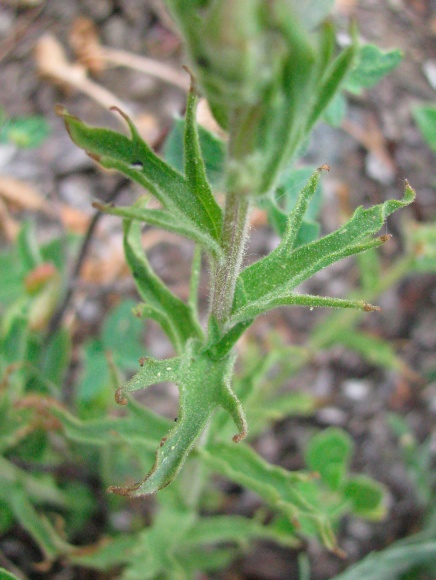
Castilleja applegatei, Wavy-leaf PaintbrushLEAVES.jpg

Here are the wavy-edged 3-lobed leaves. Some leaves are single, not lobed.

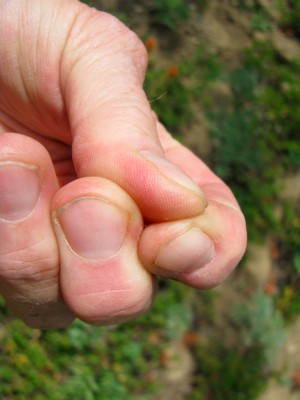
And this is my hand signal to tell myself that the flower felt “sticky”! I have found I have trouble remembering these things days later when I am looking over 300 photos, sometimes of more than one species of the same genus. Now which one had the sticky flowers? It’s characteristic of some Paintbrushes and not others, so knowing helps to identify these tricky guys.

Another difficulty was that if two similar species were photographed one after the other I couldn’t be sure where the first one ended, in the series of photos. Now when I finish photographing one species I take a “spacer” photo of my foot in its red sandal. Sounds odd but seems to be helping.

[Etymological note: Castilleja, named for Domingo Castillejo (1744-1793), Spanish botanist and Professor of Botany in Cadiz, Spain; applegatei, named after Elmer Applegate (1867-1949), a student of the flora of Oregon best known for his monograph of trout lilies (Erythronium).]

Thistle, Buckwheat, Roses and more

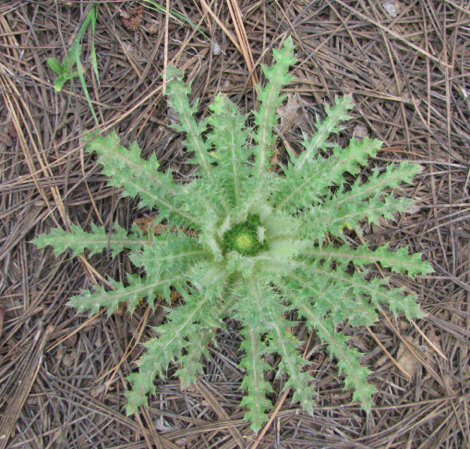
Cirsium scariosum, elk thistle CLOSE.jpg

Above is a close-up of the center of a flat-growing thistle, called Elk Thistle (Cirsium scariosum). All our other local thistles send up tall stems defended with spiky leaves and ending in one or more flowers, but this one grows and flowers at a height of just 2 or 3 inches. The plants we saw were up to a foot in diameter.

Cirsium scariosum, elk thistle.jpg

[Etymological note: Cirsium from the Greek kirsion (a kind of thistle) in turn from kirsos (a swollen vein or welt) because thistles were often used as a remedy against such things; scariosum from “New Latin” (=concocted by moderns) scariosus c. 1806, origin uncertain (dry and membranous in texture, chaffy, brown).]

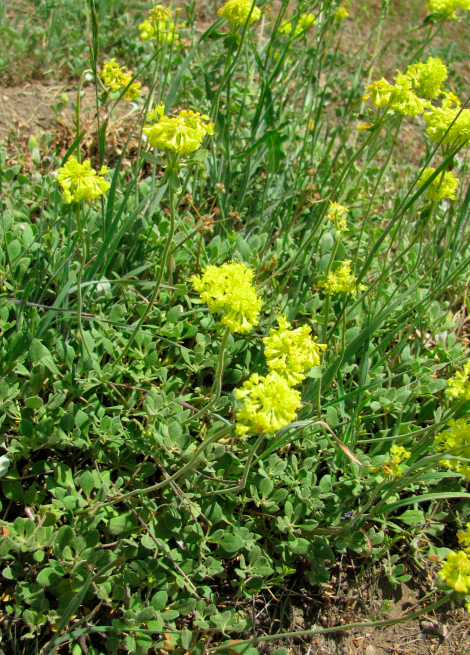
Eriogonum umbellatum, Sulphur-flower Buckwheat.jpg

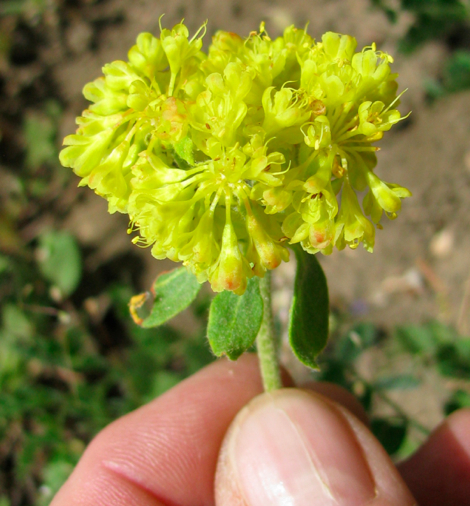
Sulphur-flower Buckwheat (Eriogonum umbellatum). The genus Eriogonum is in the same family (Polygonaceae) as the field crop buckwheat, and the seeds of some species are important for wildlife. The name ‘buckwheat’ or ‘beech wheat’ comes from its triangular seeds, which resemble the much larger seeds of the beech nut from the beech tree, and the fact that it is used like wheat [Wikipedia].

Eriogonum umbellatum, Sulphur-flower Buckwheat CLOSE.jpg

[Etymological note: Eriogonum, from the Greek erion (wool) and gony (knee or joint), so called because the jointed stems are covered with hair; umbellatum, from the Latin umbella (sunshade), diminutive of umbra (shadow), and refers to the arrangement of the flowers which arise in a head from a central point, i.e. bearing an umbel.] Now that I know this odd bit about the meaning of Eriogonum, I’ll be looking for those “hairy knees” on wild buckwheat plants in future.

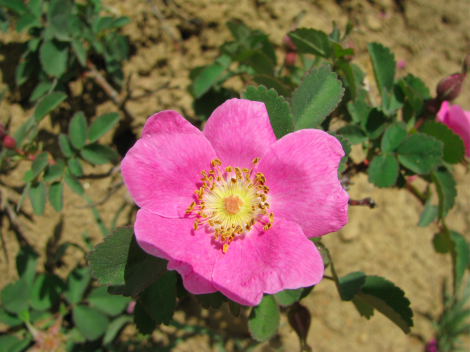
Rosa woodsii, Woods' rose.jpg

Small patches of these vivid pink roses were blooming in areas of loose dry soil, and the plants were only a few inches tall. I think it’s Wood’s Rose (Rosa woodsii).

[Etymological note: Rosa, from the Latin rosa (rose), in turn derived from the Greek rhodon (rose); woodsii, after American botanist Alphonso Wood (1810-1881).]

Penstemon azureus, azure penstemon.jpg

We think this Penstemon is Azure Penstemon (Penstemon azureus). At their peak the flowers must have been glorious.

Penstemon azureus, Azure penstemon, LEAF.jpg

The broadly oval leaves are distinctive, and seem to clasp the stem as described for this species.

[Etymological note: Penstemon from Greek penta- (five) + Greek stēmōn (thread, here meaning stamen); azureus (of a deep blue color) from Arabic via Old French azaward which developed from Arabic lāzaward, from Persian lāzhuward, of obscure origin—in Old French the initial ‘l’ was dropped from the word proper and turned into the definite article “le” as if it were French: l’azaward].]

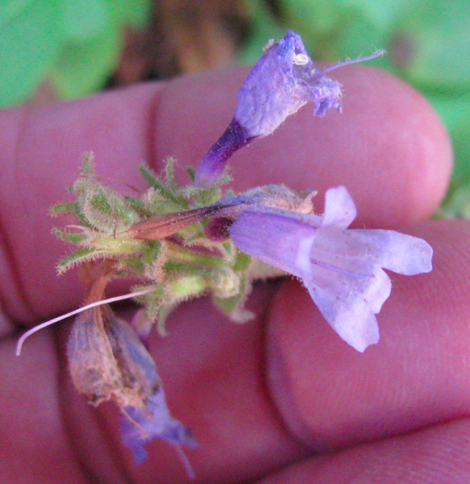
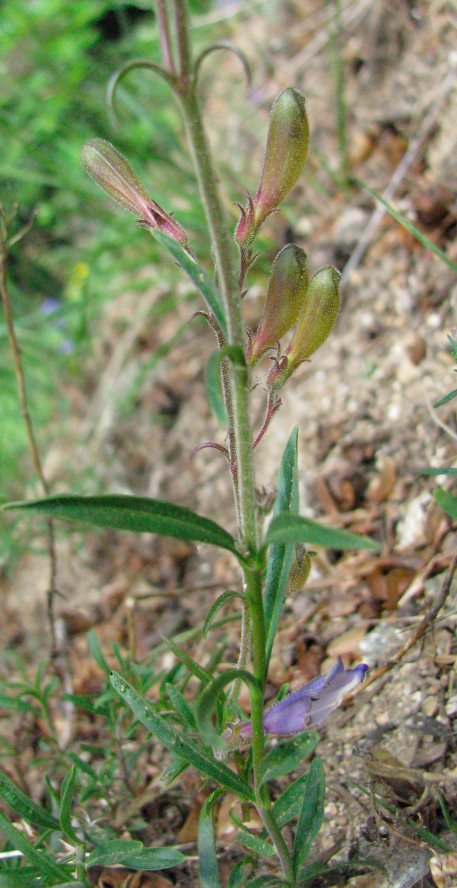
Here is a beautiful penstemon we are not able to identify.

Penstemon, unknown species 1 FLOWERS.jpg

Penstemon, unknown species 1 CLOSE.jpg

The difference in flower color between these two pictures is due to light conditions; the one taken in full sunlight is actually a bit washed out compared to how the colors appeared to my eye, and the one taken in shade is more accurate.

Penstemon, unknown species 1 LEAF.jpg

The buds and long narrow leaves of this penstemon.

A second unidentified penstemon.

Penstemon unknown species,#2 CLOSE .jpg

The leaves are quite different from the first unidentified one.
Penstemon unknown species,#2 .jpg

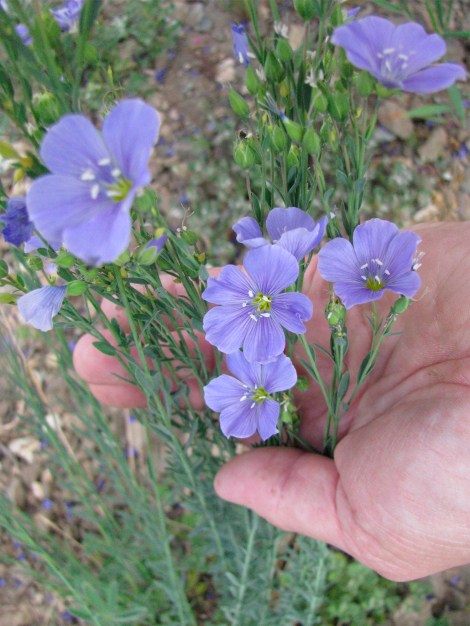
We saw many more flowers on these two trips, but I’ll stop with this one, Western Blue Flax or Prairie Flax (Linum lewisii, also called Linum perenne var. lewisii).

Linum lewisii (Linum perenne var. lewisii), Lewis flax, blue flax, prairie flax2.jpg

Western Blue Flax is very similar to the European Flax plant from which linen is made; indeed, some consider the two a single species, Linum perenne. Native American peoples used flax fiber for cordage and string, as well as for mats, snowshoes, fishing nets and baskets.

Linum lewisii (Linum perenne var. lewisii), Lewis flax, blue flax, prairie flax CLOSE.jpg

[Etymological note: Linum from Latin linum (flax, linen); lewisii, for Captain Meriwether Lewis (1774-1809) of the Lewis and Clark expedition of 1804-1806; perenne from Latin perennis (lasting through the year or years) from per- (through) + annus (year), botanical sense of “Remaining alive through a number of years”.]

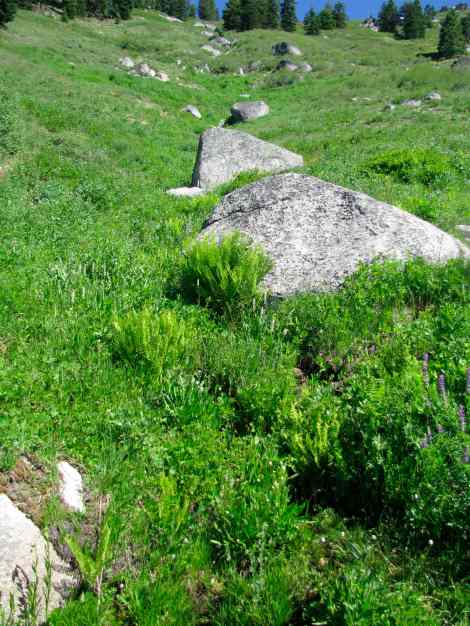
Mt. Ashland flower scene.jpg

View of Mt. Shasta from Mt. Ashland, July.jpg

View of Mt. Shasta from Mt. Ashland.

Siskiyou Wildflowers: Mt. Ashland in July, part 1

On July 22nd we left our usual nearby wildflower haunts and headed to Mt. Ashland, drawn by a brochure given us by the local ranger station. It’s called Wildflowers of Mount Ashland and the Siskiyou Crest from Mount Ashland to Cow Creek Glade, and shows small photos of 82 different flowers that may be found along Forest Road 20. There’s also concise information about each one as to wet/dry/shade habitat, location on the road, and height. The Siskiyou Chapter of the Native Plant Society of Oregon produced this, and did a great job. We’ll be joining, to support such efforts.

The day on the mountain was perfect: we left behind the valley where the temperature was headed for 100°, for an airy sunny breezy place from which Mt. Shasta was visible.

Mt. Shasta.jpg

There were still a few areas of snow, and meadows moist from springs and snowmelt.

A small seep of water flows down this crease in the land, with plants most dense where the ground levels out a bit.

Water seep line.jpg

Habitats vary from dry and rocky to wet at this time of year. Peak flowering time is July and August. We saw many wildflowers—not all 82, but we’ll go back in a couple of weeks and see what else has appeared. Here’s a first installment of what we saw.

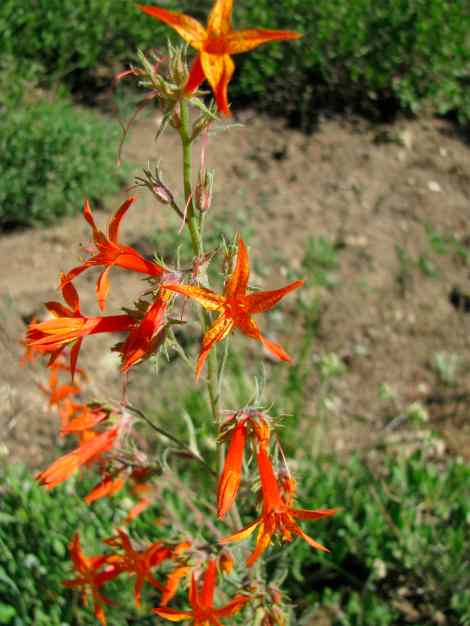
Ipomopsis aggregata, Scarlet Gilia #  - 06.jpg

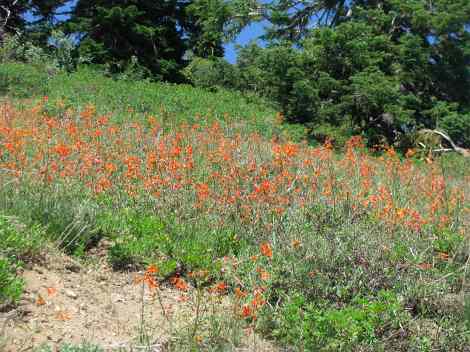
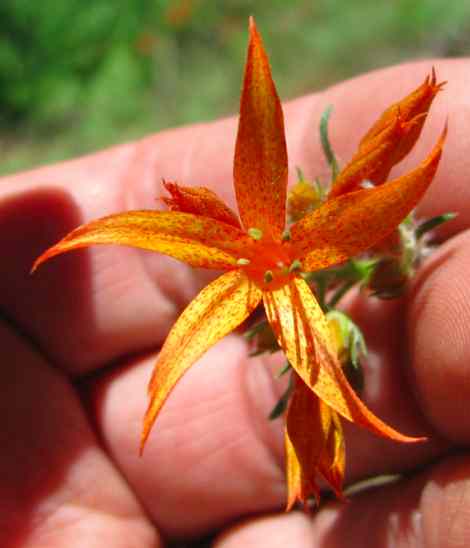
The most numerous species we saw was Scarlet Gilia (Ipomopsis aggregata). There were isolated plants, there were swathes of red. It was hard to believe something so bright and beautiful could be so abundant. [Etymological note: Ipomopsis is said to be from a Greek root meaning “striking in appearance,” but no one seems to be able to substantiate it; the species name means “flocking together,” or growing in groups, clustered, from Latin gregis (a flock) and the suffix -gate from agere (to set in motion, to drive, to lead).

Ipomopsis aggregata, Scarlet Gilia en masse.jpg

Ipomopsis aggregata, Scarlet Gilia CLOSE.jpg

Below is a yellow paintbrush, called Cobwebby Paintbrush, (Castilleja arachnoidea). Its leaves are narrow—the wide tapering hairy leaves belong to another plant that grew close in among the Castilleja. [Etymological note: named for Professor Domingo Castillejo (1744-1793), a Spanish botanist and instructor of botany at Cadiz, Spain; from Greek arachnes (spider), arachnion (spider web), like a spider’s web.]

Castilleja arachnoidea.jpg

Another Castilleja sp., but which one? Wavy-leaf Paintbrush (C. applegatei) was pictured in our guide to Mt. Ashland, but this plant did not have the distinctive wavy leaves.

Castilleja Sp. A.jpg

The next two photos show a small plant called Pussy Paws, for the soft fuzzy flowerheads(Calyptridium umbellatum). The second one pictured is the pink variety. [Etymological note: from the Greek kaluptra (a cap or covering) because of the way the petals close over the fruit; umbellatum meaning “having an umbel”, botanical term for a cluster of flowers with stalks of nearly equal length which spring from about the same point, like the ribs of an umbrella, and derived from Latin diminutive of umbra (shadow).]

Calyptridium umbellatum, Pussy Paws .jpg

Calyptridium umbellatum, Pussy PawsPINK.jpg

Two orchids were prize finds, in shady spots. Both are Uncommon, according to Turner. First the oddly named Short-spurred Rein Orchid (Piperia unalascensis). Living in the Pacific Northwest, even in a dry part of it, one wants to call this a “Rain” orchid, but all sources agree it is “Rein”. One writer alleges that it’s so named for the strap-like lower lip on each tiny flower, but I don’t really see it. [Etymological note: named after Charles Vancouver Piper (1867-1926), an agronomist with the US Department of Agriculture and an expert on Pacific Northwest flora; species name refers to Aleutian Islands (Unalaska) where species was first found. The Unangan people, who were the first to inhabit the island of Unalaska, named it “Ounalashka” meaning ‘Near the Peninsula’, according to Wikipedia. ]

Piperia unalascensis, Short-spurred Rein Orchid CLOSE.jpg

Below, not in very good focus, is the entire plant next to an Indian Paintbrush (Castilleja), species unknown.

Piperia unalascensis, Short-spurred Rein Orchid .jpg

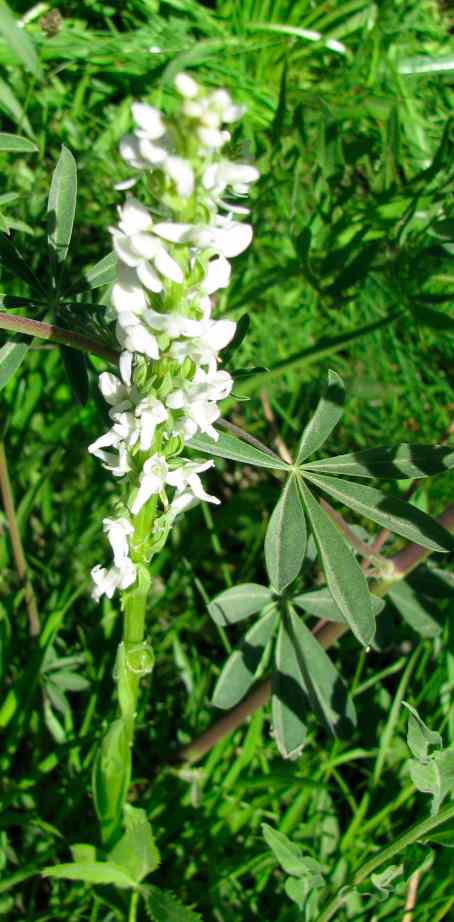
The White Bog Orchid (Platanthera leucostachys) below It’s also called the Sierra Bog Orchid. The palmate leaf and thick stalk on the right belong to a lupine. [Etymological note: from the Greek “platanos” (broad or flat), and Greek anther (from Greek anthera, feminine of antheros (flowery) from anthos (flower), here anther is the botanical term, referring to the upper part of the stamen, containing pollen; species name from the Greek leukos (white) and Greek stachus (ear of grain or a spike) in reference to the spike-like form of the flowers.]

White bog orchid, Platanthera leucostachys   - 1.jpg

White bog orchid, Platanthera leucostachys CLOSE.jpg

Orange Agoseris (Agoseris aurantiaca), bright as the sun. [Etymological note: Agoseris was the Greek name for a related plant “goat chicory” and the word is usually seen as deriving from derived from Greek aix (goat) and seris (chicory). Some members of the Agoseris genus have woolly stems or leaves, possibly relating to the “goat” connexion. Species name aurantiaca from the Latin (orange, orange-yellow or orange-red), ultimately from aurum (gold, the metal).]

Agoseris aurantiaca, Orange AgoserisCLOSE.jpg

Several delphiniums were spotted, but not yet identified. Here’s one.

Delphinium A- 2.jpg

Its leaf is small and three-lobed.

Delphinium A- 2LEAF.jpg

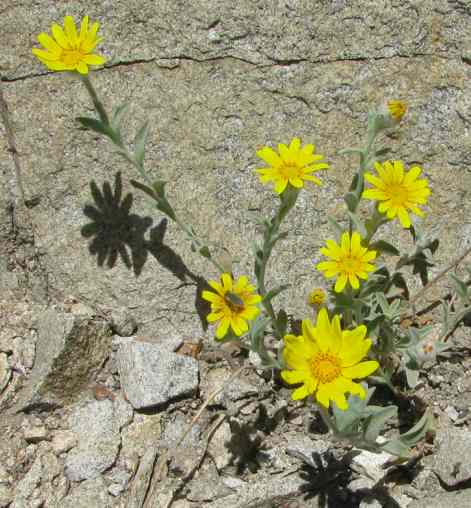
There are lots of yellow daisy-like flowers in the world, but not all have the tenacity of this one which seems to spring from the dry rock. It is Oregon Sunshine (Eriophyllum lanatum). [Etymological note: from the Greek erion (wool), phyllum (leaves); species name from the Latin lanatus, (woolly). Very very woolly!]

Eriophyllum lanatum, Oregon Sunshine  - 1.jpg

Western Wallflower (Erysimum capitatum) is another bright-flowered plant that does well in dry and disturbed soils. That trait may account for the common English name, supposedly derived from growing at the foot of walls in Europe. I suppose they’re rather like the hollyhocks you see springing up in the hard dry soil in front of abandoned sheds or at the edges of alleys. [Etymological note: from the Greek eryomai (to help or save) because some of the species supposedly had a medicinal value ; species name from Latin capitātus (having a head) from capit-, (head), refers to the way the flowers form in a head-like cluster.]

Erysimum capitatum, Western Wallflower # 2.jpg

It’s in the Mustard Family, a group called Cruciferae meaning “cross-shaped”, referring to the arrangement of the flower petals.

Erysimum capitatum, Western Wallflower.jpg

More soon!