Form and function: a columbine flower

Columbineabove.jpg

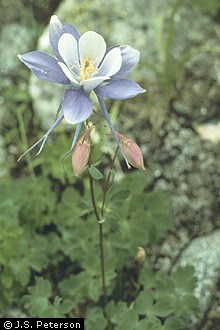
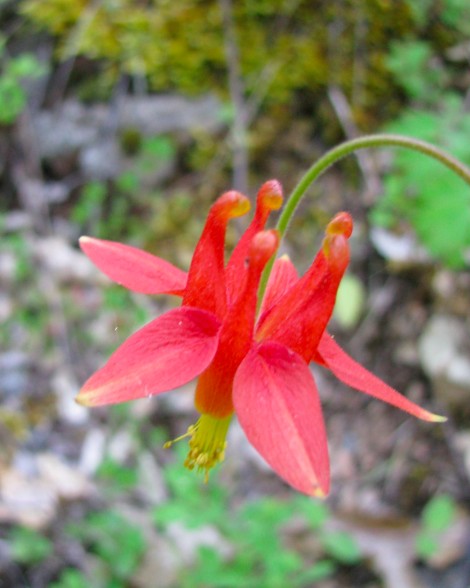
Like all columbines, the Western red columbine (Aquilegia formosa) above has a five-petalled flower with unusual “spurs” or tubules on the top. Each spur is formed by one of the five petals, curling into a cylinder as it rises.

Columbine.jpg

The lower ends of the petals join into a circle, within which are the yellow, pollen-bearing, stamens which extend beyond the petals. [Diagram below from USFS.]
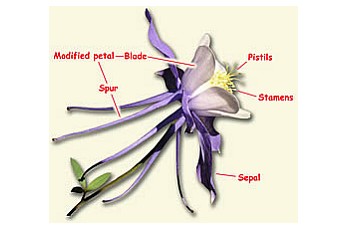
URSDA diagram.jpg

The sepals (that wrap the immature flower) are not green as in most flowers but red, and extend out at right angles when the flower opens.

ColumbineBud.jpg

Western red columbine bud.

Flower design is all about getting pollen from the stamens to the pistils (female organs); form definitely follows function.What, then, has led to the development of these seemingly superfluous spurs? One clue is that they are of widely varying lengths. North American columbines range in spur length from from 7.5 to 123 mm (0.35 to 4.8 in.). And, because the first columbine—bearing a flower with short spurs— reached North America via the Bering Strait land bridge, between 10,000 and 40,000 years ago, all this change has taken place in a relatively short time, indicating some big payoff for the plant, in terms of survival or reproduction.

The columbine has both male and female parts in each flower, allowing for self-pollination, but that would not introduce any genetic variation. So the flower of the columbine is an elaborate package which has evolved to get effective pollination from its principal pollinators: bees, hummingbirds, and hawkmoths. And the spurs are an integral part of the process…
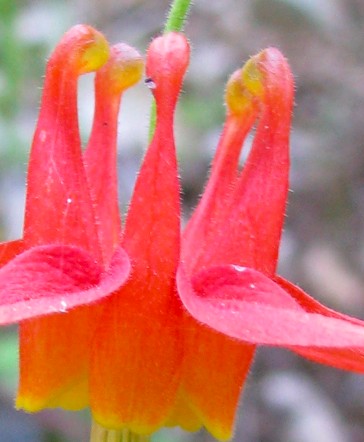
ColumbineSpur1.jpg

because the knob at the end of each spur contains nectar, and that is a big attraction to pollinators.

The flowers and pollinators have conflicting interests: the visitor just wants the nectar, as much as it can drink, while the flower wants to dole out the nectar bit by bit in order to keep attracting more insects (or other pollinators—bats, birds). One method is by placing the nectar at the end of a passage just barely long enough for the tongue of the pollinators. They can sip but not slurp, and while forcing their way in they make good contact with the pistils and stamens to pick up and deposit pollen.

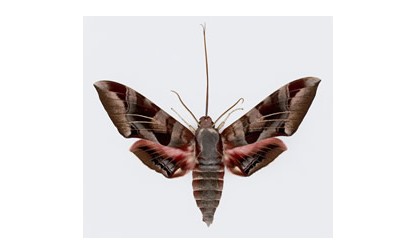
Darwin was intrigued by an extreme example, a Malagasy orchid which puts its nectar at the end of a 30 cm (11.8 in.) tube, and he hypothesized that flowers and their pollinators evolved together gradually in this regard. The flowers raised the bar, so to speak, a little at a time by lengthening the reach for the nectar, and the pollinating insects gradually evolved longer and longer tongues. In columbines, there are some species with short spurs accessible to bees, others with longer spurs that are mainly pollinated by hummingbirds, and some with even longer spurs for the long-tongued hawkmoth.

beeTongue.jpg

Bee approaching flower, with tongue out. The long tan objects are pollen-bearing anthers, on the ends of the stamens. Photo.

hummingbirdTongue.jpg

Hummingbird tongue. Photo.

Hawkmoth 1.jpg

A giant hawk moth (Eumorpha typhon) adult with its tongue (proboscis) extended. Image by Alfred University artist Joseph Scheer.

A. Longissima.jpg

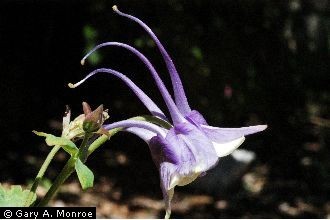
Photo by Gary Monroe.

Above is the flower of Aquilegia longissima (the longspur columbine of the SW US), which has the longest spurs of any species of columbine. Compare to those on the previous photos of our Western red columbine. The Western red is pollinated primarily by hummingbirds, though it attracts other insects too including bees and butterflies.

In a complex genetic study of North American columbine species published in 2007 (1), Whittall and Hodges found evidence that the ancestral short-spurred columbines had been bee-pollinated, but as they moved south and encountered first hummingbirds, then hawkmoths, had undergone two relatively quick transitions of lengthening spurs to adapt to these new pollinators.When long-tongued pollinators get nectar from a short-spurred flower, they will not need to shoulder their way in, and so won’t contact the stamens and pistils as much. They won’t pick up, or deposit, as much pollen.

And this led to development of different species of columbine. Once flowers in a certain area have gotten longer spurs, so that they mostly depend on a new longer-tongued pollinator, flowers that attract that particular organism better will be more successfully pollinated and produce more seeds. This may mean a change in color, flower orientation (facing up or down), or changes in form. Hodges subsequently studied color preference in the pollinators of columbines:

”What is important in this research is that hawkmoths mostly visit— and pollinate — white or pale flowers,” said senior author Scott A. Hodges, professor of ecology, evolution and marine biology at UCSB. “We have shown experimentally that hawkmoths prefer these paler colors.” When a plant population shifts from being predominantly hummingbird-pollinated where flowers are red, to hawkmoth-pollinated, natural selection works to change the flower color to white or yellow, he explained. [full original article here(2)]
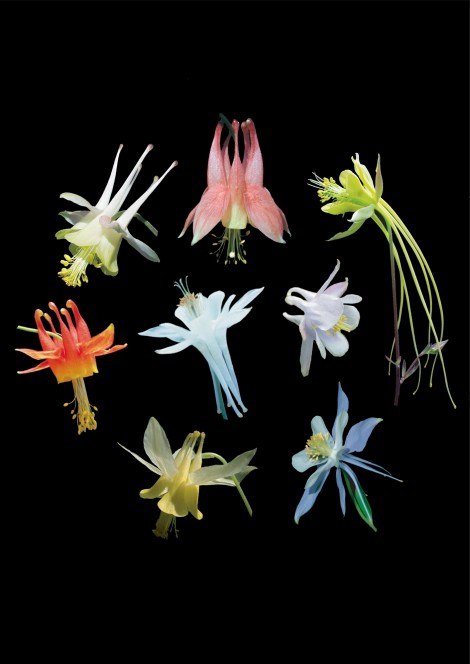
Hodges8flowers.jpg

Photo by SA Hodges, MA Hodges, D Inouye.

This can even be seen in varieties of the same species, as in the case of Aquilegia coerulea, the Colorado blue columbine. Each of the three below is, according to the USDA, the same variety: A. coerulea James.
BLueColumbine1.jpg

Photo from USDA.

BlueColumbine2.jpg

Photo from USDA.

BlueColumbine3.jpg

Photo from USDA.

Here’s the process by which the flowers get lighter in color, as the latitude changes.

Aquilegia coerulea (Colorado blue columbine) ranges in color from dark blue to pale blue to white. Aquilegia coerulea is the southern most (northern New Mexico) occurring dark blue flowered columbine and it occurs at high elevations where colder temperatures generally preclude hawk moths. As Aquilegia coerulea expanded out of the Rocky Mountains into lower elevations and warmer temperatures, the species developed into white or very pale blue varieties. This change to a lighter coloration co-evolved, as hawk moths were available as an alternative pollinator to bees and bumblebees. It is also interesting to note that the spurs on the dark blue Aquilegia coerulea are short, similar to the other dark blue, high elevation columbines whereas the spurs on the pale blue to white Aquilegia coerulea are longer. (USFS)

In this theoretically orderly process whereby bees are excluded from the nectar supplies of long-spurred flowers, it happens that the bees sometimes choose to solve the problem in a “cutting the Gordian knot” fashion, by making holes in the spurs to drink the nectar directly. Unlike a bee who blunders around in the flower and departs with no nectar, the spur-cutting bee contributes nothing to pollination. But bees require both nectar and pollen, and the columbine’s pistils and stamens are easy to reach; so the bee who stops for a quick cheating drink may look in for pollen another time, thus fulfilling the needs of the flower as well as her own. (In honeybees the workers are all females.)

So it seems that Darwin’s idea of a gradual process, with increases in spur length being answered by longer tongues on the pollinator species, is not correct for columbines at least. Based on genetic data, Whittall and Hodges hypothesize a start-and-stop process: the columbines moved into new areas, with new longer-tongued pollinators (e.g. hummingbirds) which could raid the nectar without touching the pollen, and so flowers with longer nectar spurs became more likely to be pollinated and set seed. Instead of the flowers leading the dance by lengthening the spurs, it was the presence of different pollinators that forced change.

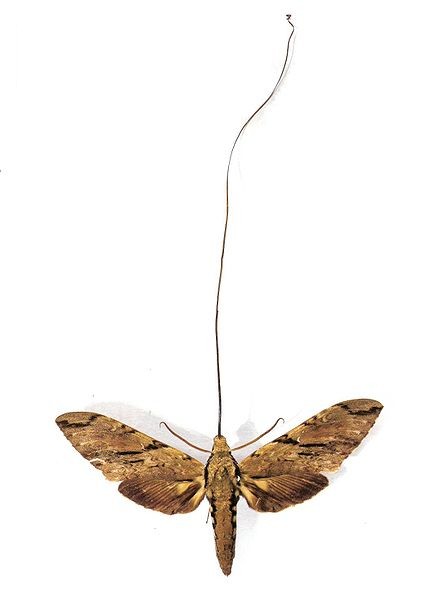
But Darwin was proved right in his prediction that an insect would turn up, capable of pollinating the incredibly long-tubed orchid. It’s a hawkmoth called Xanthopan morgani, or Morgan’s Sphinx, and here is its picture.
Morgan's sphinx.jpg

Photo from Wikipedia.

More images of these remarkable moths: night-time photo of Arizona moth feeding on Jimsonweed, showing tongue curled up in the air; pictures of the rare British hummingbird hawk-moth, which can hover: A, B; and photos of the African convolvulus hawkmoth.

References

(1) 2007: Whittall Justen B; Hodges Scott A. Pollinator shifts drive increasingly long nectar spurs in columbine flowers. Nature 2007;447(7145):706-9.

(2) 2009: Hodges, Scott A.; Derieg, Nathan J. Adaptive radiations: From field to genomic studies. Proceedings of the National Academy of Sciences June 16, 2009; 106 (suppl. 1): 9947–9954.

Some penguins to be listed under Endangered Species Act

from the Penguin News site,

4 June 2010

Legal settlement will protect seven penguin species at risk from global warming and fisheries (USA)

A federal judge has approved a settlement that requires the US federal government to finalise protections for seven penguin species under the Endangered Species Act. The court-ordered settlement results from a lawsuit filed by the Center for Biological Diversity and Turtle Island Restoration Network challenging the Obama administration’s failure to finalise its determination that these penguins warrant Endangered Species Act protection due to threats from climate change and commercial fisheries.
Read Center for Biological Diversity press release

While this is a justified action, it’s not clear what the practical results might be. The polar bear was listed under the ESA in May 2008 because of habitat loss from global warming. Yet Bush’s Secretary of the Interior Dirk Kempthorne “made clear several times during a press conference announcing the department’s decision that, despite his acknowledgement that the polar bear’s sea ice habitat is melting due to global warming, the ESA will not be used as a tool for trying to regulate the greenhouse gas emissions blamed for creating climate change.” For the bears, listing could have potential benefits of changed regulations governing activities in US territory (such as oil drilling) but action would be based on the direct impact on the ground, not the contribution of oil and drilling to climate change.

Last year the Scientific American blog stated the effects of ESA listing for these species of penguin:

Why protect penguins under the ESA if they don’t live in the U.S. or its territories? “Listing of penguins under the ESA would make import or export of the species illegal without an ESA permit,” Ward says [US Fish and Wildlife Service public affairs specialist Tamara Ward]. “Such permits are issued only if an activity has a conservation benefit and it is hoped listing may help focus international attention on the species conservation needs.” In addition, according to the CBD [Center for Biological Diversity], listing would also require federal agencies to ensure that any action carried out, authorized or funded by the U.S. government would not jeopardize the continued existence of the protected species.

Major threats to penguin species include overfishing and climate change. The latter causes loss of ice on which some species nest, and changes in currents which move fish and other prey to new areas of the sea—sometimes so far offshore that penguin parents are hampered in bringing back fish to feed the young. Oilspills and introduced terrestrial predators (rats, dogs, feral cats) can have devastating local effects.

Realistically, I think it will take a much greater disaster than the Gulf Oil spill to provide the political will for effective action on climate change and the overfishing/pollution of the oceans. Piecemeal wildlife protection is sometimes valuable, and ESA listing has symbolic importance (perhaps little else in this case), but where, where, is the “place to stand” for moving the world on these huge issues?

Oiled penguins.jpg

African Penguins (Spheniscus demersus) oiled in a spill off the South African coast. Photo by Cape Times, Cape Town South Africa, from Penguin Conservation vol. 7(2).

LittleBlue.jpg

Little Blue Penguins (Eudyptula minor), at entrance to a nest burrow on Phillip Island, Australia. Photo by M. Kuhn, Creative Commons license.

Attack of the mourning cloak butterfly larvae

That title sounds contradictory, doesn’t it? Butterflies are beautiful, innocuous, always to be protected. If only the world were as Walt Disney told us it was! [NOTE: I’ve learned from readers of this post that this caterpillar has a toxic substance in its hairs or spines that can cause a very painful reaction if you touch it, so be careful—indeed of any hairy or spiny caterpillar. See below,  https://nosleepingdogs.wordpress.com/2010/06/01/attack-of-the-mourning-cloak-butterfly-larvae/#comment-40639  and https://nosleepingdogs.wordpress.com/2010/06/01/attack-of-the-mourning-cloak-butterfly-larvae/#comment-40872 ]

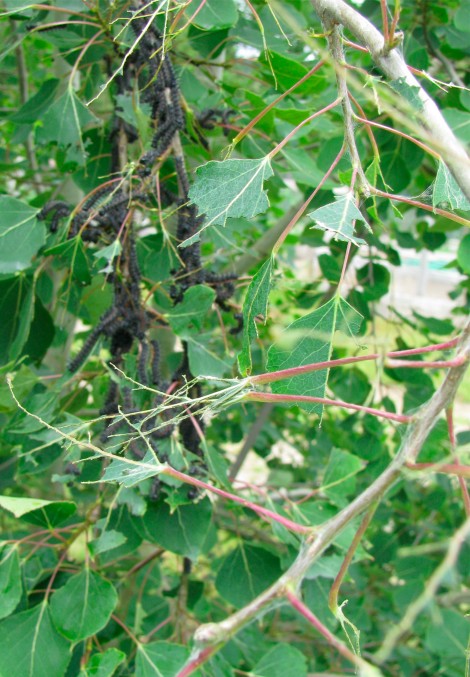
The first title of this post was “Attack of the tent caterpillars”, because of what I saw. First the caterpillars,

TentCaterpillar3Damage2.jpg

then their “tent”. The black balls visible are probably frass (caterpillar excrement). A few caterpillars are under the tent; some species retire periodically to their tent for protection from the elements and birds.

TentCaterpillar3Tent.jpg

The closer I looked the uglier they were to me.

TentCaterpillarsStem.jpg

They were chowing down on the leaves of our little grove of aspens, planted a few years ago and much cherished.

TentCaterpillarAlders.jpg

Birds, including 6 pairs of nesting tree swallows (Tachycineta bicolor), usually keep insect pests under control around our house. But nobody showed any interest in this concentration of food on the aspens; too spiky, or maybe bad-tasting. Caterpillars eat so much so fast, they can defoliate trees. I went looking for something to spray them with and found we had no insect spray. Finally I used 409 cleaning spray, it certainly smells toxic. The next day most of the caterpillars were still alive and eating. Finally a better idea occurred: cut off the branches they were on and bag them up. Since the infestation had spread to just 3 branches, I was able to do that.

It was only afterwards that I succeeded in identifying the caterpillars. I had looked at all the so-called “tent caterpillars”, and others, without finding anything that matched. Then there they were: they would have grown up to be mourning cloak butterflies (Nymphalis antiopa).

MourningCloak.jpg

Photo from milesizz on flickr.

You can imagine how bad I felt. I’ve since thought that maybe I could have cut the branches and then lodged them in among the branches of some other tree. Or kept some and fed them until they pupated. The favored food trees for the larvae are elm, willow, hackberry, and trees of the genus Populus: cottonwood, poplar, birch, and, yes, aspen. Except for occasional cottonwoods and shrubby willow along the river, none of these are native around here. But we do see the occasional mourning cloak, one of which must have laid the eggs earlier this spring—this species overwinters as adults, emerges to mate and lay eggs in spring, then after 10 days or so the caterpillars hatch out, eat, pupate and emerge as butterflies before fall. Given how much caterpillars eat, harvesting enough willow from the riverbanks to keep them fed doesn’t sound practical, at least not for very many individuals. But if there is a next time I think I will try it.

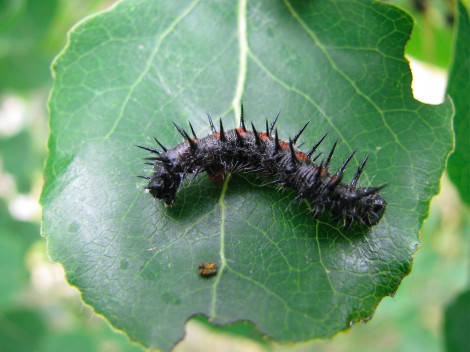
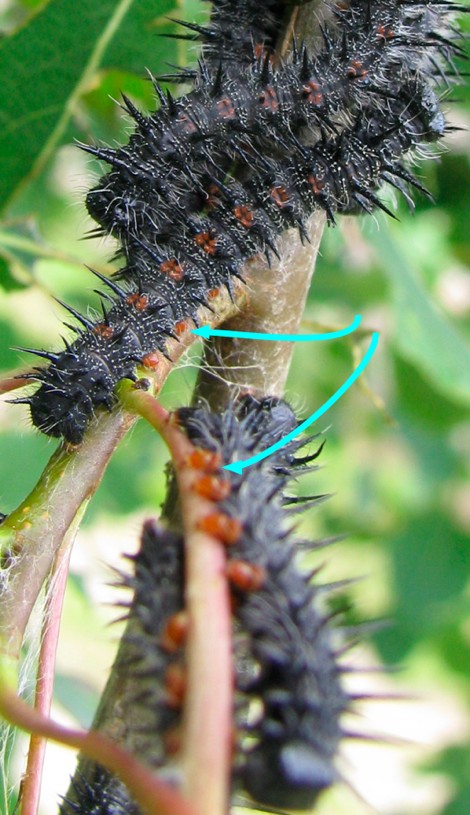
Here are a few closeups of the caterpillars. Identification was hard, maybe because they go through 5 “instars” or stages, shedding their skins each time and so perhaps different instars look a bit different. Some of the photos of this species showed much hairier-looking caterpillars, whereas the ones here were extremely spiny but with few hairs.

TentCaterpillarCloseup1.jpg

TentCaterpillarCloseup.jpg

Note the red dots on the back, and the red legs (arrows).

CaterpillarLegs.jpg

The eggs would have looked like this.

MourningCloakEggs.jpg

Photo from Canadian Biodiversity Information Facility. For an excellent series of photos showing a female laying eggs, changes in the eggs as they get close to hatching, and the tiny new caterpillars, see this backyardnature.com page by Bea Laporte.

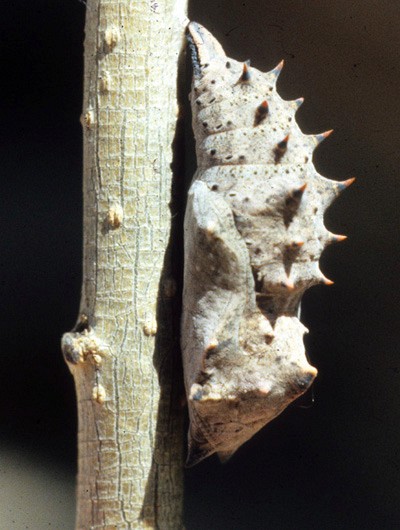
And each spiky black voracious caterpillar, after eating its fill of the tender leaves of our aspens, would have toddled off to some sheltered place to pupate, making a chrysalis like this.

Mourning Cloak Chrysalis2.jpg

Photo from bugwood.org.

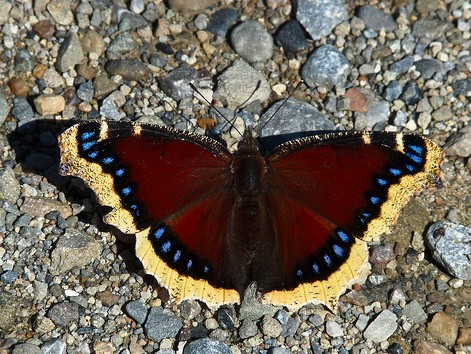
Since mourning cloak adults overwinter, they are one of the earliest butterflies to appear, and regarded as a sign of spring. The “mourning cloak” refers to their dominant wing color, dark rusty red bordered with black—though it’s lightened with blue jewels and cream-colored edges.

MourningCloack4.jpg

I’ll close this tale of butterflies-never-to-be, with a melancholy ballad in which the mourning cloak appears, perhaps in the role of one of the Greek Furies, haunting one who has done wrong. Usually such messengers of vengeance and doom have unpleasant appearances, as did the Furies, but to the guilty heart a bright butterfly might be even more menacing than a dark spiky caterpillar.

The Mourning Cloak
(Karah Stokes/Spruce and Maple Music 1)

One fair morning late in June
The sun shone on the daisies white
When a messenger of sorrow deep
Came into my garden bright

Wings of deepest velvet black
Bound with gold and sapphires rare
A butterfly, a Mourning Cloak,
Like one a wealthy widow’d wear

He promised me a golden ring
But he gave it to a rich man’s child
He craved the ease wealth would bring
Above a love both true and wild

So I called him to our trysting place
“Since there’s no help, let’s kiss and part”
He took me in a sweet embrace
And he felt a penknife in his heart

He looked at me with fading eyes
I left him there as he left me
The dawn next morning brought the news
That he’d been set upon by thieves

Oh, butterfly, why do you haunt?
Know you the secret in my breast?
I pierced his heart as he pierced mine
I slew the one I loved the best

One fair morning late in June
The sun shone on the daisies white
When a messenger of sorrow deep
Came into my garden bright

swoosh.jpg

Wildflowers of gold and royal purple, and a dance invitation

We’ve been busy lately helping to organize a benefit Country Dance (and dinner) for our local library, and wildflower walks have been displaced by trips to the restaurant supply store, gathering raffle prizes, and other tasks. But yesterday, when I parked to do my volunteer time at the friends of the library bookstore, there was a dramatic purple and gold display covering a berm of pushed-up soil and rock. These are the sort of flowers that are so common we disregard them, or even call them “weeds” when they appear where we don’t want them.

Poppies&Vetch.jpg

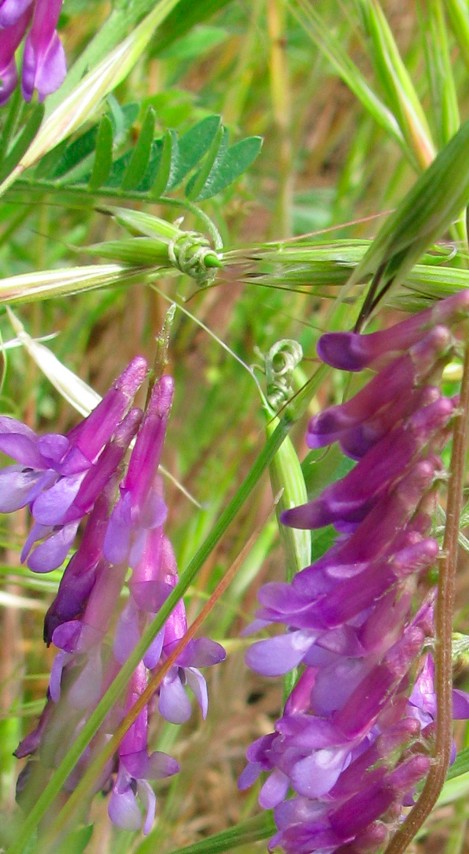
Everybody recognizes the California poppy (Eschscholzia californica). The deep purple flowers are a vetch introduced from Europe , probably Tufted Vetch (Vicia cracca), that is more than a weed—it’s an invasive non-native. It has long sprawling vines with tendrils that climb and bind, and likes disturbed ground. On the good side, it’s used as forage for cattle, provides nectar for bees and butterflies, and like other legumes it adds nitrogen to the soil. Below, its tendrils have looped around the seeds of a wild grass that I know only as foxtail, though it has single seeds (noted for working their way into the flesh of dogs) rather than the plumy seedheads that are rightfully called foxtail.

Poppies&Vetch3.jpg

Now that you’ve read this far, let me invite you to our benefit dance this Saturday evening, at the Upper Applegate Grange, 4 miles from Ruch, Oregon. We’ll have the Oregon Old Time Fiddlers (6 to 8 pm) and bluesmen David Pinsky & the Rhythm Kings (8 to 11 pm) making music for listening or dancing. There will be dinner, raffles, the Finest Hat Contest with a great prize, activities for kids, and it all helps our library. To be precise, we’re raising money to “buy” hours on Saturday, because the budget from the county doesn’t provide any hours on Saturday. Each year we have to raise $12,300. Come and bring your friends!

More details can be found here: go to the More Events page. Or if you live too far away to attend, you can make a contribution or a monthly pledge on the Pledge Form page. [Due to the way the site is hosted, I can’t post a separate url for these two pages; you need to go the main page and use the links there.]

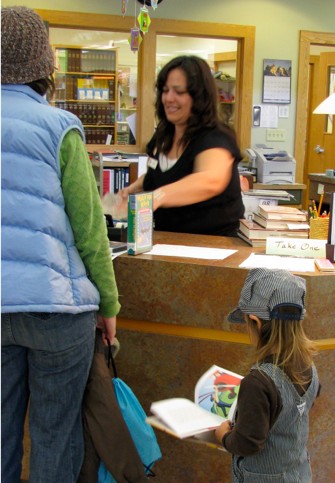
Here’s a picture inside our rural library:

Lisa4.jpg